

P1109 on 2005-2009 Lotus Elise: Intake Air System Fault Causes and Fixes
On a 2005-2009 Lotus Elise, code P1109 almost always indicates an issue with the intake air system, frequently caused by a non-approved aftermarket air filter. Reverting to the stock air filter or cleaning/replacing the Mass Airflow (MAF) sensor is the most common fix. This code is often accompanied by P0101.
- P1109 on a Lotus Elise is an intake air system code, almost always caused by a non-OEM air filter or a dirty/faulty MAF sensor.
- It is highly specific to the Lotus ECU calibration and is not the same as P1109 on a Toyota with the same 2ZZ-GE engine.
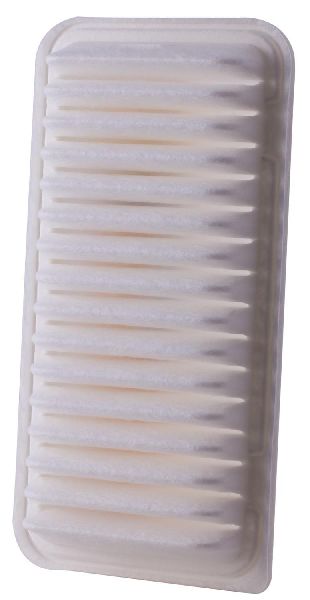
- The first and cheapest step is to replace any aftermarket air filter with a stock paper filter (P/N: A120E6385S).
- The second step is to carefully clean the MAF sensor with dedicated cleaner.
- The code is almost always seen with P0101.
What's Unique About the 2005-2009 Lotus ELISE
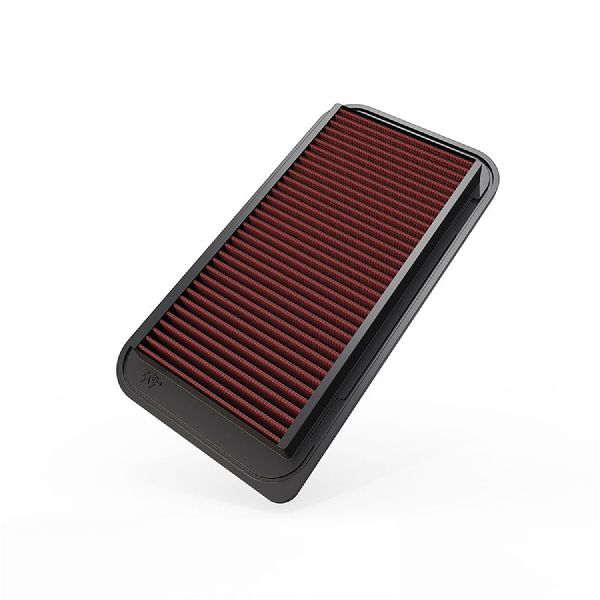
The Lotus Elise of this era uses a Toyota 2ZZ-GE engine but pairs it with a Lotus-specific Engine Control Unit (ECU). This Lotus ECU is highly sensitive to changes in intake airflow characteristics. As a result, modifications that might be benign on other vehicles, such as installing an aftermarket performance air filter (e.g., K&N, ITG), can disrupt the expected airflow readings and trigger codes P1109 and P0101, an issue officially documented by Lotus. [sb_2020_01]
Diagnostic Flowchart
Tap your situation to follow the diagnostic path that matches what you're seeing on this vehicle.
Symptoms You May Notice
- Check Engine Light (MIL) is illuminated
- Reduced engine performance or 'limp mode'
- Rough or unstable idle, sometimes fluctuating up and down.
- Hesitation during acceleration
- Stalling at low speeds, when stopping, or when disengaging the clutch at higher RPM.
- Decreased fuel economy
- Audible hissing or whistling noise from the engine bay, indicating a vacuum leak.
- Replacing oxygen (O2) sensors. An incorrect air-fuel mixture caused by a MAF issue can make the O2 sensors read lean or rich, but they are reporting the problem, not causing it.
Most Likely Causes
- Non-approved aftermarket air filter 🔴 High Probability → Shop Air Cleaner Assembly As per Lotus TSB #sb_2020_01, the ECU is sensitive to the airflow characteristics of non-OEM filters, which can cause implausible sensor readings. Oiled filters (like K&N) or high-flow foam filters (like ITG) are common triggers.
How to confirm: Visually inspect the airbox for an aftermarket (e.g., oiled cotton gauze or foam) air filter. The OEM filter is a paper element.
Typical fix: Replace the aftermarket filter with a stock, original equipment (OE) paper filter (Part No. A120E6385S).
Est. part cost: $30-$60 - Dirty or faulty Mass Airflow (MAF) sensor 🟡 Medium Probability → Shop Fuel Injection Air Flow Meter Oiled aftermarket filters can contaminate the MAF sensor's hot wire, leading to incorrect readings. General dust and debris can also accumulate over time, insulating the sensor elements.
How to confirm: Remove the MAF sensor and inspect the small wires inside for dirt, oil residue, or debris. Test the sensor's output voltage with a multimeter while the engine is running to see if it responds correctly to changes in RPM.
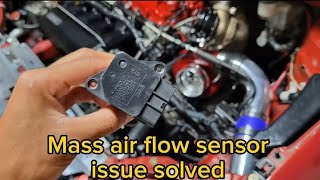
Typical fix: First, attempt to clean the sensor using only a dedicated MAF sensor cleaner spray. 🎬 Watch: How to clean a mass airflow sensor fast and easy. Do not touch the delicate wires. Allow it to air dry completely for at least 30-60 minutes before reinstalling. If cleaning does not resolve the issue, the sensor must be replaced.
Est. part cost: $10-$15 for cleaner, $70-$150 for a new sensor - Vacuum leak in the intake system ⚪ Low Probability Hoses and intake boots can become brittle and crack over time, allowing unmetered air to enter the engine after the MAF sensor. This is more common on older, higher-mileage vehicles.
How to confirm: Visually inspect all intake hoses and vacuum lines for cracks or loose connections. A smoke test is the most effective way to pinpoint the location of a leak. 🎬 Watch: How to find and fix vacuum leaks fast. Alternatively, spraying brake cleaner or propane near suspected leak points while the engine is idling can cause a change in engine RPM, indicating a leak.
Typical fix: Replace the cracked or leaking hose/gasket. Pay close attention to the intake manifold gaskets and the main intake hose between the airbox and throttle body.
Est. part cost: $20-$100 depending on the specific hose
Rare But Worth Checking
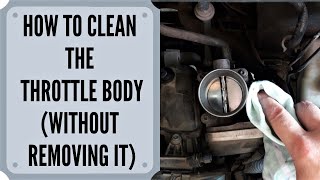
- Dirty Throttle Body: → Shop Fuel Injection Throttle Body Carbon buildup around the throttle plate can cause airflow disturbances and erratic idle, which may contribute to setting this code. A user on The Lotus Forums reported that stalling symptoms consistent with this code were resolved by cleaning a very dirty throttle body. 🎬 See this step-by-step guide for cleaning your throttle body.
- Faulty Engine Control Unit (ECU): This is extremely rare, but an internal failure of the ECU, where the barometric pressure sensor is located, could theoretically cause this code. All other possibilities should be exhausted before considering the ECU.
Diagnosis Steps
- Read the trouble codes with an OBD-II scanner and confirm P1109 and any other codes (especially P0101).
- Inspect the air filter. If it is an aftermarket, oiled, or excessively dirty filter, this is your primary suspect. Replace with an OEM-spec filter (Lotus P/N: A120E6385S).
- Inspect the full intake tract from the airbox to the throttle body for any cracks, loose clamps, or disconnected hoses that could cause a vacuum leak. Listen for hissing sounds with the engine running.
- Carefully remove the Mass Airflow (MAF) sensor. It is held by two screws. Disconnect the electrical connector by pressing the release tab.
- Clean the MAF sensor using only a dedicated MAF sensor cleaner spray. Spray the internal wires and elements from a few inches away. Do not touch the delicate wires with fingers, brushes, or cotton swabs. Allow it to air dry completely for at least 30-60 minutes before reinstalling.
- While the MAF is out, inspect the throttle body for heavy carbon buildup. If dirty, clean it carefully with throttle body cleaner and a soft cloth. Do not force the butterfly valve open on an electronic throttle body; have a helper press the accelerator with the ignition on (engine off) to open it.
- Reinstall the clean and dry MAF sensor and the intake components. Clear the trouble codes with the scanner and perform a test drive, including idle, city, and highway conditions.
- If the code returns, the MAF sensor itself may be faulty and require replacement. The Denso sensor is the OEM equivalent.
- If the problem persists, perform a smoke test to definitively rule out hard-to-see vacuum leaks.
Parts You'll Likely Need
- Mass Airflow (MAF) Sensor
(OEM #22204-22010)— This sensor provides the primary airflow measurement to the ECU. It is often the root cause if it's dirty or has failed, especially after cleaning doesn't resolve the code. The OEM sensor is made by Denso.
Trusted brands: Denso (OEM), Hitachi
OEM price range: $120-$180
Aftermarket price range: $70-$110 - Engine Air Filter
(OEM #A120E6385S)— A non-approved aftermarket air filter is the most common trigger for this code on the Elise, as documented in a TSB. [sb_2020_01] Reverting to the stock paper filter is the first and most effective fix.
Trusted brands: Genuine Lotus/Toyota
OEM price range: $30-$60
Aftermarket price range: $20-$40 - MAF Sensor Cleaner — Often, the MAF sensor is just dirty, not broken. A $10 can of dedicated cleaner can be a very effective first step before replacing parts.
Trusted brands: CRC, Liqui Moly, WD-40 Specialist
OEM price range: $10-$15
Aftermarket price range: $10-$15
Related Codes That Often Appear With This One
- P0101 — This code for 'Mass Air Flow (MAF) Circuit Range/Performance' is often set with P1109. A Lotus TSB explicitly mentions them occurring together as a result of intake modifications. [sb_2020_01]
- P0171 — This code for 'System Too Lean' can be triggered by the same root causes, such as a dirty MAF sensor providing incorrect low airflow readings or a vacuum leak allowing unmetered air into the engine.
Technical Service Bulletins (TSBs) & Recalls
- sb_2020_01: States that diagnostic trouble codes P0101 & P1109 can be generated by the fitment of non-approved after-market air filters.
Platform-Specific Known Issues
- The Lotus ECU's sensitivity to intake modifications is a well-documented issue. Lotus issued TSB #sb_2020_01 specifically warning that 'non-approved after-market air filter' installations can result in the generation of DTCs P0101 & P1109. [sb_2020_01]
- Some owners report that even after cleaning or replacing the MAF, ensuring the electrical connector is perfectly seated and secure (sometimes even using a zip tie) is critical to prevent the code from returning.
Mechanic-Grade Diagnostic Values
- MAF Sensor Signal Voltage at Idle (engine warm) — expected: ~1.1 V to 1.5V DC. Failure: Voltage is static and does not change with RPM, is significantly higher (e.g., >1.8V), or is near zero.
- MAF Sensor Signal Voltage at ~3,000 RPM — expected: ~1.7V DC or higher. Failure: Voltage does not increase smoothly as RPMs rise from idle.
- MAF Sensor Live Data at Idle (Scan Tool) — expected: 2 to 7 grams/second (g/s). Failure: Reading is outside the expected range or does not respond to throttle input.
- MAF Sensor Live Data at 2,500 RPM (Scan Tool) — expected: 15 to 25 grams/second (g/s). Failure: Reading does not rise to this range or the rise is not linear from idle.
- MAF Sensor Power Supply Pin — expected: 10V to 12V (Battery Voltage) with key on, engine off. Failure: No voltage indicates a problem with the EFI relay or wiring.
- MAF Sensor Ground Pin — expected: 10V to 12V (Battery Voltage) when testing between the ground pin and the positive battery terminal. Failure: No voltage indicates a broken ground wire or a fault in the ECU's ground supply.
Scan Tool Commands That Help
- Manual Procedure (No Tool Required): Throttle Position Sensor (TPS) Reset / Calibration — After cleaning the throttle body, disconnecting the battery, or replacing intake components. An uncalibrated TPS can cause idle and stalling issues. The procedure for the Lotus ECU is: 1. Turn ignition ON (engine off). 2. Slowly press the accelerator pedal fully to the floor, then slowly release it completely. 3. Turn ignition OFF, remove the key, and wait at least 40 seconds for the ECU to fully power down before restarting.
Wiring & Ground Locations
- MAF Sensor Connector (5-Pin Toyota/Denso) — On the intake tube between the airbox and the throttle body.. This is the primary data source for the code. A bad connection or damaged wire here is a direct cause. The pinout is typically: Pin 1: IAT Sensor Signal (to ECU), Pin 2: IAT Sensor Ground (from ECU), Pin 3: MAF Signal (to ECU), Pin 4: MAF Ground (from ECU), Pin 5: +12V Power (from EFI relay). Note: Pinouts can vary, always verify with a wiring diagram if possible.
- Engine Block Ground — A ground wire from the harness connects to the engine block, typically right above the VVTL-i solenoids on the front of the cylinder head.. A poor engine ground can cause erratic behavior from all engine sensors, including the MAF, leading to incorrect readings and fault codes.
- Firewall Ground — A ground point connects from the engine harness to the firewall, located above the alternator.. This is another critical ground for the engine management system. It is sometimes overlooked during engine service.
- ECU Pins (2005 Elise) — At the Engine Control Unit (ECU).. Allows for continuity testing of the MAF sensor wiring. Key pins include RB3 (Intake Air Temp), RD2 (Sensor Ground), and others related to the MAF signal itself.
Real Owner Repair Stories
- The Lotus Forums user 'pakyrs' (2006 Lotus Elise S (1ZZ engine, but drive-by-wire system is relevant to 2006+ 2ZZ models)) — Car entered limp mode with high idle after being stuck in traffic. Operating temperature was high (95-98C).
❌ Tried (didn't work) Initial diagnosis focused on heat-related issues and standard intake problems.
✅ What actually fixed it Replacing the entire accelerator pedal assembly. The owner noted the new pedal registered a 3% throttle position at rest on their scan tool, suggesting the old pedal's sensor had failed or drifted out of spec, causing the ECU to command a high idle.
OEM Part Supersession History
22204-0C020, 22204-0D030→22204-22010— Standard part consolidation and revision by Toyota.
Heads up: The newer part number (22204-22010) is the correct replacement for the earlier numbers and should be used for this application.
Model Year Variations Within This Range
- 2005 only: The 2005 US model uses a mechanical throttle cable connected directly to the throttle body.
- 2006-2009: These models feature an electronic 'drive-by-wire' throttle. There is no physical cable; an Accelerator Pedal Position (APP) sensor sends an electronic signal to the ECU, which then commands a motor on the throttle body. This introduces the APP sensor and throttle body motor as additional potential points of failure that can cause symptoms related to P1109.
Helpful Videos




We Have This Part in Stock


The information in this article is provided for general reference and educational purposes only. Vehicle specifications, procedures, and part compatibility can vary by production date, trim level, and region. Always consult your vehicle's factory service manual and verify part numbers before purchasing or performing repairs. Safety-critical components such as airbags, seat belts, and braking systems should be installed by a qualified professional.
- Lotus ELISE:
- 🧭 Diagnostic Flowchart
- 🎬 Helpful Videos
- 🛍️ Shop This Part
- What's Unique About the 2005-2009 Lotus ELISE
- Symptoms You May Notice
- Most Likely Causes
- Rare But Worth Checking
- Diagnosis Steps
- Parts You'll Likely Need
- Related Codes That Often Appear With This One
- Technical Service Bulletins (TSBs) & Recalls
- Platform-Specific Known Issues
- Mechanic-Grade Diagnostic Values
- Scan Tool Commands That Help
- Wiring & Ground Locations
- Real Owner Repair Stories
- OEM Part Supersession History
- Model Year Variations Within This Range
- 🎟️ Get 5% Off