

P1121 on 2003-2005 Honda Pilot: Throttle Position Sensor Causes and Fixes
On a 2003-2004 Honda Pilot, code P1121 almost always points to a faulty Throttle Position Sensor (TPS). Before replacing the sensor, first try cleaning the throttle body. An aftermarket replacement sensor costs around $30-$60 and is a straightforward DIY repair. This issue is specific to the 2003-2004 models with the J35A4 engine, as the 2005 model uses a different Drive-By-Wire system.
- P1121 on a 2003-2004 Pilot specifically means the Throttle Position Sensor's voltage is too low.
- The most likely cause is a failed Throttle Position Sensor (TPS), which is a relatively inexpensive and easy part to replace on this engine.
- Always clean the throttle body before replacing parts, as carbon buildup can cause similar symptoms and is a cheaper fix.
- This guide applies to the 2003-2004 Pilot (J35A4 engine); the 2005 model has a different electronic throttle system.
- After replacing the TPS, it must be manually calibrated to ensure correct voltage readings at closed throttle.
What's Unique About the 2003-2005 Honda Pilot
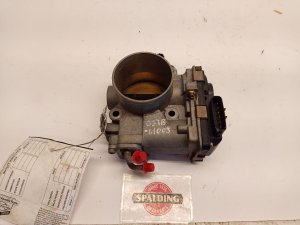
The 2003-2004 Honda Pilot with the J35A4 engine uses a traditional throttle cable and a separate, replaceable Throttle Position Sensor (TPS). This makes diagnosis and repair relatively simple, as the sensor can be replaced independently of the entire throttle body assembly. This is a key distinction from the 2005 Pilot, which switched to a J35A6 engine with a Drive-By-Wire (DBW) system that has an integrated, non-serviceable sensor. Therefore, for the specified 2003-2004 engine, the fix does not typically require replacing the expensive throttle body.
Symptoms You May Notice
- Check Engine Light is on
- Poor or hesitant acceleration
- Engine stalling or misfiring, especially at idle
- Rough or erratic idle
- Automatic transmission may not shift correctly or smoothly
- Reduced fuel economy
- Replacing the entire throttle body assembly. On the 2003-2004 Pilot, the sensor is available separately and is the most common point of failure. Replacing the whole assembly is unnecessary and expensive.
- Assuming the issue is with the transmission, as symptoms can include poor shifting.
Most Likely Causes
- Faulty Throttle Position Sensor (TPS) 🔴 High Probability → Shop Fuel Injection Throttle Body The sensor is a potentiometer with moving parts that wear out over time, leading to dead spots or incorrect voltage readings. It's a common failure item on many Hondas of this era due to internal wear.
How to confirm: With the key on and engine off, use a multimeter to back-probe the signal wire on the TPS (typically the middle wire). The voltage should read around 0.5V at closed throttle and sweep smoothly up to ~4.5V at wide-open throttle. Any dropouts, jumps, or incorrect readings indicate a bad sensor.
Typical fix: Replace the throttle position sensor. Aftermarket sensors are widely available and cost-effective.
Est. part cost: $30 - $80 - Dirty or Sticking Throttle Body 🟡 Medium Probability → Shop Fuel Injection Throttle Body Carbon and gunk can build up in the throttle bore and on the throttle plate, preventing it from closing fully. This causes a mismatch between the actual throttle angle and what the TPS reports, leading to a lower-than-expected voltage reading at what should be closed throttle.
How to confirm: Visually inspect the inside of the throttle body for black carbon deposits, especially around the edges of the throttle plate and the bore.
Typical fix: Remove the air intake tube and clean the throttle body bore and plate thoroughly with throttle body cleaner and a soft cloth or brush. Ensure the throttle plate moves freely without sticking.
Est. part cost: $5 - $15 - Wiring or Connector Issue ⚪ Low Probability
How to confirm: Visually inspect the wiring harness and 3-pin connector going to the TP sensor for any signs of damage, corrosion, or loose pins. Perform a 'wiggle test' on the connector and wiring while monitoring the TPS voltage on a scan tool or multimeter to see if the reading fluctuates.
Typical fix: Repair the damaged section of wire or clean/replace the connector pigtail.
Est. part cost: $10 - $50
Rare But Worth Checking
- Faulty Powertrain Control Module (PCM): This is extremely rare. The PCM should only be considered after all other possibilities, including the sensor, wiring, and throttle body, have been definitively ruled out. A faulty PCM might not provide the correct 5V reference voltage to the sensor.
Diagnosis Steps
- Scan for any other trouble codes. If codes like P0122 are present, it reinforces the diagnosis of a TPS fault.
- Visually inspect the air intake hose for cracks or leaks between the air filter and the throttle body.
- Inspect the TP sensor wiring and its 3-pin connector for any obvious damage, corrosion, or loose connections.
- Remove the intake ducting from the throttle body. Check for heavy carbon buildup that could prevent the throttle plate from closing properly. If dirty, clean it thoroughly with throttle body cleaner.
- Using a scan tool, observe the live data for 'Throttle Position'. It should be at a low percentage (under 10%, often around 9%) at idle and increase smoothly to near 100% at wide-open throttle.
- If a scan tool is unavailable, use a multimeter to test the sensor. Back-probe the signal wire (usually the middle pin). With the key on (engine off), verify the voltage is around 0.5V with the throttle closed and sweeps smoothly to about 4.5V when you manually open it. Any glitches or dead spots mean the sensor is bad.
- If the sensor tests good and the throttle body is clean, perform a 'wiggle test' on the harness while watching the voltage to check for an intermittent wiring fault.
- If the sensor fails the test, replace it. After replacement, the new sensor must be calibrated. This is done by loosening the sensor's mounting screws and rotating it until the closed-throttle voltage is ~0.5V or the scan tool reads ~9% throttle. Then, perform an ECU reset by disconnecting the battery for a few minutes.
Parts You'll Likely Need
- Throttle Position Sensor (TPS)
(OEM #16400-P06-A11)— This sensor is the most frequent cause of code P1121 on this vehicle due to internal wear over time. The original part number often refers to the entire throttle body assembly, but the sensor itself is what fails and is available separately in the aftermarket.
Trusted brands: Denso, Dorman, Walker Products, Standard Motor Products (SMP)
OEM price range: $100-$150
Aftermarket price range: $30-$80
Related Codes That Often Appear With This One
- P0122 — P0122 is the generic OBD-II code for 'TPS Circuit Low Input'. It often appears with the manufacturer-specific P1121 as they both point to the same fault condition of an abnormally low voltage from the sensor.
- P1122 — This code indicates 'Throttle Position Sensor Circuit Intermittent Low Voltage', which is a closely related fault that also points directly to a failing TPS or wiring issue.
Platform-Specific Known Issues
- Owner Experience: TPS Replacement and Calibration: A user on the Honda Element forum (which shares similar engine components) with a P1121 code described the importance of calibrating the new sensor after installation. The fix involves rotating the sensor until a multimeter reads 0.5V (or a scan tool shows ~9% throttle) with the throttle closed. After calibration, an ECU reset by disconnecting the battery is recommended to allow the system to relearn the new sensor's values.
- Forum Confirmation: Common Failure: Multiple discussions on Piloteers.org confirm that P1121 on the 2003-2004 Pilot is a very common code pointing directly to the TPS. Owners report that replacing the sensor is a lasting fix for symptoms like hesitation and erratic shifting.
Mechanic-Grade Diagnostic Values
- TPS Signal Wire Voltage (Key On, Engine Off) — expected: Approx. 0.45V - 0.5V at closed throttle, sweeping smoothly to approx. 4.5V at wide-open throttle.. Failure: Voltage is outside the 0.45-0.5V range at closed throttle, or has dropouts, spikes, or dead spots when opening the throttle.
- TPS 5V Reference Wire Voltage (Key On, Engine Off) — expected: Approx. 5.0V ±0.2V.. Failure: Voltage is significantly lower than 5.0V or is absent, indicating a wiring or PCM issue.
- TPS Ground Wire Resistance — expected: Near 0 Ω continuity to chassis or battery ground.. Failure: High resistance (more than a few ohms) indicates a poor ground connection, which can cause low voltage readings.
- TPS Sensor Internal Resistance (Bench Test) — expected: Between outer pins, a static resistance (e.g., 3.5-6.5 kΩ). Between the center pin and an outer pin, resistance should sweep smoothly as the sensor is turned.. Failure: Infinite resistance (open circuit) or resistance that jumps erratically indicates a worn-out sensor.
- Scan Tool Live Data: Throttle Position % (Idle) — expected: Approx. 9-10% with a warm engine at idle.. Failure: Value is significantly lower or higher, or does not increase smoothly when the pedal is pressed.
Wiring & Ground Locations
- TPS Connector Pins (J35A4) — On the throttle body, opposite the throttle cable linkage.. Correctly identifying the pins is crucial for testing. For many Hondas of this era: Yellow wire is 5V Reference, Green wire is Ground, and Red wire is the Signal to the ECU. Always verify with a multimeter.
- G101 (Main Engine Harness Ground) — Typically mounted on the driver's side of the intake manifold, often on a vacuum 'T' fitting or thermostat housing.. This is a primary ground point for many engine sensors, including the TPS. A loose or corroded G101 ground can cause a low voltage reference and trigger P1121 and other sensor codes.
- Battery to Chassis/Transmission Ground — The main negative battery cable connects to the vehicle body and often has a secondary strap to the transmission case.. A compromised main ground path for the entire engine can create floating grounds and cause erratic sensor readings across the board. Ensure these connections are clean and tight.
Real Owner Repair Stories
- Reddit r/HondaElement user (Honda Element (similar J-series engine electronics)) — Check Engine Light with code P1121, 'Throttle position body sensor is lower than expected'.
❌ Tried (didn't work) Replacing the throttle position sensor initially did not fix the problem; the code returned.
✅ What actually fixed it The new sensor was not calibrated. The final fix was to loosen the new TPS, connect a scan tool to read live data, and physically rotate the sensor until the throttle position read ~9% at closed throttle. After tightening the sensor, an ECU reset (disconnecting the battery) was performed to make the computer learn the new calibrated values.
OEM Part Supersession History
37890-HN2-006→37890-H09-J02— Part revision by Honda.
Heads up: These part numbers are often associated with Honda ATV/Motorcycle applications but share the same electronic design as the automotive J-series sensors and are sometimes cross-referenced. The key is physical fitment and connector type. Aftermarket is far more common for this repair.
Model Year Variations Within This Range
- 2003-2004: Uses the J35A4 engine with a mechanical throttle cable and a separate, serviceable TPS. This is the focus of this guide.
- 2005: Switched to the J35A6 engine with a Drive-By-Wire (DBW) throttle body. The TPS is integrated into the throttle body assembly and is not sold or serviced as a separate component. A P1121 code on a 2005 model would point to a failure of the entire throttle body assembly.
Diagnostic Flowchart
Other Known Issues on This Vehicle
Issues unrelated to this code that are worth knowing about as an owner of this generation:
- Automatic Transmission Failure 🔴 High — Very common, especially on 2003 models, often occurring around or after 100,000 miles. Problems include slipping, jerking, and complete failure. (Ref: A recall was issued for 2003-2004 models to install an oil jet kit to improve lubrication to the second gear, but failures are still common.)
- Clogged EGR Passages 🟠 Medium — Widespread issue causing code P0401 (Insufficient EGR Flow). The EGR valve itself is usually fine; the passages in the intake manifold get clogged with carbon. (Ref: Honda TSB 05-026 was released to address this, outlining the procedure to clean the intake manifold passages.)
- Failing Torque Converter 🟠 Medium — Owners report a shudder or judder while driving at steady speeds, typically between 20-60 mph. This is often caused by a failing torque converter or deteriorated transmission fluid. (Ref: While TSBs exist for later models (e.g., 17-017), the issue is well-documented on first-gen Pilots and often misdiagnosed.)
- Power Steering System Leaks/Failure 🟡 Low — Some owners report leaks from the power steering pump, lines, or pressure switch, leading to noise and loss of power assist.
Used vs. New Parts: Buying Guide for This Vehicle
When a used part is the smart pick: Buying a complete used throttle body assembly from a low-mileage donor vehicle can be a viable option if you want an OEM sensor and your entire throttle body is dirty or worn. However, for just the P1121 code, buying only the sensor is more cost-effective.
Donor-vehicle mileage cap: roughly under 80000 miles for the part to have meaningful remaining life.
What to inspect on the donor part:
- Check for a clean throttle bore with minimal carbon buildup.
- Ensure the throttle plate snaps back sharply and doesn't stick.
- Inspect the TPS connector for corrosion, cracks, or broken locking tabs.
- If possible, test the sensor's resistance sweep with a multimeter before purchase.
OEM-only on this vehicle (don't cheap out):
- Powertrain Control Module (PCM) - Used PCMs often require dealer programming to match the vehicle's immobilizer system.
Aftermarket brands forum-validated for this vehicle:
- Denso (often the original OEM supplier)
- Standard Motor Products (SMP)
- NTK
- Walker Products
Brands owners have reported issues with on this vehicle:
- No-name, unbranded sensors from online marketplaces can have high failure rates and incorrect voltage ranges out of the box.
Real Owner Stories
Aggregated from forums and TSBs cited above. Mileages and costs reflect what owners reported in those sources.
2003 Honda Pilot J35A4
Symptoms: Rough idling and multiple codes present, including those for EGR and MAP sensors.
What fixed it: Replaced the throttle position sensor as part of the diagnostic process for the air/fuel management system.
Source hint: honda-tech.com
2003-2004 Honda Pilot J35A4
Symptoms: Hesitation and erratic shifting.
What fixed it: Replacing the Throttle Position Sensor (TPS).
Source hint: piloteers.org: Forum discussions on this site for first-generation Pilots
2003-2005 Honda Pilot J35A4
Symptoms: P1121 code; needed to ensure the system learned new sensor values.
What fixed it: Installed new TPS, rotated sensor to 0.5V (9% throttle) at closed position, and performed an ECU reset by disconnecting the battery.
Source hint: reddit.com/r/HondaElement
Related OBD-II Codes
Frequently Asked Questions
Is there a TSB for the P1121 code on my 2003 Honda Pilot?
Can I just clean the throttle body to fix P1121 on my J35A4 engine?
How do I calibrate a new TPS on my 2003-2005 Pilot?
Why is my Pilot shifting erratically along with the Check Engine Light?
What is the expected voltage for the TPS on a J35A4 engine?
Is the P1121 code common for the first-generation Honda Pilot?
Helpful Videos

We Have This Part in Stock

The information in this article is provided for general reference and educational purposes only. Vehicle specifications, procedures, and part compatibility can vary by production date, trim level, and region. Always consult your vehicle's factory service manual and verify part numbers before purchasing or performing repairs. Safety-critical components such as airbags, seat belts, and braking systems should be installed by a qualified professional.
- Honda Pilot:
- 🧭 Diagnostic Flowchart
- 🎬 Helpful Videos
- 🛍️ Shop This Part
- What's Unique About the 2003-2005 Honda Pilot
- Symptoms You May Notice
- Most Likely Causes
- Rare But Worth Checking
- Diagnosis Steps
- Parts You'll Likely Need
- Related Codes That Often Appear With This One
- Platform-Specific Known Issues
- Mechanic-Grade Diagnostic Values
- Wiring & Ground Locations
- Real Owner Repair Stories
- OEM Part Supersession History
- Model Year Variations Within This Range
- Other Known Issues on This Vehicle
- Used vs. New Parts: Buying Guide for This Vehicle
- Real Owner Stories
- 2003 Honda Pilot J35A4
- 2003-2004 Honda Pilot J35A4
- 2003-2005 Honda Pilot J35A4
- Related OBD-II Codes
- Frequently Asked Questions
- 🎟️ Get 5% Off