

OBD-II Code P1163: Slow Oxygen Sensor Response
What P1163 means, why it triggers, and how to fix it
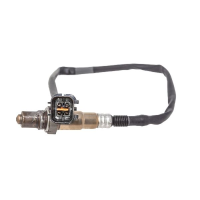
- Replace the upstream Air/Fuel Ratio sensor (Bank 1, Sensor 1) to resolve P1163 in over 80% of cases.
- Inspect the exhaust manifold for hairline cracks before buying parts, as fresh air entering the exhaust skews sensor readings and mimics a dead sensor.
- Check Long-Term Fuel Trim (LTFT) data; a reading above +10% indicates a vacuum or exhaust leak is triggering the code rather than a faulty sensor.
- Review Technical Service Bulletins (TSBs) 00-028 and 04-013 if driving a 1998-2003 Honda Civic or CR-V, as an overly sensitive ECU requires a software update, not a new sensor.
What Does P1163 Mean?

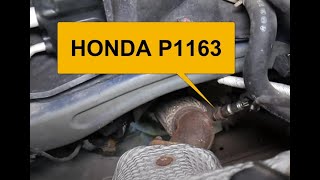
P1163 means the engine computer (ECU) detects the primary oxygen sensor is not responding quickly enough to air-fuel mixture changes. Located in the exhaust before the catalytic converter, this sensor must switch its voltage reading rapidly. When it slows down, the computer cannot accurately control the fuel injectors, causing poor performance and increased pollution.
Technical definition: P1163 is a manufacturer-specific code most commonly defined by Honda and Acura as 'Air/Fuel Ratio (A/F) Sensor (Bank 1, Sensor 1) Slow Response'. The Powertrain Control Module (PCM) detects the sensor's voltage fails to switch between rich and lean conditions within the expected timeframe. On Volkswagens, this code indicates a fuel temperature sensor issue, while on GM vehicles, it points to a post-catalytic converter O2 sensor fault.
Can I Drive With P1163?

Yes, But With Caution. Yes, you can drive with this code, but your car will suffer poor fuel economy and higher emissions. Long-term driving (over 300 miles) causes unburned fuel to overheat and permanently damage the catalytic converter, a repair costing $1,500 to $4,000. Address the issue promptly to avoid this expense.
Common Causes

- Defective upstream oxygen sensor (A/F sensor) (Very Common) — The sensor element wears out or gets contaminated by oil ash, carbon, or coolant, losing its ability to react quickly to exhaust gas changes.
- Exhaust system leak (Common) — A cracked exhaust manifold or leaking gasket near the sensor lets outside air into the exhaust stream. This fresh air skews the readings, making the sensor appear unresponsive. 🎬 Watch this simple guide to finding exhaust leaks.
- Damaged wiring or corroded connectors (Common) — The oxygen sensor wiring harness endures high heat and road debris. Frayed wires, loose connections, or connector corrosion disrupt the signal to the ECU.
- Vacuum Leaks (Unmetered Air) (Less Common) — Leaks in a vacuum hose, intake manifold gasket, or EVAP system introduce extra air after the mass airflow sensor. This creates a lean condition the PCM misinterprets as a slow sensor response.
- Low Fuel Pressure or Delivery Issues (Less Common) — A weak fuel pump, clogged filter, or failing pressure regulator creates a persistent lean condition. The oxygen sensor appears 'slow' because it constantly reads a lean state instead of fluctuating.
- Blown sensor heater fuse (Less Common) — Oxygen sensors use an internal heater to reach operating temperature quickly. A blown heater circuit fuse delays warm-up, triggering this code alongside a P0135 heater circuit code.
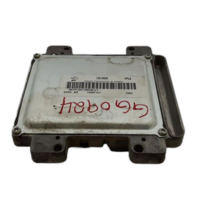
- Faulty Powertrain Control Module (PCM) or Software (Rare) — Certain older Honda models feature overly sensitive computers that set this code erroneously. This requires a software update or PCM replacement.
Symptoms
- Check Engine Light is on — The Malfunction Indicator Lamp (MIL) illuminates on the dashboard. This is often the only noticeable symptom.
- Poor fuel economy — The engine cannot properly regulate the air-fuel mixture, causing the vehicle to burn excess gasoline.
- Failed emissions test — Incorrect air-fuel ratios produce higher-than-normal exhaust pollutants, causing an automatic smog check failure.
- Engine hesitation or stumbling — The engine hesitates during acceleration because fuel delivery fails to match real-time demand.
- Rough or irregular idle — The engine idles unevenly as the computer struggles to find the correct air-fuel balance.
Diagnostic Flowchart
Tap your situation to follow the diagnostic path that matches what you're seeing on this code.
Common Fixes & Costs
- Replace the upstream (Bank 1, Sensor 1) Air/Fuel Ratio Sensor — Parts: $80-$250, Labor: $70-$150, ~0.8 hr book time (DIY)
- Repair exhaust leak (e.g., replace exhaust manifold gasket) — Parts: $20-$100, Labor: $150-$300, ~2.5 hr book time (Intermediate)
- Repair vacuum leak (e.g., replace intake gasket, EVAP hose) — Parts: $10-$150, Labor: $100-$250, ~1.8 hr book time (Intermediate)
- Repair damaged wiring or clean connector — Parts: $5-$20, Labor: $100-$200, ~1.2 hr book time (DIY)
- Update PCM Software or Replace Module — Parts: $150-$1200, Labor: $100-$200, ~1.5 hr book time (Professional)
DIY vs Professional
- Replace Air/Fuel Ratio Sensor — Beginner: Yes
Tools: Ratchet, 22mm or 7/8" O2 sensor socket, penetrating oil, anti-seize lubricant. - Repair Exhaust Leak — Beginner: No
Tools: Socket set, torque wrench, new gaskets, pry bar, grinder. - Repair Damaged Wiring — Beginner: Yes, with caution.
Tools: Wire strippers, soldering iron, heat shrink tubing, electrical tape. - Repair Vacuum Leak — Beginner: It depends.
Tools: Smoke machine, basic hand tools.
Used vs. New Parts: Buying Guide
When a used part is worth it: Buying a used Air/Fuel Ratio sensor is never recommended. It is a wear-and-tear item with a 60,000 to 100,000-mile lifespan. The labor to replace it makes installing a used part a poor financial decision.
Donor-vehicle mileage cap: roughly under 20000 miles for the part to have meaningful remaining life.
Donor quality checklist:
- Ensure the part number is an exact match, including for the specific trim level.
- Avoid parts from flood-damaged or collision-damaged vehicles.
Decision logic:
- If The part is an Air/Fuel Ratio Sensor → Buy a new, direct-fit sensor from an OEM supplier like Denso or NTK. Avoid universal sensors.
- If The required part is a rare or expensive ECU/PCM → Buy a used part from a reputable salvage yard, ensuring it is the exact part number and does not require dealer programming you cannot access.
Warranty tradeoff: Used sensors have no effective warranty. Aftermarket new sensors typically offer a 1-year warranty. OEM parts carry a 12-month/12,000-mile warranty.
Worst-case if a used part fails: $150-250 if a used or cheap aftermarket sensor fails shortly after installation, requiring repeat labor costs.
What Happens If You Wait — Timeline
- 0-2 weeks: Check Engine Light illuminates. Code P1163 is stored. No noticeable symptoms. (MPG impact: 0-5%% · Added cost: $0)
- 2 weeks - 3 months: ECU operates in open-loop mode. Fuel economy drops. Engine hesitates or idles roughly. (MPG impact: 5-15%% · Added cost: $25-$75 in wasted fuel)
- 3-8 months: Sustained rich mixture sends unburned fuel into the exhaust, overheating the catalytic converter and damaging its internal ceramic substrate. (MPG impact: 10-20%% · Added cost: $100-$200 in wasted fuel, plus increasing risk of catalytic converter damage)
- 8+ months: Catalytic converter substrate melts, causing severe exhaust restriction and a P0420 code. Requires complete replacement. (MPG impact: 15-25%+% · Added cost: $1500-$4000+ for catalytic converter replacement)
Cost of Not Fixing It
- 0-1 month: Decreased fuel economy by up to 15% and a failed emissions test. (Added cost: $20-$50 in wasted fuel.)
- 1-6 months: The engine runs rich, sending unburned fuel into the exhaust that overheats the catalytic converter. (Added cost: $0, but risk of major expense increases.)
- 6+ months: Complete failure of the catalytic converter, resulting in a P0420 code and significant loss of engine power. (Added cost: $1,500 - $4,000)
Diagnosis Steps
- Check for Other Codes
Use an OBD-II scanner to check for additional codes. Address heater circuit (P0135), fuel trim (P0171), or misfire codes first, as they directly cause P1163.
Tools: OBD-II Scanner (Beginner) - Consult Technical Service Bulletins (TSBs)
Check for TSBs for your specific vehicle. Honda TSB 00-028 (1998-2000 Civic HX) and TSB 04-013 (2002-2003 CR-V) require a software update to fix P1163, not a new sensor.
Tools: Smartphone or Computer (Beginner) - Analyze Fuel Trim Data
Observe Short-Term (STFT) and Long-Term (LTFT) fuel trims at idle and 2500 RPM. If LTFT exceeds +10%, the engine is running lean. This confirms a vacuum or exhaust leak is the root cause, not the sensor.
Tools: OBD-II Scanner with Live Data (Intermediate) - Inspect the Exhaust System
With the engine cold, inspect the exhaust manifold and pipe leading to the oxygen sensor. Look for black soot trails or listen for ticking sounds indicating a leak. Cracked exhaust manifolds are a primary culprit.
Tools: Flashlight, Safety Glasses (Beginner) - Test Sensor Response with Graphing Scanner
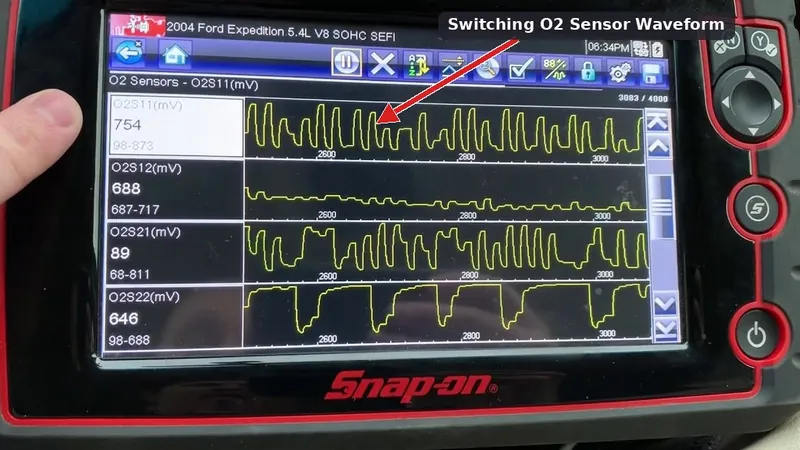
Monitor the upstream A/F sensor voltage. When snapping the throttle, voltage must drop sharply (lean) and recover instantly. A lazy, slow-moving, or flat line confirms a dead sensor.
Tools: Graphing OBD-II Scanner (Advanced) - Inspect Wiring and Fuses
Visually inspect the Bank 1, Sensor 1 wiring for melting, chafing, or corrosion. Check the fuse box for blown 'A/F Heater' or 'O2 Sensor' fuses.
Tools: Flashlight (Beginner) - Test Sensor Heater Circuit Resistance
Disconnect the cold sensor and measure resistance between the two identical-color wires (usually black or white) using a multimeter. Good heaters read 3-20 Ohms. An 'OL' reading means the heater is broken.
Tools: Digital Multimeter (Advanced) - Check for Vacuum Leaks
Listen for hissing sounds around the intake manifold with the engine running. Use a smoke machine to pinpoint hard-to-see leaks causing lean conditions.
Tools: Smoke Machine (Intermediate) - Check Fuel Pressure
Verify fuel pressure using a gauge. Consistently low pressure indicates a weak fuel pump or clogged filter, creating a lean condition that triggers P1163.
Tools: Fuel Pressure Gauge (Advanced)
When This Code Triggers (Freeze-Frame Conditions)
- Engine Coolant Temp: 180-200°F (The engine must be fully warmed up to closed-loop operation.)
- RPM: 1500-2500 (The code sets during steady-state cruising, not heavy acceleration.)
- Engine Load: 20-60% (A moderate, steady engine load is present when the monitor runs.)
- Vehicle Speed: 40-60 mph (The sensor response test performs during steady highway driving.)
Related Codes
- P0133 — The generic SAE code for 'O2 Sensor Circuit Slow Response'. P1163 is the manufacturer-specific version. The diagnostic approach is identical.
- P0135 — Indicates a malfunction in the sensor's heater circuit. A faulty heater prevents the sensor from reaching operating temperature, directly causing the slow response of P1163. Fix P0135 first.
- P0171 — Means 'System Too Lean'. An exhaust or vacuum leak causes both P1163 and P0171. If fuel trims are highly positive, a leak is the root cause.
- P1143 — On Nissan V-type engines, P1143 is the Bank 1 equivalent of P1163. If both appear, suspect a major vacuum leak or MAF sensor issue affecting both banks.
Climate & Environmental Factors
- Cold Weather: Freezing temperatures delay the sensor's internal heater from reaching its 600°F operating temperature. The PCM interprets this slow warm-up as a slow response, triggering P1163.
- Road Salt: Winter road salt corrodes the sensor body, threads, and external wiring. This seizes the sensor in the exhaust and degrades the electrical connection.
- High Altitude: Less dense air at high altitudes reduces available oxygen, creating a lean condition. This pushes the sensor to the edge of its operational range, making it highly sensitive to slow response flags.
How to Talk to a Mechanic About This Code
Say this: "I have a P1163 code. Please check for exhaust or vacuum leaks and review the live sensor data graph before recommending a sensor replacement."
Signals you understand that replacing the sensor isn't always the right first step, directing the mechanic to perform a proper diagnosis.
Avoid saying:
- 'My check engine light is on, can you just fix it?'
- 'I think I need a new oxygen sensor.'
- 'Just do whatever you think is best.'
Questions to ask before authorizing the repair:
- Did you find any exhaust or vacuum leaks?
- Can you show me the live data graph confirming the sensor is slow?
- Are you using an OEM-quality Denso or NTK part?
- What is the warranty on the parts and labor for this repair?
Where to Take It: Dealer vs Independent vs Chain
- Dealer:
Best for: Vehicles under an emissions warranty (typically 8 years/80,000 miles)., Specific models with known TSBs requiring a software update (e.g., 2002-2003 Honda CR-V).
Downsides: Labor rates are significantly higher than independent shops., May be quicker to replace parts rather than perform detailed wiring or leak repairs. (Typical cost: +50% vs. baseline) - Independent Shop:
Best fit for most situations. A reputable independent shop has the tools to diagnose P1163 correctly by checking for leaks and analyzing sensor data before replacing parts.
Best for: Most out-of-warranty vehicles., Straightforward sensor replacements after proper diagnosis., Exhaust leak and vacuum leak repairs.
Downsides: Quality and diagnostic skill vary widely; check reviews and look for ASE certifications., May not have access to manufacturer-specific software for ECU updates. (Typical cost: +0% vs. baseline) - Chain Shop:
Avoid for initial diagnosis; they often replace the sensor without checking for underlying leaks.
Best for: Getting the code read for free., Simple, clear-cut repairs if you have already diagnosed the issue yourself.
Downsides: Technician skill varies dramatically., High pressure to upsell services; may recommend unnecessary part replacements. (Typical cost: -10% vs. baseline)
When to Walk Away From the Repair
If the estimated repair cost exceeds 50% of the car's private-party value, consider selling or trading in the vehicle.
- Car worth $4000, fix is $500: Fix it. The repair cost is well below the 50% threshold.
- Car worth $3000, fix is $1800: Walk away. The repair cost is over 50% of the car's value.
- Car worth $8000, fix is $850: Fix it. This is a reasonable cost to keep a more valuable car running properly.
What Scan Tool You Need for This Code
Minimum: A scanner that reads and graphs live O2 sensor data and views freeze-frame data.
A basic $20 code reader only gives you the code, leading you to guess the sensor is bad. You need live data graphs to confirm the sensor is actually slow and freeze-frame data to see engine conditions when the code set.
Budget: BlueDriver Pro Scan Tool (~$100) — Connects to your smartphone to display live sensor data graphs and read freeze-frame data.
Mid-range: Foxwell NT510 Elite (~$180) — Dedicated handheld unit providing fast live data graphing and access to manufacturer-specific systems.
Professional: Autel MaxiCOM MK808 (~$500-900) — Professional tablet scanner with fast live data and bidirectional controls.
Rent vs buy: Auto parts stores offer Loan-A-Tool programs to borrow a scanner for free. This is a great option for a one-time diagnosis. If you work on cars regularly, buying a tool like the BlueDriver is a worthwhile investment.
How to Clear the Code After You Fix It
- Use an OBD-II scan tool to clear the diagnostic trouble code.
- Perform a complete drive cycle to allow the vehicle's readiness monitors to run.
- Check for pending or stored codes after the drive cycle.
Drive cycle (~20 minutes): 1) Cold start. 2) Idle for 2.5 minutes with A/C on. 3) Accelerate to 55 mph at half throttle. 4) Hold 55 mph for 3 minutes. 5) Coast to 20 mph without braking. Repeat acceleration and steady driving.
Readiness monitors affected: Oxygen Sensor Monitor, Catalyst Monitor, Oxygen Sensor Heater Monitor
Before emissions retest: drive at least 50 miles to fully set monitors.
Watch out for:
- Disconnecting the battery clears the code but resets all readiness monitors, guaranteeing an emissions test failure.
- The code returns if the root cause, like an exhaust leak, remains unfixed.
Will This Fail Emissions / State Inspection?
Yes — this code typically fails an OBD-II emissions inspection.
- California: An illuminated Check Engine Light is an automatic failure. All readiness monitors must be 'Ready', requiring 50-100 miles of driving after a repair.
- New York: An active code automatically fails the emissions inspection. A full drive cycle must be completed after clearing the code.
- Texas: An active P1163 code causes an automatic failure. Clearing the code resets the O2 sensor monitor to 'Not Ready', which also results in failure.
Most Commonly Affected Vehicles
- Honda Civic HX (1998-2000) — TSB 00-028 states the original ECU is too sensitive and requires an updated part to resolve the code.
- Honda CR-V (2002-2004) — TSB 04-013 requires an ECM/PCM software update because the original software was too sensitive. Do not replace the sensor.
- Acura Integra (1996-2001) — Triggers P1163 due to a slow-responding primary A/F sensor.
- Honda Accord (1998-2002) — Four-cylinder models trigger P1163 when the front oxygen sensor fails.
- Hyundai Santa Fe, Elantra, Tucson (2001-2006) — P1163 is frequently triggered by vacuum leaks from cracked EVAP hoses rather than a faulty O2 sensor.
- Kia Optima, Sorento, Forte (2001-2006) — Sets this code due to vacuum leaks or fuel delivery problems.
- Chevrolet / GM Various V6/V8 Models (1999-2007) — P1163 means 'Heated Oxygen Sensor Bank 2 Sensor 3 Lean System', pointing to the post-catalytic converter sensor on the driver's side.
- Nissan Frontier, Xterra (2000-2004) — Indicates 'Heated Oxygen Sensor 1 Lean Shift Monitoring Bank 2', pointing to the upstream sensor on the driver's side.
Manufacturer-Specific Notes
- Honda/Acura: For 1998-2000 Civic HX and 2002-2003 CR-V models, P1163 is caused by an overly sensitive ECU requiring a software update (TSBs 00-028 and 04-013). Additionally, check if your vehicle falls under the 15-year/150,000-mile PZEV emissions warranty.
- Hyundai/Kia: P1163 is often triggered by vacuum leaks from broken EVAP hoses or fuel delivery issues, causing a lean condition the PCM misinterprets as a sensor fault.
- Volkswagen/Audi: P1163 means 'Fuel Temp. Sensor Circ. Open / Short to B+'. It is completely unrelated to the oxygen sensor.
- General Motors (GM): P1163 means 'Heated Oxygen Sensor Bank 2 Sensor 3 Lean System', pointing to the post-catalyst sensor on the engine bank without cylinder #1.
- BMW: Defined as 'Fuel Trim Additive Per Ignition Bank 1 High', indicating a fuel mixture problem rather than a sensor speed issue.
Real Owner Stories
1999 Honda Civic HX at ~120K miles
Check Engine Light came on with P1163. Owner had replaced the upstream O2 sensor with an OEM NTK part about 11,000 miles prior.
What they tried:
- Reset the code, which returned after about a month.
- Considered replacing the downstream O2 sensor.
- Discovered a crack in the exhaust manifold.
Outcome: The primary advice from forum members was to fix the known exhaust leak first before replacing any more sensors.
Lesson: Fix known physical faults like exhaust leaks before replacing electronic parts. Leaks introduce fresh air, skewing sensor readings.
2002 Honda CR-V with recurring P1163
A professional technician was servicing a CR-V where the P1163 code would return a day or two after being cleared.
What they tried:
- Replaced the front A/F sensor.
- Checked the wiring to the sensor, which appeared okay.
Outcome: The issue was identified as a software problem in the vehicle's computer. Honda released TSB 04-013 for this exact issue on 2002-03 CR-V models.
Lesson: Always check for TSBs before replacing expensive parts. A software update fixes the root cause on specific models.
How to Prevent This Code From Triggering
- Use Top-Tier certified gasoline (Every fill-up) — Contains higher detergent levels that prevent carbon deposits, ensuring cleaner combustion and preventing sensor tip fouling.
- Address engine oil and coolant leaks promptly (As soon as noticed) — Burning oil or antifreeze creates chemical byproducts (silicone/phosphorus) that poison the oxygen sensor and cause premature failure.
- Replace upstream O2/A-F sensors proactively (Every 80,000 to 100,000 miles) — Oxygen sensors are wear items with a 60k-100k mile lifespan. Proactive replacement maintains fuel economy and prevents catalytic converter damage.
Frequently Asked Questions
Can I just reset the code and keep driving?
You can reset the code, but it will return within a day or two. Resetting does not fix the underlying problem, which causes poor fuel economy and potential catalytic converter damage.
I replaced the sensor and the code came back. What now?
The problem is elsewhere. The most likely culprits are an undetected exhaust leak before the sensor, damaged wiring, a vacuum leak, or an outdated ECU requiring a software update.
What is the most common misdiagnosis for P1163?
Replacing the oxygen sensor without checking for exhaust and vacuum leaks. A cracked exhaust manifold lets in air, making a perfectly good sensor appear slow. Always inspect for leaks first.
Can I use a cheap universal oxygen sensor?
Universal sensors require splicing wires and lack the precise response characteristics of Original Equipment (OEM) parts. Always use a direct-fit, OEM-quality sensor like Denso or NTK to avoid persistent codes.
What is Bank 1, Sensor 1?
'Bank 1' is the side of the engine containing cylinder #1. 'Sensor 1' is the upstream oxygen sensor located before the catalytic converter.
Is an Air/Fuel Ratio Sensor the same as an Oxygen Sensor?
An Air/Fuel Ratio (A/F) sensor is a more advanced, wideband oxygen sensor providing precise measurements across a wider range. Most modern cars use an A/F sensor for Sensor 1.
How do I test the sensor's heater circuit?
With the sensor unplugged and engine cold, use a multimeter set to Ohms to probe the two identical-color wires on the connector. A good heater shows 3 to 20 Ohms. An 'OL' reading means the heater is broken.
Can a bad fuel injector cause P1163?
Yes, but it is rare. A leaking or clogged injector creates an air-fuel imbalance the ECU misinterprets as a sensor issue, but it usually triggers a misfire code (P0300-P0308) first.
Key Takeaways
- Replace the upstream Air/Fuel Ratio sensor (Bank 1, Sensor 1) to resolve P1163 in over 80% of cases.
- Inspect the exhaust manifold for hairline cracks before buying parts, as fresh air entering the exhaust skews sensor readings and mimics a dead sensor.
- Check Long-Term Fuel Trim (LTFT) data; a reading above +10% indicates a vacuum or exhaust leak is triggering the code rather than a faulty sensor.
- Review Technical Service Bulletins (TSBs) 00-028 and 04-013 if driving a 1998-2003 Honda Civic or CR-V, as an overly sensitive ECU requires a software update, not a new sensor.
Helpful Videos
Shop the Parts Behind P1163
Below are the parts most often responsible for code P1163, ranked by how frequently each one is the actual culprit (per the diagnosis above). Tap any to see what we have for your vehicle.


The information in this article is provided for general reference and educational purposes only. Vehicle specifications, procedures, and part compatibility can vary by production date, trim level, and region. Always consult your vehicle's factory service manual and verify part numbers before purchasing or performing repairs. Safety-critical components such as airbags, seat belts, and braking systems should be installed by a qualified professional.
- 🧭 Diagnostic Flowchart
- 🎬 Helpful Videos
- 🛍️ Shop This Part
- What Does P1163 Mean?
- Can I Drive With P1163?
- Common Causes
- Symptoms
- Common Fixes & Costs
- DIY vs Professional
- Used vs. New Parts: Buying Guide
- What Happens If You Wait — Timeline
- Cost of Not Fixing It
- Diagnosis Steps
- When This Code Triggers (Freeze-Frame Conditions)
- Related Codes
- Climate & Environmental Factors
- How to Talk to a Mechanic About This Code
- Where to Take It: Dealer vs Independent vs Chain
- When to Walk Away From the Repair
- What Scan Tool You Need for This Code
- How to Clear the Code After You Fix It
- Will This Fail Emissions / State Inspection?
- Most Commonly Affected Vehicles
- Manufacturer-Specific Notes
- Real Owner Stories
- 1999 Honda Civic HX at ~120K miles
- 2002 Honda CR-V with recurring P1163
- How to Prevent This Code From Triggering
- Frequently Asked Questions
- Can I just reset the code and keep driving?
- I replaced the sensor and the code came back. What now?
- What is the most common misdiagnosis for P1163?
- Can I use a cheap universal oxygen sensor?
- What is Bank 1, Sensor 1?
- Is an Air/Fuel Ratio Sensor the same as an Oxygen Sensor?
- How do I test the sensor's heater circuit?
- Can a bad fuel injector cause P1163?
- Key Takeaways
- 🎟️ Get 5% Off