

P1185 on 2017-2022 Jeep Compass 2.4L: General Pressure Sensor Correlation Fixes
On the 2017-2022 Jeep Compass, code P1185 is most often caused by outdated Powertrain Control Module (PCM) software. The first step is to have a dealer check for updates using your VIN. If the software is current, the Manifold Absolute Pressure (MAP) sensor is the next likely cause, costing around $40-$100 for the part. Do not replace any parts before checking for software updates.
- First, have a Jeep dealer check for software updates; this is the most common and cheapest fix.
- Do not replace any parts until you have confirmed the PCM software is current.
- If a part is needed, the MAP sensor is the most likely culprit.
- The MAP sensor is on the back of the engine and is difficult to access, making the repair more challenging for a DIYer.
- This code indicates an air pressure sensor issue, not a fuel system problem.
What's Unique About the 2017-2022 Jeep Compass
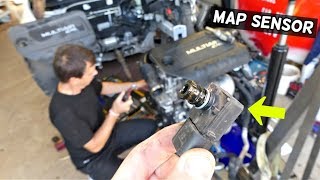
The 2.4L MultiAir engine used across the FCA/Stellantis lineup (including Jeep, Chrysler, and Dodge) is known for having this specific software sensitivity. FCA has released multiple Technical Service Bulletins (TSBs) and software updates for various models with this engine to correct the logic that triggers P1185. This makes it crucial to rule out a simple software update before spending money on hardware. The physical location of the MAP sensor on the rear of the intake manifold 🎬 Watch: How to locate and replace the MAP sensor also makes it a more difficult part to replace than on many other engines, often requiring access from underneath the vehicle.
Symptoms You May Notice
- Check Engine Light illuminated
- Reduced engine power or sluggish acceleration
- Rough or unstable idle
- Vehicle may enter 'limp mode' with limited power
- Poor fuel economy
- Engine may not start or may run incorrectly
- Replacing the MAP sensor before verifying that the PCM software is up-to-date. This is the most common mistake and often results in the code returning because the root cause is the PCM's diagnostic logic.
- Confusing the code with a fuel pressure issue. Generic code readers may provide misleading definitions; on this Jeep, P1185 is strictly related to air pressure sensors (MAP/BARO).
Most Likely Causes
- Outdated Powertrain Control Module (PCM) Software 🔴 High Probability → Shop Engine Control Module (ECM) FCA released multiple software updates for the 2.4L MultiAir engine platform to correct overly sensitive logic for this specific diagnostic check. TSBs for platform mates like the Jeep Renegade and Chrysler 200 explicitly list P1185 as a code fixed by a PCM flash.
How to confirm: A Jeep dealership or a qualified independent shop with a wiTECH scan tool must check the vehicle's current software calibration ID against the latest version available for the VIN. This is the only definitive method.
Typical fix: Reprogramming (flashing) the PCM with the latest manufacturer software. TSB 18-016-17 REV. B is one such update that addresses P1185 on the related 2017 Jeep Renegade platform. A dealer will typically charge between $150 and $200 for this service if the vehicle is out of warranty.
Est. part cost: $0 - Faulty Manifold Absolute Pressure (MAP) Sensor 🟡 Medium Probability → Shop Manifold Absolute Pressure Sensor The MAP sensor is a common failure point that provides a direct input for this diagnostic. If its reading is inaccurate or stuck, it will conflict with the BARO sensor reading, triggering the code.
How to confirm: With the key on and engine off, use a scan tool to compare the live data from the MAP and BARO sensors. The readings should be nearly identical (within 0.5 PSI or 1.0 inHg). If they differ significantly, and the software is confirmed to be up-to-date, the MAP sensor is likely faulty.
Typical fix: Replace the MAP sensor. On the 2.4L engine, it is located on the rear of the intake manifold and is typically accessed from underneath the vehicle. The sensor is removed by twisting it approximately 90-100 degrees counter-clockwise and pulling it out.
Est. part cost: $40-$100 - Wiring or Connector Issue at MAP Sensor ⚪ Low Probability → Shop Manifold Absolute Pressure Sensor The wiring harness is exposed to engine heat and vibration, which can lead to a loose connection, corrosion on the pins, or chafed wires over time. A loose or damaged connector is a common point of failure.
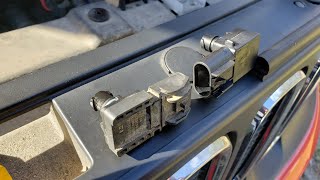
How to confirm: Visually inspect the MAP sensor's electrical connector and the surrounding wiring for any signs of damage, corrosion, or looseness. Check for a secure connection and ensure the red locking tab is engaged.
Typical fix: Repair the damaged wiring or clean/replace the connector. TSB 08-061-16 for the 2015 Renegade noted that improperly sealed wire terminations in the engine harness could cause P1185, requiring sealing with heat shrink tubing.
Est. part cost: $5-$30
Rare But Worth Checking
- Faulty Powertrain Control Module (PCM): → Shop Engine Control Module (ECM) A recall (NHTSA 18V-524 / FCA U87) was issued for some 2018 Compass models due to a faulty voltage regulator inside the PCM. While not directly citing P1185, a failing PCM can cause a wide range of erroneous codes and is a possibility for the affected model year.
- Significant Vacuum Leak: While less common, a large vacuum leak from a source like a cracked intake manifold or faulty PCV hose could theoretically cause MAP sensor readings that are implausible enough to trigger a correlation fault with the BARO sensor. TSBs for platform mates sometimes bundle P1185 with vacuum leak codes like P2172.
Diagnosis Steps
- Check for Recalls and TSBs: Contact a Jeep dealer with your VIN to see if any open recalls (like U87 for 2018 models) or software updates (like those related to TSBs 18-016-17, 18-061-16) apply to your vehicle. This is the most critical first step.
- Scan Tool Data Comparison: With the ignition on and the engine off (KOEO), use a scan tool to view the live data for the MAP and BARO sensors. Their pressure readings should be within 0.5 PSI (or 1.0 inHg) of each other.
- Evaluate Scan Data: If the readings are significantly different, the MAP sensor or its circuit is suspect. If the readings are identical, the issue is highly likely to be intermittent or related to the PCM's software logic, reinforcing the need for Step 1.
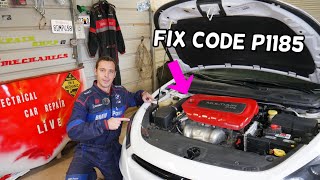
- Inspect MAP Sensor and Wiring: If a sensor fault is suspected, locate the MAP sensor on the rear of the intake manifold. Inspect its connector for corrosion, damage, or loose pins. Ensure the red locking tab is secure. 🎬 Watch: Step-by-step diagnosis and repair for code P1185 Trace the wiring as best as possible for any visible damage, chafing, or melting.
- Test the Circuit: If you have a multimeter and the software is confirmed to be current, test the MAP sensor connector. You should find a 5-volt reference wire, a ground wire (less than 0.1V), and a signal wire.
- Replace MAP Sensor: If the PCM software is up-to-date, the wiring is intact, and the sensor data is incorrect, replace the MAP sensor. This often requires accessing it from under the vehicle.
- Clear Codes and Test Drive: After any repair (including a software flash), clear the trouble codes and perform a complete drive cycle to ensure the fault does not return.
Parts You'll Likely Need
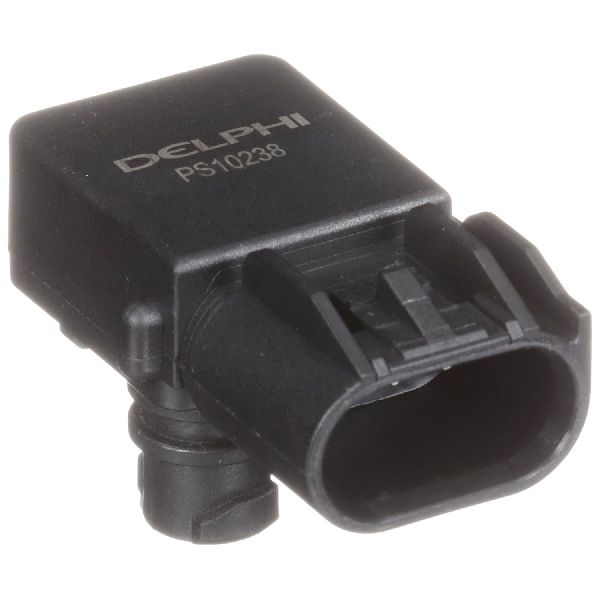
- Manifold Absolute Pressure (MAP) Sensor
(OEM #68199324AB)— This sensor is the most common hardware component to fail and directly causes the correlation fault when its readings become inaccurate.
Trusted brands: Mopar, Bosch, Delphi, Standard Motor Products
OEM price range: $70-$100
Aftermarket price range: $30-$75
Related Codes That Often Appear With This One
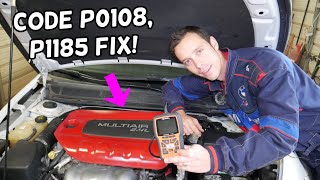
- P0108 — P0108 (Manifold Absolute Pressure/Barometric Pressure Circuit High) is often triggered alongside P1185 because a failing MAP sensor can cause both a high voltage reading 🎬 See this guide for fixing P0108 and P1185 codes and a correlation fault.
- P0335 — P0335 (Crankshaft Position Sensor Circuit) is listed in several TSBs for the 2.4L engine (e.g., 18-061-16, 18-032-17) as being resolved by the same PCM software update that fixes P1185, indicating a software glitch can trigger both.
- P050D — P050D (Cold Start Rough Idle) is another code frequently mentioned in the same software update TSBs as P1185, suggesting the underlying software issue can also manifest as a rough idle condition.
- P0128 — Thermostat Rationality Error is noted in TSB Bulletin #18-122-16 and Bulletin #1805520 as appearing alongside P1185.
- U1504 — Implausible Message Data Length Received From Steering Angle Sensor is cited in TSB Bulletin #18-110-20 and Bulletin #1801617 as a related code found with P1185.
Technical Service Bulletins (TSBs) & Recalls
- 18-016-17 REV. B: Specifically lists P1185 as a code resolved by a PCM software update on the related 2017 Jeep Renegade platform.
- 18-061-16: For the 2016 Jeep Renegade, this TSB also lists P1185 as a fault fixed by a PCM software update.
- 18-023-16 (Revisions B, C, D): For the Dodge Dart and Chrysler 200, these TSBs confirm the same P1185 software issue on platform mates.
- Customer Satisfaction Notification W20: Involves a PCM reprogram for 2017-2018 Jeep Compass models with the 2.4L engine to address engine performance characteristics.
- TSB Bulletin #18-110-20: For the Jeep Cherokee, this bulletin notes that a technician may find P1185 (General Pressure Sensor Correlation) alongside other codes like U1504 and P0101.
- TSB Bulletin #18-032-17: This manufacturer bulletin for the Jeep Cherokee identifies P1185 as a General Pressure Sensor Correlation fault that may occur with crankshaft position sensor circuit issues.
- TSB Bulletin #1805520: For the Jeep Renegade, this record lists P1185 as a correlation fault that may be experienced by customers along with thermostat rationality and brake switch performance codes.
- TSB Bulletin #18-122-16: This bulletin for the Jeep Cherokee platform confirms P1185 as a General Pressure Sensor Correlation fault.
- TSB Bulletin #1801617: For the Jeep Renegade, this bulletin specifically identifies P1185 as a General Pressure Sensor Correlation error that may be present with invalid data from the brake system control module.
Platform-Specific Known Issues
- A known issue with excessive oil consumption on some 2017-2018 models with the 2.4L engine led to a warranty extension and a Customer Satisfaction Notification (W20) that involves a PCM reflash. While for a different symptom, it highlights the prevalence of software fixes for this powertrain.
- A recall (U87 / NHTSA 18V-524) for some 2018 models involved replacing the PCM due to a faulty internal voltage regulator that could cause stalling.
Mechanic-Grade Diagnostic Values
- MAP Sensor 5V Reference Wire Voltage — expected: 4.5V - 5.0V with key on, engine off (KOEO).. Failure: Voltage significantly below 4.5V indicates a problem with the PCM or wiring.
- MAP Sensor Ground Wire Continuity — expected: Near 0 ohms of resistance between the ground pin at the connector and the negative battery terminal.. Failure: High resistance (OL) indicates an open or poor ground connection.
- MAP Sensor Signal Wire Voltage (KOEO) — expected: Approximately 0.5V to 1.5V with key on, engine off. The voltage should correspond to atmospheric pressure.. Failure: Voltage that is stuck high (near 5V) or low (near 0V), or does not match the BARO sensor's equivalent value, points to a faulty sensor.
- MAP Sensor Signal Wire Voltage (Engine Running) — expected: Voltage should drop as throttle is applied (manifold vacuum increases) and fluctuate between approximately 1V and 4.5V depending on engine load.. Failure: A static voltage that does not respond to changes in engine RPM or throttle indicates a failed sensor.
Scan Tool Commands That Help
- wiTECH (Dealer Scan Tool): PCM Reprogram/Flash — This is the primary fix when a Technical Service Bulletin (TSB) indicates a software update is available to correct the logic that triggers P1185. It should be the first step in diagnosis for this specific code on this platform.
- Any OBD-II Scan Tool: Chrysler Drive Cycle Procedure — After clearing codes or performing a repair (like a PCM flash or sensor replacement), a specific drive cycle must be completed to allow the PCM to run its internal self-tests and confirm the fault is resolved.
Wiring & Ground Locations
- MAP Sensor Connector — On the MAP sensor itself, located on the rear of the intake manifold, close to the firewall.. This is the primary connection point. A loose connection, corrosion on the pins, or damaged wires here will directly cause a fault. The wire colors are typically: Pin 1: Violet/Brown (Signal to PCM), Pin 2: Dark Blue/Dark Green (Sensor Ground), Pin 3: Pink/Yellow (5V Supply from PCM). Note: Pin numbers and colors are based on diagrams for platform mates and should be verified.
- PCM Connector C2 — At the Powertrain Control Module (PCM).. This is the termination point for the MAP sensor harness. Testing here can confirm if a wiring fault exists between the sensor and the PCM. Relevant pins are Pin 45 (MAP Signal), Pin 67 (5V Supply), and Pin 66 (Sensor Ground).
- G300 / G301 — Interior ground points, often located under the center console or trim near the shifter.. These are not the primary grounds for the MAP sensor itself, but they ground various control modules. A poor ground at these locations can cause widespread, difficult-to-diagnose electrical issues that could potentially manifest as erroneous sensor codes.
Real Owner Repair Stories
- YouTube Channel 'Electrical Car Repair LIVE' (2015 Dodge Dart with 2.4L MultiAir engine (platform mate)) — Check Engine Light with codes P0108 and P1185.
❌ Tried (didn't work) The narrator noted that the code is sometimes mistaken for a fuel pressure issue, which was ruled out.
✅ What actually fixed it The problem was a faulty Manifold Absolute Pressure (MAP) sensor. Replacing the sensor and clearing the codes resolved the issue. - YouTube Channel 'World Mechanics' (2016 Jeep Cherokee with 2.4L MultiAir engine (platform mate)) — Check Engine Light with code P1185.
✅ What actually fixed it The video identifies the two most common causes as a faulty MAP sensor or a problem with its wiring harness (unplugged, loose, or damaged by the serpentine belt). The fix demonstrated is replacing the MAP sensor.
OEM Part Supersession History
5033310AC, 5149091AA, 68199324AA→68199324AB— Standard part evolution for improved reliability or manufacturing changes.
Model Year Variations Within This Range
- 2017-2022: While there was a significant cosmetic and interior refresh for the 2022 model year, the 2.4L MultiAir engine and its related engine management systems remained consistent throughout this period. Therefore, the causes and fixes for P1185 do not vary significantly within this year range. The 2.4L engine was replaced by a 2.0L Turbo for the 2023 model year.
Diagnostic Flowchart
Used vs. New Parts: Buying Guide for This Vehicle
When a used part is the smart pick: For a critical and relatively inexpensive electronic part like the MAP sensor, buying a used part is not recommended. The cost savings are minimal compared to the risk of receiving a faulty part or one with a very short remaining lifespan.
What to inspect on the donor part:
- Not applicable, as new purchase is strongly advised.
OEM-only on this vehicle (don't cheap out):
- Powertrain Control Module (PCM) - This must be purchased new or professionally remanufactured and requires dealer programming to the vehicle's VIN.
Aftermarket brands forum-validated for this vehicle:
- Delphi
- NGK / NTK
- Standard Motor Products (SMP)
Real Owner Stories
Aggregated from forums and TSBs cited above. Mileages and costs reflect what owners reported in those sources.
Jeep Grand Cherokee
Symptoms: Owner needed a computer flash for a tow package installation.
What fixed it: A dealer computer flash.
Cost: $150-$150
Source hint: Reddit r/Jeep - 'Cost to flash computer for tow package Grand Cherokee?'
Jeep Wrangler (JL)
Symptoms: Owner needed a software flash.
What fixed it: A dealer software flash.
Cost: $0-$200
Source hint: JLwranglerforums.com - 'How much do dealerships charge to flash software?'
Related OBD-II Codes
Frequently Asked Questions
My dealer says my 2018 Compass needs a software update for code P1185. Is this a common problem?
How much does the PCM software flash typically cost if my Jeep is out of warranty?
I have a 2018 Jeep Compass. Could my P1185 code be related to a recall?
How can I check the MAP sensor myself before taking my Compass to a shop?
The TSBs mentioned, like 18-016-17, are for the Renegade. Why are they relevant to my Compass?
What is Customer Satisfaction Notification W20 and could it fix my P1185 code?
Helpful Videos
We Have This Part in Stock


The information in this article is provided for general reference and educational purposes only. Vehicle specifications, procedures, and part compatibility can vary by production date, trim level, and region. Always consult your vehicle's factory service manual and verify part numbers before purchasing or performing repairs. Safety-critical components such as airbags, seat belts, and braking systems should be installed by a qualified professional.
- Jeep Compass:
- 🧭 Diagnostic Flowchart
- 🎬 Helpful Videos
- 🛍️ Shop This Part
- What's Unique About the 2017-2022 Jeep Compass
- Symptoms You May Notice
- Most Likely Causes
- Rare But Worth Checking
- Diagnosis Steps
- Parts You'll Likely Need
- Related Codes That Often Appear With This One
- Technical Service Bulletins (TSBs) & Recalls
- Platform-Specific Known Issues
- Mechanic-Grade Diagnostic Values
- Scan Tool Commands That Help
- Wiring & Ground Locations
- Real Owner Repair Stories
- OEM Part Supersession History
- Model Year Variations Within This Range
- Used vs. New Parts: Buying Guide for This Vehicle
- Real Owner Stories
- Jeep Grand Cherokee
- Jeep Wrangler (JL)
- Related OBD-II Codes
- Frequently Asked Questions
- 🎟️ Get 5% Off