

OBD-II Code P1186: Fuel Pressure Too Low & Other Meanings
The ultimate guide to what P1186 means, why it triggers, and how to fix it for good.
- P1186 means 'Low Fuel Pressure' on Hyundai/Kia, but indicates an O2 sensor fault on BMW/VW and a temperature sensor issue on Ford.
- On Hyundai and Kia diesels, a clogged in-tank fuel strainer causes 80% of P1186 codes and costs under $40 in parts to fix.
- Never replace a $1,000+ high-pressure fuel pump without first graphing live 'Desired vs. Actual' fuel pressure and replacing the main fuel filter.
- Stop driving immediately; sudden engine stalling at highway speeds poses a severe safety risk and starves the fuel pump of critical lubrication.
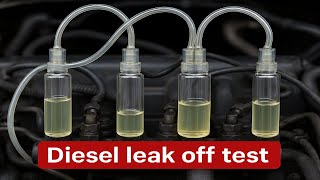
- Perform a diesel injector leak-off test to identify internal leaks if the low-pressure system tests normal at 40-70 PSI.
What Does P1186 Mean?
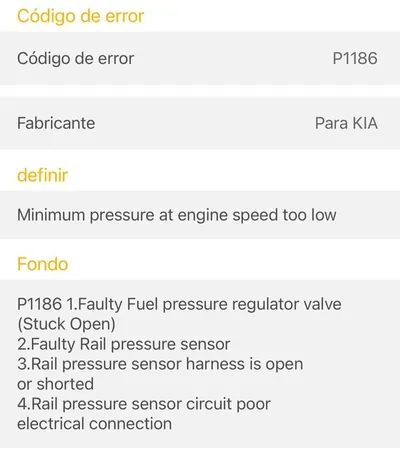
P1186 is a manufacturer-specific code. On Hyundai and Kia, it means the powertrain control module (PCM) detects critically low fuel pressure. On Ford, BMW, or GM, it points to oxygen sensors or oil temperature. You must verify your vehicle's specific definition before diagnosing.
Technical definition: For Hyundai and Kia, P1186 is 'Fuel Pressure Monitoring - Minimum Pressure at Engine Speed Too Low'. The PCM sets this when actual fuel pressure drops significantly below target pressure (typically a 200+ bar deviation) for several seconds. For Ford, it means 'Fuel Pump Temperature Sensor Low'. For BMW, it indicates 'O2 Sensor Heater Control Circuit Bank 1 Sensor 2'. For GM, it refers to 'Engine Oil Temperature Sensor Circuit Performance'.
Can I Drive With P1186?
No — Do Not Drive. Do not drive. The primary risk is sudden engine stalling at any speed, creating a severe safety hazard in traffic. Continuing to drive starves the high-pressure fuel pump and injectors of lubrication, guaranteeing catastrophic failure and adding $1,000-$3,000+ to your repair bill.
Common Causes

- Clogged In-Tank Fuel Filter/Strainer (Very Common) — A fine mesh screen on the fuel pump inside the gas tank clogs with debris or 'diesel bug' slime. This is the #1 cause of P1186 on Hyundai and Kia CRDi vehicles, restricting fuel flow to the high-pressure system.
- Clogged Main Fuel Filter (Very Common) — The primary fuel filter severely restricts fuel volume when clogged by dirt, gelled diesel in cold weather, or poor-quality fuel. This causes an immediate pressure drop under load.
- Failing Low-Pressure Fuel Pump (Lift Pump) (Common) — The electric pump in the fuel tank weakens and fails to supply sufficient fuel volume (typically 40-70 PSI) to the high-pressure pump, leading to starvation.
- Faulty Fuel Pressure Regulator (Common) — This valve controls fuel pressure. When stuck open, it dumps excessive fuel back into the tank, causing an immediate pressure loss that triggers the code.
- Leaking Fuel Injector(s) (Common) — An injector stuck open or suffering from high internal leakage bleeds off rail pressure. On diesels, excessive fuel returning to the tank instead of being injected is a frequent failure point.
- Defective Fuel Rail Pressure Sensor (Less Common) — The sensor fails and sends inaccurate low-voltage signals to the PCM. However, it is far more common for the sensor to correctly read low pressure caused by a mechanical fault.
- Air in the Fuel System (Less Common) — A cracked fuel filter housing or damaged O-ring allows air into the fuel lines. This air compresses in the rail, causing erratic pressure drops.
- Damaged Wiring or Connectors (Less Common) — Wiring to the fuel pressure sensor, regulator, or pump frays or shorts. On GM vehicles, the engine harness rubs against the EGR valve gasket, causing intermittent shorts.
- Failing High-Pressure Fuel Pump (HPFP) (Rare) — The mechanical high-pressure pump wears out internally, usually as a direct result of fuel starvation and lack of lubrication from clogged filters.
Symptoms

- Engine Enters 'Limp Mode' — The vehicle suddenly loses power and caps engine speed at 2,000 or 3,000 RPM, regardless of throttle input. 🎬 Watch: Diagnosing a Kia Sorento in limp mode with P1186.
- Engine Stalling or Shutting Off — The engine cuts out unexpectedly during acceleration or when the fuel tank level drops below half.
- Poor Acceleration and Sluggish Performance — The car feels weak and unresponsive when accelerating hard or climbing hills due to fuel starvation.
- Hard Starting or Long Crank Time — The engine takes longer to start because the fuel rail struggles to build the minimum pressure required for injection.
- Check Engine Light Illuminated — The Malfunction Indicator Lamp (MIL) activates on the dashboard.
- Fuel Pressure Deviation on Scan Tool (scan-tool only — no driver-felt sign) — Live data shows the 'Actual Fuel Rail Pressure' PID significantly lower than the 'Desired Fuel Rail Pressure' PID under load.
Diagnostic Flowchart
Tap your situation to follow the diagnostic path that matches what you're seeing on this code.
Common Fixes & Costs
- Clean or replace in-tank fuel pump strainer
— Parts: $15-$40, Labor: $150-$250, ~1.5 hr book time
(Intermediate)
: OEM
: OEM - Replace fuel filter
— Parts: $30-$80, Labor: $70-$150, ~1.0 hr book time
(DIY)
: OEM
: OEM - Replace low-pressure fuel pump assembly — Parts: $200-$500, Labor: $250-$450, ~2.0 hr book time (Professional)
- Replace fuel pressure regulator
— Parts: $100-$300, Labor: $100-$250, ~1.2 hr book time
(Intermediate)
: OEM - Replace fuel rail pressure sensor
— Parts: $80-$250, Labor: $80-$160, ~0.8 hr book time
(Intermediate)
: OEM - Replace leaking fuel injector(s) — Parts: $150-$500 per injector, Labor: $200-$400, ~2.5 hr book time (Professional)
- Replace high-pressure fuel pump (HPFP) — Parts: $500-$1200+, Labor: $300-$600+, ~3.5 hr book time (Professional)
Used vs. New Parts: Buying Guide
When a used part is worth it: For high-cost items like a high-pressure fuel pump (HPFP) or injectors on an older vehicle where repair costs approach the car's value. Never buy used filters or strainers.
Donor-vehicle mileage cap: roughly under 60000 miles for the part to have meaningful remaining life.
Donor quality checklist:
- Verify the exact part number matches; CRDi systems are highly specific.
- Obtain parts from a reputable dismantler offering a 30-90 day warranty.
- Avoid parts from vehicles that sat for a long time, which causes internal corrosion.
Decision logic:
- If The part is a filter, strainer, or seal. → Always buy new. The cost is low and they are critical wear items.
- If The part is an electronic sensor or regulator. → Buy new aftermarket or OEM. Used electronics carry a high risk of immediate failure.
- If The part is a high-pressure fuel pump or injector and the vehicle has over 120k miles. → A low-mileage used part is a reasonable budget choice, but new OEM provides long-term security.
Warranty tradeoff: Used parts offer a 30-90 day warranty on the part only. New aftermarket parts have a 1-year warranty. New OEM parts carry a 1-2 year warranty.
Worst-case if a used part fails: $500-$1500 if a used HPFP fails, requiring repeat labor and another replacement part.
What Happens If You Wait — Timeline
- 0-1 month: Intermittent limp mode or stalling during hard acceleration. Restarting temporarily clears the symptom. No permanent damage yet. (MPG impact: 0-5%% · Added cost: $0-$50 in wasted fuel and potential towing.)
- 1-3 months: Stalling becomes frequent. The high-pressure fuel pump (HPFP) experiences accelerated wear due to fuel starvation and lack of lubrication. (MPG impact: 5-10%% · Added cost: $100-$200 in wasted fuel.)
- 3-6 months: Sustained starvation causes significant internal HPFP wear. The pump sheds small metal particles into the fuel system, damaging injector nozzles. (MPG impact: 10-15%% · Added cost: $800-$1,800 (HPFP replacement required).)
- 6+ months: Catastrophic HPFP failure. Metal debris destroys the fuel rail, pressure sensor, and all fuel injectors. The vehicle is inoperable. (MPG impact: N/A% · Added cost: $3,000-$5,000+ (Requires complete high-pressure system replacement and tank flush).)
Cost of Not Fixing It
- Immediate: Unpredictable engine stalling creates a severe safety hazard in traffic. (Added cost: $100-$300 for towing.)
- 1-3 months: Fuel starvation causes permanent damage to the high-pressure fuel pump (HPFP) due to lack of lubrication. (Added cost: $800-$1800)
- 3-6 months: Catastrophic HPFP failure sends metal debris through the system, destroying the fuel rail and all injectors. (Added cost: $2000-$5000+)
Diagnosis Steps

- Verify Code Meaning and Scan for Other Codes
Confirm P1186 is present and verify its definition for your specific make and model. Check for related codes like P0087 (generic low pressure), P0191 (sensor circuit fault), or P1188 (leakage) to isolate the system.
Tools: OBD-II Scanner (Beginner) - PRO TIP: Graph Live Fuel Pressure Data
Graph 'Desired Fuel Rail Pressure' and 'Actual Fuel Rail Pressure'. At idle, they must match (approx. 250-300 bar). Rev the engine under load. If actual pressure drops 200+ bar below desired pressure, you have confirmed a mechanical fuel delivery deficit.
Tools: Advanced OBD-II Scan Tool (Intermediate) - Inspect and Replace the Main Fuel Filter
Replace the main fuel filter if its history is unknown. Cut the old filter open; if you find metallic particles, the high-pressure fuel pump is failing and contaminating the system.
Tools: Wrenches, New fuel filter, Rags, Catch pan (Beginner) - Inspect the In-Tank Fuel Pump Strainer
Access the fuel pump module under the rear seat. Remove the assembly and inspect the mesh strainer. If covered in black slime or debris, clean it thoroughly with brake cleaner or replace it. This fixes 80% of Hyundai/Kia P1186 codes.
Tools: Basic hand tools, Brake cleaner, Rags (Intermediate) - Test Low-Pressure Fuel System
Connect a fuel pressure gauge before the high-pressure pump. Verify pressure meets manufacturer specs (typically 40-70 PSI). A weak low-pressure pump starves the high-pressure pump and triggers the code.
Tools: Fuel pressure gauge kit (Intermediate) - PRO TIP: Perform an Injector Leak-Off Test (Diesel)
Disconnect the low-pressure return lines from each injector and connect a leak-off test kit with graduated cylinders. Run the engine at idle for 60 seconds. If one injector returns significantly more fuel (e.g., double the others or over 30 mL/min), it is leaking internally and bleeding off rail pressure.
Tools: Injector leak-off test kit, Graduated cylinders, Basic hand tools (Advanced) - Test Fuel Rail Pressure Sensor (FRP)
With key on/engine off, verify the FRP sensor has a 5V reference, a ground, and a signal wire. Signal voltage should be around 0.5V, rising to 1.0-1.5V at idle. Erratic voltage indicates a bad sensor or wiring.
Tools: Multimeter, Service manual (Intermediate) - Test Fuel Pressure Regulator and Wiring
Inspect the regulator's electrical connector. Check resistance across the terminals and compare to the service manual (commonly 2.5-5.0 Ohms). Out-of-spec readings require regulator replacement.
Tools: Multimeter, Service manual, Basic hand tools (Advanced)
When This Code Triggers (Freeze-Frame Conditions)
- Engine Coolant Temp: 180-210°F (82-99°C) (Fully warmed up and at normal operating temperature.)
- RPM: 1800-3000 RPM (During moderate acceleration or steady highway cruising, when fuel demand increases.)
- Engine Load: 40-70% (The engine is under significant load, such as climbing a hill or accelerating to merge.)
- Vehicle Speed: 40-65 mph (65-105 km/h) (Occurs at highway speeds where a consistent, high volume of fuel is required.)
Related Codes
- P0087 — The generic OBD-II code for 'Fuel Rail Pressure Too Low'. Seeing P0087 alongside P1186 guarantees a mechanical low-pressure condition.
- P1188 — Means 'Fuel Pressure Monitoring - Leakage'. Triggered alongside P1186, it points to a leaking fuel injector or stuck-open pressure regulator.
- P0191 — Means 'Fuel Rail Pressure Sensor Circuit Range/Performance'. Points to an electrical problem with the sensor or wiring, rather than a mechanical pressure drop.
- P1185 — The opposite of P1186, meaning 'Fuel Pressure Too High'. Points to a faulty fuel pressure regulator stuck closed.
Climate & Environmental Factors
- Cold Weather (Diesel Fuel Gelling): In cold temperatures, paraffin wax in diesel crystallizes and thickens into a gel. This gelled fuel completely blocks the in-tank strainer and main fuel filter, starving the engine and directly causing P1186.
- Water Contamination: Water in diesel promotes the growth of 'diesel bug' microbes. This creates a slimy substance that rapidly clogs fuel filters and strainers, triggering low-pressure faults.
How to Talk to a Mechanic About This Code
Say this: "I have a P1186 code on my Hyundai/Kia and it's stalling. I know this is commonly a clogged in-tank fuel strainer or main fuel filter. Please start the diagnosis by inspecting the in-tank strainer and replacing the main filter before checking the high-pressure pump."
Signals you are an informed customer, steering the mechanic away from quoting an expensive fuel pump replacement. It directs them to the most common, low-cost fixes first.
Avoid saying:
- 'My car is stalling, just fix it.'
- 'My check engine light is on, can you look at it?'
- 'I think I need a new fuel pump.'
Questions to ask before authorizing the repair:
- What did the in-tank fuel strainer look like? Was it clogged? Can you send me a picture?
- Can you show me the live data graph of 'Desired' versus 'Actual' fuel pressure under load?
- If you recommend an injector or pump, what specific tests confirmed that part failed?
- What is the warranty on the parts and labor for this repair?
Where to Take It: Dealer vs Independent vs Chain
- Dealer:
Best for: Vehicles still under powertrain or emissions warranty., Very new models where independent shops lack specific diagnostic software.
Downsides: Significantly higher labor rates (1.5-2x) and parts costs., Quick to replace entire assemblies (e.g., full fuel pump module for $500+) instead of cleaning a $10 strainer. (Typical cost: +50% vs. baseline) - Independent Shop:
Best fit. An experienced independent mechanic knows to check the filters/strainer first, providing the most cost-effective repair.
Best for: Out-of-warranty Hyundai/Kia vehicles with this common P1186 code., Cost-conscious owners who want targeted diagnostics.
Downsides: Quality varies; you must find a shop with good reviews and diesel experience. (Typical cost: +0% vs. baseline) - Chain Shop:
AVOID. They are ill-equipped to diagnose the root cause and will recommend expensive, ineffective solutions.
Best for: Simple, routine maintenance like oil changes.
Downsides: Technicians lack specific expertise for diesel fuel system diagnostics., High pressure to upsell services leads to misdiagnosis and unnecessary 'fuel system flushes'. (Typical cost: -10% vs. baseline)
When to Walk Away From the Repair
If the estimated repair cost exceeds 50% of the car's private-party market value, seriously consider selling the car as-is.
- Car worth $5000, fix is $400: Fix it. The repair cost is low and well below the threshold.
- Car worth $5000, fix is $3000: Walk away. The repair cost is over half the car's value, indicating catastrophic HPFP failure.
- Car worth $15000, fix is $3000: Borderline. This is a major repair, but on a more valuable vehicle, it is worth it. Get a second opinion.
What Scan Tool You Need for This Code
Minimum: A scanner that reads and graphs live data, specifically Fuel Rail Pressure.
A basic $20 code reader only shows the P1186 code. It cannot display live fuel pressure data, which is essential to confirm if pressure drops under load.
Budget: BlueDriver Pro (~$100) — Connects to your smartphone and graphs live data streams like 'Fuel Rail Pressure' vs 'Desired Fuel Rail Pressure'.
Mid-range: Foxwell NT510 Elite (~$180) — Offers brand-specific software and bidirectional controls to command the fuel pump on.
Professional: Autel MaxiCOM MK808S (~$450) — Provides full bidirectional control to test individual components and supports injector coding.
Rent vs buy: For a one-time diagnosis, use the AutoZone 'Loan-A-Tool' program. You pay a fully refunded deposit for a scanner. Buy a scanner only if you plan to do regular repairs.
How to Clear the Code After You Fix It
- Use an OBD-II scan tool to erase the diagnostic trouble codes.
- Do not disconnect the battery, as this clears readiness monitors without fixing the underlying flag.
- Perform a complete drive cycle to allow the ECU to re-run internal tests.
Drive cycle (~30 minutes): Cold start and idle for 3 minutes. Drive at a steady 55 mph for 15 minutes. Perform stop-and-go city driving for 10 minutes. Allow the vehicle to cool completely (8+ hours).
Readiness monitors affected: Fuel System Monitor, Catalyst Monitor, O2 Sensor Monitor
Before emissions retest: drive at least 50 miles to fully set monitors.
Watch out for:
- Clearing the code does not mean the car passes emissions; readiness monitors must read 'Ready'.
- If the root cause remains, P1186 returns immediately when the engine is put under load.
Will This Fail Emissions / State Inspection?
Yes — this code typically fails an OBD-II emissions inspection.
- California: An active P1186 code is an automatic failure. All readiness monitors must be 'Ready' to pass the smog check.
- New York: An illuminated Check Engine Light for P1186 results in an automatic failure during the OBD-II scan.
- Texas: An active P1186 code causes the vehicle to fail the OBD portion of the inspection.
Most Commonly Affected Vehicles
- Hyundai i30, i20, Santa Fe, Tucson/ix35 (CRDi) (2007-2016) — Extremely common issue caused by a clogged in-tank strainer or main fuel filter. 2011-2014 models are highly susceptible.
- Kia Sorento, Sportage, Cee'd (CRDi) (2010-2018) — Shares the CRDi fuel system with Hyundai. P1186 is frequently paired with P0087 due to clogged filters.
- Hyundai iLoad / iMax (2008-2017) — Commercial vans experience power loss and limp mode from P1186, traced back to fuel delivery restrictions.
- Ford Focus, Fiesta, Mondeo (2005-2015) — P1186 means 'Fuel Pump Temperature Sensor Low' or a 'Fuel Composition Sensor' fault, not low pressure.
- BMW 3-Series, 5-Series (2005-2015) — P1186 indicates 'O2 Sensor Heater Control Circuit Bank 1 Sensor 2' malfunction, unrelated to fuel.
- Chevrolet / GM Various Models (2005-2016) — P1186 is 'Engine Oil Temperature Sensor Circuit Performance'. Engine harness chafing near the EGR valve causes this.
- Volkswagen / Audi Various Models (2004-2012) — P1186 means 'Linear Oxygen Sensor Common Ground Short To Positive', pointing to an O2 sensor wiring issue.
- Jaguar / Land Rover Various Models (2005-2015) — Points to issues with fuel composition or temperature sensors rather than low pressure.
- Hyundai Verna (CRDi) (2011-2017) — Suffers from P1186 due to leaking fuel injectors causing a drop in rail pressure under load.
Manufacturer-Specific Notes
- Hyundai / Kia: This code on CRDi engines is almost always a clogged in-tank fuel strainer. The car stalls when accelerating or when the tank is below half. Inspect this strainer before replacing any expensive parts.
- Ford / Mazda / Volvo: P1186 refers to a fault with the 'Fuel Composition Sensor' or 'Fuel Temperature Sensor'. Diagnosing it as a low-pressure problem is a complete waste of time.
- BMW / VW / Audi: P1186 points to an electrical fault in an Oxygen (O2) Sensor heater circuit. Diagnosis must focus on the sensor's wiring and fuse.
- General Motors (GM): P1186 is for the 'Engine Oil Temperature Sensor Circuit'. A known issue is the engine wiring harness rubbing through on the EGR valve bracket, causing a short.
Real Owner Stories
2010 Hyundai i30 1.6 CRDi with stalling issue
Car cut out when revved hard. P1186 code was present. Owner suspected a failed fuel pressure regulator.
What they tried:
- Initial diagnosis pointed towards expensive high-pressure components.
Outcome: The issue was resolved by replacing the main fuel filter and cleaning the in-tank fuel pump strainer, which was clogged with debris.
Lesson: Always start with the cheapest causes. On Hyundai/Kia CRDi engines, clogged filters are the culprit for P1186, not expensive sensors.
2017 Kia Sportage 2.0 Diesel with sudden power loss
Vehicle suddenly lost power and RPM capped at 2,000 (limp mode). Restarting temporarily fixed it. OBD scan revealed P1186 with no check engine light.
What they tried:
- Owner sought advice and was directed to inspect the low-pressure fuel delivery system.
Outcome: The confirmed fix was cleaning a clogged in-tank fuel strainer, restoring proper fuel flow.
Lesson: Intermittent limp mode without a constant check engine light is still a severe fuel starvation issue. Do not ignore it.
2009 Hyundai Santa Fe 2.0 CRDi with P1186 & P0087
Vehicle had both generic (P0087) and manufacturer-specific (P1186) codes for low fuel pressure, with stalling and hard starting.
What they tried:
- Connected a low-pressure fuel gauge, showing only 18 PSI at idle (spec is 45-55 PSI).
- This ruled out high-pressure side components immediately.
Outcome: Replacing the weak in-tank low-pressure fuel pump restored pressure to 52 PSI and cleared the codes.
Lesson: When P0087 and P1186 pair up, it guarantees a mechanical low-pressure problem. A simple pressure gauge isolates the issue instantly.
How to Prevent This Code From Triggering
- Replace the main diesel fuel filter. (Every 15,000-20,000 miles.) — Traps contaminants before they reach the high-pressure pump, preventing restriction codes and expensive component wear.
- Use a quality diesel biocide and water dispersant additive. (Every fill-up in humid climates or for stored vehicles.) — Kills microbial growth ('diesel bug') that creates slime, eliminating the #1 cause of in-tank strainer clogging.
- Use a winter anti-gel fuel additive. (Before and during winter months.) — Prevents paraffin wax in diesel from gelling and completely blocking fuel filters.
- Keep the fuel tank above 1/4 full. (Daily habit.) — Reduces condensation buildup on tank walls and ensures the in-tank lift pump remains submerged and cool.
Frequently Asked Questions
My mechanic replaced the fuel pressure sensor for P1186, but the code came back. What's next?
This is extremely common. The sensor correctly reported low pressure, but the root cause is a fuel delivery restriction. Replace the main fuel filter and clean the in-tank strainer to resolve the actual problem.
Why does my car only stall or lose power when the fuel tank is below half?
When the tank is full, fuel weight provides 'head pressure' that assists the pump. As the level drops, the pump works harder, exposing any restrictions in the strainer. This fuel starvation triggers the stall and the P1186 code.
I saw P1186 means an O2 sensor problem, but my Kia is stalling. Why the confusion?
P1186 is a manufacturer-specific code, meaning brands reuse the number for different systems. Hyundai/Kia use it for low fuel pressure, while BMW/VW use it for O2 sensor heater circuits. Always use a scanner programmed for your specific VIN to get the correct definition.
Can a bad ground wire cause fuel pressure problems?
Yes. A poor ground connection to the fuel pump or its driver module reduces pump speed and fuel volume. This directly causes the low-pressure conditions that trigger P1186.
What does 'fuel pressure monitoring' actually mean?
The PCM constantly compares the 'desired' fuel pressure for your current speed against the 'actual' pressure reported by the rail sensor. If actual pressure drops significantly below the target (often by 200+ bar) for several seconds, it triggers P1186.
Is P1186 an expensive fix?
Costs range from $120 for a simple filter replacement to over $3,000 if the high-pressure fuel pump fails. Always start by cleaning the in-tank strainer and replacing the main filter, as these $50-$100 parts fix the majority of cases.
What happens if fuel pressure is too low?
Low fuel pressure creates a lean air-fuel mixture, causing misfires, hesitation, and stalling. It also starves the high-pressure fuel pump of lubrication, leading to catastrophic metal-on-metal wear. This debris then destroys the fuel injectors, turning a minor issue into a $3,000+ repair.
Key Takeaways
- P1186 means 'Low Fuel Pressure' on Hyundai/Kia, but indicates an O2 sensor fault on BMW/VW and a temperature sensor issue on Ford.
- On Hyundai and Kia diesels, a clogged in-tank fuel strainer causes 80% of P1186 codes and costs under $40 in parts to fix.
- Never replace a $1,000+ high-pressure fuel pump without first graphing live 'Desired vs. Actual' fuel pressure and replacing the main fuel filter.
- Stop driving immediately; sudden engine stalling at highway speeds poses a severe safety risk and starves the fuel pump of critical lubrication.
- Perform a diesel injector leak-off test to identify internal leaks if the low-pressure system tests normal at 40-70 PSI.
Helpful Videos
Shop the Parts Behind P1186
Below are the parts most often responsible for code P1186, ranked by how frequently each one is the actual culprit (per the diagnosis above). Tap any to see what we have for your vehicle.



The information in this article is provided for general reference and educational purposes only. Vehicle specifications, procedures, and part compatibility can vary by production date, trim level, and region. Always consult your vehicle's factory service manual and verify part numbers before purchasing or performing repairs. Safety-critical components such as airbags, seat belts, and braking systems should be installed by a qualified professional.
- 🧭 Diagnostic Flowchart
- 🎬 Helpful Videos
- 🛍️ Shop This Part
- What Does P1186 Mean?
- Can I Drive With P1186?
- Common Causes
- Symptoms
- Common Fixes & Costs
- Used vs. New Parts: Buying Guide
- What Happens If You Wait — Timeline
- Cost of Not Fixing It
- Diagnosis Steps
- When This Code Triggers (Freeze-Frame Conditions)
- Related Codes
- Climate & Environmental Factors
- How to Talk to a Mechanic About This Code
- Where to Take It: Dealer vs Independent vs Chain
- When to Walk Away From the Repair
- What Scan Tool You Need for This Code
- How to Clear the Code After You Fix It
- Will This Fail Emissions / State Inspection?
- Most Commonly Affected Vehicles
- Manufacturer-Specific Notes
- Real Owner Stories
- 2010 Hyundai i30 1.6 CRDi with stalling issue
- 2017 Kia Sportage 2.0 Diesel with sudden power loss
- 2009 Hyundai Santa Fe 2.0 CRDi with P1186 & P0087
- How to Prevent This Code From Triggering
- Frequently Asked Questions
- My mechanic replaced the fuel pressure sensor for P1186, but the code came back. What's next?
- Why does my car only stall or lose power when the fuel tank is below half?
- I saw P1186 means an O2 sensor problem, but my Kia is stalling. Why the confusion?
- Can a bad ground wire cause fuel pressure problems?
- What does 'fuel pressure monitoring' actually mean?
- Is P1186 an expensive fix?
- What happens if fuel pressure is too low?
- Key Takeaways
- 🎟️ Get 5% Off