

OBD-II Code P1233: Fuel Pump Driver Module Offline / Fuel System Deviation
The Ultimate Guide: What P1233 means, why it triggers, and how to fix it for good
- P1233 indicates a critical fuel delivery failure that causes sudden engine stalling, making the vehicle unsafe to drive under any circumstances.
- The definition of P1233 depends entirely on the manufacturer: it means a failed Fuel Pump Driver Module (FPDM) on Fords, a cracked fuel filter housing on Hyundai/Kias, and a faulty throttle body on Nissans.
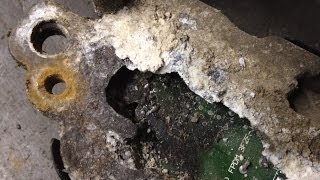
- On 2004-2008 Ford F-150s, galvanic corrosion destroys the aluminum FPDM mounted above the spare tire in over 90% of P1233 cases.
- Hyundai and Kia dealerships fix P1233 for free on 2015-2020 Sonatas and Optimas under a 15-year/150,000-mile warranty extension for cracked fuel filter housings.
- Before buying expensive parts, always check the FPDM fuse (often Fuse #9 or #12) and reset the passenger-footwell inertia switch, which cost nothing to fix.
What Does P1233 Mean?

The P1233 code is a manufacturer-specific code with two primary, distinct meanings. For Ford, Lincoln, and Mazda vehicles, it means the Powertrain Control Module (PCM) lost communication with the Fuel Pump Driver Module (FPDM). The FPDM regulates the voltage and speed of the fuel pump; when it goes offline, the fuel pump shuts down completely, starving the engine. For Hyundai and Kia models, P1233 means 'Low Pressure Fuel System – High Deviation', indicating a massive internal leak within the in-tank low-pressure fuel pump assembly that prevents the system from building required pressure.
Technical definition: For Ford and related manufacturers, the SAE definition is "Fuel Pump Driver Module Off-Line." The PCM sets this DTC when it stops receiving the 50% duty cycle status signal from the FPDM over the Fuel Pump Monitor (FPM) circuit. For Hyundai and Kia, the definition is "Low Pressure Fuel System – High Deviation between target and current pressure," set when the low-pressure fuel sensor reading falls significantly below the ECM's target pressure.
Can I Drive With P1233?
No — Do Not Drive. Driving is not recommended under any circumstances. The P1233 code indicates a critical failure in the fuel delivery system. The engine stalls suddenly and without warning at any speed, creating a severe and immediate safety risk.
Common Causes

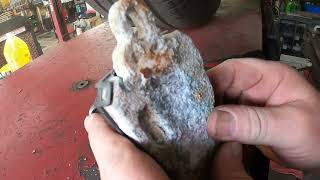
- Corroded or failed Fuel Pump Driver Module (FPDM) (Very Common) — On Ford trucks and SUVs, the aluminum FPDM mounts directly to the steel frame. This causes severe galvanic corrosion that cracks the housing, allows water intrusion, and destroys the internal electronics.
- Cracked Fuel Pump Filter Housing (Hyundai/Kia) (Very Common) — On specific Hyundai and Kia models, a cracked plastic fuel filter housing inside the in-tank fuel pump assembly causes an internal leak, preventing the system from holding pressure.
- Blown FPDM fuse or tripped inertia switch (Common) — A blown supply fuse (e.g., Fuse #12 on an Expedition or #34 on an F-150) or a tripped inertia fuel shutoff switch instantly cuts all power to the FPDM, taking it offline and triggering the code.
- Damaged wiring, melted connector, or poor ground (Common) — Exposed wiring harnesses suffer damage from road debris, moisture, or heat. A failing fuel pump drawing excessive current melts the FPDM connector, or a rusted chassis ground point interrupts the circuit.
- Faulty fuel pump (Rare) — A failing in-tank fuel pump draws excessive electrical current, which overloads and damages the FPDM or repeatedly blows its fuse, indirectly causing the P1233 code.
- Faulty Powertrain Control Module (PCM) (Very Rare) — If the internal driver circuit inside the main engine computer fails, it falsely reports the FPDM as offline. This requires professional diagnosis and is the absolute last consideration.
Symptoms

- Engine cranks but will not start — The starter turns the engine over normally, but it refuses to fire because the fuel pump is offline and delivering zero fuel pressure.
- Engine stalls while driving (often restarts after cooling) — The vehicle shuts off suddenly at speed. If the FPDM is failing thermally, the engine often restarts and runs normally after sitting for 30 minutes to cool down.
- No sound from the fuel pump at key-on — Turning the key to the 'on' position normally produces a faint 2-second hum from the fuel tank. Silence confirms the pump is not receiving power.
- Reduced engine power or 'limp mode' — The computer enters a reduced power mode to prevent engine damage, severely limiting RPM and vehicle speed.
- Check Engine Light is illuminated — The Malfunction Indicator Lamp (MIL) illuminates on the dashboard to alert the driver of the critical fuel system fault.
Diagnostic Flowchart

Tap your situation to follow the diagnostic path that matches what you're seeing on this code.
Common Fixes & Costs
- Replace Fuel Pump Driver Module (FPDM) — Parts: $70-$200, Labor: $75-$150, ~0.6 hr book time (DIY)
- Replace Fuel Pump / Filter Assembly (Hyundai/Kia) — Parts: $150-$400, Labor: $0 (if under warranty), $300-$450 (if not), ~2.5 hr book time (Intermediate)
- Replace Blown Fuse or Reset Inertia Switch — Parts: $1-$5, Labor: $0-$50, ~0.1 hr book time (DIY)
- Repair Wiring, Connector, or Ground — Parts: $10-$50, Labor: $150-$400, ~1.5 hr book time (Intermediate)
Used vs. New Parts: Buying Guide
When a used part is worth it: A used Ford FPDM is never recommended due to the 100% failure rate from corrosion. A used Hyundai/Kia fuel pump assembly from a low-mileage salvage vehicle is acceptable only if the budget is extremely tight.
Donor-vehicle mileage cap: roughly under 60000 miles for the part to have meaningful remaining life.
Donor quality checklist:
- Verify the exact part number matches.
- For fuel pump assemblies, ensure all plastic nipples and connectors are intact and not brittle.
Decision logic:
- If The part is a Ford FPDM. → Buy new. Redesigned OEM and quality aftermarket parts include rubber spacers to prevent the corrosion that causes the failure. A used part retains the design flaw and will fail again.
- If The part is a Hyundai/Kia fuel pump assembly and the vehicle is NOT covered by the warranty extension. → A new OEM or reputable aftermarket part is strongly preferred. A used part is a gamble.
Warranty tradeoff: Used salvage parts offer a 30-90 day warranty. New aftermarket parts offer 1-year to lifetime warranties. New OEM parts carry a 1-2 year warranty.
Worst-case if a used part fails: $300-$700 if a used part fails, requiring repeat labor and a second replacement part.
What Happens If You Wait — Timeline
- First occurrence to 2 months: Intermittent stalling occurs when the vehicle is hot, often restarting after cooling down. The Check Engine Light illuminates sporadically. (MPG impact: 0-5%% · Added cost: $0)
- 2-4 months: Stalling becomes frequent and unpredictable. The vehicle suffers extended crank times, and the P1233 code becomes permanent. (MPG impact: 5-10%% · Added cost: $100-$300 for a potential tow.)
- 4-6 months: A failing fuel pump draws excessive current, melting the FPDM connector. On Hyundai/Kia, driving with low pressure strains and damages the high-pressure fuel pump. (MPG impact: N/A (vehicle is unreliable)% · Added cost: $150-$400 for wiring repair or HPFP damage.)
- 6+ months / Sudden Failure: Complete failure. The FPDM shorts internally, or the Hyundai fuel pump assembly leaks completely. The engine cranks but will not start under any circumstances. (MPG impact: N/A (vehicle is inoperable)% · Added cost: $100-$300 for a guaranteed tow.)
Cost of Not Fixing It
- Immediate: Sudden engine stalling creates a severe safety hazard in traffic. The vehicle will eventually fail to start, leaving you stranded. (Added cost: Towing costs ($100-$300))
- 0-3 months: Intermittent fuel delivery causes lean running conditions, reducing fuel economy and straining the battery and starter from repeated cranking. (Added cost: $50-$200 in wasted fuel and minor wear.)
- 3+ months: A failing fuel pump drawing excess current melts wiring connectors. Inconsistent fuel pressure causes severe lean conditions that overheat and destroy the catalytic converter. (Added cost: $400-$2500+ (for catalytic converter or wiring harness replacement).)
Diagnosis Steps
- Visually Inspect the Fuel Pump Driver Module (FPDM)
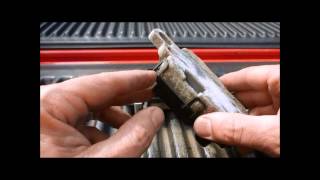
On Ford trucks, the FPDM mounts to a frame crossmember above the spare tire. Lower the spare tire and inspect the module. If the aluminum housing is cracked, swollen, or covered in white powdery corrosion, the module is destroyed and requires replacement.
Tools: Wrench for spare tire, safety glasses, flashlight (Beginner) - Check the Inertia Switch and FPDM Fuse
Locate the inertia fuel shutoff switch in the passenger-side footwell and ensure the red button is pressed down. Next, check the FPDM fuse in the fuse box (e.g., Fuse #9 or #34 on an F-150). Replace it if the internal metal strip is broken.
Tools: Fuse puller or needle-nose pliers (Beginner) - Inspect the FPDM Connector and Wiring
Unplug the FPDM electrical connector. Inspect the pins for green corrosion, melting, or burn marks. Trace the wiring harness along the frame, looking for cuts, abrasions, or rodent damage that breaks the circuit.
Tools: Flashlight (Intermediate) - Test for Power and Ground at the FPDM Connector
With the key ON, use a multimeter to check for battery voltage (~12.6V) at the power supply wire (Pin 5 on Fords). Measure resistance between the ground wire (Pin 3) and a clean chassis ground; it must be under 5.0 ohms. Missing power or high ground resistance confirms a wiring fault.
Tools: Multimeter, wiring diagram (Advanced) - [PRO TIP] Check FPDM Duty Cycle with a Scan Tool
Connect a live-data scan tool and monitor 'Fuel Pump Duty Cycle' (FPDC). At idle, it fluctuates between 20-50%. A constant 75%+ value indicates the FPDM is maxed out trying to compensate for a weak, failing fuel pump. A constant 0% or 100% indicates a PCM or wiring fault.
Tools: Advanced OBD-II Scan Tool (Advanced) - [PRO TIP] Test Hyundai/Kia Low Pressure Fuel System
For Hyundai/Kia models, connect a fuel pressure gauge to the low-pressure line. Key ON, engine OFF, pressure must prime to 72.5 PSI (500 kPa) and hold. If pressure fails to build or drops instantly, it confirms the cracked filter housing defect.
Tools: Fuel pressure gauge with adapters, Advanced OBD-II Scan Tool (Advanced) - [PRO TIP] Perform a Fuel Pump Maximum Output Test
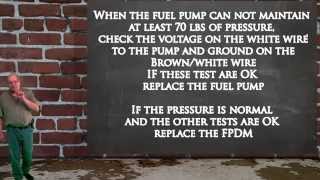
Bypass the FPDM to run the pump at 100%. Jump the FPDM connector's main power wire (Pin 5) to the fuel pump feed wire (Pin 4), and main ground (Pin 3) to the pump ground (Pin 6). If the pump runs and builds 35-45 PSI, the pump is good and the FPDM is faulty. If it fails to build pressure, the pump is dead.
Tools: Jumper wires, fuel pressure gauge, wiring diagram (Professional) - [PRO TIP] Scope the FPDM Monitor Circuit
Back-probe the Fuel Pump Monitor (FPM) wire at the PCM with an oscilloscope. Key ON, you must see a 50% duty cycle digital square wave from the FPDM. A flatlined or erratic signal confirms internal FPDM communication failure.
Tools: Oscilloscope, wiring diagram (Professional)
When This Code Triggers (Freeze-Frame Conditions)
- Engine Coolant Temp: 175-205°F (The fault frequently occurs after the engine reaches full operating temperature, as heat exacerbates electronic failures.)
- RPM: 1200-2800 (The code sets during steady-state cruising or light acceleration, pointing to an intermittent communication failure under load.)
- Vehicle Speed: 30-60 mph (Failures commonly happen at city and highway cruising speeds, causing dangerous sudden stalls.)
Related Codes
- U0109 — Means 'Lost Communication with Fuel Pump Control Module.' It frequently appears with P1233 on Ford vehicles.
- P0191 — Means 'Fuel Rail Pressure Sensor Circuit Range/Performance'. It triggers when a failing FPDM provides erratic fuel pressure.
- P1237 — Means 'Fuel Pump Secondary Circuit Fault' on Fords. It logs when the FPDM detects a wiring fault between itself and the fuel pump.
Climate & Environmental Factors
- High Humidity and Road Salt (Rust Belt): Moisture and road salt dramatically accelerate galvanic corrosion between the FPDM's aluminum housing and the truck's steel frame. FPDM failures are exponentially higher in northern climates with winter salting.
- Extreme Heat: High ambient temperatures push failing electronic components over the edge. Heat increases electrical resistance, causing a marginal FPDM circuit board to fail and stall the engine until it cools down.
How to Talk to a Mechanic About This Code
Say this: "My [Vehicle Year, Make, Model] has a P1233 code and is stalling. I'd like to authorize one hour of diagnostic time to either: A) [For Ford] Visually inspect the FPDM above the spare tire for corrosion and test its power/ground, or B) [For Hyundai/Kia] Please check my VIN against Hyundai TSB 23-FL-004H or Kia TSB WTY028 for the fuel filter housing warranty extension before beginning paid diagnosis."
This directs the technician to the most probable cause, saving diagnostic time. For Hyundai/Kia, it immediately puts a free repair on the table. For Ford, it prevents the shop from immediately quoting an expensive fuel pump replacement.
Avoid saying:
- 'My car won't start, just fix it.'
- 'The internet said it's the FPDM, just change it.' (Authorizes a repair without diagnosis, which could be wrong).
- 'My check engine light is on, can you look at it?' (Too vague, invites expensive diagnostics).
Questions to ask before authorizing the repair:
- [For Ford] Did you visually confirm the FPDM is corroded, or did you test the power and ground at the connector to confirm the module failed?
- [For Hyundai/Kia] Was my vehicle covered under the warranty extension? If not, what was the result of the low-pressure fuel test?
- What is the warranty on the part and the labor?
Where to Take It: Dealer vs Independent vs Chain
- Dealer:
Required for Hyundai/Kia owners seeking a free warranty repair. A good, but expensive, final option for complex wiring cases.
Best for: Hyundai Sonata (2015-2019) and Kia Optima (2016-2020) to claim the free warranty extension repair., Complex electrical diagnosis if a new FPDM and fuse checks don't solve the issue on a Ford.
Downsides: Highest labor rates., Unnecessarily expensive for a common Ford FPDM replacement. (Typical cost: +50% vs. baseline) - Independent Shop:
Best overall fit for an out-of-warranty Ford F-150. The FPDM failure is a well-known issue that independent shops handle efficiently.
Best for: Out-of-warranty Ford, Lincoln, or Mazda vehicles., Owners who confirmed the issue is not a simple fuse or inertia switch.
Downsides: May be unaware of the Hyundai/Kia warranty extension, leading you to pay for a free repair. (Typical cost: +0% vs. baseline) - Chain Shop:
AVOID for diagnosing a P1233 code. The risk of misdiagnosis is too high.
Best for: Checking or replacing a fuse if you cannot do it yourself.
Downsides: Technician skill is inconsistent., High pressure to sell parts leads to misdiagnosis (e.g., selling a fuel pump when the FPDM is the problem). (Typical cost: -10% vs. baseline)
When to Walk Away From the Repair
If the estimated repair cost exceeds 50% of the car's private-party value, seriously consider selling the car as-is rather than repairing it.
- Car worth $5000, fix is $350: Fix it. A $350 repair for a corroded FPDM on a $5,000 Ford F-150 is an excellent value.
- Car worth $12000, fix is $0: Fix it. The repair on a 2017 Hyundai Sonata is covered under warranty, costing you nothing.
- Car worth $3000, fix is $1800: Walk away. If a new FPDM didn't fix your older Ford and the shop quotes $1,800 for complex wiring diagnostics, the cost is 60% of the car's value. Sell the car as a 'mechanic's special'.
What Scan Tool You Need for This Code
Minimum: An OBD-II reader that displays LIVE DATA, specifically manufacturer-specific PIDs.
A basic $20 code reader only shows 'P1233'. It cannot show the live data needed for diagnosis, such as the 'Fuel Pump Duty Cycle' on a Ford or the 'Low Pressure Fuel Sensor' reading on a Hyundai.
Budget: BlueDriver Pro Bluetooth Scanner (~$100) — Connects to your smartphone to read and graph live data PIDs. This reveals if the FPDM duty cycle is abnormally high or if the commanded signal is erratic.
Mid-range: Innova 5610 or Foxwell NT604 Elite (~$150) — These handheld scanners offer robust manufacturer-specific data and testing functions without relying on a phone app.
Professional: Autel MaxiCOM MK808 (~$500) — Provides professional bidirectional control. This allows you to command the fuel pump on and off directly through the scanner to test the circuit independently.
Rent vs buy: For a one-time diagnosis, use the AutoZone 'Loan-A-Tool' program to pull the initial code for free. However, these loaner tools lack the live data capability needed for a full diagnosis.
How to Clear the Code After You Fix It
- Perform the physical repair (e.g., replace FPDM).
- Reconnect the battery if disconnected.
- Use an OBD-II scan tool to clear the Diagnostic Trouble Codes (DTCs).
- Perform a complete drive cycle to allow readiness monitors to complete.
Drive cycle (~30 minutes): Start with a cold engine. Idle for 3 minutes. Drive for 15 minutes in mixed city conditions (25-45 mph). Drive for 10 minutes at a steady highway speed (55-60 mph). Allow the vehicle to cool down completely.
Readiness monitors affected: Comprehensive Component Monitor, Evaporative System (EVAP) Monitor, Catalyst Monitor
Before emissions retest: drive at least 50 miles to fully set monitors.
Watch out for:
- Disconnecting the battery clears the code but resets all monitors to 'Not Ready', guaranteeing an emissions failure.
- The code returns immediately if the root cause (bad FPDM, broken wire) is not fixed.
Will This Fail Emissions / State Inspection?
Yes — this code typically fails an OBD-II emissions inspection.
- California: An active P1233 code is an automatic smog check failure. After repair, the vehicle must complete a drive cycle to set readiness monitors before re-testing.
- New York: Any active Check Engine Light results in an automatic emissions failure. Clearing the code without a proper repair results in a 'Not Ready' status, which also fails the test.
Most Commonly Affected Vehicles
- Ford F-150 (2004-2008) — The most common vehicle for this code. The aluminum FPDM corrodes against the steel frame above the spare tire.
- Ford Expedition (2005-2008) — Uses the identical flawed FPDM design and mounting location as the F-150, making it highly prone to the exact same failure.
- Hyundai Sonata (2015-2019) — Code means 'Low Pressure Fuel System Deviation'. Caused by a cracked fuel pump filter housing. Covered by a 15-year/150,000-mile warranty extension (TSB 23-FL-004H).
- Kia Optima (2016-2020) — Suffers from the identical cracked fuel filter housing issue as the Sonata. Covered by warranty extension WTY028 (15 years/150,000 miles).
- Lincoln Mark LT (2006-2008) — As a luxury F-150, it suffers from the identical FPDM corrosion issue. Diagnosis and repair are exactly the same.
- Ford Explorer / Sport Trac (2005-2007) — Experiences FPDM failures due to poor module placement and exposure to moisture.
- Lincoln Aviator (2004-2005) — Known for intermittent stalling and no-start issues traced back to a thermally failing FPDM.
- Mazda B-Series Truck / Tribute (2001-2011) — Based on Ford platforms, these use a similar fuel pump control system prone to FPDM communication failures.
- Nissan / Infiniti Various Models (2002-2019) — On these vehicles, P1233 indicates a 'Bank 2 Electronic Throttle Body' fault, causing limp mode. It is completely unrelated to the fuel pump.
Manufacturer-Specific Notes
- Ford: P1233 is exceptionally common on 2004-2008 trucks due to galvanic corrosion. The official Ford replacement part (4L3Z-9D370-A) and quality aftermarket kits include rubber standoffs to mount the new module away from the frame, preventing future corrosion.
- Hyundai: P1233 means 'Low Pressure Fuel System Deviation', caused by a cracked fuel pump filter housing. Hyundai issued TSB 23-FL-004H, extending the warranty to 15 years/150,000 miles for 2015-2019 Sonatas. Check with a dealer before paying for repairs.
- Kia: Identical to Hyundai, P1233 means a cracked fuel pump filter housing. Kia issued TSB FUE061 and warranty extension WTY028 (15 years/150,000 miles) for 2016-2020 Optimas. Contact a dealer for free repair coverage.
- Nissan / Infiniti: P1233 is completely unrelated to the fuel system. It points to a failure in the Bank 2 electronic throttle body, causing limp mode and poor throttle response.
Real Owner Stories
2005 Ford F-150, 160K miles - The Classic FPDM Failure
The truck ran perfectly, was parked, and then cranked but refused to start. The fuel pump made no priming sound at key-on.
What they tried:
- Owner initially assumed the in-tank fuel pump died and prepared for a $800 repair.
Outcome: After researching P1233, the owner lowered the spare tire and found the FPDM's aluminum casing completely cracked and corroded. They installed a Dorman 590-001 kit with rubber standoffs for $80. The truck started immediately.
Lesson: On a 2004-2008 Ford truck with a crank/no-start, visually inspect the FPDM above the spare tire before assuming the fuel pump failed. It is the cause over 90% of the time.
2017 Hyundai Sonata, 85K miles - Misdiagnosis and Warranty Win
The car stalled intermittently at idle, suffered long crank times, and triggered a P1233 code.
What they tried:
- A local shop misdiagnosed the issue and replaced the expensive high-pressure fuel pump (HPFP) on the engine, but the stalling continued.
Outcome: A dealership correctly identified P1233 as a low-pressure system fault. The repair fell under Hyundai's 15-year/150,000-mile warranty extension (TSB 23-FL-004H). The dealer replaced the cracked in-tank fuel filter assembly for free, permanently fixing the car.
Lesson: If you own a 2015-2019 Sonata or 2016-2020 Kia Optima with P1233, call a dealership with your VIN immediately. The repair is a known defect covered by an extended warranty.
2002 Ford Mustang, 180K miles - The Wiring Gremlin
The car threw a P1233 code and stalled randomly. The owner threw parts at the problem without success.
What they tried:
- Replaced the fuel pump, the FPDM, the fuel filter, and the coil pack.
Outcome: The stalling persisted. A diagnostic technician tested the circuit pin-by-pin and found an intermittent open in the power supply wire leading to the FPDM. Splicing in a new section of wire permanently resolved the code.
Lesson: If replacing the FPDM on a Ford does not clear P1233, stop replacing parts. You must verify power, ground, and signal continuity at the FPDM connector with a multimeter.
How to Prevent This Code From Triggering
- Proactively replace the FPDM on Ford trucks in the Rust Belt. (Once, around 80,000 miles or upon buying a used truck.) — The original design guarantees failure from galvanic corrosion. Installing an updated kit with rubber spacers creates an air gap, preventing moisture and salt from destroying the module.
- Apply dielectric grease to the FPDM connector and backing. (During FPDM replacement.) — Waterproof grease provides an extra barrier against moisture intrusion, protecting the exposed electrical pins and aluminum housing from the elements.
- Clean chassis ground connections to bare metal. (Every 50,000 miles in rust-prone areas.) — The FPDM requires a perfect ground to the frame. Removing the ground bolt, sanding the surface to bare metal, and re-securing it prevents high resistance and intermittent electrical dropouts.
Frequently Asked Questions
Can I just reset the code and keep driving?
No. This is a critical fault. Resetting the code does not fix the underlying problem, and the engine will stall again at any moment without warning, creating an extreme driving hazard.
Is the Fuel Pump Driver Module the same as the fuel pump?
No, they are two distinct parts. The fuel pump is a motor inside the fuel tank that physically moves gasoline. The Fuel Pump Driver Module (FPDM) is an external computer that regulates the fuel pump's speed based on commands from the engine computer.
Why did my car stall but then restart after sitting for a while?
This is a classic symptom of a thermally failing FPDM. The electronic components inside the module overheat and fail, cutting power to the pump. Once the module cools down, the connection temporarily restores until it overheats again.
I replaced the FPDM on my Ford, but the code came back. What now?
If a new FPDM fails to fix the issue, the fault lies in the electrical circuit. First, re-check the FPDM fuse, as the old module often blows it during failure. If the fuse is intact, use a multimeter to verify 12V power and a solid ground at the connector.
My mechanic wants to replace the whole fuel pump for a P1233 code. Is that right?
It depends entirely on your vehicle's make and model. On a Ford, Lincoln, or Mazda, replacing the fuel pump is usually a misdiagnosis, as the code points to the external FPDM. However, on a 2015-2019 Hyundai Sonata or 2016-2020 Kia Optima, replacing the in-tank fuel pump assembly is the correct repair.
What does P1233 mean on a Nissan or Infiniti?
On many Nissan and Infiniti vehicles, P1233 does not relate to the fuel system at all. It indicates a fault with the Bank 2 electronic throttle body. Symptoms include limp mode and poor acceleration rather than a crank/no-start condition.
Are cheap aftermarket FPDMs from online stores a good idea?
No, ultra-cheap aftermarket electronic modules have a notoriously high premature failure rate. Always use an OEM part or a premium aftermarket replacement from a reputable brand like Dorman or Motorcraft. Ensure the new kit includes updated mounting hardware with rubber spacers to prevent future corrosion.
Where is the inertia switch located?
The inertia switch is a safety device designed to cut fuel pressure during an accident. It typically sits in the passenger-side footwell behind the kick panel, or occasionally in the trunk. Press the red or black button on top down to reset it if tripped.
Key Takeaways
- P1233 indicates a critical fuel delivery failure that causes sudden engine stalling, making the vehicle unsafe to drive under any circumstances.
- The definition of P1233 depends entirely on the manufacturer: it means a failed Fuel Pump Driver Module (FPDM) on Fords, a cracked fuel filter housing on Hyundai/Kias, and a faulty throttle body on Nissans.
- On 2004-2008 Ford F-150s, galvanic corrosion destroys the aluminum FPDM mounted above the spare tire in over 90% of P1233 cases.
- Hyundai and Kia dealerships fix P1233 for free on 2015-2020 Sonatas and Optimas under a 15-year/150,000-mile warranty extension for cracked fuel filter housings.
- Before buying expensive parts, always check the FPDM fuse (often Fuse #9 or #12) and reset the passenger-footwell inertia switch, which cost nothing to fix.
Helpful Videos
Shop the Parts Behind P1233
Below are the parts most often responsible for code P1233, ranked by how frequently each one is the actual culprit (per the diagnosis above). Tap any to see what we have for your vehicle.



The information in this article is provided for general reference and educational purposes only. Vehicle specifications, procedures, and part compatibility can vary by production date, trim level, and region. Always consult your vehicle's factory service manual and verify part numbers before purchasing or performing repairs. Safety-critical components such as airbags, seat belts, and braking systems should be installed by a qualified professional.
- 🧭 Diagnostic Flowchart
- 🎬 Helpful Videos
- 🛍️ Shop This Part
- What Does P1233 Mean?
- Can I Drive With P1233?
- Common Causes
- Symptoms
- Common Fixes & Costs
- Used vs. New Parts: Buying Guide
- What Happens If You Wait — Timeline
- Cost of Not Fixing It
- Diagnosis Steps
- When This Code Triggers (Freeze-Frame Conditions)
- Related Codes
- Climate & Environmental Factors
- How to Talk to a Mechanic About This Code
- Where to Take It: Dealer vs Independent vs Chain
- When to Walk Away From the Repair
- What Scan Tool You Need for This Code
- How to Clear the Code After You Fix It
- Will This Fail Emissions / State Inspection?
- Most Commonly Affected Vehicles
- Manufacturer-Specific Notes
- Real Owner Stories
- 2005 Ford F-150, 160K miles - The Classic FPDM Failure
- 2017 Hyundai Sonata, 85K miles - Misdiagnosis and Warranty Win
- 2002 Ford Mustang, 180K miles - The Wiring Gremlin
- How to Prevent This Code From Triggering
- Frequently Asked Questions
- Can I just reset the code and keep driving?
- Is the Fuel Pump Driver Module the same as the fuel pump?
- Why did my car stall but then restart after sitting for a while?
- I replaced the FPDM on my Ford, but the code came back. What now?
- My mechanic wants to replace the whole fuel pump for a P1233 code. Is that right?
- What does P1233 mean on a Nissan or Infiniti?
- Are cheap aftermarket FPDMs from online stores a good idea?
- Where is the inertia switch located?
- Key Takeaways
- 🎟️ Get 5% Off