

OBD-II Code P1238: Manufacturer-Specific Fault Guide
What P1238 means, why it triggers, and how to fix it. Note: This code has completely different meanings depending on your car's make.
- P1238 is a manufacturer-specific code: it means a fuel pump circuit fault on Fords, a mechanical injector failure on Toyota diesels, and an open cylinder 2 injector circuit on VWs.
- For 2004-2008 Ford F-150s, a corroded Fuel Pump Driver Module (FPDM) causes over 90% of P1238 codes and costs under $100 to fix yourself.
- Do not replace a VW fuel injector for this code without first checking the $20 plastic electrical connector on cylinder 2, which frequently breaks and causes an open circuit.
- Driving with a P1238 code risks sudden engine stalling in traffic or catastrophic engine damage from a leaking diesel injector washing out the cylinder walls.
What Does P1238 Mean?
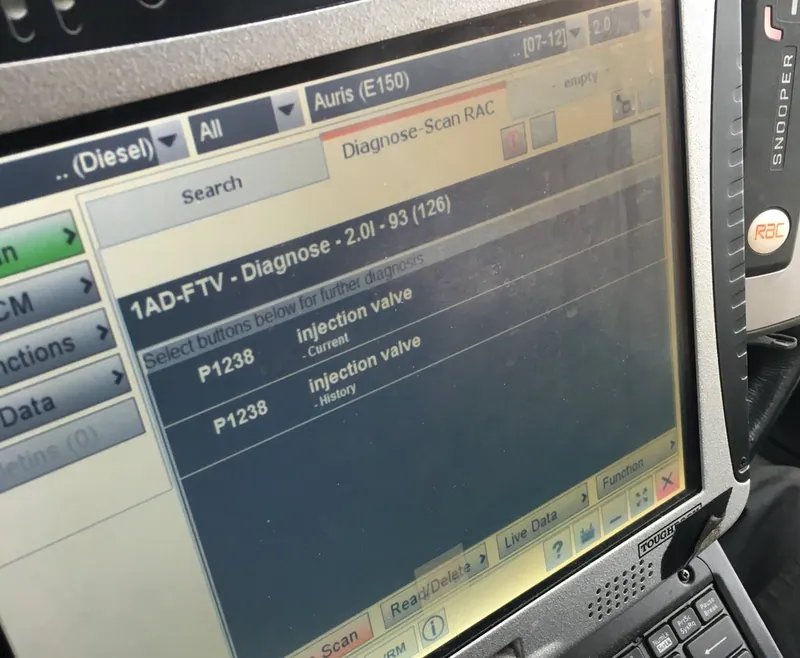
P1238 is a manufacturer-controlled code with entirely different definitions based on your car's brand. For Toyota diesels, it signals an 'Injector Malfunction' where the engine computer detects poor combustion in a specific cylinder. For Ford and Hyundai, it indicates a 'Fuel Pump Secondary Circuit Fault', pointing to an electrical issue with the Fuel Pump Driver Module (FPDM). For Volkswagen and Audi, it specifically means 'Cylinder 2 Injector Circuit Open'.
Technical definition: The SAE/ISO definition for P1238 is reserved for manufacturer-specific use. Common technical definitions include: 1) Injector Malfunction (Toyota): The Engine Control Module (ECM) detects irregular engine speed fluctuations at idle via the crankshaft position sensor, indicating poor combustion. 2) Fuel Pump Secondary Circuit Fault (Ford): The Powertrain Control Module (PCM) receives a signal from the Fuel Pump Driver Module (FPDM) detecting an open, short, or overcurrent in the fuel pump circuit. 3) Injector Circuit Open (VW): The ECM detects an open circuit in the electrical wiring or internal coil of the Cylinder 2 fuel injector.
Can I Drive With P1238?
No — Do Not Drive. Stop driving. Your vehicle can stall unexpectedly in traffic, creating a major safety hazard. If the cause is a faulty diesel injector, continuing to drive causes severe engine damage, including cracked pistons and scored cylinder walls. Short-term driving with a rich fuel condition also destroys the catalytic converter, a $1,000 to $4,000 repair.
Common Causes

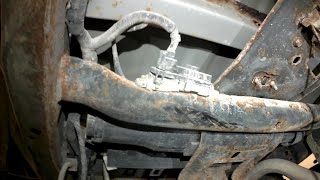
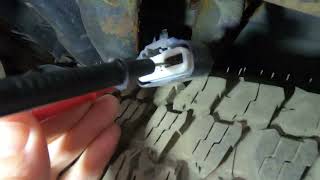
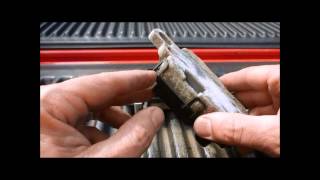
- For Ford: Faulty Fuel Pump Driver Module (FPDM) (Very Common) — This module controls voltage to the fuel pump. Mounted on the vehicle's frame, it frequently fails due to galvanic corrosion or internal electronic failure, disrupting power. 🎬 Watch: How to diagnose and replace a faulty Ford FPDM.
- For Toyota/Diesel: Faulty Fuel Injector (Very Common) — A mechanical failure inside a single diesel fuel injector is the primary cause. The injector sticks open, clogs, or leaks internally, preventing proper fuel delivery.
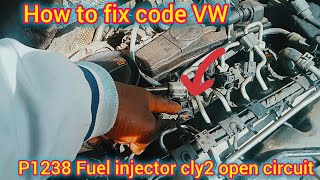
- For VW/Audi: Broken Injector Connector (Common) — This code points to an open circuit on cylinder 2. A loose, corroded, or broken plastic connector at the fuel injector is a highly common and easily fixed failure point. 🎬 See this quick fix for a Cylinder 2 open circuit.
- For Ford: Failed Fuel Pump (Common) — The fuel pump motor wears out or fails, drawing excessive current or stopping completely, which triggers a fault in the FPDM.
- For GM: Faulty Accelerator Pedal Position (APP) Sensor (Common) — On Chevrolet models like the Malibu or Traverse, P1238 indicates a faulty gas pedal assembly, causing a discrepancy between driver demand and throttle response.
- Damaged Wiring or Connectors (Less Common) — Chafed, corroded, or broken wiring in the FPDM harness or injector harness causes an open or short circuit.
- For Toyota/Diesel: Low Engine Compression (Less Common) — Low compression from worn piston rings, valve issues, or a cracked piston prevents proper firing. The ECM reads this as a speed fluctuation and sets P1238.
- Clogged Fuel Filter (Rare) — A severely clogged filter restricts fuel flow, forcing the fuel pump to overwork and triggering a secondary circuit fault on Fords.
- Faulty Powertrain Control Module (PCM/ECM) (Rare) — The engine's computer fails and sends erroneous fault codes. Consider this only after exhausting all other possibilities.
Symptoms

- Check Engine Light is On — The Malfunction Indicator Lamp (MIL) illuminates on your dashboard.
- Engine Won't Start or Hard Start — The engine cranks but fails to start, or takes a long time to start. Common with Ford fuel pump faults or severely failed Toyota injectors.
- Rough Idle or Stalling — The engine shakes, vibrates, or stalls when stopped. This is the primary symptom for the Toyota injector malfunction.
- Loss of Power and Sluggish Acceleration — The vehicle feels sluggish and unable to accelerate properly. On some Ford models, the engine will not go into boost.
- Engine Sputtering at High Speeds — With a failing fuel pump, the engine sputters or jerks at consistent high speeds as the pump struggles to supply fuel.
- Increased Fuel Consumption (also visible on scanner) — A faulty injector causes a significant, noticeable drop in fuel economy.
Diagnostic Flowchart
Tap your situation to follow the diagnostic path that matches what you're seeing on this code.
Common Fixes & Costs
- For Ford: Replace the Fuel Pump Driver Module (FPDM) — Parts: $45-$100, Labor: $60-$150, ~0.6 hr book time (DIY)
- For VW: Repair or Replace Injector Connector — Parts: $15-$50, Labor: $50-$150, ~0.8 hr book time (DIY)
- For Toyota/Diesel: Replace a Single Diesel Fuel Injector — Parts: $300-$800, Labor: $400-$750, ~3.5 hr book time (Professional)
- For Ford: Replace the Fuel Pump — Parts: $150-$500, Labor: $250-$500, ~3.2 hr book time (Intermediate)
- For GM: Replace Accelerator Pedal Position (APP) Sensor — Parts: $50-$150, Labor: $75-$125, ~0.5 hr book time (DIY)
- For VW: Replace a Single Fuel Injector — Parts: $80-$340, Labor: $320-$520, ~2.5 hr book time (Intermediate)
DIY vs Professional
- Ford FPDM Replacement 🟢 Beginner
Tools: Socket set (8mm or 10mm), penetrating oil, wire brush. - GM APP Sensor Replacement 🟢 Beginner
Tools: Socket set (typically 10mm or 13mm). - VW Injector Connector Repair 🟢 Beginner
Tools: Wire strippers, crimpers, heat shrink tubing, new pigtail connector. - VW GDI Injector Replacement 🟢 Beginner
Tools: Injector puller, seal installation/sizing tools, torque wrench. - Toyota Diesel Injector Replacement 🟢 Beginner
Tools: Torque wrench, deep sockets, specialized line wrenches, bidirectional scan tool.
Used vs. New Parts: Buying Guide
When a used part is worth it: For the Ford FPDM, buy new aftermarket parts; redesigns solve the original corrosion flaw. For diesel injectors, favor new or OEM-remanufactured parts to avoid catastrophic engine damage from cheap used units.
Donor-vehicle mileage cap: roughly under 60000 miles for the part to have meaningful remaining life.
Donor quality checklist:
- For injectors, demand recent test results from a calibrated bench machine.
- Match part numbers exactly; subtle revisions affect performance.
- Avoid parts from vehicles scrapped due to engine failure or from high-salt regions.
Decision logic:
- If The part is a Ford FPDM. → Buy a new aftermarket 'OE FIX' part with corrosion-resistant features. The cost is low and it solves the root cause.
- If The part is a diesel fuel injector. → Favor new or OEM-remanufactured injectors. The risk of a cheap used injector causing catastrophic engine damage is too high.
- If The part is a simple electrical component like a connector or pedal sensor. → A used part from a low-mileage, accident-damaged vehicle is a reasonable, low-risk way to save money.
Warranty tradeoff: Used parts typically offer a 30-90 day warranty. New aftermarket parts often come with a 1-year to limited lifetime warranty. New OEM parts carry a 1-2 year warranty.
Worst-case if a used part fails: $2,000 - $10,000. If a used diesel injector fails catastrophically, the cost includes repeating the labor and potentially replacing the entire engine.
What Happens If You Wait — Timeline
- 0-4 weeks: Fault is intermittent. Ford: Brief hesitation when accelerating. Toyota: Slightly rougher idle when cold. (MPG impact: 0-5%% · Added cost: $0-50 in wasted fuel.)
- 1-3 months: Symptoms become consistent. Ford: Truck stalls at idle or bucks severely. Toyota: Constant rough idle and noticeable loss of power. (MPG impact: 5-15%% · Added cost: $50-200 in wasted fuel.)
- 3-6 months: Secondary damage begins. Ford: The fuel pump fails completely. Toyota: The leaking diesel injector washes lubricating oil from the cylinder wall, accelerating wear. (MPG impact: 15-25%% · Added cost: $1,000 - $4,000 (Stranded vehicle tow and/or catalytic converter replacement).)
- 6+ months: Catastrophic failure. Ford: Vehicle is undrivable. Toyota: Leaking injector causes piston cracking or main bearing failure. Engine is destroyed. (MPG impact: N/A (vehicle is likely undrivable)% · Added cost: $5,000 - $15,000+ (Complete engine replacement).)
Cost of Not Fixing It
- Immediate to 1 Month: Vehicle stalls in traffic, creating a safety hazard. Noticeable drop in fuel economy and poor engine performance. (Added cost: $50-$150 in wasted fuel.)
- 1 to 6 Months: A leaking diesel injector washes lubrication off cylinder walls, accelerating wear. A rich condition overheats and destroys the catalytic converter. (Added cost: $1,200 - $4,000 (Catalytic Converter Replacement).)
- 6+ Months: Catastrophic engine damage. A severely leaking diesel injector cracks a piston or dilutes engine oil, causing complete engine seizure. A failing fuel pump leaves you stranded. (Added cost: $5,000 - $15,000+ (Engine replacement).)
Diagnosis Steps
- Identify Your Vehicle's P1238 Definition
Confirm what P1238 means for your specific make and model (e.g., Ford, Toyota, VW, Chevy). This dictates your entire diagnostic path.
Tools: Vehicle Service Manual or Online Search (Beginner) - Check for Other Codes
Scan the vehicle for other DTCs. P0200 with a Toyota P1238 points to an electrical issue, while P1237 with a Ford P1238 points to the same fuel pump circuit fault. Diagnose accompanying codes first.
Tools: OBD-II Scanner (Beginner) - Diagnosis for Ford (Fuel Pump Fault)
Visually inspect the Fuel Pump Driver Module (FPDM) on the rear frame rail for heavy corrosion or physical damage. Check the associated fuse and swap the fuel pump relay with a known good one.
Tools: Flashlight, Basic Hand Tools (Intermediate) - Diagnosis for VW (Injector Circuit Open)
Inspect the electrical connector on the cylinder 2 fuel injector. Wiggle the connector with the engine running to see if the idle changes. Unplug it and check for corrosion or broken locking tabs.
Tools: Flashlight (Intermediate) - Diagnosis for Toyota/Diesel (Injector Fault)
View live data for 'Injection Feedback Value' for each cylinder. A healthy injector reads between -3.0 mm3/st and +3.0 mm3/st. A cylinder stuck at the maximum limit (e.g., +5.0 mm3/st) is the culprit.
Tools: Advanced OBD-II Scanner with Live Data (Intermediate) - [PRO TIP] Perform a Power Balance Test (Toyota/Diesel)
Use an 'Active Test' to disable one fuel injector at a time while monitoring engine RPM. If disabling an injector causes no change in idle speed, you found the malfunctioning cylinder.
Tools: Bidirectional OBD-II Scanner (Advanced) - [PRO TIP] Test the FPDM Circuit (Ford)
Back-probe the FPDM connector. Check for battery voltage on the power supply wire and good ground. Check the Fuel Pump Command (FPC) wire from the PCM for a duty cycle signal (5-40% while running). A steady command signal with erratic output voltage points to a bad FPDM.
Tools: Digital Multimeter with Duty Cycle/Hz (Advanced) - Test the Fuel Injector Resistance (VW)
Disconnect the cylinder 2 fuel injector. Measure the resistance between the two electrical terminals. Compare to the manufacturer's specification (typically 11-18 Ohms). A reading of 'OL' indicates an open coil requiring replacement.
Tools: Digital Multimeter (Intermediate) - [PRO TIP] Test GM APP Sensor Voltages
Monitor live data for APP Sensor 1 and 2. At rest, Sensor 1 reads ~0.8-1.0V and Sensor 2 reads ~0.3-0.5V. Depress the pedal; voltages must increase smoothly, with Sensor 1 double the voltage of Sensor 2. Glitches indicate a faulty sensor.
Tools: Advanced OBD-II Scanner with Live Data (Advanced) - [PRO TIP] Check Ford Fuel Pressure Specs
Connect a fuel pressure gauge. For 2004-2008 F-150s, Key On, Engine Off (KOEO) pressure should be 28-45 PSI. A pressure of 0 PSI or an immediate drop points to a failure in the FPDM, pump, or a major leak.
Tools: Fuel Pressure Gauge (Advanced) - Check Engine Compression (Toyota/Diesel)
If injector tests are inconclusive, perform a compression test on the suspect cylinder. Low compression indicates a mechanical engine problem, not a fuel system issue. Do this before replacing an expensive diesel injector.
Tools: Compression Tester (Advanced)
When This Code Triggers (Freeze-Frame Conditions)
- Engine Coolant Temp: 170-200°F (77-93°C) (The engine is fully warmed up. For Toyota, the monitor runs when ECT is above 68°F (20°C).)
- RPM: 500-800 RPM (For Toyota/diesel variants, the fault is specifically detected at idle speed over a period of 60-90 seconds.)
- Engine Load: Low (typically < 30%) (The fault sets under low-stress conditions like idling or steady-state cruising, where fluctuations are easier to detect.)
- Vehicle Speed: 0 mph (For the Toyota/diesel definition, the vehicle must be stationary for the test to run and trigger the code.)
Related Codes
- P1237 — Identical fault to P1238 on Fords ('Fuel Pump Secondary Circuit Malfunction'). Diagnosis is the same: check the FPDM.
- P0200 — Critical clue on Toyota diesels. P1238 with P0200 indicates an electrical issue. P1238 alone indicates a mechanical injector or compression issue.
- P0093 — Indicates a large fuel system leak on diesels. Seen with P1238, it confirms a mechanically failing injector is leaking excessively.
- P0302 — Cylinder 2 misfire code confirms the issue is with cylinder 2 on VWs.
- P2138 — Confirms the issue is with the pedal assembly or wiring on GM vehicles.
Climate & Environmental Factors
- High Humidity and Road Salt (Salt Belt): The original Ford FPDM features a bare aluminum module bolted to a steel frame. Road salt and moisture cause severe galvanic corrosion, cracking the housing and destroying the circuit board.
- Cold Weather: Cold weather causes diesel fuel gelling, straining the fuel system and exacerbating pre-existing weak injectors during cold starts.
How to Talk to a Mechanic About This Code
Say this: "I have a P1238 code. For my Ford, please inspect the Fuel Pump Driver Module for corrosion first. For my Toyota Diesel, please check injector compensation values. For my VW, please check the cylinder 2 injector connector before quoting an injector."
This directs the technician to the highest probability cause, preventing them from starting with a more expensive and less likely repair (like replacing a fuel pump before the FPDM).
Avoid saying:
- 'My car is bucking and stalling, just fix it.'
- 'My check engine light is on, can you look at it?'
- 'I think I need a new fuel pump/injector.'
Questions to ask before authorizing the repair:
- For a Ford: Did you visually confirm corrosion or test the FPDM's output signal?
- For a Toyota: What were the specific injection feedback values for each cylinder?
- For a VW: Did you test the injector's resistance and inspect the connector pins for damage?
- Will you be coding the new injector to the ECU? (For Toyota diesel)
- What is the warranty on the parts and labor for this repair?
Where to Take It: Dealer vs Independent vs Chain
- Dealer:
Recommended for Toyota diesel injector replacement due to the need for OEM-specific tooling and ECU coding. For other makes, an independent shop is a better value.
Best for: Vehicles under warranty, Complex diesel injector replacement (Toyota) requiring ECU coding, Diagnosing rare electrical faults
Downsides: Highest labor rates, often 25-50% more than independent shops., May replace an entire assembly when a smaller component is the cause. (Typical cost: +50% vs. baseline) - Independent Shop:
Best choice for most P1238 repairs on Ford, VW, and GM vehicles.
Best for: Out-of-warranty vehicles, Common fixes like the Ford FPDM replacement., VW injector connector repair and GM APP sensor replacement
Downsides: Quality varies widely; vet shops by reviews and certifications., May lack expensive, brand-specific diagnostic tools for complex issues. (Typical cost: +0% vs. baseline) - Chain Shop:
AVOID for P1238 diagnosis. They are highly likely to misdiagnose the issue or upsell unnecessary related repairs.
Best for: Simple, routine maintenance like oil changes and tires.
Downsides: High pressure to upsell unnecessary services., Technician skill is inconsistent; lacks diagnostic depth for manufacturer-specific codes. (Typical cost: -10% vs. baseline)
When to Walk Away From the Repair
If the estimated repair cost exceeds 50% of the car's private-party value, seriously consider selling or trading it in.
- Car worth $15000, fix is $800: Fix it. This is a relatively minor cost compared to the vehicle's value.
- Car worth $5000, fix is $2500: Borderline. This is exactly 50% of the car's value. Get a second opinion and evaluate the car's overall health before proceeding.
- Car worth $4000, fix is $3500: Walk away. The repair cost is nearly the entire value of the car. It is not economically sensible to repair.
What Scan Tool You Need for This Code
Minimum: A scanner that reads manufacturer-specific codes and displays live data streams.
A $20 generic code reader only shows a generic 'P' code and won't give you the live data needed for diagnosis (e.g., injector compensation values, FPDM duty cycle, or APP sensor voltages).
Budget: BlueDriver Pro (~$100) — Reads manufacturer-specific codes and graphs live sensor data on your phone. Sufficient to diagnose the Ford FPDM and GM APP sensor.
Mid-range: Foxwell NT510 Elite / NT710 (~$180) — Offers full-system diagnostics and bidirectional controls. Critical for the Toyota P1238, as it allows you to perform a 'power balance test' by disabling individual injectors.
Professional: Autel MaxiCOM MK808S / XTOOL D7 (~$450-700) — Provides full bidirectional control and OEM-level functions including injector coding for Toyota diesel repairs.
Rent vs buy: Auto parts stores offer free loaner tool programs for OBD-II scanners. This is perfect for a one-time diagnosis, but these scanners typically lack the advanced live data needed for a conclusive P1238 diagnosis.
How to Clear the Code After You Fix It
- Use an OBD-II scan tool to clear the P1238 code.
- Perform a complete drive cycle to allow the vehicle's readiness monitors to run.
- Re-scan the vehicle to confirm the code has not returned and monitors are set.
Drive cycle (~20 minutes): A general drive cycle includes a cold start, 2-3 minutes of idling, 10-15 minutes of mixed city/highway driving, and a cool-down period. For the Toyota injector fault, idling for 10 minutes after warm-up is a key part of the reset procedure.
Readiness monitors affected: Fuel System Monitor, Comprehensive Component Monitor, Catalyst Monitor, Oxygen Sensor Monitor
Before emissions retest: drive at least 50 miles to fully set monitors.
Watch out for:
- Clearing the code resets all readiness monitors to 'Not Ready', causing an automatic emissions test failure.
- Not meeting specific conditions for a drive cycle (e.g., fuel level must be between 1/4 and 3/4 tank) prevents monitors from setting.
- The code returns immediately if the underlying mechanical or electrical fault is not repaired.
Will This Fail Emissions / State Inspection?
Yes — this code typically fails an OBD-II emissions inspection.
- California: An illuminated Check Engine Light from code P1238 is an automatic failure. After repair, all readiness monitors must be 'Ready' before a re-test.
- New York: The NYS DMV vehicle inspection includes an OBD-II scan. P1238 results in an immediate inspection failure.
- Texas: In counties requiring an emissions test, P1238 causes an automatic failure. You cannot renew your registration until the issue is fixed.
Most Commonly Affected Vehicles
- Ford F-150 (2004-2008) — Extremely prone to Fuel Pump Driver Module (FPDM) failure due to galvanic corrosion. A TSB was issued for this issue.
- Toyota Hilux / Land Cruiser (Diesel) (2005-2015) — Commonly experiences P1238 due to mechanical failure of the 1KD/2KD engine's diesel injectors.
- Volkswagen Jetta / Passat (2005-2015) — Often triggers P1238 for a 'Cylinder 2 Injector Circuit Open' fault, frequently caused by a broken plastic connector clip.
- Chevrolet Traverse / Malibu (2009-2017) — On these models, P1238 points to a faulty Accelerator Pedal Position (APP) sensor rather than a fuel system issue.
- Ford Explorer / Expedition (2004-2010) — Shares the same FPDM design as the F-150 and is susceptible to the same fuel pump circuit faults.
- Toyota Prado (Diesel) (2009-2015) — Uses the 1KD-FTV engine, known for injector issues that trigger the P1238 code.
- Hyundai Various (2010-2020) — Defines P1238 as a 'Fuel pump driver module has detected a fault in the fuel pump secondary circuit'.
- Ford GT (2005-2006) — Indicates a secondary fuel pump circuit failure, often caused by a faulty relay or the FPDM.
Manufacturer-Specific Notes

- Ford: Defines P1238 as 'Fuel Pump Secondary Circuit Fault'. TSB 07-22-5 addresses FPDM corrosion on 2004-2006 F-150s.
- Toyota: Defines P1238 as 'Injector Malfunction'. The ECM uses the crankshaft position sensor to detect speed fluctuations.
- Volkswagen / Audi: Specifically points to 'Cylinder 2 Injector Circuit Open'.
- General Motors (GM): Indicates a fault with the Accelerator Pedal Position (APP) sensor. Special Coverage Adjustment N182188250 extends coverage for some 2016-2018 models.
- Hyundai: Shares the Ford definition: 'Fuel pump driver module has detected a fault in the fuel pump secondary circuit'.
Real Owner Stories
2005 Ford F-150 with 184k miles in Maine
Truck would suddenly start bucking severely, with a rhythmic power-dead-power cycle. It ran fine on a cold start but the problem reappeared as it warmed up.
Outcome: Replaced the Fuel Pump Driver Module (FPDM), which was heavily corroded. The new module cost $98.49 and immediately solved the problem.
Lesson: On a 2004-2008 Ford F-150, P1238 symptoms almost always point to the FPDM. Inspect the FPDM above the spare tire for corrosion before buying a fuel pump.
2006 Toyota Avensis D4D (Diesel)
Engine misfired and ran rough. Scan tool showed P1238 (Injector Malfunction) and P0200 (Injector Circuit / Open).
Outcome: The presence of P0200 alongside P1238 points specifically to an electrical fault in the injector circuit, the Engine Driver Unit (EDU), or the ECM, rather than a purely mechanical injector failure.
Lesson: On Toyota diesels, accompanying codes are critical. P1238 alone suggests a mechanical injector problem. P1238 with P0200 means you must diagnose the electrical circuit first.
2007 VW Jetta with P1238
Check Engine Light came on with code P1238 ('Cylinder 2 Injector Circuit Open'). The engine had a slightly rough idle.
Outcome: The plastic locking tab on the injector #2 electrical connector had broken, causing a loose connection. The owner replaced the connector with a $20 pigtail kit, resolving the code.
Lesson: For VW P1238, always inspect the simplest part of the circuit first: the connector. A broken plastic clip is a very common failure and a much cheaper fix than replacing an injector.
2008 Ford F-350 5.4L No-Start Condition
Truck would not start without priming the intake. Codes P0191 and P1238 were present.
Outcome: With the FPDM bypassed, the truck fired up and ran normally, confirming the FPDM had failed. The owner replaced the FPDM, resolving all symptoms.
Lesson: If stranded with a no-start condition on a Ford, a temporary FPDM bypass confirms the diagnosis and can get you home without a tow.
How to Prevent This Code From Triggering
- For Ford owners in the Salt Belt: Proactively replace the FPDM. (Once, upon acquiring a 2004-2008 F-150/Expedition.) — Replacing the original aluminum module with an updated Dorman OE FIX part creates an air gap, preventing the galvanic corrosion that causes 99% of these failures.
- Replace the fuel filter at recommended intervals. (Every 20,000-40,000 miles (gas), or 15,000-20,000 miles (diesel).) — A clogged filter forces the fuel pump to work harder, triggering a P1238 fault in the FPDM on Ford models. For diesel, it prevents debris from damaging sensitive injectors.
- For diesel engines: Use high-quality fuel and a cetane/lubricity additive. (Every fill-up.) — Modern ultra-low sulfur diesel has less lubricity. Additives prevent deposit buildup and contamination that lead to mechanical injector failures.
- Apply dielectric grease to injector connectors during service. (When connectors are unplugged for any reason.) — On VWs, a small amount of dielectric grease seals out moisture and prevents corrosion on the pins, ensuring a reliable connection.
Frequently Asked Questions
Why do I see different meanings for P1238 online?
P1238 is a manufacturer-specific code. Ford uses it for fuel pump circuits, Toyota for fuel injectors, and VW for injector electrical circuits. Always diagnose based on your specific vehicle make.
What is the most common misdiagnosis for P1238?
For Fords, replacing the fuel pump when the cheaper Fuel Pump Driver Module (FPDM) is the actual cause. For VWs, replacing the entire fuel injector when only the plastic electrical connector is broken. Always inspect the easiest failure points first.
Is P1238 an injector or fuel pump problem?
It depends on your vehicle. On Fords or Hyundais, it is a fuel pump or module issue. On Toyota diesels, it is a fuel injector problem, and on VWs, it is an electrical issue with the #2 injector.
Can I fix P1238 myself?
Replacing a Ford FPDM or a GM accelerator pedal sensor takes under an hour with basic tools. However, replacing fuel injectors on modern direct-injection or diesel engines is complex. Leave injector replacements to professionals.
How much will it cost to fix P1238?
A DIY Ford FPDM replacement costs under $100. A VW injector replacement costs $440 to $813 at a shop. A single Toyota diesel injector replacement costs $700 to $1,500 professionally.
Can a bad fuel filter cause P1238?
A severely clogged fuel filter contributes to this code. On Fords, it overworks the fuel pump, leading to a circuit fault. On Toyotas, it starves injectors, causing poor combustion that triggers an injector malfunction code.
What happens if I ignore code P1238?
Ignoring the code causes unexpected stalling, creating a major safety hazard. A failing diesel injector causes severe engine damage by washing out cylinder walls or cracking a piston. A failing fuel pump eventually leaves you stranded.
My Ford has a P1238 code, should I replace the FPDM or the fuel pump?
Always start with the Fuel Pump Driver Module (FPDM). It is cheaper, easier to access, and fails much more frequently than the pump itself due to corrosion.
Key Takeaways
- P1238 is a manufacturer-specific code: it means a fuel pump circuit fault on Fords, a mechanical injector failure on Toyota diesels, and an open cylinder 2 injector circuit on VWs.
- For 2004-2008 Ford F-150s, a corroded Fuel Pump Driver Module (FPDM) causes over 90% of P1238 codes and costs under $100 to fix yourself.
- Do not replace a VW fuel injector for this code without first checking the $20 plastic electrical connector on cylinder 2, which frequently breaks and causes an open circuit.
- Driving with a P1238 code risks sudden engine stalling in traffic or catastrophic engine damage from a leaking diesel injector washing out the cylinder walls.
Helpful Videos
Shop the Parts Behind P1238
Below are the parts most often responsible for code P1238, ranked by how frequently each one is the actual culprit (per the diagnosis above). Tap any to see what we have for your vehicle.



The information in this article is provided for general reference and educational purposes only. Vehicle specifications, procedures, and part compatibility can vary by production date, trim level, and region. Always consult your vehicle's factory service manual and verify part numbers before purchasing or performing repairs. Safety-critical components such as airbags, seat belts, and braking systems should be installed by a qualified professional.
- 🧭 Diagnostic Flowchart
- 🎬 Helpful Videos
- 🛍️ Shop This Part
- What Does P1238 Mean?
- Can I Drive With P1238?
- Common Causes
- Symptoms
- Common Fixes & Costs
- DIY vs Professional
- Used vs. New Parts: Buying Guide
- What Happens If You Wait — Timeline
- Cost of Not Fixing It
- Diagnosis Steps
- When This Code Triggers (Freeze-Frame Conditions)
- Related Codes
- Climate & Environmental Factors
- How to Talk to a Mechanic About This Code
- Where to Take It: Dealer vs Independent vs Chain
- When to Walk Away From the Repair
- What Scan Tool You Need for This Code
- How to Clear the Code After You Fix It
- Will This Fail Emissions / State Inspection?
- Most Commonly Affected Vehicles
- Manufacturer-Specific Notes
- Real Owner Stories
- 2005 Ford F-150 with 184k miles in Maine
- 2006 Toyota Avensis D4D (Diesel)
- 2007 VW Jetta with P1238
- 2008 Ford F-350 5.4L No-Start Condition
- How to Prevent This Code From Triggering
- Frequently Asked Questions
- Why do I see different meanings for P1238 online?
- What is the most common misdiagnosis for P1238?
- Is P1238 an injector or fuel pump problem?
- Can I fix P1238 myself?
- How much will it cost to fix P1238?
- Can a bad fuel filter cause P1238?
- What happens if I ignore code P1238?
- My Ford has a P1238 code, should I replace the FPDM or the fuel pump?
- Key Takeaways
- 🎟️ Get 5% Off