

OBD-II Code P1272: A Deep Dive Into Fuel Pressure and Injector Faults
The Ultimate Guide to Diagnosing and Fixing P1272: What it means, why it triggers, and how to fix it for good.
- P1272 dictates two completely different failures depending on your brand: 'Fuel Pressure Too High' on Nissan/Toyota diesels, or 'Injector #2 Circuit Open' on Ford 7.3L diesels.
- Replace the Suction Control Valve (SCV) to fix 80% of Nissan/Toyota P1272 codes, or replace the Under Valve Cover Harness (UVCH) to resolve the Ford 7.3L variant.
- Stop driving immediately; the vehicle's 2,000 RPM 'limp mode' restriction creates severe collision risks in highway traffic and accelerates high-pressure pump damage.
- Perform a $0 scan tool live data check or a Ford injector 'buzz test' before spending $2,000+ on a new high-pressure fuel pump or fuel injectors.
What Does P1272 Mean?

The code P1272 is a manufacturer-specific code with two primary, and very different, meanings. For many common rail diesel vehicles (Nissan, Mitsubishi, Toyota), the engine's computer (ECU) detected dangerously high fuel pressure and opened a safety relief valve, triggering a low-power 'safe mode'. Conversely, on Ford and some GM vehicles, this code indicates an electrical 'open circuit' within the fuel injector circuit for cylinder #2. For some gasoline-powered Nissan models, it points to a slow-responding air-fuel ratio sensor in Bank 2.
Technical definition: In Nissan, Infiniti, and Mitsubishi diesels, P1272 means 'Pressure Limiter Malfunction' or 'Fuel Rail Pressure Relief Valve Open', indicating the ECU opened the relief valve due to excessive fuel rail pressure. For Ford 7.3L Power Stroke engines, it means 'Cylinder #2 High To Low Side Open', indicating an electrical circuit failure at the #2 fuel injector. For Toyota D-4D engines, it means 'Fuel Pressure Regulator Circuit Malfunction', pointing to a failed pressure discharge valve or circuit.
Can I Drive With P1272?
No — Do Not Drive. Do not drive the vehicle. The engine enters a low-power 'limp mode' or stalls completely, creating a severe collision risk in traffic. Continuing to drive with severe fuel pressure issues destroys the high-pressure pump and injectors.
Common Causes

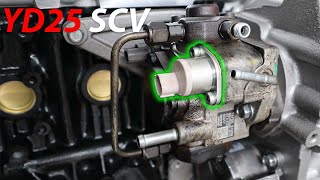
- Faulty Suction Control Valve (SCV) 🎬 Watch: How to install a new SCV on Nissan diesel engines. (Very Common) — This valve on the high-pressure fuel pump is the primary cause for the fuel pressure variant of P1272. It sticks, wears out, or becomes contaminated, failing to regulate fuel volume and causing pressure spikes that force the relief valve open.
- Failed Under Valve Cover Harness (UVCH) (Very Common) — On Ford 7.3L Power Stroke engines, this is the leading cause. The wiring harness and connector pins under the valve cover become brittle from heat and oil, creating an open circuit for the #2 injector.
- Clogged Fuel Filter (Common) — A restrictive fuel filter forces the fuel pump to overwork, causing erratic pressure and flow. This creates pressure spikes that the ECU interprets as a fault, triggering P1272.
- Faulty Fuel Rail Pressure Sensor (Common) — This sensor monitors pressure in the fuel rail. If it sends falsely high-pressure signals, the computer activates the relief valve and logs the code, even if actual pressure is normal.
- Faulty Fuel Injector (Electrical or Mechanical) (Common) — For the Ford-specific definition, a failed injector coil causes the 'High to Low Side Open' code. On diesel models, a mechanically failing injector contributes to severe pressure irregularities.
- Contaminated Fuel System (Common) — Poor quality diesel fuel with excessive water or debris damages precision components like the SCV and injectors, leading to pressure regulation failures.
- Damaged Wiring or Connectors (Less Common) — Frayed wires or corroded connectors on the suction control valve, fuel rail pressure sensor, or injector circuits cause incorrect signals, shorts, or open circuits.
- Faulty Pressure Relief Valve (Less Common) — The pressure relief valve itself fails mechanically or sticks open, contributing to the overpressure event that logs the code.
- Air in the Fuel Lines (Less Common) — Running out of fuel or a supply line leak traps air in the system. This air causes pressure fluctuations and triggers the P1272 code once the vehicle is running.
- Failing High-Pressure Fuel Pump (Rare) — The high-pressure fuel pump fails internally, causing uncontrollable pressure spikes. This is an expensive and less common root cause.
- Faulty Injector Driver Module (IDM) or Engine Control Module (ECM) (Very Rare) — The module controlling the injectors (IDM on Fords) or the main computer (ECM) fails, issuing incorrect commands. Check this only after ruling out all other hardware.
Symptoms

- Engine Enters 'Limp Mode' — The vehicle suffers a severe loss of engine power and refuses to accelerate or rev past 2,000-2,500 RPM.
- Check Engine Light On — The malfunction indicator lamp (MIL) illuminates immediately on the dashboard.
- Engine Stalling or Hard Starting — The engine stalls while driving, especially under load, and struggles to restart.
- Rough or Unstable Idle — The engine runs rough, surges, hunts for a steady RPM, or has a noticeable 'miss' when idling.
- Engine Knocking or Excessive Noise — Extreme fuel pressure causes a loud knocking sound from the engine, indicating severe combustion issues.
Diagnostic Flowchart
Tap your situation to follow the diagnostic path that matches what you're seeing on this code.
Common Fixes & Costs
- Replace Suction Control Valve (SCV) — Parts: $50-$200, Labor: $100-$250, ~1.5 hr book time (DIY)
- Replace Under Valve Cover Harness (UVCH) and Gasket — Parts: $50-$150 per side, Labor: $200-$400, ~2.5 hr book time (Intermediate)
- Replace Fuel Filter — Parts: $20-$80, Labor: $50-$100, ~0.5 hr book time (DIY)
- Replace Fuel Rail Pressure Sensor — Parts: $50-$350, Labor: $100-$250, ~1 hr book time (Intermediate)
- Replace Fuel Injector — Parts: $250-$600 per injector, Labor: $200-$500, ~3 hr book time (Professional)
Used vs. New Parts: Buying Guide
When a used part is worth it: For electronic components like a Suction Control Valve (SCV) or Under Valve Cover Harness (UVCH), buying used is not recommended due to wear and heat degradation. A used part fails shortly after installation. It only makes sense if the budget is extremely tight and the part is from a verified low-mileage wrecked vehicle.
Donor-vehicle mileage cap: roughly under 50000 miles for the part to have meaningful remaining life.
Donor quality checklist:
- Verify the donor vehicle was not scrapped for a related engine or fuel system failure.
- For harnesses (UVCH), inspect for any signs of brittleness, cracking, or oil contamination at the connectors.
- Match the part number exactly. Aftermarket brands like Denso or Bosch are reliable alternatives to new OEM.
Decision logic:
- If The part is an electronic wear item like an SCV or UVCH → Buy new OEM or a reputable aftermarket brand. The risk of premature failure and repeat labor costs outweighs the savings of a used part.
- If Vehicle is high mileage (>150k miles) and the repair is for a non-critical system → A used part might be considered, but not for primary fuel system components related to P1272.
- If The part is a simple mechanical component with no electronics → Used is acceptable, but this rarely applies to the common fixes for P1272.
Warranty tradeoff: Used parts offer a 30-90 day warranty at best, which does not cover labor. New aftermarket parts typically offer a 1-year to limited lifetime warranty. New OEM parts carry a 1-2 year warranty.
Worst-case if a used part fails: $300-$600 if a used SCV or UVCH fails after installation, primarily due to repeated labor charges.
What Happens If You Wait — Timeline
- 0-1 week: Code sets and engine enters limp mode during heavy acceleration. Restarting the engine temporarily clears the limp mode, but the underlying fault code remains stored. (MPG impact: 10-25% (while in limp mode)% · Added cost: $100-$300 (potential towing cost if stalling occurs))
- 1 week - 2 months: Limp mode events become frequent under moderate acceleration. Constant pressure spikes fatigue the metal in the fuel rail and injector lines. For injector faults, the poor connection at the UVCH arcs, damaging pins. (MPG impact: 5-10% (average, due to intermittent faults)% · Added cost: $50-$150 in wasted fuel and minor electrical damage.)
- 2-6 months: Continued pressure spikes cause mechanical wear inside the high-pressure pump (SCV failure) or permanently destroy the pressure relief valve. A bad UVCH connection overheats and damages the Injector Driver Module (IDM). (MPG impact: 15-30%% · Added cost: $800-$3,000 (cost to replace a high-pressure pump or IDM))
- 6+ months: Catastrophic failure. The high-pressure fuel pump disintegrates, sending metal debris throughout the entire fuel system. This requires replacing the pump, rail, all lines, and all injectors. (MPG impact: N/A (vehicle is undrivable)% · Added cost: $4,000-$8,000+ (for a full fuel system replacement))
Cost of Not Fixing It
- Immediate: Vehicle is unsafe to drive due to sudden power loss ('limp mode') or stalling, creating a high risk of accidents in traffic. Fuel economy drops by 10-25%. (Added cost: Towing costs ($100-$300))
- 1-3 months: Continued high-pressure spikes cause premature wear on the fuel rail, injector lines, and the high-pressure pump itself. For injector faults, it damages the Injector Driver Module (IDM). (Added cost: $800-$3,000 (High-pressure pump or IDM replacement))
- 6+ months: Catastrophic failure of the high-pressure fuel pump, sending metal debris throughout the entire fuel system. This requires replacement of the pump, fuel rail, all injectors, and lines. An ignored open injector circuit destroys the IDM and potentially damages the PCM. (Added cost: $4,000-$8,000+)
Diagnosis Steps

- Verify Code Definition and Check for Other Codes
Confirm the specific definition of P1272 for your vehicle's make and engine (fuel pressure vs. injector circuit). Use an OBD-II scanner to check for codes like P0089, P0193, or P1271-P1278. Record all codes and freeze frame data before clearing.
Tools: OBD-II Scanner (Beginner) - [Pro Tip] Analyze Live Fuel Pressure Data (Nissan/Toyota)
Using an advanced scan tool, monitor 'Desired Fuel Rail Pressure' vs. 'Actual Fuel Rail Pressure'. At idle, they should be nearly identical (typically 4,000-6,000 PSI or 27-41 MPa). During acceleration, 'Actual' must track 'Desired' closely. If 'Actual' pressure is erratic, spikes uncontrollably, or forms a 'shark fin' pattern on the graph, the Suction Control Valve (SCV) or high-pressure pump is failing.
Tools: Advanced scan tool with live data graphing (Intermediate) - [Pro Tip] Perform an Injector Buzz Test (Ford 7.3L) 🎬 See how to check wiring integrity for Ford 7.3L injector codes.
Using a capable scan tool (like FORScan), perform an injector 'buzz test'. This sends an electrical signal to each injector. All injectors must produce a sharp, audible 'buzz'. If cylinder #2 is silent or sounds noticeably different, it confirms an electrical fault in that circuit, pointing to the UVCH or the injector itself.
Tools: Ford-specific scan tool (e.g., FORScan) (Intermediate) - Inspect Fuel System and Injector Wiring
Visually inspect the wiring harnesses and connectors for the fuel rail pressure sensor, suction control valve, and (on Fords) the main injector harness connectors at the valve covers. Look for oil contamination, corrosion, or physical damage.
Tools: Flashlight (Beginner) - Replace the Fuel Filter
A clogged fuel filter is a common, inexpensive, and overlooked cause. If its service history is unknown, replacing it is a mandatory diagnostic step to rule out fuel restriction.
Tools: Filter wrench, catch pan, basic hand tools (DIY) - Test the Suction Control Valve (SCV)
Remove the SCV and check the resistance across its two terminals with a multimeter; it should typically be between 1.5 and 3.0 ohms. Apply a 12V source to its terminals to see if the internal piston actuates with an audible click. A lack of movement indicates a failed valve.
Tools: Multimeter, 12V power source, basic hand tools (Intermediate) - Test the Fuel Rail Pressure Sensor (FRP)
With the key on, engine off, back-probe the sensor's signal wire. The voltage should be around 0.5V. At idle, it rises to about 1.3-1.8V on a Toyota D-4D. If the voltage is stuck high (e.g., 4.8V) or doesn't change with engine RPM, the sensor failed. This rules out a true overpressure condition.
Tools: Multimeter, back-probe kit (Intermediate) - Inspect Under Valve Cover Harness (UVCH) - Ford 7.3L
If the buzz test fails for cylinder #2, remove the valve cover. Unplug the main connector and the injector connector. Inspect for burnt pins, loose connections, or brittle wiring. Ohm out the harness from the IDM connector to the injector to confirm continuity.
Tools: Basic hand tools, multimeter (Professional) - [Advanced] Test Injector Circuit Resistance (Ford 7.3L)
Disconnect the IDM and the valve cover connector. Using a multimeter, measure the resistance of the injector coil itself. At the valve cover connector, measure between the high and low side pins for cylinder #2. The resistance must be less than 5.0 ohms (typically 3.0-4.0 ohms). A reading higher than 5.0 ohms or an open circuit (OL) indicates a failed injector coil or a break in the UVCH.
Tools: Multimeter, breakout harness (optional) (Advanced)
When This Code Triggers (Freeze-Frame Conditions)
- Engine Coolant Temp: 170-200°F (77-93°C) (Fully warmed up)
- RPM: 1800-2800 (Under moderate to heavy acceleration or climbing a grade.)
- Engine Load: 40-80% (High demand on the fuel system, causing a pressure spike or revealing an injector fault.)
- Vehicle Speed: 30-60 mph (Often occurs during highway driving or when accelerating to merge.)
Related Codes
- P0089 — This code for 'Fuel Pressure Regulator Performance' often appears with P1272. While P1272 indicates the relief valve opened from a pressure spike, P0089 points to a performance problem with the regulator itself (like the SCV). Seeing both strongly suggests the SCV is the root cause.
- P1271, P1273-P1278 (Ford) — On a Ford 7.3L, these codes are identical to P1272 but for different cylinders (P1271 is cylinder 1, P1273 is cylinder 3, etc.). If multiple codes from this series appear, it points towards a failing IDM or a problem with the main wiring harness rather than a single injector.
- P0193 — This code indicates 'Fuel Rail Pressure Sensor Circuit High Input'. P0193 means the sensor is sending a high voltage signal, which is due to a faulty sensor or a short in the wiring. P1272 means the ECU believes the pressure is high based on that signal. Testing the sensor's voltage directly differentiates these.
- P0266 (Ford) — This code means 'Cylinder 2 Contribution/Balance Fault'. It often appears with P1272 on a 7.3L Power Stroke. While P1272 is an electrical fault code from the buzz test, P0266 is a performance code from the cylinder contribution test, indicating the cylinder is not producing power correctly. Seeing both confirms a significant problem with cylinder #2.
Climate & Environmental Factors
- Cold Weather: Extremely cold temperatures (below 15°F or -9°C) cause paraffin wax in #2 diesel fuel to crystallize and 'gel'. This gelled fuel clogs the fuel filter and lines, starving the engine of fuel. While this doesn't directly cause a P1272 fault, it leads to erratic fuel pressure and limp mode symptoms confused with an SCV or pump failure. Using an anti-gel additive or winter-blend diesel is crucial in cold climates.
- Humidity and Water Contamination: High humidity leads to more water condensation inside the fuel tank. Water in the fuel causes corrosion and damage to precision components like the SCV and injectors. This damage leads to the pressure regulation failures that trigger P1272. Regularly draining the water separator is critical in humid environments.
- High Altitude: Lower air pressure at high altitudes affects the fuel-air mixture and places different demands on the turbo and fuel system. While not a direct cause, it exacerbates pre-existing weaknesses in the fuel pressure regulation system, potentially making a borderline component, like a weak SCV, finally fail and trigger the code.
How to Talk to a Mechanic About This Code
Say this: "I have a P1272 code on my [Nissan Navara/Ford F-350]. For the Nissan, I'd like you to start by diagnosing the Suction Control Valve and checking live fuel pressure data before quoting a pump or rail. For the Ford, please perform an injector buzz test and inspect the Under Valve Cover Harness for cylinder #2 before quoting a new injector."
This signals you researched the most common, vehicle-specific failures for this code. It directs the technician to the highest probability cause first, preventing them from immediately quoting the most expensive possible repair (like a high-pressure pump or a fuel injector) and protects you from common misdiagnoses.
Avoid saying:
- 'My truck is in limp mode, can you fix it?'
- 'Just fix whatever's wrong with the check engine light'
- 'I think I need a new fuel pump'
Questions to ask before authorizing the repair:
- For a Nissan/Toyota: What did the live data for desired vs. actual fuel pressure look like under load? Was the Suction Control Valve tested?
- For a Ford 7.3L: Did cylinder #2 fail the buzz test? Did you visually inspect the UVCH connector pins for damage?
- Can you provide me with the old parts you replace?
- What is the warranty on the parts and labor for this specific repair?
Where to Take It: Dealer vs Independent vs Chain
- Dealer:
Acceptable, but the most expensive option. Choose a dealer only if a known TSB requires a proprietary software update.
Best for: Vehicles still under powertrain warranty, Repairs that require manufacturer-specific ECM reprogramming (check for TSBs)
Downsides: Labor rates are 25-50% higher than independent shops., More likely to replace an entire assembly (e.g., fuel rail) instead of a smaller component (e.g., sensor or valve). (Typical cost: +40% vs. baseline) - Independent Shop:
Best fit. A reputable independent diesel specialist provides the most cost-effective and accurate diagnosis for P1272.
Best for: Out-of-warranty diesel trucks., Shops that specialize in diesel repair are highly familiar with these common P1272 failures.
Downsides: Quality varies greatly; look for ASE-certified technicians and positive reviews related to diesel diagnostics. (Typical cost: +0% vs. baseline) - Chain Shop:
AVOID. Chain shops lack specialized diesel diagnostic tools and frequently misdiagnose this code, wasting your time and money.
Best for: Simple, unrelated maintenance like oil changes or tire rotations.
Downsides: Technicians lack the specialized diesel diagnostic tools and experience for this code., High pressure to upsell unnecessary services like fuel system flushes that won't fix the root cause. (Typical cost: -10% vs. baseline)
When to Walk Away From the Repair
If the estimated repair cost exceeds 50% of the vehicle's private-party value, sell it as-is or trade it in.
- Car worth $7000, fix is $650: Fix it. A common repair like an SCV or UVCH is well below the threshold.
- Car worth $8500, fix is $5500: Walk away. A worst-case scenario (full fuel system replacement) costs more than half the truck's value.
- Car worth $3500, fix is $1800: Borderline. The repair is over 50% of the vehicle's value. Unless the truck is in otherwise excellent condition, it's time to consider moving on.
What Scan Tool You Need for This Code
Minimum: A tool that reads manufacturer-specific codes and displays live data streams for fuel pressure. A basic code reader is insufficient.
A generic $20 reader provides the code 'P1272' but cannot differentiate between a Ford injector fault and a Nissan pressure fault. It also cannot perform the necessary live data analysis or buzz tests required for an accurate diagnosis.
Budget: FORScan with OBDLink EX Adapter (for Ford) / BlueDriver Pro (~$70) — FORScan is free software for Windows that, with a compatible adapter, performs the critical injector buzz test and cylinder contribution test on Ford Power Stroke engines. The BlueDriver graphs live fuel pressure data on Nissan/Toyota models.
Mid-range: Foxwell NT809 / ANCEL FD500 (for Ford) (~$350) — Provides full-system diagnostics, graphs live data with more detail, and includes service functions. The ANCEL FD500 is specifically designed for Ford and handles deep diagnostics including DPF regeneration.
Professional: Autel MaxiCOM MK808S / XTOOL D7 (~$500-800) — Offers full bidirectional control to test components actively, performs injector coding, and provides access to all vehicle modules with dealer-level depth. These are for the serious DIYer or small shop.
Rent vs buy: For a one-time diagnosis, many auto parts stores (like AutoZone) offer a loaner tool program for free with a deposit. However, these are often basic readers. For P1272, buying a capable tool like FORScan's adapter or a BlueDriver is a worthwhile investment for any diesel owner.
How to Clear the Code After You Fix It
- Reconnect battery if it was disconnected for the repair.
- Use an OBD-II scan tool to clear the P1272 fault code.
- Perform a complete drive cycle to allow readiness monitors to run.
Drive cycle (~30 minutes): Start with a cold engine (coolant temp below 122°F/50°C). Idle for 2-3 minutes. Drive for 15-20 minutes with a mix of city (stop-and-go) and highway speeds (steady cruise at 55-60 mph for at least 5 minutes). Perform several gradual decelerations without using the brake. Allow the vehicle to cool down completely.
Readiness monitors affected: Comprehensive Component Monitor, Fuel System Monitor, Misfire Monitor
Before emissions retest: drive at least 50 miles to fully set monitors.
Watch out for:
- Simply clearing the code without performing a drive cycle results in a 'Not Ready' status for emissions testing.
- The code returns immediately if the root cause of the high pressure or open circuit has not been properly fixed.
- Some vehicles have very specific drive cycle requirements that differ from the generic procedure.
Will This Fail Emissions / State Inspection?
Yes — this code typically fails an OBD-II emissions inspection.
- California: An illuminated Check Engine Light results in an automatic smog test failure. After repairs, all required readiness monitors must be set to 'Ready', which requires driving 50-100 miles before a retest.
- New York: A vehicle with an active Check Engine Light automatically fails the emissions portion of the state inspection. After clearing the code, the vehicle must be driven through a full drive cycle before it can be re-inspected. New York allows for one readiness monitor to be 'Not Ready' for model year 2001 and newer vehicles.
- Texas: In counties requiring emissions testing, an active P1272 code causes an automatic failure. After repairs, the readiness monitors must be completed before the vehicle passes inspection.
Most Commonly Affected Vehicles
- Nissan Navara (D40) (2005-2015) — Extremely common issue on the YD25DDTi diesel engine, almost always caused by a faulty Suction Control Valve (SCV). Some early models had a recall or TSB related to ECM reprogramming to prevent false triggers.
- Ford F-Series Super Duty (F-250, F-350) (1999-2003) — On models with the 7.3L Power Stroke diesel, P1272 means 'Cylinder #2 High To Low Side Open'. The most common cause is a failed Under Valve Cover Harness (UVCH). The harness connectors become brittle and fail, causing an open circuit. Replacing the harness and valve cover gasket is the standard fix.
- Chevrolet / GMC Silverado / Sierra 2500/3500 HD (2004.5-2005) — On LLY Duramax diesels, a surging idle and fuel pressure codes are often caused by a failed fuel pressure regulator (FPR), also known as the SCV. The 'shark fin' pattern on a live data graph of fuel pressure is a tell-tale sign.
- Nissan X-Trail (T30) (2001-2007) — The 2.2L YD22DDTi diesel engine in this model is also known to set the P1272 code for fuel pressure problems, typically a failing SCV.
- Nissan Pathfinder (R51) (2005-2012) — Shares the same YD25DDTi diesel engine platform as the Navara D40 and suffers from the same common SCV and fuel pressure issues.
- Mitsubishi L200 / Triton (2005-2015) — These models with the 4D56 engine log a P1272 code for 'Pressure Limiter Malfunction', with causes similar to the Nissan YD25, including a faulty SCV or contaminated fuel system.
- Toyota Hilux / Land Cruiser Prado (2005-2015) — On D-4D engines (1KD-FTV), P1272 is defined as 'Fuel Pressure Regulator Circuit Malfunction'. Diagnosis involves checking the pressure discharge valve, its wiring, and the injector driver (EDU). A poor connection in the wiring harness is a common culprit.
- Honda CR-V / Civic (2006-2012) — On 2.2 i-CTDi diesel models, fuel pressure issues related to the SCV or fuel filter trigger limp mode and various fuel system codes, including those that present with symptoms identical to P1272.
Manufacturer-Specific Notes

- Nissan / Infiniti (Diesel): This indicates the fuel pressure relief valve opened due to excessive pressure, most often caused by a faulty Suction Control Valve (SCV). TSB NTB12-041b for some models addresses reprogramming the ECM to prevent false triggers under certain conditions.
- Ford: On Ford vehicles with the 7.3L Power Stroke diesel engine, P1272 means 'Cylinder #2 High To Low Side Open'. This points to an electrical fault in the fuel injector circuit for cylinder 2, caused by a failed Under Valve Cover Harness (UVCH) or a bad Injector Driver Module (IDM). TSBs 01-13-8 and 03-21-36 relate to injector harness and connector issues.
- General Motors (GM): For some GM vehicles, P1272 indicates 'Cylinder #2 High To Low Side Short'. On LLY Duramax diesels (2004.5-2005), it's associated with fuel pressure regulator (FPR) performance issues that cause a surging idle. A healthy LLY sees rail pressure up to 23,000 PSI at WOT.
- Toyota: On D-4D diesel engines, P1272 is defined as 'Fuel Pressure Regulator Circuit Malfunction', pointing directly at an issue with the pressure discharge valve or its circuit, including potential ECM or EDU (Injector Driver Unit) faults. The code sets if the fuel pressure does not drop at the expected rate when the engine is turned off.
- Nissan / Infiniti (Gasoline): On many gasoline models, P1272 means 'Air Fuel Ratio Sensor 1 Circuit Slow Response' for Bank 2. This is a completely different issue related to the oxygen sensor, not fuel pressure.
Real Owner Stories
2008 Nissan Navara D40 (YD25) at 110,000 miles
Vehicle suddenly went into 'limp mode' with the check engine light on while accelerating hard to climb a hill. After restarting, the truck ran normally for a short time but the issue returned under heavy load.
What they tried:
- Read code P1272, pointing to 'Fuel Pressure Relief Valve Open'.
- Mechanic initially suggested replacing the entire fuel rail.
- Owner researched forums and found the Suction Control Valve (SCV) was a common cause.
- Replaced the SCV (Denso part) as a first step.
Outcome: Replacing the SCV resolved the limp mode and cleared the P1272 code permanently. The repair was significantly cheaper than replacing the fuel rail.
Lesson: On Nissan YD25 engines, P1272 is almost always caused by a faulty SCV. Never replace the entire fuel rail or high-pressure pump before replacing this inexpensive valve.
2000 Ford F-350 (7.3L Power Stroke) at 185,000 miles
Engine developed a rough idle, a fuel knock sound, and surged at a steady RPM. An injector buzz test was performed using a scan tool.
What they tried:
- The buzz test returned code P1272 'Cylinder #2 High to Low Side Open'.
- Injector #2 was silent during the individual buzz test, confirming an electrical fault.
- Owner removed the driver's side valve cover and found the Under Valve Cover Harness (UVCH) connector was loose with arcing pins.
- Attempted the 'fifty cent mod' as a temporary fix, but the problem returned.
Outcome: Replaced the UVCH and the valve cover gasket. The P1272 code cleared, the buzz test passed for all cylinders, and the rough idle disappeared.
Lesson: A failed buzz test on a specific cylinder of a 7.3L Power Stroke almost always points to the UVCH. Inspect the harness under the valve cover before buying a new injector.
2012 Toyota Hilux (1KD-FTV) with P1272
Check engine light came on with poor acceleration and the engine refusing to rev past a certain point. Scan tool showed P1272 'Fuel Pressure Regulator Circuit Malfunction'.
What they tried:
- Initial thought was a failed fuel pressure regulator or sensor.
- Performed a visual inspection of the engine wiring harness.
- Disconnected the main connectors to the Engine Control Unit (ECU) and the Injector Driver Unit (EDU) for inspection.
Outcome: No parts were faulty. The pins inside one of the main ECU connectors were slightly loose, causing a poor connection. Cleaning the connectors and ensuring a tight fit cleared the code permanently.
Lesson: On Toyota D-4D engines, P1272 is often a wiring or connection issue. Perform a thorough visual inspection of harnesses and connectors before replacing expensive components.
How to Prevent This Code From Triggering
- Replace fuel filter at regular intervals (Every 10,000-15,000 miles) — Prevents fuel starvation and stops the high-pressure pump from overworking, which causes erratic pressure spikes. A clean filter is the cheapest insurance for a healthy common rail system.
- Use high-quality diesel fuel from high-volume stations (Every fill-up) — Minimizes contaminants and water that cause scoring and premature failure of precision components like the Suction Control Valve (SCV) and injectors.
- Regularly drain the fuel/water separator (Monthly or at every oil change) — Removes water from the fuel system before it causes corrosion and damage to the high-pressure pump and injectors.
- Use a quality diesel fuel additive (With every tank, especially in winter) — Adds lubricity to protect the pump and SCV from wear with modern ULSD fuel. Anti-gel agents prevent fuel from waxing in cold weather, which clogs filters and mimics P1272 symptoms.
- Install a UVCH connector reinforcement clip (Ford 7.3L) (Once, whenever the valve cover is removed) — The infamous 'fifty cent mod' or aftermarket clips prevent the main UVCH plug from vibrating loose, the primary cause of open-circuit injector codes like P1272 on the 7.3L Power Stroke.
Frequently Asked Questions
What is a Suction Control Valve (SCV)?
The Suction Control Valve (SCV), also known as a Fuel Pressure Regulator (FPR), is a small electronic solenoid on the high-pressure fuel pump. It controls the volume of fuel entering the pump, regulating the final pressure in the fuel rail. It is the single most common part to fail and cause the pressure-related P1272 code.
Can I just clean the Suction Control Valve?
Some owners report temporary success by cleaning the SCV's internal piston with carburetor cleaner. However, if contamination caused the failure, the issue returns quickly. Replacement is the only reliable, long-term solution.
What is the 'fifty cent mod' for the Ford 7.3L UVCH?
This is a popular DIY fix where a quarter or shim holds the main valve cover harness connector together tightly, preventing it from vibrating loose. While effective as a temporary fix, replacing the harness is the correct long-term repair.
What are the most common misdiagnoses for P1272?
On Nissan diesels, a common mistake is replacing the expensive high-pressure pump when the actual cause is the much cheaper Suction Control Valve. On a 7.3L Power Stroke, a misdiagnosis is replacing a costly injector when the issue is a failed Under Valve Cover Harness (UVCH).
Can a performance chip or tuner cause a P1272 code?
Yes. Aftermarket tuners that increase fuel rail pressure push the system beyond factory safety limits, causing the relief valve to open and trigger P1272. Returning the vehicle to the stock tune is a critical first diagnostic step.
Why did my car go into 'limp mode'?
Limp mode is a self-preservation feature. The car's computer detected dangerously high fuel pressure or a major injector fault and intentionally restricted engine power to prevent catastrophic damage to the engine.
Is P1272 the same as an O2 sensor code?
Only on some gasoline-powered Nissan and Infiniti vehicles. On the vast majority of diesel vehicles, P1272 is a fuel pressure or injector circuit problem and is completely unrelated to the oxygen (O2) sensor.
Key Takeaways
- P1272 dictates two completely different failures depending on your brand: 'Fuel Pressure Too High' on Nissan/Toyota diesels, or 'Injector #2 Circuit Open' on Ford 7.3L diesels.
- Replace the Suction Control Valve (SCV) to fix 80% of Nissan/Toyota P1272 codes, or replace the Under Valve Cover Harness (UVCH) to resolve the Ford 7.3L variant.
- Stop driving immediately; the vehicle's 2,000 RPM 'limp mode' restriction creates severe collision risks in highway traffic and accelerates high-pressure pump damage.
- Perform a $0 scan tool live data check or a Ford injector 'buzz test' before spending $2,000+ on a new high-pressure fuel pump or fuel injectors.
Helpful Videos

Shop the Parts Behind P1272
Below are the parts most often responsible for code P1272, ranked by how frequently each one is the actual culprit (per the diagnosis above). Tap any to see what we have for your vehicle.



The information in this article is provided for general reference and educational purposes only. Vehicle specifications, procedures, and part compatibility can vary by production date, trim level, and region. Always consult your vehicle's factory service manual and verify part numbers before purchasing or performing repairs. Safety-critical components such as airbags, seat belts, and braking systems should be installed by a qualified professional.
- 🧭 Diagnostic Flowchart
- 🎬 Helpful Videos
- 🛍️ Shop This Part
- What Does P1272 Mean?
- Can I Drive With P1272?
- Common Causes
- Symptoms
- Common Fixes & Costs
- Used vs. New Parts: Buying Guide
- What Happens If You Wait — Timeline
- Cost of Not Fixing It
- Diagnosis Steps
- When This Code Triggers (Freeze-Frame Conditions)
- Related Codes
- Climate & Environmental Factors
- How to Talk to a Mechanic About This Code
- Where to Take It: Dealer vs Independent vs Chain
- When to Walk Away From the Repair
- What Scan Tool You Need for This Code
- How to Clear the Code After You Fix It
- Will This Fail Emissions / State Inspection?
- Most Commonly Affected Vehicles
- Manufacturer-Specific Notes
- Real Owner Stories
- 2008 Nissan Navara D40 (YD25) at 110,000 miles
- 2000 Ford F-350 (7.3L Power Stroke) at 185,000 miles
- 2012 Toyota Hilux (1KD-FTV) with P1272
- How to Prevent This Code From Triggering
- Frequently Asked Questions
- What is a Suction Control Valve (SCV)?
- Can I just clean the Suction Control Valve?
- What is the 'fifty cent mod' for the Ford 7.3L UVCH?
- What are the most common misdiagnoses for P1272?
- Can a performance chip or tuner cause a P1272 code?
- Why did my car go into 'limp mode'?
- Is P1272 the same as an O2 sensor code?
- Key Takeaways
- 🎟️ Get 5% Off