

P1285 on 2007-2014 Ford Edge 3.5L: Cylinder Head Over-Temperature Causes and Fixes
P1285 on a 2007-2014 Ford Edge is a critical 'Cylinder Head Over-Temperature' warning. It is most often caused by a genuine and severe cooling system failure, frequently the vehicle's notorious internal water pump, which is the subject of class-action lawsuits. Less often, a faulty Cylinder Head Temperature (CHT) sensor can be the cause. Do not drive the vehicle until this is diagnosed to avoid catastrophic engine damage.
- P1285 is a critical overheat code. Stop driving immediately to prevent engine seizure.
- The first step is to determine if the engine is *actually* overheating (steam, low coolant) or if it's a false alarm from a bad sensor.
- On the 3.5L V6, a genuine overheat is very often caused by the internal water pump failing. Look for coolant leaks near the passenger side of the engine.
- If it's a false alarm, the CHT sensor is likely bad, but replacing it is a difficult job that requires removing the intake manifolds.
- Due to the high cost and complexity of the most common repairs (water pump or CHT sensor), professional diagnosis is strongly recommended.
What's Unique About the 2007-2014 Ford Edge
The 3.5L Cyclone V6 in the first-generation Ford Edge has two major design characteristics that make P1285 a particularly challenging code. First, the water pump is mounted internally and is driven by the engine's timing chain. When its seal fails, it is designed to leak coolant either externally through a weep hole or, more dangerously, internally into the oil pan. This internal leak contaminates the engine oil, destroying its lubricating properties and leading to catastrophic engine failure. This design flaw has led to multiple class-action lawsuits. Second, the Cylinder Head Temperature (CHT) sensor, which triggers this code, is buried deep in the engine valley underneath the lower intake manifold, making its replacement a significant job as well. These two factors mean that both of the primary causes for P1285—a real overheat or a sensor failure—are expensive and involved repairs.
Generation note: The 2007-2014 model years cover the first-generation Ford Edge, which includes the 2007-2010 pre-facelift and 2011-2014 facelift models. The 3.5L V6 engine, internal water pump design, and CHT sensor location are consistent across this entire range, so the causes and fixes are the same.
Symptoms You May Notice
- Temperature gauge suddenly goes to Hot
- "Engine Coolant Over Temp" or similar warning message on the dashboard
- Check Engine Light is on
- Engine enters a reduced power "limp mode" or shuts down completely
- Cooling fans running constantly at high speed
- Steam or smoke coming from the engine bay
- Puddles of coolant under the vehicle, particularly on the passenger side near the front wheel
- Whining or grinding noise from the engine's timing cover area, indicating a failing water pump bearing
- Immediately replacing the CHT sensor without first verifying if the engine is actually overheating. If the engine is truly hot, the sensor is doing its job correctly and the problem lies within the cooling system.
- Replacing the thermostat without first checking for the more common water pump leak. While a thermostat is a possible cause, the internal water pump is a more frequent and serious point of failure on this engine.
- Ignoring a slow coolant leak. On this engine, any coolant loss should be treated as a potential early warning sign of water pump failure and investigated immediately.
Most Likely Causes
- Failed Internal Water Pump 🔴 High Probability → Shop Engine Water Pump The 3.5L Cyclone V6 uses an internal, timing-chain-driven water pump. The seals and bearings are a known high-failure item, leading to coolant leaks either externally or, more dangerously, internally into the oil pan. This issue is so widespread it has resulted in class-action lawsuits.
How to confirm: Check for coolant leaking from a 'weep hole' down the front of the engine block, often dripping near the A/C compressor or alternator. Check the engine oil for a milky, 'chocolate milk' appearance, which indicates coolant contamination and imminent engine failure. A shop can perform a cooling system pressure test to confirm the leak. A whining or grinding noise from the passenger side of the engine is also a key symptom.
Typical fix: Replacement of the water pump, timing chain, tensioners, and guides. This is a very labor-intensive job (11+ hours) requiring removal of the timing cover, intake manifolds, and valve covers. Due to the high labor cost, it is critical to use high-quality OEM or equivalent parts.
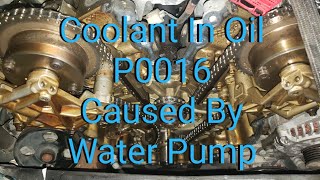
Est. part cost: $200-$500 for a quality water pump and timing component kit. The OEM Motorcraft water pump part number is often AT4Z-8501-A or PW-515, but always verify with VIN. 🎬 See this step-by-step guide to replacing the internal water pump
- Low Engine Coolant 🔴 High Probability Can be a symptom of a failing water pump, but also caused by leaking radiator hoses, a cracked radiator, or a faulty reservoir cap. These components can degrade over time.
How to confirm: Visually inspect the coolant reservoir. When the engine is completely cool, check the coolant level. Look for signs of external leaks (pink or orange crusty residue) on hoses, the radiator, and under the vehicle.
Typical fix: Find and repair the source of the leak, then refill and bleed the cooling system. If the water pump is the cause, it must be replaced.
Est. part cost: $20-$300 depending on the source of the leak (hose, thermostat housing, radiator, etc.). - Faulty Cylinder Head Temperature (CHT) Sensor 🟡 Medium Probability → Shop Engine Cylinder Head The sensor can fail electrically, sending a false overheat signal to the PCM. Due to its location in the hot engine valley, it is subjected to extreme heat cycles which can cause internal failure or damage to its wiring.
How to confirm: This is typically diagnosed when there are no physical signs of overheating (no steam, coolant level is full, infrared thermometer shows normal temps) yet the gauge reads hot and P1285 is present. A technician can test the sensor's resistance; it should be approximately 37,000 Ohms at 68°F (20°C) and decrease as temperature rises. A reading of 'OL' (Open Loop) or 0 Ohms indicates a failed sensor.
Typical fix: Replace the CHT sensor and its pigtail connector. This requires removing the upper and lower intake manifolds to gain access. The intake manifold gaskets must also be replaced. Ford service information states the CHT sensor is a one-time use part and must be replaced if removed. 🎬 Watch: How to replace the Cylinder Head Temperature sensor
Est. part cost: $30-$60 for the sensor (OEM part number may be GN1Z-6G004-A, verify with VIN), plus $50-$100 for intake gaskets. - Stuck Thermostat ⚪ Low Probability → Shop Integrated Thermostat Housing Assembly
How to confirm: If the engine is truly overheating, a stuck-closed thermostat will prevent coolant from circulating. The upper radiator hose will be very hot, while the lower hose may remain cool. This is a classic cooling system failure point, though less common than the water pump on this engine.
Typical fix: Replace the thermostat and refill/bleed the cooling system. Given the labor to access other components, it's often replaced preventatively during a water pump or CHT sensor job.
Est. part cost: $20-$50
Rare But Worth Checking
- Damaged CHT Sensor Wiring: The wiring harness leading to the CHT sensor can become brittle and crack from heat, or be damaged by rodents, causing a short or open circuit that triggers a false P1285 code. This can happen at the connector or further up the harness.
- Cooling Fan Assembly Failure: If the vehicle only overheats while idling or in stop-and-go traffic but is fine at highway speeds, it points to a failure in the electric cooling fans, their control module, or associated relays. The fans should run when the A/C is on, which is a simple way to test basic function.
- EGR Cooler Leak: → Shop Exhaust Gas Recirculation (EGR) Valve Manufacturer bulletin SSM 48345 notes that an over-temperature warning and P1285 may be due to an EGR Cooler that is leaking coolant into the engine intake and exhaust system.
- Coolant Intrusion into Cylinder: TSB 22-2229 describes a condition where P1285 and P1299 are stored due to coolant intrusion into the cylinder, which may occur with or without an illuminated MIL.
Diagnosis Steps
- SAFETY FIRST: If the temperature gauge is high or a warning light is on, pull over immediately and shut off the engine to prevent damage.
- Visual Inspection (Engine OFF and COOL): Check the coolant reservoir level. Is it empty or low? Check the engine oil dipstick. Is the oil milky or foamy? This indicates coolant contamination from a severe internal leak and means the engine should not be started.
- Check for External Leaks: Look under the vehicle for coolant drips. On the 3.5L V6, pay close attention to the area around the passenger side of the engine, near the alternator and A/C compressor, for signs of leakage from the water pump weep hole. 🎬 Watch: How to diagnose a leaking water pump on a 2007 Edge
- Verify Overheat Condition: If you have an infrared thermometer, you can (carefully) measure the temperature of the cylinder heads and radiator hoses to see if they match the extreme reading on the dash. If the engine is not physically hot (e.g., under 220°F), suspect a CHT sensor or wiring issue.
- Scan for Codes: Confirm P1285 and look for P1299. The presence of both strongly indicates the PCM believes there is a critical issue.
- Diagnose Cooling System: If a real overheat is confirmed, a full cooling system diagnosis is needed. This includes pressure testing the system to find leaks, checking for proper cooling fan operation (turn on A/C to force them on), and testing the thermostat.
- Diagnose CHT Sensor Circuit: If no real overheat is found, the CHT sensor and its wiring are the primary suspects. This involves testing the sensor's resistance (approx. 37k ohms at 68°F) and checking the wiring harness for continuity between the sensor connector and the PCM.
Parts You'll Likely Need
- Water Pump & Timing Chain Kit
(OEM #AT4Z-8501-A (Water Pump), check specific kit for chains/guides)— The internal water pump is the most common major failure leading to a real overheat. The timing components are replaced at the same time due to the extensive labor overlap. - Cylinder Head Temperature (CHT) Sensor
(OEM #GN1Z-6G004-A)— The most likely cause of a false overheat signal. It is a one-time use part. - Upper and Lower Intake Manifold Gaskets — Must be replaced when accessing the CHT sensor or performing a water pump replacement.
- Thermostat and Gasket — A possible, though less likely, cause of overheating. Often replaced as preventative maintenance during a larger job.
- Motorcraft VC-13-G Yellow Concentrated Coolant
(OEM #VC-13-G)— The specified coolant for this vehicle. Using the correct coolant is critical for the longevity of the cooling system, especially the water pump seals.
Related Codes That Often Appear With This One
- P1299 — P1299 ('Cylinder Head Overtemperature Protection Active') is set as the second stage of the fail-safe strategy, immediately after P1285. It means the PCM is actively taking steps to cool the engine, such as cutting fuel to alternating cylinders. Seeing both codes together is a strong confirmation that the PCM believes the engine is in critical danger.
- P1290 — P1290 ('Cylinder Head Temperature Sensor Circuit High Input') can sometimes accompany P1285 if the sensor or its wiring has failed in a way that sends an abnormally high voltage signal, which the PCM interprets as extreme heat.
- P0217 — This code for engine over-temperature often appears alongside P1285 in cases of actual coolant loss or internal leaks, as noted in TSB 20-2234.
Technical Service Bulletins (TSBs) & Recalls
- TSB 14-0213: Addresses a common P1450 code caused by a faulty EVAP purge valve on 2012-2013 models.
- Customer Satisfaction Program 13N03: Extended warranty for the electronic throttle body on certain models due to high failure rates.
- Class Action Lawsuit (Roe v. Ford Motor Company): While not a TSB, this lawsuit highlights the widespread, documented nature of the internal water pump failure across multiple Ford vehicles with the Cyclone engine.
- TSB 20-2234: Notes that vehicles may exhibit P1285 and P1299 along with low coolant levels and white smoke from the tailpipe.
- TSB 19-2046: Indicates that P1285 and P1299 may be stored in the PCM due to various settings in the PCM software, requiring a software update.
Platform-Specific Known Issues
- The internal water pump on the 3.5L Cyclone V6 is a widely documented failure point. Unlike external pumps, failure can allow coolant to leak directly into the engine oil, leading to rapid and catastrophic engine damage if not addressed immediately.
- NHTSA ODI #11639979 describes an instance where a vehicle was diagnosed with P1285 and P0217, revealing a coolant leak specifically at the water pump weep hole.
Mechanic-Grade Diagnostic Values
- CHT Sensor Resistance (disconnected) — expected: Approximately 37,000 Ohms (37 kΩ) at 68°F (20°C). Resistance decreases as temperature increases.. Failure: A reading of infinity (Open Loop) or near 0 Ohms indicates a failed sensor.
- CHT Sensor Signal Voltage (Key On, Engine Off, cold engine) — expected: 2.0V - 3.0V, back-probed at the sensor connector.. Failure: Voltage stuck at 5V (open circuit or bad ground) or 0V (short to ground).
- CHT Sensor Signal Voltage (Engine at normal operating temperature) — expected: 0.5V - 0.6V, back-probed at the sensor connector.. Failure: Voltage does not drop from the cold reading as the engine warms up.
Scan Tool Commands That Help
- Ford IDS (or equivalent professional scanner): Monitor CHT, CHT_V PIDs — To watch the live temperature and voltage data the PCM is receiving from the sensor. This helps determine if the reading is rational (e.g., climbing smoothly as the engine warms) or erratic/stuck, pointing to a sensor or wiring issue.
- Ford IDS (or equivalent professional scanner): Cooling Fan Control (On/Off/Variable Speed) — To command the cooling fans on to verify their operation independently of the PCM's automatic control. This is a crucial step if the vehicle overheats in traffic but not at highway speeds.
Wiring & Ground Locations
- CHT Sensor — Deep in the engine valley, threaded into a cylinder head, underneath the lower intake manifold.. This is the sensor that triggers the P1285 code. Its buried location makes replacement a labor-intensive job requiring significant disassembly.
- CHT Sensor Wiring Harness — Runs from the sensor in the engine valley, up towards the firewall to the main engine harness and eventually the PCM.. The harness is exposed to extreme heat in the engine valley, which can make the wiring brittle and prone to cracking. A short or open in this harness will cause a false P1285 code. A continuity test from the sensor connector to the PCM connector is required to rule out a wiring fault.
Real Owner Repair Stories
- 2CarPros Forum User (2006 Ford F-150 (similar CHT logic)) — P1285 and P1299 codes, temperature gauge pegged hot, but no physical signs of overheating.
❌ Tried (didn't work) Replacing the CHT sensor, Replacing plugs and wires, Replacing PCV valve, Replacing oil pressure switch, Replacing upper radiator hose, Verifying power to the CHT sensor
✅ What actually fixed it Replacing the thermostat finally resolved the issue. - BobIsTheOilGuy Forum User (2008 Ford Edge 3.5L) — Preventive maintenance, no symptoms reported.
✅ What actually fixed it Owner had the internal water pump and timing chains replaced at a Ford dealership at 235,000 miles for $1,600. The original timing chains were still in good condition. - Reddit /r/Ford User (2017 Ford Explorer with 3.5L (same engine family)) — Coolant leak from weep hole, discovered during a routine oil change.
✅ What actually fixed it Water pump was replaced under warranty at 115,000 miles. The estimated cost without warranty was $4,000. - NHTSA Report — An owner reported in NHTSA ODI #11639979 that their vehicle was diagnosed with codes P0217 and P1285, which the dealer determined was caused by a coolant leak at the water pump weep hole.
"I Checked Everything" — The Actual Cause
- The equivalent for this code is 'No signs of overheating, but P1285 is set'. In this case, the standard procedure is to use an infrared thermometer to confirm the actual temperature of the cylinder heads. If the heads are at a normal temperature (e.g., below 220°F) while the gauge reads HOT and P1285 is active, it confirms the issue is electrical (bad CHT sensor, wiring, or PCM) rather than a mechanical cooling system failure. This prevents the technician from unnecessarily disassembling the cooling system.
When the Usual Fixes Don't Work
- While the internal water pump and CHT sensor are the most common culprits for P1285, they are not the only ones. In one documented case on a similar Ford engine, a technician replaced the CHT sensor to no effect. After extensive diagnosis, the root cause was found to be a faulty thermostat that was not opening correctly, leading the PCM to trigger the overheat protection codes even without dramatic physical symptoms. This highlights the importance of performing a complete cooling system diagnosis, including checking thermostat operation, before committing to a complex CHT sensor or water pump replacement.
OEM Part Supersession History
AT4Z-8501-A (Water Pump for Edge)→BR3Z-8501-D (Water Pump for RWD 3.5/3.7L)— Part variation for different drivetrain layouts.
Heads up: While the base engine is the same, part numbers for the water pump can differ between FWD/AWD applications (like the Edge) and RWD applications (like the F-150/Mustang). Always confirm the correct part number with the vehicle's VIN.
Model Year Variations Within This Range
- 2007-2014 (Service Practice): Ford later issued TSBs recommending a switch from the original Motorcraft Orange Coolant (VC-3-B) to the newer Motorcraft Yellow Coolant (VC-13-G). Technicians report that the Yellow coolant has a revised formula that may offer better long-term protection for the internal water pump seals. Flushing the system and refilling with Yellow coolant is considered a best practice to potentially extend the life of the water pump.
Diagnostic Flowchart
Other Known Issues on This Vehicle
Issues unrelated to this code that are worth knowing about as an owner of this generation:
- Power Transfer Unit (PTU) Leak/Failure 🔴 High — Common on AWD models. Fluid can overheat and 'cook,' leading to seal failure and leaks. Often noticed by a burning gear oil smell. (Ref: TSB 19-2017 (for later models, but describes the common failure mode of a right-side seal leak).)
- Electronic Throttle Body (ETB) Failure 🟠 Medium — Widespread issue causing sudden limp mode, stalling, and codes like P2111/P2112. Internal electrical contacts become contaminated. (Ref: TSB 10-21-6, Customer Satisfaction Programs 13N03 and 16B23 were issued for specific build dates.)
- Door Ajar Sensor Failure 🟡 Low — Extremely common; the sensor within the door latch assembly fails, causing the 'door ajar' light to stay on, draining the battery and preventing doors from locking properly.
- Brake Booster Failure 🔴 High — The internal diaphragm can tear, leading to a hard brake pedal and a hissing noise. This is a significant safety concern. (Ref: Customer Satisfaction Program 13N02 and Recall 23S12 for some years.)
- EVAP Canister Purge Valve Failure 🟡 Low — A very common cause for the check engine light with code P1450. The valve sticks open. It is an inexpensive and easy part to replace. (Ref: TSB 14-0213 for 2012-2013 models.)
Used vs. New Parts: Buying Guide for This Vehicle
When a used part is the smart pick: Used parts are only recommended for non-wear, external components related to the repair. This includes items like the upper intake manifold, engine covers, or a wiring harness connector pigtail if the original is damaged.
Donor-vehicle mileage cap: roughly under 100000 miles for the part to have meaningful remaining life.
What to inspect on the donor part:
- For any engine component, check for a milky, sludgy residue on any surface that contacts oil, which indicates the donor vehicle had a catastrophic water pump failure.
- Inspect plastic parts for heat-related brittleness or cracking.
- Check electrical connectors for corrosion, bent pins, or damaged locking tabs.
OEM-only on this vehicle (don't cheap out):
- Water Pump
- Timing Chains, Guides, and Tensioners
Aftermarket brands forum-validated for this vehicle:
- Gates (For water pump and belts)
- Fel-Pro (For intake and valve cover gaskets)
Brands owners have reported issues with on this vehicle:
- Unbranded 'white box' or no-name water pumps and timing components. The labor cost for this job is extremely high, and the risk of premature failure from a low-quality part leading to catastrophic engine damage is not worth the small initial savings.
Real Owner Stories
Aggregated from forums and TSBs cited above. Mileages and costs reflect what owners reported in those sources.
2007-2014 Ford Edge 3.5L Cyclone V6
Symptoms: The owner experienced P1285 and P1299 codes simultaneously. They followed the Ford service manual diagnostic checklist to determine if the overheat was physical or sensor-related.
What fixed it: The owner worked through the diagnostic checklist provided by Ford's service manual to identify the root cause between a real overheat and a sensor circuit issue.
Source hint: ford-trucks.com thread titled 'P1285/P1299'
2007-2014 Ford Edge 3.5L Cyclone V6
Symptoms: Owners discussed the internal water pump failing and leaking coolant directly into the engine oil, which can lead to catastrophic engine failure.
What fixed it: More frequent coolant changes were discussed as a maintenance strategy to prolong the life of the internal water pump and prevent the seals from failing.
Source hint: fordedgeforum.com thread titled 'Water Pump Failure Prevention'
Related OBD-II Codes
Frequently Asked Questions
Is there a class-action lawsuit regarding the water pump failure on my Ford Edge 3.5L Cyclone V6?
My 2012 Ford Edge has a P1450 code along with the overheat warning; are they related?
Can I just replace the CHT sensor on my 3.5L V6 without removing the intake?
What is the specific Motorcraft part number for the water pump on the Cyclone 3.5L engine?
Is there an extended warranty for the throttle body on my Ford Edge?
Why is the water pump repair so expensive on the 2007-2014 Edge?
Helpful Videos
Used OEM Parts in Stock
New Aftermarket Parts Available


The information in this article is provided for general reference and educational purposes only. Vehicle specifications, procedures, and part compatibility can vary by production date, trim level, and region. Always consult your vehicle's factory service manual and verify part numbers before purchasing or performing repairs. Safety-critical components such as airbags, seat belts, and braking systems should be installed by a qualified professional.
- Ford Edge:
- 🧭 Diagnostic Flowchart
- 🎬 Helpful Videos
- 🛍️ Shop This Part
- What's Unique About the 2007-2014 Ford Edge
- Symptoms You May Notice
- Most Likely Causes
- Rare But Worth Checking
- Diagnosis Steps
- Parts You'll Likely Need
- Related Codes That Often Appear With This One
- Technical Service Bulletins (TSBs) & Recalls
- Platform-Specific Known Issues
- Mechanic-Grade Diagnostic Values
- Scan Tool Commands That Help
- Wiring & Ground Locations
- Real Owner Repair Stories
- "I Checked Everything" — The Actual Cause
- When the Usual Fixes Don't Work
- OEM Part Supersession History
- Model Year Variations Within This Range
- Other Known Issues on This Vehicle
- Used vs. New Parts: Buying Guide for This Vehicle
- Real Owner Stories
- 2007-2014 Ford Edge 3.5L Cyclone V6
- 2007-2014 Ford Edge 3.5L Cyclone V6
- Related OBD-II Codes
- Frequently Asked Questions
- 🎟️ Get 5% Off