

P1285 on 2010-2012 Ford Fusion 2.5L: Cylinder Head Over Temperature Causes and Fixes
On a 2010-2012 Ford Fusion with the 2.5L engine, code P1285 is most often caused by a faulty Cylinder Head Temperature (CHT) sensor or a corroded electrical connector, not an actual overheating event. This is a well-documented issue addressed by a Ford TSB, and the fix typically involves replacing the sensor and its pigtail connector for under $100 in parts. The sensor is located in a recess on the cylinder head that is prone to collecting water.
- P1285 on this car is most likely an electrical fault, not a mechanical one.
- Before suspecting a major cooling system failure, your first step should be to inspect the Cylinder Head Temperature (CHT) sensor and its connector for corrosion.
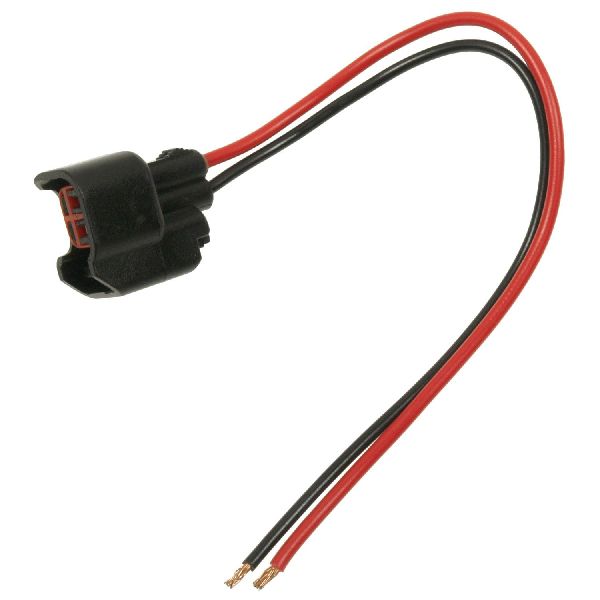
- The official fix, per a Ford TSB, is to replace both the sensor and the connector pigtail (Motorcraft WPT-985).
- Applying dielectric grease to the new connector is a critical step to prevent the problem from recurring.
- Do not drive the vehicle with this code active, as the engine's protective systems are engaged and can limit power unexpectedly.
What's Unique About the 2010-2012 Ford Fusion
Unlike later model Fusions with EcoBoost engines where this code often signals a catastrophic internal engine failure, the 2010-2012 2.5L model has a much more common and less severe issue. The CHT sensor is located on top of the cylinder head in a recessed well between the spark plugs for cylinders 2 and 3. This area has a low ridge that allows water from rain or car washes to pool around the sensor. This moisture seeps into the electrical connector (C1164), causing corrosion that leads to high resistance and false temperature signals, triggering the P1285 code even when the engine temperature is normal. Ford issued Technical Service Bulletin TSB 12-5-5 to address this specific design flaw.
Symptoms You May Notice
- Temperature gauge reading at maximum (HOT) or behaving erratically.
- Check Engine Light is on.
- Engine may run rough, misfire, or lack power.
- Cooling fans run constantly at high speed, even when the engine is cold.
- Hard starting or engine cranks but won't start.
- Air conditioning may stop working as the PCM tries to reduce engine load.
- Assuming the engine has a major internal failure. On the 2.5L engine, the cause is far more likely to be the inexpensive CHT sensor or its wiring, unlike on later EcoBoost engines where this code can mean a cracked block or head gasket failure.
- Replacing the thermostat or water pump before verifying if the overheat condition is real. If scan tool data shows erratic CHT values on a cold engine, the fault is electrical, not mechanical.
Most Likely Causes
- Faulty Cylinder Head Temperature (CHT) Sensor and/or Corroded Connector 🔴 High Probability → Shop Engine Cylinder Head A known design issue allows water to pool in the CHT sensor well on the cylinder head, leading to moisture intrusion and corrosion in the connector (C1164). Ford TSB 12-5-5 (which supersedes 11-10-5 and 11-8-17) specifically addresses this issue for the Fusion, Escape, and other models with the 2.5L engine.
How to confirm: Visually inspect the CHT sensor's electrical connector for signs of moisture or corrosion (white or green powder). The sensor is located between the center two ignition coils under a rubber boot. With a scan tool, monitor the CHT live data; erratic or illogical readings (e.g., showing 250°F on a cold engine) point to a sensor or wiring issue.
Typical fix: Replace both the CHT sensor and the pigtail connector. It is critical to use butt splices with heat shrink tubing to create a sealed connection for the new pigtail. Apply dielectric grease to the new connector to seal it from future moisture intrusion. Some technicians also apply a bead of silicone sealant around the CHT sensor's rubber boot where it meets the valve cover for extra protection.
Est. part cost: $30-$75 - Low Engine Coolant Level 🟡 Medium Probability
How to confirm: Visually check the coolant level in the degas (overflow) bottle when the engine is cool. If low, top it off and inspect for visible leaks from hoses, the radiator, or the water pump. A low level can cause an actual overheat, triggering a legitimate P1285.
Typical fix: Top off the coolant with the correct type (Motorcraft VC-3-D Orange or VC-13-G Yellow, depending on what is in the system) and repair any found leaks.
Est. part cost: $20-$300+ - Stuck Thermostat ⚪ Low Probability → Shop Integrated Thermostat Housing Assembly
How to confirm: After starting a cold engine, feel the upper and lower radiator hoses. If the engine is warming up but the lower hose remains cold, the thermostat is likely stuck closed, preventing coolant circulation. This will cause a true overheat condition.
Typical fix: Replace the thermostat and gasket. It is recommended to also replace the engine coolant at this time. On the 2.5L, the thermostat is part of the water outlet housing.
Est. part cost: $50-$120
Rare But Worth Checking
- Failing Water Pump: → Shop Engine Water Pump While less common than the CHT sensor issue, a water pump failure will cause a genuine and rapid overheating condition. Listen for grinding or whining noises from the engine belt area.
- Cooling Fan Malfunction: If the cooling fans fail to turn on when the engine gets hot (especially in traffic), the engine can overheat. This could be due to a bad fan motor, relay, or wiring. Conversely, a bad CHT sensor can cause the fans to run constantly.
- Damaged Wiring Harness: The wires leading to the CHT sensor can become damaged from chafing or rodents, causing a short or open circuit that mimics a sensor failure.
- Coolant Intrusion: While more common on other engine variants, manufacturer service bulletins such as TSB 22-2322 and TSB 22-2229 note that P1285 and P1299 can be stored in the PCM due to coolant intrusion into the cylinder.
Diagnosis Steps
- Check for other stored DTCs to get a complete picture, especially P1299 or P0128.
- With the engine cold, check the coolant level in the overflow reservoir and top off if necessary.
- Using a scan tool, observe the CHT sensor's live data reading before starting the engine. It should be close to the ambient air temperature. A reading of over 200°F on a cold engine is a definitive sign of a CHT circuit fault.
- Start the engine and monitor the CHT reading as it warms up. Look for sudden jumps, drops, or erratic behavior. If the gauge pegs hot but the scan tool shows a normal temperature progression, the CHT circuit is the fault.
- Locate the CHT sensor on the cylinder head, between the ignition coils for cylinders 2 and 3. Pull up the rubber boot and disconnect the electrical pigtail (C1164). Inspect the sensor and connector for any signs of green or white corrosion, or moisture.
- If corrosion is found, replacing both the CHT sensor (Motorcraft DY-1144 / 8S4Z-6G004-A) and the connector pigtail (Motorcraft WPT-985) is the recommended repair per TSB 12-5-5.
- When replacing the pigtail, stagger the wire cuts to prevent a bulky repair and use heat-shrink butt connectors to ensure a waterproof seal.
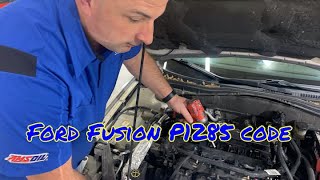
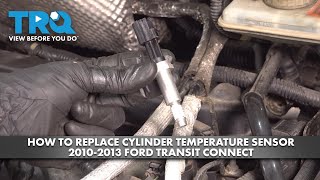
- Use a 19mm deep-well socket that does not have an internal shoulder to remove and install the CHT sensor. 🎬 Watch this walkthrough for replacing the sensor and pigtail.
- Apply Motorcraft Electrical Grease to the connector terminals before reassembly to prevent future corrosion.
- If the CHT circuit appears fine and the engine is genuinely overheating (verified with an infrared thermometer on the cylinder head), proceed with standard cooling system diagnostics: check for a stuck thermostat, verify cooling fan operation, and inspect the water pump.
Parts You'll Likely Need
- Cylinder Head Temperature Sensor Connector
(OEM #WPT-985)— This is the most common failure point due to corrosion from water intrusion, as documented in Ford TSBs. It is highly recommended to replace this along with the sensor.
Trusted brands: Motorcraft, Dorman, Standard Motor Products
OEM price range: $15-$25
Aftermarket price range: $10-$20 - Cylinder Head Temperature (CHT) Sensor
(OEM #8S4Z-6G004-A (Motorcraft DY-1144))— The sensor itself can fail or become damaged by the same moisture that corrodes the connector. It should be replaced with the connector pigtail for a complete repair.
Trusted brands: Motorcraft, NGK, Standard Motor Products
OEM price range: $30-$50
Aftermarket price range: $15-$35 - Dielectric Grease / Electrical Grease — Essential for preventing future moisture intrusion into the new connector. The Ford TSB specifically calls for using Motorcraft Electrical Grease.
Trusted brands: Motorcraft, Permatex
OEM price range: $5-$10
Aftermarket price range: $3-$8
Related Codes That Often Appear With This One
- P1299 — P1299 ('Cylinder Head Over-Temperature Protection Active') is the next stage in Ford's fail-safe strategy. It appears when the PCM takes more drastic action, like cutting fuel to cylinders, after P1285 is set. 🎬 Watch: Understanding Ford's fail-safe cooling strategy and these codes.
- P0128 — This code ('Coolant Thermostat (Coolant Temperature Below Thermostat Regulating Temperature)') can also be triggered by a faulty CHT sensor providing incorrect data to the PCM, or by a thermostat that is stuck open. The TSB for the CHT sensor issue includes this code.
- P030x — Misfire codes (e.g., P0301, P0302) can occur if the PCM activates fail-safe cooling and begins shutting down injectors. Water intrusion into the spark plug wells, which often happens along with the CHT sensor contamination, can also cause misfires. Manufacturer records such as NHTSA ODI #11625213 and NHTSA ODI #11649929 confirm that P1285 often appears alongside misfire codes P0300-P0304 and P0316.
Technical Service Bulletins (TSBs) & Recalls
- TSB 12-5-5 (Supersedes 11-10-5, 11-8-17): Addresses MIL on with DTCs P1285, P1299, and/or P0128 due to water contamination in the CHT sensor connector (C1164). The fix involves inspecting for corrosion and replacing the sensor and pigtail connector if severe.
- TSB 22-2322: Notes that P1285 and P1299 may be stored in the PCM due to coolant intrusion into the cylinder, which may or may not be accompanied by an illuminated MIL.
- TSB 22-2229: Describes a condition where P1285, P1299, and misfire codes (P0300-P0304) are stored due to coolant intrusion into the cylinder.
Platform-Specific Known Issues
- Ford Technical Service Bulletin TSB 12-5-5 (and its predecessors 11-10-5 and 11-8-17) was issued for the 2010-2012 Fusion 2.5L due to false overheat conditions (P1285/P1299) caused by water contamination of the CHT sensor connector C1164.
Mechanic-Grade Diagnostic Values
- CHT Sensor Resistance — expected: ~2.03 kΩ at 212°F (100°C). Failure: A reading that is significantly different from the expected value at a known temperature, or an open/infinite resistance reading.
- CHT Sensor Voltage (Dual-Range Operation) — expected: Ford uses a dual-switching resistor circuit. This means at a specific temperature, the voltage can be in one of two ranges. For example, at 90°C (194°F), the voltage could correctly read either ~0.60V or ~3.71V as it transitions between ranges.. Failure: Voltage that is stuck high (e.g., >4.6V) or low, or does not change as the engine warms up.
- CHT Sensor Circuit Voltage (Sensor Unplugged) — expected: 5 Volts (Reference Voltage). Failure: If the voltage is not 5V with the sensor unplugged, there may be an issue with the wiring or the PCM's 5V reference circuit.
- Live Scan Tool Data (Sensor Unplugged) — expected: -40°F or -40°C (Default fail-safe value). Failure: If the scan tool does not show the default low-temperature value when the sensor is unplugged, it could indicate a wiring short or PCM issue.
Scan Tool Commands That Help
- Ford IDS (Integrated Diagnostic System): Active Commands / Bi-Directional Controls — To functionally test components without manual disassembly. For a P1285 diagnosis, a technician can use IDS to command the cooling fans on and off to verify their operation, helping to distinguish a true mechanical overheat from a false electrical one.
Wiring & Ground Locations
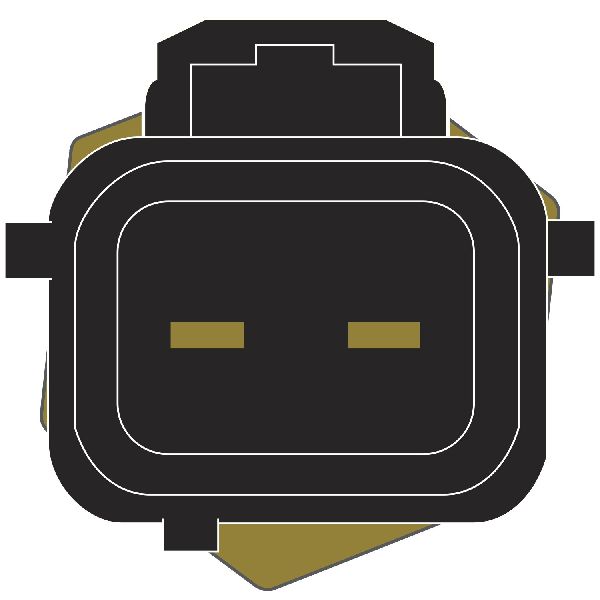
- Connector C1164 — The 2-wire electrical connector for the Cylinder Head Temperature (CHT) sensor, located on the top center of the cylinder head, between the ignition coils for cylinders #2 and #3.. This is the primary failure point. Its recessed location allows water to pool and seep into the connector, causing corrosion that creates high resistance and triggers a false P1285 code.
- PCM Connector Pins — At the main Powertrain Control Module (PCM) connector.. To perform a definitive end-to-end wiring check, test continuity between the CHT sensor connector and these PCM pins: Pin 41 (Yellow/Green wire) is the CHT signal, and Pin 58 (Gray/Red wire) is the Signal Return (ground). A break in either wire will cause a fault.
- Ground G104 — A primary engine compartment ground point located on the right side of the engine compartment, sometimes near the strut tower.. The CHT sensor circuit relies on a clean ground path back to the PCM. A loose or corroded G104 can introduce electrical noise or voltage offsets into multiple sensor circuits, potentially according to NHTSA reports, causing erratic readings and false codes like P1285.
Real Owner Repair Stories
- YouTube video on a 2010 Ford Fusion 2.5L (2010 Ford Fusion 2.5L) — Hard starting (crank-no-fire), cooling fans running constantly, P1285 code present.
❌ Tried (didn't work) The diagnosis immediately pointed to an electrical issue based on the symptoms and a known TSB.
✅ What actually fixed it The CHT sensor connector was full of moisture. Replacing both the CHT sensor and the pigtail connector according to Ford TSB 11-10-5 resolved all symptoms. The mechanic also noted oil from a valve cover leak had contaminated the spark plug wells, contributing to the hard start. - 2CarPros forum user (Ford vehicle with 2.5L engine) — Temperature gauge pegged in the red (hot), but the engine was not physically overheating. Codes P1285 and P1299 were present.
❌ Tried (didn't work) Replaced CHT sensor, Replaced spark plugs and wires, Replaced PCV valve, Replaced oil pressure sensor, Replaced upper radiator hose, Verified wiring to the CHT sensor had power
✅ What actually fixed it After numerous part replacements and verifying the CHT circuit was powered, the user replaced the thermostat, which fixed the problem. This indicated a true, intermittent mechanical overheating issue was occurring.
When the Usual Fixes Don't Work
- While the vast majority of P1285 codes on this vehicle are due to the faulty CHT sensor or connector as described in Ford's TSB, it should not be treated as the only possibility. There are confirmed owner reports where the CHT circuit was tested and found to be good, and the ultimate cause was a simple, mechanically stuck thermostat causing a genuine overheating condition. This highlights the importance of not skipping fundamental cooling system diagnostics (e.g., checking radiator hoses for temperature differential) before defaulting to the common electrical repair.
Documented NHTSA Reports
- NHTSA ODI #11497725 describes an illuminated MIL with codes P0300, P0301-P0304, P0316, P0217, P1285 and/or P1299 stored in the PCM, which may be due to coolant intrusion into the cylinder.
OEM Part Supersession History
TSB 11-8-17, TSB 11-10-5→TSB 12-5-5— Ford updated the service bulletin to include additional model years and refine the repair procedure for the CHT sensor connector corrosion issue.
Model Year Variations Within This Range
- 2010-2012: No significant variations related to the P1285 fault are documented within this specific 2010-2012 model year range for the 2.5L engine. The water intrusion issue at the CHT sensor connector (C1164) is consistent across these years.
Diagnostic Flowchart
Used vs. New Parts: Buying Guide for This Vehicle
When a used part is the smart pick: For this specific repair, using a USED part is NOT recommended. The primary failure parts are a low-cost electronic sensor and its connector, which fail due to age-related corrosion and moisture damage. A used part from a salvage yard will have a similar or greater risk of failure.
What to inspect on the donor part:
- Not applicable as used parts are not advised.
OEM-only on this vehicle (don't cheap out):
- Cylinder Head Temperature Sensor
- CHT Sensor Connector Pigtail
Aftermarket brands forum-validated for this vehicle:
- For sensors, NTK is a widely respected OEM supplier and a reliable aftermarket choice if Motorcraft is unavailable.
Brands owners have reported issues with on this vehicle:
- Avoid unbranded, 'white-box' sensors and connectors. The CHT sensor's resistance curve is critical for correct temperature reporting to the PCM, and off-brand parts may not have the correct calibration, leading to persistent issues even after replacement.
Real Owner Stories
Aggregated from forums and TSBs cited above. Mileages and costs reflect what owners reported in those sources.
2010 Ford Fusion 2.5L
Symptoms: The owner reported the car was hard to start, cranking for a long time before it would fire, similar to a flooded carburetor. The cooling fans were also running much more than normal.
What fixed it: The context implies the fix was replacing the CHT sensor and connector, as the story was used to illustrate the symptoms of the P1285 code which is the article's focus.
Source hint: YouTube Comment by NMC Repairs
2010 Ford Fusion 2.5L
Symptoms: The vehicle experienced hard starting and the cooling fans were running constantly.
What fixed it: The owner found water in the CHT sensor connector and resolved the issue by replacing both the sensor and the pigtail.
Source hint: YouTube - '2010 Fusion P1285 CHT sensor failure...'
2009 Ford Fusion
Symptoms: The owner reported an overheat situation with the Check Engine Light on for codes P1285, P1290, and P1299.
What fixed it: Another user correctly diagnosed the issue as a likely sensor/wiring fault rather than a mechanical problem, advising the owner to check the CHT data stream for erratic behavior.
Source hint: Reddit r/Cartalk - '2009 Ford Fusion overheating, MIL Codes P1285, 1290, 1299...'
Ford Fusion Owner
Symptoms: An owner reported an illuminated malfunction indicator lamp (MIL) with diagnostic trouble codes P0300, P0301-P0304, P0316, P0217, P1285 and/or P1299 stored in the powertrain control module (PCM).
What fixed it: Manufacturer records suggest this may be due to coolant intrusion into the cylinder.
Source hint: NHTSA ODI #11625213
Ford Fusion Owner
Symptoms: A report filed with the NHTSA noted an illuminated malfunction indicator light (MIL) with diagnostic trouble codes P0300, P0301-P0304, P0316, P0217, P1285 and/or P1299.
What fixed it: The report indicates the condition may be due to coolant intrusion into the cylinder.
Source hint: NHTSA ODI #11649929
Related OBD-II Codes
Frequently Asked Questions
Is there a Technical Service Bulletin (TSB) for the P1285 code on my 2011 Fusion 2.5L?
Where is the CHT sensor located on the 2.5L engine?
My mechanic says the P1285 code means I need a new thermostat, but the engine doesn't seem hot. Is this right?
What specific parts are needed for the TSB-recommended repair for P1285?
My 2012 Ford Escape 2.5L has the exact same symptoms. Does this information apply?
How can I check if the CHT sensor is the problem before buying parts?
Helpful Videos

Used OEM Parts in Stock
New Aftermarket Parts Available


The information in this article is provided for general reference and educational purposes only. Vehicle specifications, procedures, and part compatibility can vary by production date, trim level, and region. Always consult your vehicle's factory service manual and verify part numbers before purchasing or performing repairs. Safety-critical components such as airbags, seat belts, and braking systems should be installed by a qualified professional.
- Ford Fusion:
- 🧭 Diagnostic Flowchart
- 🎬 Helpful Videos
- 🛍️ Shop This Part
- What's Unique About the 2010-2012 Ford Fusion
- Symptoms You May Notice
- Most Likely Causes
- Rare But Worth Checking
- Diagnosis Steps
- Parts You'll Likely Need
- Related Codes That Often Appear With This One
- Technical Service Bulletins (TSBs) & Recalls
- Platform-Specific Known Issues
- Mechanic-Grade Diagnostic Values
- Scan Tool Commands That Help
- Wiring & Ground Locations
- Real Owner Repair Stories
- When the Usual Fixes Don't Work
- Documented NHTSA Reports
- OEM Part Supersession History
- Model Year Variations Within This Range
- Used vs. New Parts: Buying Guide for This Vehicle
- Real Owner Stories
- 2010 Ford Fusion 2.5L
- 2010 Ford Fusion 2.5L
- 2009 Ford Fusion
- Ford Fusion Owner
- Ford Fusion Owner
- Related OBD-II Codes
- Frequently Asked Questions
- 🎟️ Get 5% Off