

P1285 on 1998-2012 Ford Ranger 4.0L: Cylinder Head Overheat Causes and Fixes
On a Ford Ranger with the 4.0L SOHC V6, code P1285 almost always points to an actual engine overheat condition. The most likely cause is a cracked plastic thermostat housing, a very common failure on this engine. Coolant pools in the valley of the engine, often making the leak hard to spot at first. Expect to pay $200-$500 for a shop to replace it, or around $50-$150 for parts to do it yourself. Many owners upgrade to a more durable all-aluminum housing.
- P1285 means your engine is critically overheating; stop driving immediately to prevent severe damage.
- The most likely cause on a 4.0L SOHC Ranger is a cracked plastic thermostat housing leaking coolant.
- Inspect the top front of your engine for signs of a coolant leak before replacing any parts.
- When replacing the thermostat housing, it is best practice to also replace the thermostat and temperature sensors at the same time.
- Consider upgrading to a more durable aftermarket aluminum thermostat housing to prevent the issue from recurring.
What's Unique About the 1998-2012 Ford Ranger
Unlike many modern Fords (especially EcoBoost models) where P1285 can signal a catastrophic engine block failure, on the 4.0L SOHC V6 in the Ranger, the cause is almost always a more traditional (and less expensive) cooling system failure. This engine is notorious for its two-piece plastic thermostat housing, which is prone to cracking and developing coolant leaks 🎬 Watch: See where these common coolant leaks typically develop., especially at the molded seam. This single part is the source of the problem in a vast majority of cases for this specific truck and its platform mates (Explorer, Mountaineer).
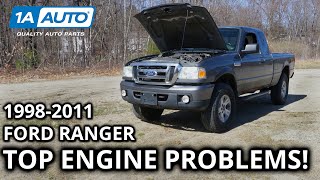
Generation note: The 1998-2012 year range covers the third generation of the Ford Ranger in North America. The 4.0L SOHC V6 engine and its associated cooling system design, including the failure-prone thermostat housing, were consistent throughout these years and also shared with the Ford Explorer, 🎬 Watch: A guide to common engine problems for this generation. Explorer Sport Trac, and Mercury Mountaineer.
Symptoms You May Notice
- Temperature gauge reading at maximum (HOT)
- Check Engine Light illuminated with code P1285
- Low coolant level or visible coolant leaks on top of the engine, often pooling in the 'V' under the intake manifold
- Steam coming from the engine bay
- Sweet smell of antifreeze
- Engine may enter a reduced power 'limp mode' (associated with code P1299)
- Coolant spray visible on the front-center of the motor, often blown around by the fan
- Replacing only the CHT sensor without first finding and fixing the root cause of the overheating (like a coolant leak). The code is usually reporting a real problem.
- Replacing the thermostat housing but reusing the old O-rings on the temperature sensors, leading to a new leak from the sensor port.
Most Likely Causes
- Cracked Plastic Thermostat Housing 🔴 High Probability → Shop Integrated Thermostat Housing Assembly The original equipment (OE) thermostat housing is made of a two-piece plastic design that becomes brittle with heat cycles. It most commonly cracks along the seam where the upper and lower halves are joined, causing a coolant leak. Coolant then pools in the valley of the engine under the intake manifold, which can be difficult to see initially.
How to confirm: Visually inspect the thermostat housing at the front-center of the engine. Look for white or green coolant residue, active dripping, or a visible crack along the seam. Coolant may be sprayed around the engine bay by the fan. A cooling system pressure test will almost always confirm the leak.
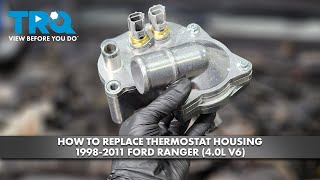
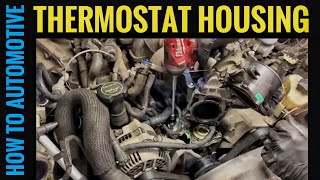
Typical fix: Replace the entire thermostat housing assembly (upper, lower, thermostat, and new sensors/gaskets). Many owners and shops strongly recommend upgrading to a one-piece cast aluminum 🎬 See this walkthrough on replacing the plastic housing assembly. aftermarket housing to prevent repeat failures.
Est. part cost: $45-$150 - Stuck-Closed Thermostat 🟡 Medium Probability → Shop Integrated Thermostat Housing Assembly This is a common failure on any vehicle. The thermostat is located inside the problematic plastic housing, making it wise to replace both at the same time.
How to confirm: After a cold start, the upper radiator hose will become very hot while the lower radiator hose remains cool, indicating coolant is not circulating through the radiator. This is a classic sign of a stuck thermostat.
Typical fix: Replace the thermostat. This is almost always done as part of a complete thermostat housing replacement job.
Est. part cost: $10-$30 - Low Engine Coolant 🟡 Medium Probability This is a symptom of a leak, most commonly from the thermostat housing, but can also be from a radiator, water pump, or hoses. If the coolant level drops too low, the CHT sensor will detect the rapid rise in metal temperature.
How to confirm: Check the coolant level in the reservoir and the radiator (only when the engine is cold). If low, perform a cooling system pressure test to find the source of the leak.
Typical fix: Find and repair the leak, then refill and bleed the cooling system with the correct coolant type.
Est. part cost: $20-$300+ - Faulty Cylinder Head Temperature (CHT) Sensor ⚪ Low Probability → Shop Engine Cylinder Head The sensor itself can fail, but it's more common for it to be damaged by the extreme heat of an overheat event or for its wiring to be compromised. If the code returns immediately after fixing a leak and the engine is confirmed to not be overheating (e.g., by using an infrared thermometer on the cylinder head), the sensor or its wiring is the likely culprit.
How to confirm: Use a scan tool to monitor the CHT sensor reading. If it reads erratically or shows an extremely high temperature on a cold engine, it has failed. It can also be tested by checking its resistance against a temperature chart. Check the wiring harness for damage, especially where it bends near the back of the engine.
Typical fix: Replace the CHT sensor. On the 4.0L SOHC, this sensor is located under the intake manifold and is difficult to access.
Est. part cost: $20-$50
Rare But Worth Checking
- Failing Water Pump: → Shop Engine Water Pump The impeller can degrade or the bearing can fail, leading to a lack of coolant circulation or a leak from the weep hole. While less common on the Ranger than the housing, NHTSA ODI #11639979 notes a similar case where P1285 was retrieved alongside a coolant leak at the water pump weep hole on a related Ford platform.
- Failing Fan Clutch: If the fan clutch is not engaging properly, it won't pull enough air through the radiator at low speeds or idle, causing the engine to overheat in traffic. If the truck cools down once moving at speed, the fan clutch is a primary suspect.
- Blown Head Gasket: A severe overheat event can cause the head gasket to fail. Check for milky oil, white smoke from the exhaust, or use a chemical block tester to check for combustion gases in the coolant. In some Ford models, NHTSA ODI #11520798 reports P1285 appearing when coolant was found in the cylinder due to internal engine failure.
- Reused Sensor O-rings: When replacing the thermostat housing, it is critical to use new O-rings for the temperature sensors. Reusing the old, heat-compressed O-rings will often cause a new leak from the sensor ports, even with a new housing.
- Active Grille Shutter Failure: While not standard on all Ranger years, NHTSA ODI #11703132 describes a scenario where P1285 was triggered in conjunction with an active grille shutter failure, creating a collision hazard at highway speeds.
Diagnosis Steps
- DO NOT DRIVE THE VEHICLE. Allow the engine to cool completely.
- Check the engine coolant level in the reservoir and radiator. If it is low, you have a leak.
- Carefully inspect the plastic thermostat housing at the front of the engine. Use a flashlight to look for signs of dried coolant (white/green crust), wetness, or visible cracks, especially on the seam between the upper and lower halves. Check the valley of the engine block directly underneath the housing for pooled coolant.
- Inspect all coolant hoses, the radiator, and the water pump for leaks.
- If a leak is not obvious, use a cooling system pressure tester to pressurize the system (when cold) to 15-16 PSI. This will usually make the leak from the thermostat housing seam very apparent.
- If no leaks are found, start the engine from cold and monitor the upper and lower radiator hoses. If the upper hose gets hot and the lower stays cold after 5-10 minutes of running, the thermostat is likely stuck closed.
- If the engine only overheats at idle or in traffic but cools down at highway speeds, check for proper operation of the engine's mechanical cooling fan clutch.
- If the P1285 code persists after fixing a confirmed leak and the engine does not seem to be overheating (verify with an infrared thermometer), the CHT sensor itself was likely damaged by the heat and needs to be replaced, or its wiring is faulty.
Parts You'll Likely Need
- Thermostat Housing Kit
(OEM #2L2Z-8592-BA (Upper Housing), 1L2Z-8575-AA (Lower Housing), 6L2Z-8592-FA (Updated Assembly))— This is the most common failure point on the 4.0L SOHC engine leading to coolant loss and overheating. It's best to replace the entire assembly. Upgrading to a metal version is highly recommended for durability.
Trusted brands: Motorcraft (OEM Plastic), Dorman (offers both plastic 902-860 and aluminum replacements), Gates, Austekk (Aluminum)
OEM price range: $70-$120
Aftermarket price range: $45-$150 - Cylinder Head Temperature (CHT) Sensor
(OEM #F7DZ-6G004-AA)— This sensor can be damaged by the extreme heat of the primary overheat event, or its wiring can be compromised. It's often replaced as a precaution if the code returns after fixing the root cause leak.
Trusted brands: Motorcraft, Standard Motor Products (TX130), NTK
OEM price range: $25-$50
Aftermarket price range: $15-$40
Related Codes That Often Appear With This One
- P1299 — This code, 'Cylinder Head Overtemperature Protection Active,' is the second stage of Ford's fail-safe strategy. It sets after P1285 if the overheating continues, and the PCM starts shutting down alternating fuel injectors to use the cylinders as air pumps to cool the engine.
- P0128 — 'Coolant Thermostat Temperature Below Regulating Temperature.' This can sometimes appear if the thermostat is stuck open or if there are issues with the temperature sensors, though it's less common with an overheat condition.
Technical Service Bulletins (TSBs) & Recalls
- While no specific TSB for P1285 on the Ranger is widely cited, the underlying cause (thermostat housing leak) is a well-documented issue across platforms using the 4.0L SOHC engine. Related TSBs like 09-8-1 for Explorer radiator leaks show a pattern of cooling system vulnerabilities.
- Manufacturer Bulletin #TSB 26-2060 notes that P1285 and P1299 can be stored due to a loss of engine coolant at the heater hose assembly near the engine cooling fan, sometimes caused by an incorrectly indexed hose connection at the thermostat housing.
Platform-Specific Known Issues
- The 4.0L SOHC engine uses two temperature sensors in the thermostat housing area on earlier models: a two-wire sensor for the PCM (this is the CHT sensor that triggers P1285) and a one-wire sender for the dashboard temperature gauge. Later models may only have one sensor as the gauge is controlled by the PCM. It is critical to diagnose and replace the correct one.
- Accessing the thermostat housing requires removing the throttle body and air intake tube. One of the housing bolts is notoriously difficult to access without a swivel socket and extensions, leading some DIYers to remove the upper intake manifold for better access.
- The CHT sensor that triggers P1285 is located on the driver's side cylinder head, underneath the lower intake manifold, making it very difficult to access for replacement.
Mechanic-Grade Diagnostic Values
- Cylinder Head Temperature (CHT) Sensor Resistance — expected: Approximately 2000-3000 Ω at 68°F (20°C) and 200-300 Ω at 194°F (90°C).. Failure: An infinite reading (open circuit) or near-zero reading (short circuit) indicates a failed sensor.
- Cylinder Head Temperature (CHT) Sensor Voltage (Scan Tool PID) — expected: Approximately 2.03 - 2.1 volts at normal operating temperature (~194-198°F).. Failure: Voltage that is stuck high (e.g., 5V) or low (e.g., 0V), or does not decrease as the engine warms up, points to a sensor or wiring issue.
- CHT Sensor Signal Wire Voltage (KOEO, Cold Engine) — expected: 2.0V - 3.0V when back-probed at the sensor connector.. Failure: Voltage stuck at 5V or 0V.
Wiring & Ground Locations
- CHT Sensor Wiring (at PCM) — On similar Ford engines, the CHT signal wire is Yellow with a Green trace at Pin 41 of the PCM connector, and the signal return (ground) is a Gray wire with a Red stripe at Pin 58.. If the sensor itself tests good, a continuity test must be performed on these wires between the sensor and the PCM to find a break or short in the harness.
- G101 — Typically located on the RH (passenger side) inner fender apron, near the battery.. This is a primary body and component ground point. While not directly for the CHT sensor's signal return, a poor connection here can cause various electrical issues and erratic sensor behavior.
- Engine to Firewall Ground Strap — Usually located on the back of the driver's side cylinder head, connecting to the firewall.. A loose or corroded engine-to-body ground strap is a common cause of widespread electrical problems, including incorrect sensor readings, as it affects the PCM's ground reference.
Real Owner Repair Stories
- Ranger-Forums user 'IN2 FX4' (Ford Ranger 4.0L SOHC (year not specified)) — After upgrading from the OEM plastic thermostat housing to an aftermarket aluminum one, the temperature gauge would immediately go all the way to HOT.
❌ Tried (didn't work) Replacing the CHT sensor connector pigtail after a wire broke.
✅ What actually fixed it Reversing the polarity of the two wires going to the CHT sensor connector solved the problem. The theory is that with the non-conductive plastic housing, polarity doesn't matter, but with the conductive aluminum housing, the sensor body becomes grounded, making the wire polarity critical. - 2CarPros Forum user 'Michelle Vanhorn' (2006 Ford F-150 4.2L (Note: Different vehicle, but same codes and similar fail-safe logic)) — Codes P1285 and P1299, temperature gauge pegged HOT, but engine did not seem to be physically overheating.
❌ Tried (didn't work) Replacing the CHT sensor., Replacing spark plugs and wires., Replacing PCV valve., Replacing oil pressure sensor., Replacing upper radiator hose., Checking for power at the CHT sensor wiring.
✅ What actually fixed it Replacing the thermostat fixed the issue. This indicates the thermostat was likely failing in a way that caused a localized hot spot at the CHT sensor before causing a full-system boil-over, or it was mechanically stuck, triggering the code. - NHTSA ODI #11062287 — An owner reported that after their vehicle was taken to the dealer with fault code P1285, the dealer replaced the radiator fan and head temperature sensor, which resolved the issue.
OEM Part Supersession History
2L2Z-8592-BA (Upper), 1L2Z-8575-AA (Lower)→6L2Z-8592-FA (Updated Upper Housing Assembly)— The part was updated over the years, likely with minor design or material changes. 6L2Z-8592-FA is a common OEM replacement part number for the upper housing.
Heads up: Some aftermarket or even OEM replacement housings may have two sensor ports, while later model year Rangers (approx. 2004+) only use one sensor. The two-port housing can still be used; the unused port is either left with the blank sensor/plug or the single sensor is installed in the correct port and the other is left disconnected.
Model Year Variations Within This Range
- 2001-2012: The number of temperature sensors used in the thermostat housing can vary. Early 4.0L SOHC models (approx. 2001-2003) often used two sensors (one for the PCM, one for the gauge), while later models (approx. 2004-2012) integrated this function and used only a single CHT sensor. When ordering a replacement housing, it is critical to verify if one or two sensor ports are needed, though a two-port housing can be used on a single-sensor vehicle by leaving the second port plugged.
Diagnostic Flowchart
Used vs. New Parts: Buying Guide for This Vehicle
When a used part is the smart pick: For this specific repair, obtaining a USED plastic thermostat housing from a junkyard is NEVER a smart choice. The part fails due to heat cycles and age-related brittleness, so a used part is likely near the end of its life.
What to inspect on the donor part:
- Do not buy a used plastic housing under any circumstances.
OEM-only on this vehicle (don't cheap out):
- No parts for this specific repair are strictly OEM-only. The OEM plastic housing is a known failure point.
Aftermarket brands forum-validated for this vehicle:
- Dorman (Aluminum version, P/N 902-860)
- Simons Auto Sportz / SAS (Offers a 1-piece aluminum design)
- Austekk (Aluminum)
- Motorcraft (For a direct OEM plastic replacement)
Brands owners have reported issues with on this vehicle:
- Unnamed, no-brand plastic replacement kits should be avoided as their quality may be even lower than the original OEM part.
Real Owner Stories
Aggregated from forums and TSBs cited above. Mileages and costs reflect what owners reported in those sources.
Ford Ranger 4.0L
Symptoms: Owner noticed coolant spray on the engine and confirmed high temperatures using a Scangauge, which led to discovering the leak.
What fixed it: Replaced the thermostat housing, sensors, and PCV valve all at the same time.
Source hint: Ranger-Forums.com: Thread 'Thermostat housing took a dump'
Ford Ranger 4.0L SOHC
Symptoms: Experienced an unexplainable coolant loss and overheating, particularly when the truck was at idle.
What fixed it: The problem was identified as a classic symptom of a split seam on the plastic thermostat housing, which required replacement.
Source hint: Ford-Trucks.com: Thread '4.0 sohc unexplainable overheating with coolant loss'
2001 Ford Ranger 4.0L SOHC
Symptoms: The owner had a leaking thermostat housing that needed replacement.
What fixed it: The owner replaced the thermostat housing but noted extreme difficulty with the 'center' bolt, emphasizing the need for proper tools like swivel sockets to complete the job.
Source hint: BobIsTheOilGuy.com: Thread ''01 Ranger 4.0L SOHC Thermostat Housing Replacement'
Ford Ranger 4.0L
Symptoms: A hard-to-trace antifreeze leak that was pooling in the engine block valley and getting blown around by the fan, making initial diagnosis difficult.
What fixed it: The source describes the diagnosis of a leaking thermostat housing, implying the fix was to replace the housing.
Source hint: Reddit r/fordranger: Thread 'Thermostat housing on 4.0 leaking antifreeze'
Related OBD-II Codes
Frequently Asked Questions
My temperature gauge is maxed out, but I don't see a leak. Where is the coolant going?
I'm replacing the thermostat housing. Should I use the OEM plastic part or something else?
How can I confirm the thermostat housing is leaking before I start taking things apart?
I fixed a major coolant leak, but the P1285 code came back right away. What's wrong now?
Is the CHT sensor that triggers P1285 easy to get to?
I see two temperature sensors near the thermostat housing. Which one is related to code P1285?
I heard one of the thermostat housing bolts is a nightmare. What tools do I need?
Helpful Videos
We Have This Part in Stock

The information in this article is provided for general reference and educational purposes only. Vehicle specifications, procedures, and part compatibility can vary by production date, trim level, and region. Always consult your vehicle's factory service manual and verify part numbers before purchasing or performing repairs. Safety-critical components such as airbags, seat belts, and braking systems should be installed by a qualified professional.
- Ford Ranger:
- 🧭 Diagnostic Flowchart
- 🎬 Helpful Videos
- 🛍️ Shop This Part
- What's Unique About the 1998-2012 Ford Ranger
- Symptoms You May Notice
- Most Likely Causes
- Rare But Worth Checking
- Diagnosis Steps
- Parts You'll Likely Need
- Related Codes That Often Appear With This One
- Technical Service Bulletins (TSBs) & Recalls
- Platform-Specific Known Issues
- Mechanic-Grade Diagnostic Values
- Wiring & Ground Locations
- Real Owner Repair Stories
- OEM Part Supersession History
- Model Year Variations Within This Range
- Used vs. New Parts: Buying Guide for This Vehicle
- Real Owner Stories
- Ford Ranger 4.0L
- Ford Ranger 4.0L SOHC
- 2001 Ford Ranger 4.0L SOHC
- Ford Ranger 4.0L
- Related OBD-II Codes
- Frequently Asked Questions
- 🎟️ Get 5% Off