

OBD-II Code P1285: Cylinder Head Overheating - The Definitive Guide
What P1285 means, why it triggers, and how to fix it for good
- Code P1285 indicates a critically hot cylinder head; pull over immediately to prevent catastrophic engine failure costing upwards of $8,000.
- On 2013-2020 Ford and Lincoln EcoBoost models, P1285 frequently signals a cracked engine block requiring a $7,000+ complete engine replacement.
- Always perform a $30 chemical block test before replacing parts to differentiate between a simple stuck thermostat and a fatal internal coolant leak.
- Provide your VIN to a Ford dealer to check for active Technical Service Bulletins (like TSB 22-2229) that might cover the repair cost under extended warranty programs.
What Does P1285 Mean?

P1285 is a manufacturer-specific code, predominantly used by Ford, meaning 'Cylinder Head Over Temperature Sensed.' The vehicle's Powertrain Control Module (PCM) received a signal from the Cylinder Head Temperature (CHT) sensor that the engine's cylinder head metal is dangerously hot. This is a direct warning of a severe overheating event requiring immediate attention.
Technical definition: Indicates an engine overheat condition was sensed by the cylinder head temperature (CHT) sensor. The PCM receives a signal from the CHT sensor that the temperature has exceeded the calibrated limit (typically above 258°F / 126°C). The CHT sensor works as a negative temperature coefficient (NTC) thermistor; its electrical resistance decreases as the metal temperature increases, allowing the PCM to infer the cylinder head's temperature. This system detects an overheat even during a total loss of coolant.
Can I Drive With P1285?

No — Do Not Drive. Never drive with this code. P1285 indicates a critical engine overheat condition that causes severe and permanent engine damage, such as a warped cylinder head, cracked engine block, or complete engine seizure. If the cause is coolant leaking into the cylinders, continuing to drive causes engine hydro-lock, a catastrophic failure. Ignoring the warning voids potential warranty or customer satisfaction program coverage for the repair.
Common Causes

- Internal Coolant Leak (Coolant Intrusion) (Very Common) — On many Ford EcoBoost engines (1.5L, 2.0L), a known design flaw in the 'open-deck' engine block allows coolant to leak directly into the cylinders through small cracks between the cylinder walls. This causes overheating and misfires, requiring a complete engine short or long block replacement per Ford TSBs.
- Low Engine Coolant Level (Common) — Insufficient coolant is the most basic cause of overheating. This stems from an external leak via a cracked radiator, bad radiator cap, split hose, leaking water pump gasket, or cracked coolant reservoir.
- Stuck Thermostat (Common) — If the thermostat sticks in the closed position, coolant cannot circulate to the radiator to be cooled. The engine overheats rapidly, leaving the top radiator hose hot while the bottom hose remains cold. 🎬 Watch this walkthrough on replacing a stuck thermostat.
- Failed Water Pump (Less Common) — If the water pump's impeller fails or the shaft seizes, coolant stops moving entirely, causing immediate engine overheating.
- Faulty Cylinder Head Temperature (CHT) Sensor or Wiring (Less Common) — A malfunctioning CHT sensor, corroded connector pigtail, or damaged wire sends a false high-temperature signal to the computer, triggering the code even if the engine temperature is normal.
- Cooling Fan Malfunction (Less Common) — Failed electric cooling fans, relays, fuses, or control modules prevent air from pulling through the radiator at low speeds, causing the engine to overheat in traffic or while idling.
- Leaking EGR Cooler (Less Common) — On 2019-2020 Ford Edge/Lincoln Nautilus models with the 2.0L EcoBoost, a leaking Exhaust Gas Recirculation (EGR) cooler consumes coolant, leading to low levels and overheating (TSB 20-2234).
- Air Pocket in Cooling System (Rare) — Air trapped in the cooling system after a recent service (like a thermostat replacement) prevents proper coolant circulation and causes localized hot spots in the cylinder head.
- Restricted or Clogged Radiator (Rare) — Internal sediment clogs or external debris blocking the radiator fins reduce airflow and heat dissipation, preventing the cooling system from maintaining normal temperatures.
- Machining Debris in Cooling System (Rare) — On 2023-2025 Ford Escape 1.5L models, machining chips from the manufacturing process block coolant passages in the cylinder head, causing localized overheating.
- Exhaust Leak Near CHT Sensor (Rare) — An exhaust manifold leak blows extremely hot gases directly onto the CHT sensor, tricking it into reporting a high temperature to the PCM.
Symptoms

- Temperature Gauge at Maximum (HOT) — The PCM intentionally 'pegs' the dashboard temperature gauge to the 'H' or red zone to force immediate driver action as part of Ford's fail-safe strategy.
- Reduced Engine Power ('Limp Mode') — The PCM deliberately reduces engine power and limits RPMs to prevent further heat damage, making the vehicle feel sluggish and unable to accelerate.
- White, Sweet-Smelling Exhaust Smoke — Vaporized coolant exiting the tailpipe creates thick white smoke with a distinct sweet, maple syrup-like smell, confirming an internal leak.
- Cooling Fans Running Constantly at High Speed — The PCM commands the electric cooling fans to run at maximum speed, making them unusually loud even immediately after startup.
- Check Engine Light and Overheat Warning — The Check Engine Light illuminates alongside instrument cluster messages like 'Engine Overtemperature' or 'High Engine Temperature'.
- Rough Running Engine or Misfires (also visible on scanner) — Coolant entering the cylinders fouls the spark plugs, causing a rough idle, shaking, and misfire codes (P0300-P0304), especially on cold starts.
Diagnostic Flowchart
Tap your situation to follow the diagnostic path that matches what you're seeing on this code.
Common Fixes & Costs
- Engine Short/Long Block Replacement — Parts: $4000-$7000, Labor: $3000-$5000, ~13 hr book time (Professional)
- Thermostat Replacement — Parts: $20-$60, Labor: $150-$300, ~1.5 hr book time (Intermediate)
- Water Pump Replacement — Parts: $80-$200, Labor: $400-$900, ~3.5 hr book time (Professional)
- Cylinder Head Temperature (CHT) Sensor Replacement — Parts: $25-$50, Labor: $100-$250, ~1.2 hr book time (DIY)
- EGR Cooler Replacement — Parts: $300-$600, Labor: $500-$900, ~3.6 hr book time (Professional)
DIY vs Professional
- Engine Short/Long Block Replacement — Beginner:
- Water Pump Replacement — Beginner:
- Thermostat Replacement — Beginner:
- Cylinder Head Temperature (CHT) Sensor Replacement — Beginner:
Used vs. New Parts: Buying Guide
When a used part is worth it: For the EcoBoost coolant intrusion failure, buying a used engine is extremely risky unless you verify it is a newer, revised block design (2020+). Avoid used engines from the problematic year range (2015-2019).
Donor-vehicle mileage cap: roughly under 50000 miles for the part to have meaningful remaining life.
Donor quality checklist:
- Verify the engine is the revised design meant to fix the coolant intrusion flaw.
- Obtain the VIN from the donor vehicle to check its history and build date.
- Favor remanufactured engines from reputable suppliers (like Jasper) with a long-term warranty over a standard salvage yard engine.
Decision logic:
- If Repair is for the EcoBoost coolant intrusion issue → Strongly favor a new OEM long block or a professionally remanufactured engine with the updated design and a warranty.
- If Budget is the absolute primary concern and the vehicle has high mileage → A verified, low-mileage used engine from a 2020+ donor vehicle is a potential option, but carries significant risk.
- If The failed part is a simpler component like a water pump or thermostat → Always buy new. The cost savings for a used part are minimal and not worth the risk of premature failure.
Warranty tradeoff: Used salvage yard engines typically have a 30-90 day warranty on parts only. A remanufactured engine comes with a 1-3 year, 100,000-mile warranty covering parts and sometimes labor. A new OEM engine installed by a dealer has the best warranty.
Worst-case if a used part fails: $4000-$6000 if a used engine fails after installation, requiring you to pay for labor a second time plus another engine.
What Happens If You Wait — Timeline
- 0-5 Minutes from trigger: CHT sensor detects temperature >258°F. PCM sets P1285, pegs temperature gauge to HOT, and flashes an 'Engine Overtemperature' warning. Cooling fans commanded to full speed. (MPG impact: 0%% · Added cost: $0 (if engine is shut off immediately))
- 5-10 Minutes of continued driving: PCM sets P1299 'Fail-Safe Cooling Active'. It shuts down fuel injectors in alternating cylinders to pump air, causing severe power loss ('limp mode'). The engine runs extremely rough. (MPG impact: 50-70%% · Added cost: $500 - $2,500 (Risk of warped cylinder head begins. The original problem escalates to a major head repair.))
- 10-15 Minutes of continued driving: Aluminum cylinder head warps from extreme heat. Head gasket is crushed and fails, allowing high-pressure combustion gas into the cooling system and coolant into the cylinders. (MPG impact: N/A (Vehicle is barely drivable)% · Added cost: $2,500 - $6,000 (Catastrophic damage is likely. A warped head requires removal and machining, or replacement.))
- 15+ Minutes / Complete Failure: Engine seizure. Lack of lubrication from coolant-contaminated oil and thermal expansion cause pistons to score cylinder walls and bearings to melt. The engine hydro-locks or the block cracks. (MPG impact: N/A (Engine is destroyed)% · Added cost: $8,000 - $15,000+ (The vehicle requires a complete replacement engine.))
Cost of Not Fixing It
- Immediately (Minutes): Catastrophic engine failure. Continuing to drive warps the cylinder head, cracks the engine block, or causes complete engine seizure. (Added cost: $8000-$15000+)
- Short-Term (Days, if driven intermittently): Coolant contaminates the engine oil, destroying its lubricating properties and accelerating wear on all internal components. It also damages the catalytic converter. (Added cost: $1500-$3000)
- Long-Term: The vehicle quickly becomes undrivable, escalating repair costs from a component replacement to a complete engine replacement. (Added cost: Total vehicle loss)
Diagnosis Steps
- Safely Stop and Check Coolant Level
Pull over and shut off the engine immediately. DO NOT open the radiator or coolant reservoir cap while the engine is hot. Wait 1-2 hours for the engine to cool completely. Check the coolant level in the plastic overflow reservoir. A low or empty reservoir is a critical clue.
Tools: None (Beginner) - Scan for All Stored and Pending Codes
Read all stored, pending, and permanent trouble codes. P1285 is often accompanied by P1299 (fail-safe cooling active), P0217 (generic overheat), misfire codes (P0300-P0304), or P0316 (misfire on startup).
Tools: OBD-II Scanner (Beginner) - Inspect for External Coolant Leaks
With a cool engine, top off the coolant. Visually inspect the engine bay for puddles, wet spots, or chalky residue on hoses, the radiator, water pump, and thermostat housing. Pressurize the system to 15-16 PSI to reveal slow or hidden leaks.
Tools: Flashlight, Correct Coolant, Cooling System Pressure Tester (Intermediate) - Perform a Block Test for Internal Leaks
Crucial for Ford EcoBoost models. A block tester kit checks for combustion gases (CO2) in the coolant. If the blue test fluid turns yellow or green, it confirms an internal leak from a cracked engine block or failed head gasket.
Tools: Block Tester Kit (Advanced) - Test the Cooling Fans
Start the engine and turn the air conditioning to maximum. This commands the electric cooling fans to turn on within a minute. If they do not spin, diagnose the fan motor, relay, fuse, or wiring.
Tools: None (Beginner) - Perform Borescope Inspection
If an internal leak is suspected, remove the spark plugs and look inside each cylinder. Coolant pooling, or an unnaturally clean piston top, is definitive proof of coolant intrusion. Cylinders 2 and 3 are the most common failure points on EcoBoost engines.
Tools: Borescope, Spark Plug Socket, Ratchet (Professional) - Advanced: Test CHT Sensor Resistance
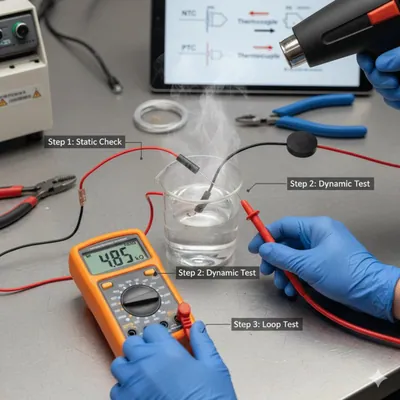
Disconnect the sensor and measure its resistance. A typical Ford CHT sensor reads 2000-3000 Ω at 68°F (20°C) and drops to 200-300 Ω at 194°F (90°C). An infinite reading (open) or near-zero reading (short) indicates a failed sensor.
Tools: Digital Multimeter with Ohms function (Advanced) - Advanced: Check CHT Sensor Voltage and Wiring
With the sensor connected and ignition on (engine off), back-probe the CHT signal wire. On a cold engine, voltage is 2.0V - 3.0V. At normal operating temperature, it drops to 0.5V - 0.6V. If stuck at 5V or 0V, check the wiring for continuity between the sensor and the PCM.
Tools: Digital Multimeter with DC Volts, Back-probe kit, Wiring diagram (Professional) - Advanced: Monitor Live Data PIDs
Monitor the CHT sensor voltage PID and temperature PID. Observe the voltage as the engine warms up. It must show a smooth, inverse correlation with temperature. Erratic voltage points to a sensor or wiring fault.
Tools: Advanced OBD-II Scan Tool with Live Data (Advanced)
When This Code Triggers (Freeze-Frame Conditions)
- Engine Coolant Temp (ECT) or CHT: 250°F+ (121°C+) (Triggers when the sensor reading exceeds the calibrated maximum, far above normal operating temperature.)
- RPM: 1500-3000 (Occurs under sustained load, such as steady highway cruising or climbing a grade, putting thermal stress on the cooling system.)
- Engine Load: 40-70% (The engine is working moderately hard, generating significant heat that a compromised cooling system cannot handle.)
- Vehicle Speed: 40-65 mph (Common during highway driving where engine load is constant and cooling system inefficiency becomes apparent.)
Related Codes
- P1299 — Means 'Cylinder Head Over-Temperature Protection Active' and is the second stage of Ford's fail-safe cooling strategy. P1285 is the initial warning; P1299 confirms the PCM has actively intervened by shutting down fuel injectors to cool the engine.
- P0217 — A generic code for 'Engine Over-Temperature Condition.' P1285 is manufacturer-specific and triggered by the CHT sensor reading the cylinder head's metal temperature, while P0217 indicates a general overheat.
- P0300-P0308 — Misfire codes (e.g., P0301 for cylinder 1) are very common with P1285 when the cause is an internal coolant leak. The misfire is caused by coolant fouling the spark plugs, a direct consequence of the internal leak.
- P0316 — Means 'Misfire Detected on Startup.' A strong indicator of coolant intrusion. It points to a misfire immediately upon starting a cold engine, suggesting coolant leaked into a cylinder while the car was off.
Climate & Environmental Factors
- High Altitude: Thinner air at high altitudes is less effective at dissipating heat from the radiator, increasing the engine's operating temperature and exposing marginal cooling system weaknesses.
- High Ambient Temperatures: Hot climates reduce the cooling system's efficiency, exposing underlying issues like a partially clogged radiator or a weak water pump.
- High Humidity: Prolonged exposure to high humidity accelerates corrosion on electrical components, including the CHT sensor connector, leading to a false P1285 code.
How to Talk to a Mechanic About This Code
Say this: "I have a P1285 code on my [Year, Make, Model] and need to schedule a diagnostic. I'm aware this is a critical overheat code. Please start by checking for any relevant TSBs for my VIN, and perform a cooling system pressure test and a chemical block test to check for internal leaks before replacing any parts."
This signals you are an informed customer who understands the gravity of P1285. It directs the shop to perform essential diagnostic steps to differentiate between a simple issue, a false sensor reading, and the catastrophic coolant intrusion failure. It prevents them from just replacing the CHT sensor.
Avoid saying:
- 'My car is overheating, can you fix it?'
- 'I think it's just a bad sensor, can you replace it?'
- 'Just do whatever you think is right.'
Questions to ask before authorizing the repair:
- Did you check my VIN for any open Customer Satisfaction Programs or TSBs related to coolant intrusion, like 21N12 or 22-2229?
- What were the results of the cooling system pressure test? Did it hold pressure?
- What were the results of the chemical block test? Did the fluid change color?
- If you're recommending an engine replacement, is it the updated/revised part number specified in the TSB?
- What is the parts and labor warranty for this specific repair?
Where to Take It: Dealer vs Independent vs Chain
- Dealer:
Best first stop for affected EcoBoost models to check for warranty or special program coverage. If not covered, their quote for an engine replacement serves as your baseline.
Best for: Vehicles within the 7yr/84k mile window for Ford's coolant intrusion programs (CSP 21N12)., Confirming eligibility for any TSBs or warranty extensions., Getting the definitive engine replacement with the correct revised parts.
Downsides: Highest labor rate., Unwilling to explore non-engine replacement options if a TSB applies. (Typical cost: +50% vs. baseline) - Independent Shop:
A strong choice for out-of-warranty repairs, IF you vet the shop. Ask if they have performed the EcoBoost coolant intrusion repair before.
Best for: Out-of-warranty vehicles where cost is a major factor., Diagnosing non-EcoBoost models or simpler failures like a water pump or thermostat., Getting a second opinion on a dealer's diagnosis.
Downsides: Must be a high-quality shop with experience in major engine work., Crucial to find one aware of the specific Ford coolant intrusion TSBs to avoid misdiagnosis. (Typical cost: +0% vs. baseline) - Chain Shop:
AVOID. P1285 is a complex, high-stakes code. Taking it to a chain shop is a recipe for disaster, wasted money, and catastrophic engine failure.
Best for: None. This repair is outside their scope.
Downsides: Technicians are not trained or equipped for complex internal engine diagnostics or major repairs like engine replacement., High risk of misdiagnosis, leading to wasted money on incorrect repairs. (Typical cost: -10% vs. baseline)
When to Walk Away From the Repair
If the estimated repair cost exceeds 50% of the car's current market value, sell the vehicle as-is.
- Car worth $10000, fix is $8500: Walk away. The repair cost is 85% of the car's value. You will never recoup this cost.
- Car worth $18000, fix is $8500: Borderline. The repair is ~47% of the vehicle's value. If the car is otherwise in excellent condition and you plan to keep it for many more years, fixing it makes sense. Get a second opinion first.
- Car worth $6000, fix is $450: Fix it. If the diagnosis is a simple stuck thermostat or bad sensor, the repair cost is low and well below the threshold.
What Scan Tool You Need for This Code
Minimum: A scanner that reads and graphs live data, specifically the Cylinder Head Temperature (CHT) PID.
A basic $20 code reader only shows the P1285 code. It cannot show live temperature data from the CHT sensor, which is essential to determine if the engine is truly overheating or if the sensor is providing a false reading.
Budget: BlueDriver Pro (~$100) — Connects to your smartphone via Bluetooth. It reads the code, provides freeze-frame data, and graphs the CHT sensor reading in real-time. This is enough for a skilled DIYer to determine if the overheat reading is plausible.
Mid-range: Innova 5610 / Foxwell NT510 Elite (~$180-350) — Powerful handheld units offering stable connections and fast data refresh. They provide excellent live data graphing for the CHT sensor and access manufacturer-specific codes and data from other modules, giving more diagnostic context.
Professional: Autel MaxiCOM MK808Z / Launch X431 series (~$450-1200) — Professional-level tablets offering full bi-directional control. For P1285, you can command the cooling fans to turn on to test their function. They provide the most comprehensive data and diagnostic capabilities outside of a dealership tool.
Rent vs buy: Auto parts stores read codes for free, but their loaner tools are basic code readers. For a P1285 diagnosis, where live data is critical, you must own or borrow a more capable scanner. If this is a one-time event, go to a professional. If you plan to do your own maintenance, buy a budget pick like the BlueDriver.
How to Clear the Code After You Fix It
- Use an OBD-II scan tool to formally clear all diagnostic trouble codes.
- Ensure the fuel tank is between 15% and 85% full.
- Perform a complete drive cycle to allow the vehicle's readiness monitors to run.
Drive cycle (~30 minutes): From a cold start (engine off for 8+ hours), idle for 2-3 minutes. Drive in mixed city/highway conditions, including steady cruising at 55-65 mph for at least 5-10 minutes. Include several accelerations and decelerations. Allow the engine to cool down completely afterward.
Readiness monitors affected: Comprehensive Component Monitor, Misfire Monitor, Catalyst Monitor, Evaporative System Monitor
Before emissions retest: drive at least 100 miles to fully set monitors.
Watch out for:
- Disconnecting the battery clears the code but resets all readiness monitors to 'Not Ready', causing an automatic emissions test failure.
- The P1285 code returns immediately if the underlying mechanical or electrical fault is not repaired.
- Not allowing the engine to cool completely before starting the drive cycle prevents the EVAP monitor from running.
Will This Fail Emissions / State Inspection?
Yes — this code typically fails an OBD-II emissions inspection.
- California: An active P1285 code is an automatic failure. All readiness monitors must be 'Ready' for the test to proceed. After repairs, a full drive cycle of 100+ miles is needed before re-testing.
- New York: The NYS DMV inspection includes an OBD-II scan. An illuminated Check Engine Light from a P1285 code results in an immediate test failure.
- Texas: In counties requiring emissions testing, an illuminated Check Engine Light is an automatic failure. You cannot pass the inspection until the vehicle is repaired and the code is cleared.
Most Commonly Affected Vehicles
- Ford Fusion (EcoBoost) (2014-2019) — Highly prone to the coolant intrusion issue due to the engine block design flaw in 1.5L and 2.0L engines. P1285 is a primary indicator for this failure (TSBs 19-2346, 20-2100, 22-2229).
- Ford Escape (EcoBoost) (2013-2019) — Shares the problematic 1.5L and 2.0L EcoBoost engines. Coolant intrusion is a very common cause for P1285. 2013-2014 1.6L models also had significant overheating issues.
- Ford Edge (EcoBoost) (2015-2020) — The 2.0L EcoBoost engine in 2015-2018 models suffers from the coolant intrusion problem (TSB 22-2229). 2019-2020 models experience overheating from a leaking EGR cooler (TSB 20-2234).
- Lincoln MKZ (2.0L EcoBoost) (2017-2019) — Affected by the engine block defect leading to coolant leaks into the cylinders, as noted in TSB 19-2346 and TSB 22-2229.
- Lincoln MKC (2.0L EcoBoost) (2017-2019) — Shares the 2.0L EcoBoost engine and platform with the Ford Escape, making it equally susceptible to the coolant intrusion failure (TSB 22-2229).
- Ford F-150 (2000-2010) — In these trucks (especially 4.6L/5.4L engines), the code is commonly associated with a failing CHT sensor, wiring, or a stuck thermostat. The CHT sensor is located under the intake manifold.
- Ford F-Super Duty (V10) (2005-2007) — TSB 06-21-15 addresses 6.8L V10 engines exhibiting false overheat conditions (P1285/P1299). The fix involves installing a revised thermostat and coolant crossover pipe.
- Ford Mustang (3.8L V6) (2001-2004) — Triggered by traditional overheating causes like a stuck thermostat, low coolant, or a failing CHT sensor located on the rear of the passenger-side cylinder head.
- Ford Ranger (2019-2023) — Less common than in EcoBoost cars, this code appears related to general cooling system issues or a faulty CHT sensor rather than a systemic engine block flaw.
- Chrysler/Dodge/Jeep Various Models (2008-2016) — Though primarily a Ford code, it appears on some FCA vehicles pointing to a faulty CHT sensor, wiring, or a stuck thermostat.
Manufacturer-Specific Notes
- Ford: P1285 is a key part of Ford's 'Fail-Safe Cooling Strategy.' The PCM intentionally commands the temperature gauge to its maximum reading to alert the driver, even before the coolant is boiling.
- Ford: Ford issued multiple TSBs for the coolant intrusion issue (TSB 22-2229, TSB 22-2134, TSB 19-2346). These bulletins explicitly name P1285 as a primary DTC and specify engine replacement as the definitive repair.
- Ford: Customer Satisfaction Program 21N12 provided a no-cost engine short block replacement for certain 2017-2019 Fusion and Escape 1.5L vehicles within 7 years or 84,000 miles, acknowledging P1285 as a key symptom.
- Ford: On 2005-2007 F-Super Duty trucks with 5.4L/6.8L engines, TSB 06-21-15 addresses false P1285/P1299 codes by installing a revised thermostat and an updated coolant crossover pipe.
- Ford: Erratic sensor readings, including a false P1285, are sometimes caused by a poor engine ground. Checking primary PCM ground points (like G101/G102) is a valid diagnostic step.
Real Owner Stories
2017 Ford Escape 1.5L EcoBoost at 80,000 miles
Check engine light came on with P1285, P1299, and P0302 (misfire cylinder 2). Coolant was a gallon low with no visible leaks. Engine ran rough on cold starts with white exhaust smoke.
What they tried:
- Owner initially suspected a bad sensor or thermostat.
- A pressure test showed the system losing pressure, but no external leaks were found.
Outcome: A borescope inspection revealed significant coolant in cylinder 2. Diagnosed as coolant intrusion from a cracked engine block. The fix was a complete short block engine replacement per Ford TSB 20-2100, costing over $7,000.
Lesson: On an EcoBoost engine, if P1285 is paired with misfire codes and coolant loss, do not waste money on simple fixes. The problem is coolant intrusion requiring an engine replacement. Confirm with a chemical block test or borescope.
2002 Ford Mustang 3.8L V6 at 96,000 miles
Car overheated badly on the freeway, temp gauge pegged, and P1285 code appeared. Owner found the coolant was low and topped it off. The code remained.
What they tried:
- Replaced the thermostat, but the issue persisted.
- Replaced the CHT sensor located on the back of the cylinder head.
Outcome: Replacing the CHT sensor cleared the code. The initial overheat was caused by low coolant, but the extreme heat damaged the original CHT sensor, causing the code to persist after refilling.
Lesson: On older, non-EcoBoost engines, P1285 is caused by a simple overheat event that damages the sensor. Fix the root cause of the overheat first, but be prepared to replace the CHT sensor if the code doesn't clear.
2009 Ford Escape 3.0L V6 with P1285 & P1299
While driving, the engine suddenly died. After a brief wait, it restarted, drove a short distance, and died again. Check engine light was on with codes P1285 and P1299.
What they tried:
- A scan tool showed the CHT reading over 250°F, confirming a real overheat.
- Technician inspected the cooling system and found the water pump belt broken.
Outcome: The water pump pulley seized, breaking the drive belt. This stopped all coolant circulation, causing rapid overheat and engine shutdown. The fix was a new water pump and belt. The engine was protected by Ford's fail-safe cooling strategy.
Lesson: If the engine shuts itself off, Ford's fail-safe system is active. Check for coolant circulation (e.g., are both radiator hoses hot?) to quickly diagnose a flow problem like a failed water pump.
How to Prevent This Code From Triggering
- Perform regular coolant flushes with the correct coolant type. (Every 30,000 to 60,000 miles, or as specified by the manufacturer.) — Corrosion-inhibiting additives in coolant break down, making the fluid acidic. Acidic coolant corrodes internal engine components, the water pump, and the radiator, leading to leaks and blockages.
- Use only the specified Ford Motorcraft coolant. (Every time you top off or flush the system.) — Ford engines are sensitive to coolant chemistry. Using generic coolant leads to premature breakdown of seals and gaskets. For modern Fords, this is typically Motorcraft VC-13-G (Yellow).
- Inspect cooling system hoses and the coolant reservoir. (During every oil change.) — Rubber hoses become brittle and plastic reservoirs develop hairline cracks. Catching a small leak early prevents a catastrophic failure and subsequent overheat on the road.
- Allow the engine to properly warm up before aggressive driving. (Daily habit.) — For EcoBoost engines, rapid temperature changes create thermal stress on the thin walls between cylinders. Allowing the engine to reach operating temperature gently reduces stress cycles that contribute to cracks.
- Do not ignore a low coolant light or a rising temperature gauge. (Always.) — P1285 is the result of a failure, not the cause. Addressing a small leak or a weak water pump when early signs appear prevents the overheat that triggers P1285 and causes major engine damage.
Frequently Asked Questions
Can I just replace the CHT sensor to fix a P1285 code?
Replacing the sensor rarely fixes the problem, especially on affected EcoBoost models. P1285 is almost always triggered by a real and severe overheating condition. Ignoring the root cause leads to catastrophic engine damage.
Is a P1285 code the same as a bad head gasket?
No. While a blown head gasket causes overheating, modern Ford engines more commonly suffer from a cracked engine block (coolant intrusion). A head gasket replacement will not fix a cracked block.
Why did my temperature gauge shoot to HOT instantly?
This is a designed fail-safe feature on many Ford vehicles. The PCM detects a critical temperature and deliberately pegs the gauge to maximum to force you to stop driving immediately.
My coolant level is full, but I still have a P1285. What's the problem?
If you are not losing coolant, the problem lies in circulation or measurement. The most likely causes are a stuck-closed thermostat, a failing water pump, a clogged radiator, or a faulty CHT sensor.
I got a P1285 code right after replacing my thermostat. What's wrong?
This is caused by an air pocket trapped in the cooling system during the repair. Trapped air creates a localized hot spot that triggers the CHT sensor. You must properly 'burp' the system to purge all air.
What if the engine isn't actually overheating but the code is on?
If you confirm the engine is cool, the fault is electrical. The most likely culprits are a failed CHT sensor, a corroded electrical connector, or a damaged wire harness. Rarely, an exhaust leak near the sensor causes a false reading.
Will my car be covered by a recall for this issue?
There are no universal recalls for P1285, but Ford issued numerous Technical Service Bulletins (TSBs) and Customer Satisfaction Programs for EcoBoost coolant intrusion. Contact a Ford dealer with your VIN to check for active extended warranty coverage.
What are the most common misdiagnosis mistakes with P1285?
The biggest mistake is replacing the CHT sensor without confirming if the engine is actually overheating. The second is assuming a simple head gasket leak on EcoBoost engines instead of the more common cracked block. Always perform a chemical block test before major repairs.
Can an exhaust leak cause a P1285 code?
Yes, though it is rare. A significant exhaust manifold leak near the cylinder head superheats the CHT sensor. This tricks the computer into thinking the cylinder head is overheating when it is not.
Key Takeaways
- Code P1285 indicates a critically hot cylinder head; pull over immediately to prevent catastrophic engine failure costing upwards of $8,000.
- On 2013-2020 Ford and Lincoln EcoBoost models, P1285 frequently signals a cracked engine block requiring a $7,000+ complete engine replacement.
- Always perform a $30 chemical block test before replacing parts to differentiate between a simple stuck thermostat and a fatal internal coolant leak.
- Provide your VIN to a Ford dealer to check for active Technical Service Bulletins (like TSB 22-2229) that might cover the repair cost under extended warranty programs.
Helpful Videos

Shop the Parts Behind P1285
Below are the parts most often responsible for code P1285, ranked by how frequently each one is the actual culprit (per the diagnosis above). Tap any to see what we have for your vehicle.


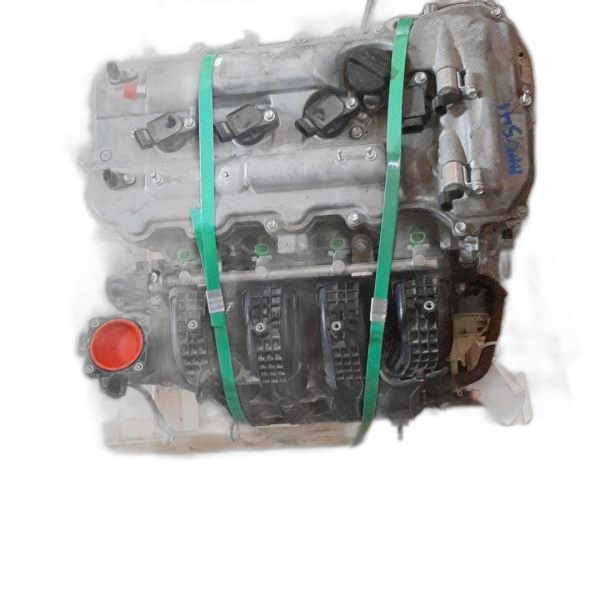
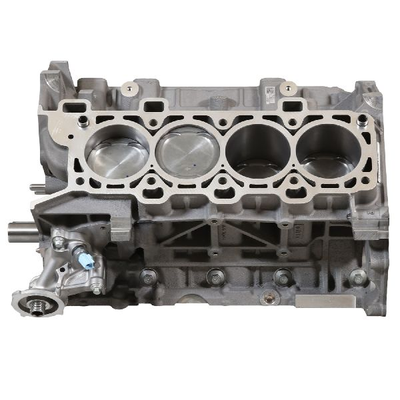



The information in this article is provided for general reference and educational purposes only. Vehicle specifications, procedures, and part compatibility can vary by production date, trim level, and region. Always consult your vehicle's factory service manual and verify part numbers before purchasing or performing repairs. Safety-critical components such as airbags, seat belts, and braking systems should be installed by a qualified professional.
- 🧭 Diagnostic Flowchart
- 🎬 Helpful Videos
- 🛍️ Shop This Part
- What Does P1285 Mean?
- Can I Drive With P1285?
- Common Causes
- Symptoms
- Common Fixes & Costs
- DIY vs Professional
- Used vs. New Parts: Buying Guide
- What Happens If You Wait — Timeline
- Cost of Not Fixing It
- Diagnosis Steps
- When This Code Triggers (Freeze-Frame Conditions)
- Related Codes
- Climate & Environmental Factors
- How to Talk to a Mechanic About This Code
- Where to Take It: Dealer vs Independent vs Chain
- When to Walk Away From the Repair
- What Scan Tool You Need for This Code
- How to Clear the Code After You Fix It
- Will This Fail Emissions / State Inspection?
- Most Commonly Affected Vehicles
- Manufacturer-Specific Notes
- Real Owner Stories
- 2017 Ford Escape 1.5L EcoBoost at 80,000 miles
- 2002 Ford Mustang 3.8L V6 at 96,000 miles
- 2009 Ford Escape 3.0L V6 with P1285 & P1299
- How to Prevent This Code From Triggering
- Frequently Asked Questions
- Can I just replace the CHT sensor to fix a P1285 code?
- Is a P1285 code the same as a bad head gasket?
- Why did my temperature gauge shoot to HOT instantly?
- My coolant level is full, but I still have a P1285. What's the problem?
- I got a P1285 code right after replacing my thermostat. What's wrong?
- What if the engine isn't actually overheating but the code is on?
- Will my car be covered by a recall for this issue?
- What are the most common misdiagnosis mistakes with P1285?
- Can an exhaust leak cause a P1285 code?
- Key Takeaways
- 🎟️ Get 5% Off