

P1299 on 2001-2012 Ford Escape: Cylinder Head Overheating Causes and Fixes
P1299 means your Escape's engine has entered a protective 'limp mode' due to a detected overheat. The most common cause is a faulty Cylinder Head Temperature (CHT) sensor giving a false reading, especially if the warning appears on a cold engine. If the engine is truly hot, you have a cooling system problem like low coolant, a bad thermostat, or a failing water pump.
- P1299 is a critical code. Stop driving immediately to prevent severe engine damage.
- Your first step is to determine if the engine is truly overheating or if the warning appeared on a cold engine.
- If the engine is cold, the most likely problem is a failed Cylinder Head Temperature (CHT) sensor.
- If the engine is hot, you have a standard cooling system problem to diagnose, such as a leak, bad thermostat, or water pump.
- On the 3.0L V6 engine, be prepared for a significant labor charge to replace the CHT sensor due to its location under the intake manifold.
What's Unique About the 2001-2012 Ford Escape
On the 2001-2012 Ford Escape and its platform mates, the Mazda Tribute and Mercury Mariner, this code presents a clear diagnostic fork: is it a real overheat or a sensor error? Unlike later EcoBoost models known for complex coolant intrusion issues, the problem on these Escapes is typically more straightforward. For the 3.0L V6, the story is about the CHT sensor's notoriously difficult location under the intake manifold, turning a simple part swap into a multi-hour job. For all engines, the CHT sensor is a primary suspect, often failing and sending a false 'hot' signal when the engine is cold, a scenario frequently discussed by owners in forums.
Generation note: This guide covers the first (2001-2007) and second (2008-2012) generations of the Ford Escape. The meaning of P1299 is the same for both. The primary differences are the engine options and the specific location of the Cylinder Head Temperature (CHT) sensor, which can vary between the I4 and V6 engines.
Symptoms You May Notice
- Check Engine Light is on
- Temperature gauge reads full HOT, often immediately after starting
- Dashboard message indicating 'Engine Overheated' or similar warning
- Drastically reduced engine power (Limp Mode)
- Engine may run rough, misfire, or stall
- Cooling fans running constantly at high speed, even on a cold engine
- Replacing the Engine Coolant Temperature (ECT) sensor. Most of these Ford engines rely on a CHT sensor that measures metal temperature, not a sensor that sits in the coolant. Replacing the wrong sensor will not fix the issue.
- Assuming a major engine failure (like a head gasket) without proper diagnosis. While P1299 indicates a critical condition, it is very often triggered by a simple, inexpensive sensor failure, as documented in many owner forums.
Most Likely Causes
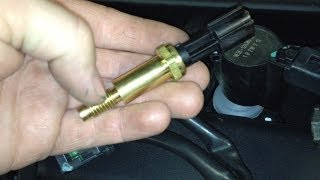
- Faulty Cylinder Head Temperature (CHT) Sensor 🔴 High Probability → Shop Engine Cylinder Head The CHT sensor is a common failure point. It can fail internally and send an incorrect, high-resistance signal that the PCM interprets as an extreme temperature, even when the engine is cold.
How to confirm: If the temperature gauge goes to HOT instantly on a cold engine, the CHT sensor is almost certainly the culprit. You can use a scan tool to read the live CHT data; a reading of 250°F+ on a cold engine confirms sensor failure. You can also test the sensor's resistance with a multimeter. Expected values are approximately 37,000 Ohms at 68°F (20°C) and 2,000-3,000 Ohms at 212°F (100°C).
Typical fix: Replace the Cylinder Head Temperature (CHT) sensor and inspect the connector pigtail for corrosion or damage, replacing it if necessary.
Est. part cost: $25-$80 - Low Engine Coolant Level 🟡 Medium Probability Leaks can develop over time in aging hoses, the radiator, water pump seals, or thermostat housing, leading to insufficient coolant to manage engine heat.
How to confirm: Visually inspect the coolant level in the overflow reservoir and the radiator (only when the engine is completely cool). Check for visible puddles of green, orange, or yellow fluid under the vehicle and signs of leaks around the engine bay.
Typical fix: Find and repair the source of the leak (e.g., replace a hose, radiator, or water pump), then refill and bleed the cooling system with the correct type of coolant.
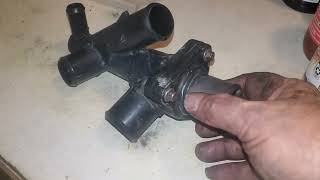
Est. part cost: $10-$500+ - Stuck Thermostat 🟡 Medium Probability → Shop Integrated Thermostat Housing Assembly The thermostat can fail and get stuck in the closed position, preventing coolant from circulating to the radiator and causing a rapid overheating condition.
How to confirm: After starting a cold engine, feel the upper radiator hose. It should remain cool for a few minutes and then get hot quickly as the thermostat opens. If the engine gets hot but the hose stays cool or only gets warm, the thermostat is likely stuck closed.
Typical fix: Replace the thermostat and gasket. It is often recommended to replace the coolant at the same time.
Est. part cost: $20-$60 - Failing Water Pump ⚪ Low Probability → Shop Engine Water Pump The water pump impeller can degrade or break, or the pump can leak from its weep hole, leading to a lack of coolant circulation and a genuine overheat condition.
How to confirm: Listen for a grinding or whining noise from the front of the engine. Look for coolant leaks from the pump's weep hole. With the engine running, a lack of coolant flow visible in the radiator (with cap off, when cool) can indicate a bad pump.
Typical fix: Replace the water pump. This is often a more labor-intensive job.
Est. part cost: $50-$200
Rare But Worth Checking
- Faulty Cooling Fan Assembly: If overheating only occurs in stop-and-go traffic or at idle, but is fine on the highway, the cooling fans may not be activating. Check fuses and relays first, then test the fan motor. This was the solution for one owner after replacing the CHT and thermostat.
- Damaged CHT Sensor Wiring: The wiring or connector for the CHT sensor can become damaged, corroded, or chewed by rodents, causing a short or open circuit that mimics a failed sensor. The connector pigtail is a common replacement part (Motorcraft WPT-118).
- Faulty Powertrain Control Module (PCM): This is extremely rare. The PCM should only be considered as a cause after all other possibilities, including wiring, have been exhaustively checked and ruled out.
Diagnosis Steps
- DO NOT open the radiator cap if the engine is hot. Let the vehicle cool down completely for several hours.
- Determine if the engine is actually overheating. If the P1299 code and 'HOT' gauge appeared instantly on a cold start, proceed to Step 6.
- If the engine may be genuinely hot, use an infrared thermometer to check the temperature of the cylinder head and radiator hoses to verify an overheat condition.
- If actually overheating, check the coolant level in the reservoir and radiator (when cool). If low, top it off and inspect for obvious leaks from hoses, the radiator, and the water pump area.
- If the coolant level is okay but the engine is overheating, diagnose the cooling system components: check for a stuck thermostat, ensure cooling fans are operating, and verify the water pump is circulating coolant.
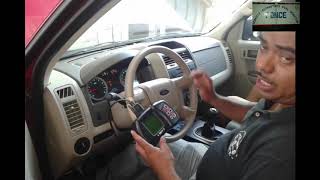
- If the engine is physically cold but the gauge reads HOT, the CHT sensor is the primary suspect. Use a scan tool to confirm the CHT reading is illogically high (e.g., >250°F).
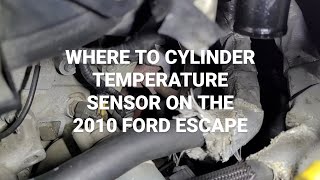
- Locate and inspect the CHT sensor and its wiring connector for any signs of damage, corrosion, or coolant contamination. On 4-cylinder engines, it's accessible between the #2 and #3 spark plugs. 🎬 Watch: Locate the CHT sensor on a 2010 Escape On the 3.0L V6, it is located under the lower intake manifold, between the cylinder heads.
- Test the CHT sensor with a multimeter or replace it. For the 3.0L V6, be aware that this requires removing the intake manifold. If the connector is damaged, replace it with a pigtail kit like Motorcraft WPT-118.
- After repairs, clear the DTCs with a scan tool and test drive to ensure the problem is resolved.
Parts You'll Likely Need
- Cylinder Head Temperature (CHT) Sensor
(OEM #XL3Z-6G004-AA)— This is the most common cause of a false P1299 code, especially when the overheat warning appears on a cold engine. This part number is widely used across many Ford engines from this era.
Trusted brands: Motorcraft, Bosch, Standard Motor Products (SMP)
OEM price range: $40-$80
Aftermarket price range: $25-$50 - CHT Sensor Connector Pigtail
(OEM #WPT-118)— The sensor connector can become brittle, corroded, or the locking tab can break, causing an intermittent connection that mimics a failed sensor. Replacing the pigtail ensures a solid connection.
Trusted brands: Motorcraft
OEM price range: $40-$70
Aftermarket price range: $15-$30
Related Codes That Often Appear With This One
- P0298 — On the 3.0L V6, the PCM uses the CHT sensor reading to calculate oil temperature. A faulty CHT sensor sending a false high temp reading will often trigger both P1299 and P0298 (Engine Oil Over Temperature) simultaneously.
- P1285 — This code for 'Cylinder Head Over-Temperature Sensed' is a precursor to P1299. It indicates the engine is approaching the critical limit, while P1299 means the limit has been breached and protective action is being taken.
Platform-Specific Known Issues
- On the 3.0L Duratec V6, the CHT sensor is located on the rear cylinder head, underneath the upper and lower intake manifolds. Its replacement is a labor-intensive job requiring 3-5 hours.
- A faulty CHT sensor on the 3.0L V6 will often set code P0298 (Engine Oil Over Temperature) along with P1299, because the PCM uses the CHT data to infer oil temperature.
Mechanic-Grade Diagnostic Values
- CHT Sensor Resistance vs. Temperature — expected: Approx. 37,000Ω at 68°F (20°C); Approx. 2,400Ω at 212°F (100°C). A more detailed reference is: ~10,000Ω at 0°C, ~3,000Ω at 20°C, ~300Ω at 80°C.. Failure: Infinite resistance (open circuit), near-zero resistance (short circuit), or a value that does not change as the engine warms up.
- CHT Sensor Signal Voltage (Key On, Engine Off, Cold Engine) — expected: Typically 3.0V - 3.7V at the PCM, read via a scan tool PID or by back-probing the signal wire.. Failure: A voltage reading near 5.0V indicates an open circuit or unplugged sensor. A reading near 0.0V indicates a short to ground. The PCM will typically set a fault if the voltage exceeds 4.6V.
- CHT Sensor Connector Reference Voltage (KOEO, Connector Unplugged) — expected: One of the two pins in the harness-side connector should have a steady ~5.0V reference signal from the PCM.. Failure: No voltage or very low voltage on the reference wire points to a problem in the wiring harness or an issue with the PCM itself.
Scan Tool Commands That Help
- Ford IDS (Integrated Diagnostic System): Datalogger - CHT PID Monitoring — This is the primary method for diagnosing a false overheat signal. On a cold start, the CHT PID should display a temperature close to the ambient air and IAT sensor readings. If it immediately shows a high temperature (e.g., 260°F), it confirms a sensor or circuit fault.
- Ford IDS (or equivalent professional scanner): KOEO (Key On, Engine Off) and KOER (Key On, Engine Running) Self-Tests — Running these self-tests can help identify related circuit fault codes (like P1289 - CHT Sensor High Input or P1290 - CHT Sensor Low Input) that may not be immediately present but are stored, helping to pinpoint the exact electrical fault.
Wiring & Ground Locations
- G101 — Varies by engine and year. For 2008-2009 models: on the rear of the engine for the 2.5L I4, or near the battery for the 3.0L V6. For 2004 models: on the top center of the transmission.. This is a primary engine and transmission ground. A poor connection here can cause erratic sensor readings for multiple components, including the CHT sensor.
- G104 — Typically located at the left front corner of the engine compartment, near the Battery Junction Box (BJB) / underhood fuse panel.. This is a critical engine compartment ground point. Corrosion or a loose connection at G104 can directly cause incorrect CHT sensor readings and trigger a false P1299 code.
- CHT Sensor Connector — On 4-cylinder engines (2.0L, 2.3L, 2.5L), it is on the cylinder head between the #2 and #3 spark plugs/ignition coils. On the 3.0L V6, it is buried under the lower intake manifold.. This is the direct connection point. The connector itself or the wiring pigtail can become corroded, brittle, or damaged, causing an open or short in the circuit.
- Powertrain Control Module (PCM) — On second-generation models (2008-2012), the PCM is often located on the driver's side of the engine bay, under the headlight and near the front wheel.. Knowing the PCM location is necessary for advanced circuit testing, such as checking for continuity and voltage directly at the module's pins to rule out wiring harness issues.
Real Owner Repair Stories
- AliExpress Review / Blog Post (2013 Ford Escape 2.0L (similar platform/engine family)) — Intermittent check engine light, rough idling, sudden power drops on the highway, and a persistent P1299 code.
❌ Tried (didn't work) Checking for low coolant or air pockets in the cooling system.
✅ What actually fixed it The owner performed a wiring continuity test and found frayed copper strands in the CHT sensor harness at a tight bend point near the AC compressor mount. A temporary solder fix worked, but the ultimate solution was replacing the CHT sensor itself, suggesting both the wiring and sensor were compromised. - YouTube video by 'Living the Northern Life' (2017 Ford Escape (newer model, but demonstrates common repair issue)) — P1299 code, engine in limp mode.
✅ What actually fixed it Replacing the Cylinder Head Temperature (CHT) sensor resolved the code. The owner noted the extreme difficulty in the repair, stating it took over an hour just to release the electrical connector's clip due to its tight location and orientation. The repair was confirmed successful after three weeks of driving.
OEM Part Supersession History
XL3Z-6G004-AA→N/A— No supersession information found in searches. This part number appears to be stable for the specified vehicle range.
Model Year Variations Within This Range
- 2001-2007 vs 2008-2012: The location of primary ground G101 can differ. On some earlier models (e.g., 2004), it is located on the top of the transmission. On later models (e.g., 2008-2009), it is located on the rear of the engine for I4 models or near the battery for V6 models. While both serve as a critical ground, their physical location for inspection varies.
Diagnostic Flowchart
Other Known Issues on This Vehicle
Issues unrelated to this code that are worth knowing about as an owner of this generation:
- Rear Shock Tower Rust 🔴 High — Very common in salt-belt regions, can occur on vehicles over 5-7 years old. The passenger side rear is notoriously prone to failure first. (Ref: No recall, but it is a widely documented failure. Repair panels are available (e.g., Part #924-358).)
- CD4E Automatic Transmission Failure 🔴 High — Common in first-generation (2001-2008) models, often before 100,000 miles. Symptoms include harsh shifting, flashing O/D light, and eventual loss of forward gears. (Ref: A recall existed for a small batch of remanufactured transmissions, but not for the widespread internal failures.)
- Ignition Coil Failure (especially 3.0L V6) 🟠 Medium — A frequent cause of misfires (P030X codes). On the 3.0L V6, the rear three coils are under the intake manifold, making replacement labor-intensive. A failed coil can also damage the PCM. (Ref: TSBs have been issued for some model years suggesting RF interference from spark plugs can damage coils and the PCM.)
- Alternator Failure 🟠 Medium — Common across all engines, often occurring between 80,000 and 150,000 miles. The location on the V6 can make replacement difficult.
- Blower Motor Resistor Failure 🟡 Low — Extremely common issue where the fan only works on the highest setting. It's an inexpensive and relatively easy part to replace behind the glove box.
Used vs. New Parts: Buying Guide for This Vehicle
When a used part is the smart pick: For this specific code, using used parts is generally not recommended for the primary cause (CHT sensor), as it is an inexpensive electronic part prone to failure. However, a used part from a reputable salvage yard could be a cost-effective option for more expensive secondary causes like a complete cooling fan assembly or a Powertrain Control Module (PCM), provided it can be reprogrammed.
Donor-vehicle mileage cap: roughly under 80000 miles for the part to have meaningful remaining life.
What to inspect on the donor part:
- For electrical parts (fan assembly, PCM): Check for any signs of corrosion on connectors, cut wires, or physical damage to the housing.
- For mechanical parts (water pump): Check for excessive play in the pulley shaft and look for any signs of leakage from the weep hole.
- Verify the donor vehicle was not involved in a front-end collision, which could have caused unseen damage to the radiator or fans.
OEM-only on this vehicle (don't cheap out):
- Powertrain Control Module (PCM): While a used PCM can work, it requires specific programming to the vehicle's VIN and options. This often makes a new or professionally remanufactured OEM unit a more reliable, albeit more expensive, choice.
Aftermarket brands forum-validated for this vehicle:
- For the CHT Sensor, brands like Standard Motor Products (SMP) and NTK are reported to be reliable, high-quality alternatives to OEM.
Brands owners have reported issues with on this vehicle:
- No specific brands were consistently reported as problematic in search results, but it is generally advised to avoid unbranded, 'white-box' sensors due to the labor involved in replacement, especially on the V6 engine.
Real Owner Stories
Aggregated from forums and TSBs cited above. Mileages and costs reflect what owners reported in those sources.
2012 Ford Escape 2.5L
Symptoms: Owner received a P1299 code. They attempted to fix it by replacing the CHT sensor and the thermostat, but the issue persisted.
What fixed it: The problem was eventually traced to a faulty cooling fan relay.
Source hint: FordForums.com thread titled 'Calling all coolant system gurus'
2001 Ford Escape 3.0L V6 — ~100000 miles
Symptoms: Flashing O/D light and reduced engine power.
What fixed it: The vehicle required a full transmission rebuild due to internal failure of the CD4E unit.
Cost: $3500-$3500
Source hint: Ford Truck Enthusiasts Forums thread 'CD4E transmission problem'
2013 Ford Escape (Newer Gen Logic)
Symptoms: The temperature gauge went to 'full hot' while sitting in the driveway immediately upon startup.
What fixed it: Identified as a sensor or wiring issue rather than a physical overheat, as P1299 indicates the protection strategy is active.
Source hint: Reddit r/MechanicAdvice thread 'Need help 2013 Ford Escape SE 1.6L code P1299'
Related OBD-II Codes
Frequently Asked Questions
My 2001-2012 Ford Escape temperature gauge jumped to HOT immediately after a cold start. Is my engine actually overheating?
Where is the CHT sensor located on my 3.0L V6 Duratec engine?
I have a 2.3L 4-cylinder Escape; is the CHT sensor easier to reach than on the V6?
Why are my cooling fans running at high speed even though I just started the car?
Is there a specific replacement part for a damaged CHT sensor connector?
Does this P1299 issue affect the Mazda Tribute or Mercury Mariner as well?
Helpful Videos
We Have This Part in Stock


The information in this article is provided for general reference and educational purposes only. Vehicle specifications, procedures, and part compatibility can vary by production date, trim level, and region. Always consult your vehicle's factory service manual and verify part numbers before purchasing or performing repairs. Safety-critical components such as airbags, seat belts, and braking systems should be installed by a qualified professional.
- Ford Escape:
- 🧭 Diagnostic Flowchart
- 🎬 Helpful Videos
- 🛍️ Shop This Part
- What's Unique About the 2001-2012 Ford Escape
- Symptoms You May Notice
- Most Likely Causes
- Rare But Worth Checking
- Diagnosis Steps
- Parts You'll Likely Need
- Related Codes That Often Appear With This One
- Platform-Specific Known Issues
- Mechanic-Grade Diagnostic Values
- Scan Tool Commands That Help
- Wiring & Ground Locations
- Real Owner Repair Stories
- OEM Part Supersession History
- Model Year Variations Within This Range
- Other Known Issues on This Vehicle
- Used vs. New Parts: Buying Guide for This Vehicle
- Real Owner Stories
- 2012 Ford Escape 2.5L
- 2001 Ford Escape 3.0L V6 — ~100000 miles
- 2013 Ford Escape (Newer Gen Logic)
- Related OBD-II Codes
- Frequently Asked Questions
- 🎟️ Get 5% Off