

P1299 on 2000-2007 Ford Focus: Cylinder Head Over Temperature Causes and Fixes
On a 2000-2007 Ford Focus, code P1299 is most often caused by a faulty Cylinder Head Temperature (CHT) sensor giving a false overheating signal. Replacing the sensor is a common DIY fix costing around $30-$50 for the part, but requires a special extra-deep 19mm socket to access it between the spark plugs.
- P1299 is a critical code. Stop driving immediately to prevent severe engine damage.
- The first step is to determine if the engine is truly overheating. Use an infrared thermometer to check the cylinder head temperature.
- A faulty Cylinder Head Temperature (CHT) sensor is the most likely cause. If the engine is cold but a scan tool shows a hot reading, replace the sensor.
- Replacing the CHT sensor requires a special tool: an extra-deep 19mm socket.
- Always inspect the sensor's electrical connector; it's a common point of failure and may need to be replaced.
What's Unique About the 2000-2007 Ford Focus
Unlike many vehicles that measure coolant temperature, the 2000-2007 Ford Focus uses a 'dry' Cylinder Head Temperature (CHT) sensor screwed directly into the engine's metal between the spark plug wells. This design allows the computer to detect an overheat condition even if there's a catastrophic coolant loss. However, it also means a simple sensor failure can trick the computer into thinking the engine is overheating when it's not, making a faulty CHT sensor a very common cause for this code on the Focus.
Generation note: The 2000-2007 year range covers the entire first generation of the Ford Focus in North America, including the original (2000-2004) and the facelifted models (2005-2007). The CHT sensor system, its location between the #2 and #3 spark plugs, and the meaning of code P1299 are consistent 🎬 Watch: How to fix the P1299 overtemperature protection message. across these years for both the 2.0L Zetec and 2.3L Duratec engines.
Symptoms You May Notice
- Check Engine Light is on
- Engine goes into 'limp mode' with severely reduced power
- Flashing or illuminated engine temperature warning light
- Temperature gauge behaves erratically, swinging from cold to hot suddenly
- Engine may run rough or hesitate
- Cooling fans run constantly at high speed, even when the engine is cold
- Air conditioning may shut off
- Sudden overheating warning right after starting the vehicle
- Replacing the thermostat when the actual problem is a faulty CHT sensor sending a false signal.
- Assuming the engine is fine because the coolant level is full, without verifying the CHT sensor's reading against the actual engine temperature.
- Replacing the wrong sensor. This vehicle uses a CHT sensor for the PCM and a separate coolant temperature sender for the gauge on some configurations, which can cause confusion.
Most Likely Causes
- Faulty Cylinder Head Temperature (CHT) Sensor 🔴 High Probability → Shop Engine Cylinder Head The sensor is a common failure item. It can send an incorrect high-temperature reading to the PCM, triggering the P1299 code even on a cold engine, sometimes immediately after startup.
How to confirm: With a cold engine, use a scan tool to view live CHT data. If the temperature reads an impossibly high value (e.g., 250°F / 121°C) immediately after startup, the sensor is bad. Alternatively, use an infrared thermometer to confirm the actual cylinder head temperature does not match the sensor's reading. You can also test the sensor's resistance with a multimeter; at room temperature (~68°F/20°C), it should be around 37,000 ohms (37 kΩ).
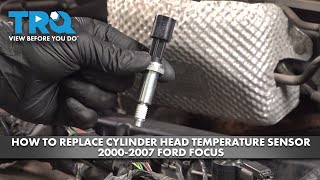
Typical fix: Replace the CHT sensor. This is a 'dry' sensor, so no coolant needs to be drained. It requires a special extra-deep 19mm socket for removal 🎬 See this walkthrough for replacing the sensor on Zetec engines. and installation to clear the sensor's body. The sensor is located between the #2 and #3 spark plugs, under a rubber boot and sometimes the ignition coil bracket.
Est. part cost: $25-$55 - Damaged CHT Sensor Connector or Wiring 🟡 Medium Probability Located on top of the engine, the plastic connector and wiring are exposed to extreme heat cycles, causing them to become brittle and fail over time. The connector's locking tab frequently breaks during sensor removal.
How to confirm: Visually inspect the CHT sensor's electrical connector for cracks, corrosion, or broken locking tabs. Wiggle the connector with the engine running (if safe to do so) to see if it affects the temperature reading. Check for continuity and resistance in the wiring harness between the sensor and the PCM. With the key on and sensor disconnected, one wire should have a 5-volt reference signal.
Typical fix: Replace the connector pigtail, which involves cutting the old connector off and splicing the new one in. Using heat-shrink butt connectors is recommended for a durable, weather-resistant repair. The Motorcraft pigtail is part number WPT-985.
Est. part cost: $15-$30 - Low Engine Coolant Level 🟡 Medium Probability Coolant leaks from hoses, the radiator, water pump, or the plastic thermostat housing can lead to an actual overheating condition. The thermostat housing is a known weak point. A manufacturer service bulletin for other Ford models, TSB 26-2060, notes that a loss of engine coolant can occur at the heater hose assembly near the cooling fan, potentially triggering P1299.
How to confirm: Visually check the coolant level in the expansion tank when the engine is cool. Inspect the engine bay and under the car for any signs of green, yellow, or orange coolant leaks, paying close attention to the thermostat housing area.
Typical fix: Find and repair the source of the leak, then refill and bleed the cooling system with the correct type of coolant (Ford specifies Motorcraft Gold or equivalent).
Est. part cost: $10-$300+ - Stuck-Closed Thermostat ⚪ Low Probability → Shop Integrated Thermostat Housing Assembly Thermostats can fail with age, sticking in the closed position and preventing coolant from circulating to the radiator.
How to confirm: After the engine has warmed up, carefully feel the upper and lower radiator hoses. If the upper hose is hot and the lower hose is cool, the thermostat is likely stuck closed and not allowing coolant to flow.
Typical fix: Replace the thermostat and gasket/housing. It's recommended to also replace the coolant at the same time.
Est. part cost: $20-$50
Rare But Worth Checking
- Failing Water Pump: → Shop Engine Water Pump A water pump failure will cause a legitimate and rapid overheat. Look for coolant leaking from the pump's weep hole or listen for grinding noises from the pump pulley area. NHTSA ODI #11569516 describes a case where P1299 appeared alongside P2601, indicating a fault in the coolant pump control circuit.
- Air Trapped in the Cooling System: If the cooling system was recently serviced, an air pocket can get trapped and cause localized overheating in the cylinder head, triggering the CHT sensor even if the overall coolant temperature seems normal. The system may need to be properly 'burped' or vacuum-filled to remove the air.
- Faulty Powertrain Control Module (PCM): This is extremely rare. The PCM should only be considered after all other possibilities, including the sensor, wiring, and the entire cooling system, have been thoroughly tested and ruled out.
Diagnosis Steps
- STOP DRIVING. Pull over safely and turn off the engine.
- Check for obvious signs of overheating: steam from the engine bay, the smell of hot coolant, or visible coolant leaks on the ground.
- Allow the engine to cool completely for several hours.
- Once cool, check the coolant level in the expansion tank. If it is low, you have a leak that must be found and repaired.
- If the coolant level is correct, the next step is to determine if the overheat signal is real or false. Use an OBD-II scanner to read the live data from the Cylinder Head Temperature (CHT) sensor *before* starting the cold engine. If it shows a high temperature (e.g., over 200°F), the sensor or its wiring is faulty.
- If the cold reading is normal, start the engine and monitor the CHT temperature on the scan tool. Compare this reading to the actual temperature of the cylinder head using an infrared thermometer. If the readings differ significantly, the sensor is likely bad.
- If the sensor reading accurately reflects a real overheating condition (temperature climbing past ~230°F), diagnose the mechanical cooling system: check for a stuck thermostat, failing water pump, or clogged radiator.
- Inspect the CHT sensor's electrical connector and wiring for any signs of damage, corrosion, or looseness. The connector is often brittle and can be the source of the problem.
Parts You'll Likely Need
- Cylinder Head Temperature (CHT) Sensor
(OEM #8S4Z-6G004-A)— This is the most common failure point for a P1299 code on this vehicle, often sending false overheat signals. OEM is strongly recommended for accuracy.
Trusted brands: Motorcraft, Standard Motor Products, NGK, Walker Products
OEM price range: $35-$55
Aftermarket price range: $25-$40 - CHT Sensor Connector Pigtail
(OEM #WPT-985)— The original connector becomes brittle from engine heat and often breaks during sensor replacement 🎬 Watch: Step-by-step guide to replacing the CHT sensor and connector. or fails on its own, causing a bad connection. This is a common point of failure.
Trusted brands: Motorcraft, Dorman (p/n 645-246), Standard Motor Products
OEM price range: $25-$40
Aftermarket price range: $15-$25 - Engine Thermostat
(OEM #5S4Z-8575-AA (for 2.0L Zetec))— Can stick closed, causing a genuine overheat condition. Often replaced as preventative maintenance during other cooling system repairs.
Trusted brands: Motorcraft, Stant, Gates
OEM price range: $25-$45
Aftermarket price range: $15-$30
Related Codes That Often Appear With This One
- P1289 — P1289 is 'Cylinder Head Temp Sensor High Input'. It often appears as a precursor or companion to P1299, indicating the sensor's signal is out of range on the high side before the full 'Protection Active' mode is triggered.
- P0217 — P0217 is 'Engine Coolant Overtemperature Condition'. While the Focus uses a CHT, this generic overheat code can sometimes be stored alongside the manufacturer-specific P1299 during a true overheating event.
Technical Service Bulletins (TSBs) & Recalls
- No specific TSBs were found for the 2000-2007 Focus regarding code P1299. However, TSB 19-2346 for newer 2.0L EcoBoost engines lists P1299 as a potential code related to coolant intrusion issues, which is a different root cause than what is seen on the older Focus models.
- Manufacturer Bulletin #SSM 52786 notes that some vehicles may exhibit a false overheat condition with DTC P1299 present; it suggests disconnecting the generator electrical connector and positive cable as a diagnostic step to check for electrical interference.
- Manufacturer Bulletin #TSB 26-2060 describes an issue where an incorrectly indexed hose connection at the thermostat housing can cause a coolant loss and trigger P1299.
Platform-Specific Known Issues
- DIY CHT Sensor Replacement: Owners on forums and in YouTube videos frequently document the process of replacing the CHT sensor. A critical, non-negotiable tool for the job is an extra-deep 19mm socket, as a standard or even a normal deep socket will not be long enough to clear the body of the sensor. Access requires removing the ignition coil and a small bracket on some models. The rubber boot covering the sensor is also a common point of failure, often becoming brittle and breaking, but is unfortunately not sold separately from the main engine wiring harness.
Mechanic-Grade Diagnostic Values
- CHT Sensor Resistance vs. Temperature — expected: Approximately 37.3 kΩ at 68°F (20°C), 16.0 kΩ at 104°F (40°C), 7.5 kΩ at 140°F (60°C), and 2.4 kΩ at 194°F (90°C).. Failure: Readings that are infinite (open circuit), near zero (short circuit), or deviate significantly from the expected resistance at a known temperature indicate a faulty sensor.
- CHT Sensor Signal Voltage at PCM (Key On, Engine Off) — expected: With the sensor connected, voltage should vary with temperature. For example, ~3.26V at 68°F (20°C) or ~1.68V at 212°F (100°C).. Failure: A voltage reading above 4.6V often indicates an open circuit or disconnected sensor, while a voltage near 0V suggests a short to ground.
- CHT Sensor Reference Voltage (Key On, Sensor Disconnected) — expected: Approximately 5 volts at the signal wire side of the harness connector.. Failure: No voltage or low voltage points to a wiring issue or a problem with the PCM's 5V reference circuit.
Hidden / Shadow Codes Worth Checking
- Technical Service Bulletin (TSB): In some cases, a TSB may exist that recommends a PCM software update to address false or intermittent P1299 codes. If the sensor and wiring are confirmed to be good, checking for available PCM updates with a dealer-level scan tool is a valid next step. (see via This requires a dealer-level scan tool like Ford IDS to check for applicable TSBs and perform the software update.)
Wiring & Ground Locations
- CHT Sensor Connector (C115) — On top of the cylinder head, between the #2 and #3 spark plug wells, under a rubber boot.. This connector is the primary point of failure for wiring issues. It becomes brittle from heat and the locking tab often breaks, leading to intermittent connections that can trigger a false P1299.
- PCM Pin 30 (CHT Signal) — On the Powertrain Control Module (PCM) connector. The wire is typically Blue with a Gray stripe.. This is the pin where the PCM receives the temperature signal from the CHT sensor. A continuity test should be performed from this pin to the sensor connector to rule out a broken wire.
- PCM Pin 32 (Signal Return/Ground) — On the Powertrain Control Module (PCM) connector. The wire is typically Green with a White stripe.. This is the dedicated ground return for the sensor circuit. A poor connection at this pin or a break in this wire will cause incorrect readings and can set a P1299 code.
Real Owner Repair Stories
- G Auto Repair on YouTube (2020 Ford Transit Connect (Note: Different vehicle, but demonstrates a critical edge case for P1299)) — Temperature gauge pinned to hot, rough idle, engine bogging down, and codes P1299 and P017D (CHT Sensor Circuit High).
❌ Tried (didn't work) Replacing the CHT sensor., Performing resistance checks on the wiring harness to the PCM., Load testing the wires., Replacing and reprogramming the PCM.
✅ What actually fixed it The root cause was a failing alternator creating electrical noise (AC ripple) that interfered with the CHT sensor circuit, tricking the PCM into thinking the engine was overheating. Disconnecting the alternator's main power cable made the problem disappear instantly. Replacing the alternator resolved all symptoms and codes. - Reddit user on r/FocusST (Ford Focus ST (year not specified)) — Car went into limp mode with P1299 two weeks after a head gasket replacement.
❌ Tried (didn't work) The mechanic had previously replaced the thermostat and CHT sensor for the same code.
✅ What actually fixed it The resolution was not definitively posted by the original author, but a key diagnostic question was raised by another user: ensuring the correct head gasket was used (ST vs. RS model), as using the wrong one could potentially block coolant passages and cause a real, localized overheat condition, triggering a legitimate P1299 code.
When the Usual Fixes Don't Work
- While the vast majority of P1299 codes on the Focus are caused by a faulty CHT sensor, there are documented cases where this is not the fix. In one notable instance involving a different Ford model with the same code, a technician replaced the sensor and even the PCM without success. The ultimate culprit was a failing alternator producing electrical interference that created a 'ghost' overheating signal. Before condemning an expensive PCM, it is worth checking the charging system for excessive AC ripple voltage, as this can mimic a sensor or wiring failure.
OEM Part Supersession History
7L5Z-6G004-A→8S4Z-6G004-A— Standard part revision and consolidation by Ford.
Model Year Variations Within This Range
- 2000-2004 vs 2005-2007: The primary engine changed from the 2.0L Zetec in the earlier models to the 2.0L/2.3L Duratec in the facelifted models. However, both engine families utilize the same CHT sensor design and location on top of the cylinder head, and the P1299 code carries the same meaning and diagnostic approach for both.
Diagnostic Flowchart
Used vs. New Parts: Buying Guide for This Vehicle
When a used part is the smart pick: A used wiring connector pigtail (Motorcraft WPT-985) from a junkyard is a perfectly acceptable and cost-effective repair if the original connector is broken. Ensure the donor pigtail is not brittle and has plenty of wire length for splicing. A complete used engine wiring harness can also be a viable option if multiple connectors or wires are damaged.
Donor-vehicle mileage cap: roughly under 80000 miles for the part to have meaningful remaining life.
What to inspect on the donor part:
- For a wiring pigtail, check that the plastic is still flexible and not chalky or brittle.
- Ensure the locking tab on the connector is intact and functional.
- Inspect the wire insulation for any cracks, melting, or previous repair splices.
- Verify the internal metal pins are clean, straight, and free of corrosion.
OEM-only on this vehicle (don't cheap out):
- Cylinder Head Temperature (CHT) Sensor: Due to its critical role in engine protection and the specific resistance curve required by the PCM, using an OEM Motorcraft sensor (8S4Z-6G004-A) is very strongly recommended. Aftermarket sensors have a higher risk of being improperly calibrated, leading to persistent or new codes.
Aftermarket brands forum-validated for this vehicle:
- For the connector pigtail, Dorman (p/n 645-246) is a widely available and generally reliable alternative to the Motorcraft WPT-985.
Brands owners have reported issues with on this vehicle:
- Avoid unbranded, no-name CHT sensors from online marketplaces. The cost savings are minimal compared to the risk of inaccurate readings, which could either fail to protect the engine during a real overheat or cause the P1299 limp mode to persist.
Real Owner Stories
Aggregated from forums and TSBs cited above. Mileages and costs reflect what owners reported in those sources.
2000-2007 Ford Focus 2.0L Zetec / 2.3L Duratec
Symptoms: The Check Engine Light came on, the temperature gauge immediately pegged hot, and the car went into a severe limp mode with the cooling fans running on high constantly.
What fixed it: Based on the overwhelming consensus for this issue, the problem was resolved by replacing the faulty Cylinder Head Temperature (CHT) sensor.
Source hint: https://www.focusfanatics.com/
2000-2007 Ford Focus 2.0L Zetec / 2.3L Duratec
Symptoms: Got a P1299 code and the temperature warning light was flashing. The A/C also stopped working. The issue would happen even on a cold start.
What fixed it: Performed a DIY replacement of the CHT sensor. This required removing the ignition coil for access and using a special extra-deep 19mm socket to get the old sensor out.
Source hint: vehicle_specific_issues section on DIY CHT Sensor Replacement
2000-2007 Ford Focus 2.0L Zetec / 2.3L Duratec
Symptoms: The car kept setting a P1299 code and going into limp mode, but checking with an infrared thermometer confirmed the engine was not actually overheating.
What fixed it: The problem was traced to an electrical issue with the CHT sensor's wiring and connector, which had become brittle from heat exposure.
Source hint: https://www.fiestastforum.com/threads/p1299-cylinder-head-overtemperature-protection-active-no-overheating.25808/
Documented NHTSA Reports
NHTSA ODI #11485331
Symptoms: An owner reported that the coolant reservoir was empty and the vehicle displayed codes P0302, P0131, P1299, P1450, P0300, and P0303.
What fixed it: The owner replaced the spark plugs, coils, coolant reservoir, and thermostat to address the multiple codes and coolant loss.
NHTSA ODI #11474375
Symptoms: A diagnosis revealed codes P1299 and P0303. Further testing by a dealer confirmed no external leaks were present.
What fixed it: Investigation revealed coolant was leaking inside the engine, specifically found in cylinder #3.
Related OBD-II Codes
Frequently Asked Questions
What special tool do I need to replace the CHT sensor on my 2004 Focus?
My temperature gauge shot to HOT right after starting my car, but the engine is cold. Is this the CHT sensor?
I'm replacing the CHT sensor connector on my Focus. What is the correct Motorcraft part number for the pigtail?
Is it safe to drive my Focus with the P1299 code and the temperature light flashing?
My coolant level is full, but I still have a P1299 code. What should I check next?
I have a 2006 Ford Escape with the 2.3L engine and a P1299 code. Is the problem the same as on the Focus?
Helpful Videos

We Have This Part in Stock


The information in this article is provided for general reference and educational purposes only. Vehicle specifications, procedures, and part compatibility can vary by production date, trim level, and region. Always consult your vehicle's factory service manual and verify part numbers before purchasing or performing repairs. Safety-critical components such as airbags, seat belts, and braking systems should be installed by a qualified professional.
- Ford Focus:
- 🧭 Diagnostic Flowchart
- 🎬 Helpful Videos
- 🛍️ Shop This Part
- What's Unique About the 2000-2007 Ford Focus
- Symptoms You May Notice
- Most Likely Causes
- Rare But Worth Checking
- Diagnosis Steps
- Parts You'll Likely Need
- Related Codes That Often Appear With This One
- Technical Service Bulletins (TSBs) & Recalls
- Platform-Specific Known Issues
- Mechanic-Grade Diagnostic Values
- Hidden / Shadow Codes Worth Checking
- Wiring & Ground Locations
- Real Owner Repair Stories
- When the Usual Fixes Don't Work
- OEM Part Supersession History
- Model Year Variations Within This Range
- Used vs. New Parts: Buying Guide for This Vehicle
- Real Owner Stories
- 2000-2007 Ford Focus 2.0L Zetec / 2.3L Duratec
- 2000-2007 Ford Focus 2.0L Zetec / 2.3L Duratec
- 2000-2007 Ford Focus 2.0L Zetec / 2.3L Duratec
- Documented NHTSA Reports
- NHTSA ODI #11485331
- NHTSA ODI #11474375
- Related OBD-II Codes
- Frequently Asked Questions
- 🎟️ Get 5% Off