

P1299 on 2019-2023 Ford Ranger 2.3L: Cylinder Head Overheating Causes and Fixes
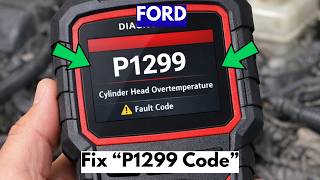
P1299 means your Ranger's engine is dangerously overheating and has entered a protective 'fail-safe' mode. Stop driving immediately. The most likely causes are a coolant leak, a stuck thermostat, or a faulty water pump. If the engine is not actually hot, especially if the warning appears instantly on a cold start, the Cylinder Head Temperature (CHT) sensor itself has likely failed, which is a common issue.
- P1299 is a critical alert. Stop the engine immediately to prevent severe damage.
- The first diagnostic step is to determine if the engine is truly overheating or if it's a false signal from a bad sensor.
- If the engine is not hot, the Cylinder Head Temperature (CHT) sensor is the most likely culprit.
- If the engine is hot, check for low coolant from leaks or a circulation problem like a stuck thermostat.
- Always use the correct Ford Motorcraft VC-13-G Yellow coolant when refilling the system.
What's Unique About the 2019-2023 Ford Ranger
The 2.3L EcoBoost engine in your Ranger uses a Cylinder Head Temperature (CHT) sensor instead of a traditional Engine Coolant Temperature (ECT) sensor. This CHT sensor reads the actual metal temperature of the cylinder head, which provides a more direct and faster indication of overheating. It's a fail-safe design that can detect an overheat condition even if all coolant has been lost, a scenario where a coolant-based sensor would fail to give an accurate reading. This code is the engine's last-ditch effort to save itself.
Symptoms You May Notice
- Check Engine Light is on
- Temperature gauge in the red (maxed out), often instantly after a cold start
- Engine overheating warning message on the instrument cluster
- Drastic reduction in engine power ('limp mode')
- Engine running rough, vibrating, or misfiring (due to deactivated cylinders)
- Cooling fans running at maximum speed
- Steam or sweet smell of coolant from the engine bay
- Engine may not start at all, displaying 'Full Accessory Mode Active'.
- Replacing the PCM when the issue is a simple wiring fault or a bad CHT sensor.
- Replacing the CHT sensor without first confirming if the engine is genuinely overheating from another cause like a coolant leak or stuck thermostat. Always verify actual engine temperature first.
- Assuming a major mechanical failure like a head gasket before ruling out a faulty CHT sensor, which is a much more common and cheaper fix, especially with cold-start symptoms.
Most Likely Causes
- Faulty Cylinder Head Temperature (CHT) Sensor 🔴 High Probability → Shop Engine Cylinder Head The CHT sensor can fail and send an erroneous, high-temperature signal to the PCM. This is a very common failure mode across many Ford platforms using this sensor.
How to confirm: This is the most likely cause if the P1299 code appears immediately on a cold start, with the temperature gauge instantly pegging to HOT. Use a scan tool to read the CHT live data; if it shows an impossibly high temperature (e.g., >250°F) on a cold engine, the sensor or its wiring is faulty. You can also use an infrared thermometer to confirm the actual engine temperature is normal.
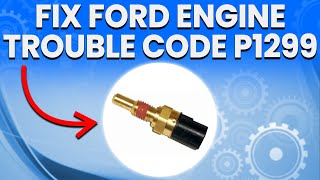
Typical fix: Replace the CHT sensor and its wiring pigtail if corroded or damaged. The sensor is located on the back of the cylinder head on the driver's side and can be difficult to access.
Est. part cost: $30-$80 - Low Engine Coolant 🔴 High Probability Coolant can be lost through leaks from plastic fittings, hoses, the radiator end tanks, or the water pump weep hole. A faulty reservoir cap that fails to hold pressure can also cause coolant to boil off.
How to confirm: Visually inspect the coolant level in the degas bottle (reservoir) when the engine is COLD. Look for puddles of coolant under the vehicle or white/pink/yellow crusty residue on hoses, the radiator, and around the water pump. A cooling system pressure test is the definitive way to find a leak.
Typical fix: Find and repair the source of the leak. Common culprits include radiator hoses, the radiator itself, or the water pump. Then, refill and bleed the cooling system with the correct Motorcraft VC-13-G Yellow coolant. 🎬 Watch: A mechanic explains the top 5 reasons Fords overheat.
Est. part cost: $20-$500 (depending on the source of the leak) - Failed Thermostat 🟡 Medium Probability → Shop Integrated Thermostat Housing Assembly Thermostats can fail by getting stuck in the closed position, which prevents coolant from circulating to the radiator to be cooled.
How to confirm: After the engine has warmed up, carefully feel the upper and lower radiator hoses. If the upper hose is hot and the lower hose is significantly cooler, the thermostat is likely stuck closed. An infrared thermometer can confirm a large temperature difference between the thermostat housing and the lower radiator hose.
Typical fix: Replace the thermostat and housing assembly. It is highly recommended to use an OEM Motorcraft part to ensure correct opening temperature and flow.
Est. part cost: $50-$150 - Failing Water Pump ⚪ Low Probability → Shop Engine Water Pump
How to confirm: Listen for grinding or whining noises from the front of the engine. Look for coolant leaks from the water pump's weep hole, which is a key indicator of internal seal failure. With the engine off and cold, check for any play or wobble in the water pump pulley.
Typical fix: Replace the water pump and serpentine belt. It's often recommended to replace the thermostat at the same time.
Est. part cost: $100-$300
Rare But Worth Checking
- Software Glitch on Cold Start: Ford issued Special Service Messages (SSM 51333, 51756, 51984) for the related 2.3L Explorer, where a P1299 code (often with P1026) could appear on a cold start in freezing temperatures when the engine is not actually overheating. This points to a potential software calibration issue. The fix may involve a PCM software update from a Ford dealer. While not specific to the Ranger, it's a known issue on the same engine platform.
- Blown Head Gasket: This is a severe mechanical failure where combustion gases enter the cooling system or coolant enters the cylinders. Symptoms include unexplained coolant loss with no external leaks, milky/foamy engine oil, persistent white smoke from the exhaust, and constant bubbling in the coolant reservoir. A 'block tester' kit can be used to check for combustion gases in the cooling system.
- Restricted Coolant Flow: On some Ford engines, manufacturing debris can clog small coolant passages in the cylinder head, causing localized hot spots and triggering P1299 under load, even if the rest of the system seems fine. Another possibility is a clogged radiator, which can be diagnosed by checking for cold spots on the core with an infrared thermometer.
Diagnosis Steps
- CRITICAL FIRST STEP: As soon as it is safe, pull over and turn off the engine to prevent damage.
- Determine if the engine is actually overheating. Feel for heat radiating from the hood (do not touch hot surfaces). Note if you see steam or smell coolant.
- If the engine is NOT hot and the code appeared on startup (instant HOT gauge), the primary suspect is a faulty CHT sensor or its wiring. Connect a scan tool and check the 'Live Data' for the CHT sensor. A reading over 250°F on a cold engine confirms a sensor/wiring fault.
- If the engine IS hot, allow it to cool completely for several hours before proceeding.
- Once cool, check the coolant level in the degas bottle. If low, you have a leak. Also check the condition of the coolant; it should not be milky or rusty.
- Perform a thorough visual inspection of the entire cooling system for signs of leaks: check all hoses, the radiator (especially the plastic end tanks), the water pump, and plastic fittings for cracks, wetness, or pink/yellow residue.
- If no leaks are visible and the coolant is full, the problem could be a lack of circulation. Start the engine and monitor the temperature gauge.
- Verify the cooling fans operate once the engine reaches operating temperature (usually commanded by the A/C being on).
- Carefully check the temperature of the upper and lower radiator hoses with your hand or an infrared thermometer. A hot upper hose and a cool lower hose indicate a stuck thermostat.
- If the cause is not obvious, a professional diagnosis is recommended. This may involve a cooling system pressure test to find hidden leaks or a chemical block test to check for a blown head gasket.
Parts You'll Likely Need
- Cylinder Head Temperature (CHT) Sensor
(OEM #P2GZ-6G004-B)— This sensor is a very common failure point that sends false overheating signals to the PCM, especially on a cold start.
Trusted brands: Motorcraft
OEM price range: $40-$70
Aftermarket price range: $25-$50 - Thermostat Assembly
(OEM #LB5Z-8575-C)— A common failure point that gets stuck closed, preventing coolant circulation and causing a genuine overheat condition.
Related Codes That Often Appear With This One
- P1285 — P1285 ('Cylinder Head Over-temperature Condition') is the first-stage warning code that is set just before the PCM activates the more serious P1299 fail-safe mode.
- P1026 — This code is often seen with P1299 on platform mates like the 2.3L Explorer, particularly during cold starts, as noted in Ford SSMs 51333, 51756, and 51984. It points towards a sensor or circuit issue rather than a true overheat.
Technical Service Bulletins (TSBs) & Recalls
- SSM 51333 / 51756 / 51984 - (For 2.3L Explorer, but relevant) Address an intermittent P1299 and/or P1026 with an over-temperature message after a cold start, especially in freezing temperatures. This points to a known sensor, wiring, or software calibration issue rather than mechanical overheating.
- SSM 49407 - (For 2.3L Explorer, but relevant) Directly links P1299 and other codes to a faulty ECT/CHT sensor or wiring harness, calling for sensor replacement.
Platform-Specific Known Issues
- False Overheat on Cold Start: Like its platform mate the Ford Explorer, the Ranger can suffer from a false P1299 code immediately upon a cold start, especially in colder weather. This is almost always due to a failed CHT sensor sending an incorrect signal, not an actual overheat condition. Multiple TSBs on the Explorer 2.3L confirm this pattern.
Mechanic-Grade Diagnostic Values
- CHT Sensor Resistance (Cold Engine) — expected: Approximately 29,000 Ohms (29 kΩ) at 77°F (25°C).. Failure: A reading that is significantly higher (open circuit) or lower (short circuit) than the expected value for the ambient temperature.
- CHT Sensor Resistance (Hot Engine) — expected: Approximately 2,000 - 3,000 Ohms (2-3 kΩ) at 194-212°F (90-100°C).. Failure: Resistance does not decrease smoothly as the engine warms up, or gives an out-of-range reading.
- CHT Sensor Signal Voltage (KOEO, Cold Engine) — expected: Typically between 2.0V and 3.0V, depending on ambient temperature.. Failure: Voltage is near 5.0V (indicating an open circuit or bad ground) or near 0V (indicating a short to ground). An instant spike to a very low voltage on a cold start also indicates sensor failure.
- CHT Sensor Reference Voltage (VREF) at Connector — expected: Approximately 5.0 Volts with the sensor disconnected and Key On, Engine Off (KOEO).. Failure: No voltage or significantly lower voltage indicates a wiring or PCM issue.
Scan Tool Commands That Help
- FORScan / Professional Scan Tools: Live Data PID Monitoring: 'CHT' (Cylinder Head Temperature) — This is the primary method to diagnose a faulty sensor. On a cold start, the CHT value should be close to the Ambient Air Temperature (AAT) and Intake Air Temperature (IAT) PIDs. If CHT reads max hot instantly, the sensor or circuit is bad.
- FORScan: Bidirectional Control: 'Fan Var %' or similar cooling fan command — To verify if the PCM can command the cooling fans on and off. If the fans can be controlled manually but do not turn on during a genuine overheat condition, it points to a logic or sensor input problem rather than a fan circuit failure.
Wiring & Ground Locations
- Cylinder Head Temperature (CHT) Sensor — Located on the back of the cylinder head, on the driver's side (LH side). It is often obscured by heat shields or other components.. This is the primary sensor that triggers code P1299. Its wiring is susceptible to heat damage from the nearby exhaust and turbocharger components. Corrosion on the connector is a common failure point.
- CHT Sensor Access (Mechanic Tip) — A proven method for access is to remove the front passenger-side wheel and the inner fender liner/splash shield. From there, you can reach up past the exhaust manifold to access the sensor and its connector.. Direct access from the top or bottom is extremely difficult. This approach provides the clearest path for sensor replacement, saving significant time and frustration.
- CHT Sensor Circuit — The sensor has a two-wire connector. One wire is the signal wire to the PCM, and the other is the signal return (ground), which also runs directly to the PCM. It does not use a separate chassis ground.. A fault on either the signal or signal return wire can cause the erroneous readings that trigger P1299. Checking for continuity and shorts on both wires back to the PCM connector is a critical diagnostic step if a new sensor doesn't fix the issue.
Real Owner Repair Stories
- Ford F150 Forum user (2016 F-150 2.7L EcoBoost (uses similar CHT sensor strategy), 120k miles) — Started with a rough idle and fuel smell. After 2 miles, CEL came on, 'engine overheat' alert flashed, cooling fan ran at high speed, and the truck entered a very rough-running limp mode. Temp gauge was pegged hot despite the transmission temp being low.
❌ Tried (didn't work) Initial scan tool suggestion was a faulty thermostat.
✅ What actually fixed it The owner diagnosed a faulty Cylinder Head Temperature (CHT) sensor based on forum advice for the cold-start symptoms. Replacing the CHT sensor (Part No. 9L8Z-6G004-F for that vehicle) and clearing the code resolved all symptoms immediately. The repair took less than 10 minutes.
"I Checked Everything" — The Actual Cause
- In a documented case on a Ford Transit Connect with similar engine controls, P1299 (along with P017D - CHT Circuit High) was repeatedly triggered with false overheating symptoms. All cooling system checks passed. The root cause was found to be electrical noise/interference from a failing alternator back-feeding into the PCM and disrupting the CHT sensor signal. Disconnecting the alternator's main power wire made the problem disappear instantly. Replacing the alternator was the final fix.
OEM Part Supersession History
P2GZ-6G004-A→P2GZ-6G004-B— Standard part revision by the manufacturer, likely for improved durability or material changes.LB5Z-8575-B→LB5Z-8575-C— Standard part revision for the thermostat assembly.
Diagnostic Flowchart
Used vs. New Parts: Buying Guide for This Vehicle
When a used part is the smart pick: For this specific trouble code, using used parts for the most common fixes is strongly discouraged. However, if a larger, more expensive component like the radiator or the complete cooling fan assembly is diagnosed as the fault, a part from a low-mileage, verified-running donor vehicle could be a cost-effective option. Inspect for fin damage, leaks, or cracks before purchasing.
Donor-vehicle mileage cap: roughly under 40000 miles for the part to have meaningful remaining life.
What to inspect on the donor part:
- For a radiator: Check for corrosion, bent fins, and any signs of past leaks (white or colored crust).
- For a fan assembly: Spin the fan blades by hand to ensure they move freely with no bearing noise or wobble. Inspect the shroud for cracks.
- Verify the donor vehicle was not in a front-end collision, which could have caused unseen damage to cooling components.
OEM-only on this vehicle (don't cheap out):
- Thermostat Assembly: Aftermarket thermostats are notorious for incorrect opening temperatures or premature failure on Ford vehicles. Using an OEM Motorcraft thermostat is a critical best practice among technicians to prevent repeat failures or other cooling system codes like P0128.
- Cylinder Head Temperature (CHT) Sensor: While some high-quality aftermarket brands exist, the cost savings are minimal compared to the risk of a poor-quality sensor causing a repeat of the limp-home mode. OEM Motorcraft is the safest choice.
Brands owners have reported issues with on this vehicle:
- Generic 'white-box' or no-name thermostats and sensors from online marketplaces should be avoided due to high failure rates and inconsistent quality control.
Real Owner Stories
Aggregated from forums and TSBs cited above. Mileages and costs reflect what owners reported in those sources.
2016 Ford Explorer 2.3L EcoBoost
Symptoms: P1299 and no-start condition, displaying 'Full Accessory Mode Active' after an actual overheat.
What fixed it: The underlying cause was a true overheat from a leaking oil cooler, which had to be repaired to resolve the issue.
Source hint: Reddit r/AskMechanics - A user with a 2.3L EcoBoost Explorer experienced a P1299 and no-start condition after an actual overheat from a leaking oil cooler
2019-2023 Ford Ranger 2.3L EcoBoost
Symptoms: A false P1299 code and over-temperature message appearing immediately upon a cold start, particularly in freezing temperatures.
What fixed it: This known issue, documented in TSBs for the platform, points to a faulty CHT sensor, wiring, or a software calibration issue, with the fix being replacement of the sensor or repair of the wiring.
Source hint: TSB SSM 51333 / 51756 / 51984
2016 Ford F-150 2.7L
Symptoms: rough idle, then sudden overheat warning and limp mode.
What fixed it: A 10-minute replacement of the CHT sensor (Ford part 9L8Z-6G004-F) resolved all symptoms.
Source hint: f150forum.com - 'Here's my fix for code P1299 - 2016 2.7L'
Related OBD-II Codes
Frequently Asked Questions
My 2021 Ranger's temperature gauge instantly went to HOT on a cold start. Is it really overheating?
The article mentions TSBs for the Ford Explorer (like SSM 51333). Are these relevant to my Ford Ranger?
What is the most common cause for a P1299 code on my 2.3L EcoBoost Ranger?
Where is the CHT sensor located on the 2.3L EcoBoost engine?
My engine went into 'limp mode' with the P1299 code. Is this a normal symptom?
What specific coolant should I use to top off my Ranger if it's low?
My truck won't start and the dash says 'Full Accessory Mode Active' along with the overheat warning. What does that mean?
Helpful Videos
We Have This Part in Stock


The information in this article is provided for general reference and educational purposes only. Vehicle specifications, procedures, and part compatibility can vary by production date, trim level, and region. Always consult your vehicle's factory service manual and verify part numbers before purchasing or performing repairs. Safety-critical components such as airbags, seat belts, and braking systems should be installed by a qualified professional.
- Ford Ranger:
- 🧭 Diagnostic Flowchart
- 🎬 Helpful Videos
- 🛍️ Shop This Part
- What's Unique About the 2019-2023 Ford Ranger
- Symptoms You May Notice
- Most Likely Causes
- Rare But Worth Checking
- Diagnosis Steps
- Parts You'll Likely Need
- Related Codes That Often Appear With This One
- Technical Service Bulletins (TSBs) & Recalls
- Platform-Specific Known Issues
- Mechanic-Grade Diagnostic Values
- Scan Tool Commands That Help
- Wiring & Ground Locations
- Real Owner Repair Stories
- "I Checked Everything" — The Actual Cause
- OEM Part Supersession History
- Used vs. New Parts: Buying Guide for This Vehicle
- Real Owner Stories
- 2016 Ford Explorer 2.3L EcoBoost
- 2019-2023 Ford Ranger 2.3L EcoBoost
- 2016 Ford F-150 2.7L
- Related OBD-II Codes
- Frequently Asked Questions
- 🎟️ Get 5% Off