

OBD-II Code P1306: A Comprehensive Guide for Pro-Level Diagnosis and Repair
What P1306 means, manufacturer-specific causes, and how to fix it right the first time
- Verify your vehicle's specific P1306 definition before diagnosing, as it means a cylinder 6 misfire on Hondas, an OCV open circuit on Subarus, and a kickdown relay fault on Fords.
- Check for warranty coverage under TSB 21-010 if you drive a 2016-2020 Honda or Acura 3.5L V6, as P1306 almost guarantees a faulty fuel injector covered up to 150,000 miles.
- Inspect the Bank 1 Oil Control Valve (OCV) connector for oil contamination and check the banjo bolt filter for sludge if diagnosing a Subaru.
- Swap the transmission kickdown relay with an identical non-critical relay (like the horn) to quickly isolate the fault on 1990s-2000s Ford models.
- Stop driving immediately if the check engine light flashes, as raw fuel from the misfire will destroy the catalytic converter and add $1,500 to $2,500 to your repair bill.
What Does P1306 Mean?
P1306 is a manufacturer-specific code; its definition changes based on the vehicle brand. Identifying the correct definition is critical before attempting diagnosis. For Honda, Acura, and Saab, it signals a catalyst-damaging misfire in cylinder 6, meaning that cylinder is not combusting fuel correctly. For Subaru, it indicates an 'Open Circuit' fault in the Bank 1 Oil Control Valve (OCV), a key part of the Active Valve Control System (AVCS). For Ford, it points to a problem with the transmission's kickdown relay, which controls downshifting during hard acceleration. For Volkswagen, it means a short in the ignition system for cylinder 9 on W8/W12 engines, while for Jaguar/Land Rover, it is a companion code to P1315, pointing toward fuel pressure control issues.
Technical definition: P1306 lacks a standardized SAE/ISO definition. Common manufacturer definitions include 'Cylinder 6 Misfire Detected' (Honda, Acura, Saab), 'OCV Solenoid Signal 1 Malfunction Open' (Subaru), 'Kickdown Relay Pull In Circuit Fault' (Ford, Mercury), 'Cylinder 9 Ignition System Short to Positive' (Volkswagen), and 'Phase Sensor - Low Input' (Daewoo). The PCM sets the code when a specific condition—such as a circuit voltage mismatch, resistance outside a defined range, or a detected misfire rate exceeding a critical threshold—persists for a set duration.
Can I Drive With P1306?
Yes, But With Caution. Driving is possible but strongly discouraged. For misfire-related definitions (Honda, Acura, Saab), a flashing check engine light indicates a severe misfire that destroys the catalytic converter in as little as 50 miles, adding a $1,500-$2,500 repair bill. Pull over immediately. For other definitions (Ford, Subaru), you experience poor acceleration, rough running, and unpredictable shifting, posing a safety risk in traffic and leading to severe component damage if ignored.
Common Causes
- Faulty Fuel Injector (Honda/Acura) (Very Common) — On 3.5L V6 engines (2016-2020), the fuel injector for cylinder 6 is the primary culprit. Manufacturing debris causes the injector to stick open or closed, leading to a misfire. This is a well-documented issue with multiple Technical Service Bulletins (TSBs).
- Faulty Ignition Coil (Honda/Acura/Saab) (Common) — The ignition coil provides high voltage for the spark plug. Heat and vibration cause the coil's internal windings to fail, resulting in a weak or absent spark in cylinder 6.
- Faulty Oil Control Valve (OCV) Solenoid (Subaru) (Common) — The OCV is an electro-hydraulic solenoid directing oil flow to the AVCS gear. It fails electronically (open circuit), clogs with sludge, or sticks, preventing proper camshaft timing adjustments and triggering P1306.
- Faulty Kickdown Relay (Ford) (Common) — This electro-mechanical switch tells the transmission to downshift. The internal coil breaks or the contacts wear and corrode, preventing it from activating the circuit.
- Worn or Fouled Spark Plug (Honda/Acura/Saab) (Common) — An old, carbon-fouled, oil-covered, or improperly gapped spark plug in cylinder 6 cannot ignite the air-fuel mixture. A worn plug also overworks and causes premature ignition coil failure.
- Dirty Oil or Clogged OCV Filter (Subaru) (Less Common) — The AVCS system depends entirely on clean oil and proper pressure. Low or sludged oil clogs the OCV or the small mesh filters inside the oil supply banjo bolts, starving the OCV of oil and triggering a fault even if the solenoid is electronically sound.
- Wiring or Connector Issue (All makes) (Less Common) — Wires leading to the relevant component fray, corrode, or loosen. On Subarus, oil leaks from the OCV solenoid into the electrical connector, disrupting the signal (TSB 02-170-17R). On Fords, fuse box corrosion affects the relay socket.
- Blown Fuse (Ford) (Uncommon) — The kickdown relay's control circuit is protected by a fuse. A blown fuse cuts power to the relay, causing it to fail and triggering the code.
- Low Engine Compression (All Misfire-Related Makes) (Uncommon) — If spark and fuel are confirmed good, the misfire stems from a mechanical engine problem. Worn piston rings, a failing head gasket, burnt valves, or a damaged camshaft lobe cause low compression in cylinder 6, making combustion impossible.
- Faulty Powertrain Control Module (PCM) (All Makes) (Rare) — The internal driver circuit sending the signal to the coil, injector, or relay fails. Consider this only after exhaustively testing and ruling out every other possibility.
Symptoms
- Flashing Check Engine Light (Honda/Acura/Saab) — A flashing light signifies a severe, catalyst-damaging misfire. Unburned fuel enters the exhaust and quickly melts the catalytic converter. Pull over and shut off the engine immediately.
- Check Engine Light is On — The PCM detects a fault and illuminates the Malfunction Indicator Lamp (MIL).
- Rough Idle and Engine Vibration (Honda/Acura/Saab/Subaru) — The engine runs unevenly and shakes, especially at idle or under load. This is caused by the non-firing cylinder (misfire) or incorrect valve timing (OCV fault).
- Poor Acceleration / Won't Downshift (Ford) — The vehicle feels sluggish and refuses to downshift to a lower gear during hard acceleration because the kickdown relay fails to activate.
- Reduced Power and Hesitation (All makes) — The engine feels weak and hesitates during acceleration due to a misfire, incorrect valve timing, or the transmission remaining in the wrong gear.
Diagnostic Flowchart
Tap your situation to follow the diagnostic path that matches what you're seeing on this code.
Common Fixes & Costs
- Replace Fuel Injector(s) (Honda/Acura) — Parts: $300-$500, Labor: $400-$800, ~4.5 hr book time (Professional)
- Replace Ignition Coil — Parts: $50-$200, Labor: $50-$150, ~0.8 hr book time (DIY)
- Replace Oil Control Valve (OCV) Solenoid (Subaru) — Parts: $70-$150, Labor: $100-$200, ~1.2 hr book time (Intermediate)
- Replace Spark Plug(s) — Parts: $15-$40, Labor: $100-$300, ~1.5 hr book time (DIY)
- Clean or Remove OCV Banjo Bolt Filters (Subaru) — Parts: $10-$25, Labor: $75-$150, ~0.8 hr book time (Intermediate)
- Replace Kickdown Relay (Ford) — Parts: $20-$50, Labor: $25-$75, ~0.2 hr book time (DIY)
DIY vs Professional
- Replace Fuel Injector(s) (Honda/Acura) 🟢 Beginner
Tools: Extensive socket set, torque wrench, fuel line disconnect tools, intake manifold gaskets, new injector seals. - Replace Ignition Coil 🟢 Beginner
Tools: Basic socket set or screwdriver. - Replace Spark Plug(s) 🟢 Beginner
Tools: Spark plug socket, ratchet, extension, torque wrench. - Replace Oil Control Valve (OCV) Solenoid (Subaru) 🟢 Beginner
Tools: Socket set, torque wrench, oil and filter. - Replace Kickdown Relay (Ford) 🟢 Beginner
Tools: None, or a small flathead screwdriver to gently pry.
Used vs. New Parts: Buying Guide
When a used part is worth it: A used OEM electronic component (ignition coil, OCV) from a low-mileage vehicle is often more reliable than a cheap aftermarket part. Avoid 'refurbished' fuel injectors; opt for 'remanufactured' injectors rebuilt to OEM specs.
Donor-vehicle mileage cap: roughly under 60000 miles for the part to have meaningful remaining life.
Donor quality checklist:
- Verify the part comes from a vehicle not scrapped due to engine or electrical failure.
- Match the OEM part number exactly.
- For fuel injectors, confirm they are 'remanufactured' (rebuilt with new seals/internals), not just 'used'.
Decision logic:
- If The part is a simple relay or fuse → Used is perfectly acceptable and cost-effective.
- If The part is a fuel injector or ignition coil and budget is a primary concern → A used OEM part from a low-mileage donor or a remanufactured part is better than a cheap, no-name brand part.
- If The vehicle is under 100K miles and you plan to keep it long-term → Buy a new OEM or OEM-supplier part for maximum longevity.
Warranty tradeoff: Used parts from salvage yards typically offer a 30-90 day warranty. New aftermarket parts offer 1-year to limited lifetime warranties. New OEM parts carry a 12-month/12,000-mile warranty.
Worst-case if a used part fails: 500-1000. If a cheap part fails, you pay for the replacement part and full labor a second time.
What Happens If You Wait — Timeline
- 0-2 weeks: Steady Check Engine Light appears. For misfire codes, a slight rough idle occurs on cold starts. For relay/OCV codes, symptoms remain intermittent. (MPG impact: 0-5%% · Added cost: $0-25 in wasted fuel)
- 2 weeks - 3 months: For misfires, the Check Engine Light flashes during acceleration, indicating raw fuel is overheating the catalytic converter. MPG loss reaches 5-15%. For Subaru/Ford issues, performance becomes consistently poor. (MPG impact: 5-15%% · Added cost: $50-150 in wasted fuel)
- 3-6 months: Catalyst damage becomes significant. The internal substrate melts and clogs. The vehicle suffers a major loss of power, and exhaust smells like sulfur. (MPG impact: 15-30%% · Added cost: $1,500-2,800 (Catalytic converter replacement is now required))
- 6+ months: Catastrophic failure. The catalytic converter completely blocks exhaust flow. The engine stalls immediately. Backpressure causes secondary damage to exhaust valves, piston rings, and head gaskets. (MPG impact: 30%+% · Added cost: $3,000-5,000+ (Engine damage has occurred))
Cost of Not Fixing It
- Immediate (0-1 month): A flashing check engine light indicates raw fuel dumping into the exhaust. Expect a 5-10% drop in fuel economy and noticeably poor performance. (Added cost: 50-100)
- Short Term (1-3 months): Continued driving with a misfire overheats and destroys the catalytic converter. The internal honeycomb substrate melts and blocks exhaust flow. (Added cost: 1200-2800)
- Long Term (6+ months): A clogged catalytic converter creates extreme exhaust backpressure, leading to burnt exhaust valves, damaged oxygen sensors, and head gasket failure. The vehicle becomes undrivable. (Added cost: 3000+)
Diagnosis Steps
- Confirm the Code Definition for Your Vehicle
Search '[Your Make] [Your Model] P1306 code' to confirm its meaning. This guide covers the most common definitions: Honda/Acura (Cylinder 6 Misfire), Subaru (OCV Fault), and Ford (Kickdown Relay). Misinterpreting the code guarantees an incorrect diagnosis.
Tools: Internet access (Beginner) - Isolate the Misfire (Honda/Acura/Saab)
Swap the cylinder 6 ignition coil with an adjacent cylinder (e.g., cylinder 5). Clear the codes and drive. If the code changes to P0305, the ignition coil is faulty. If P1306/P0306 returns, the coil is fine.
Tools: OBD-II scanner, basic socket set (Beginner) - Test the Fuel Injector (Honda/Acura/Saab)
Use a mechanic's stethoscope against the injector body to listen for a steady, rhythmic clicking sound. Silence or an erratic tick indicates a problem. Confirm the electrical signal using a noid light plugged into the injector connector; it must flash steadily.
Tools: Mechanic's stethoscope, noid light set (Intermediate) - Inspect the Spark Plug (Honda/Acura/Saab)
Remove the spark plug from cylinder 6. Inspect the tip for excessive wear, carbon fouling, oil contamination, or cracked porcelain. A healthy plug has a light tan color. Replace damaged plugs as a complete set.
Tools: Spark plug socket, ratchet, extension (Intermediate) - Test the Oil Control Valve (OCV) and Circuit (Subaru) [PRO TIP]
Unplug the Bank 1 OCV and inspect the connector for oil; contamination requires replacing the OCV and cleaning the harness. Measure resistance between the OCV pins with a multimeter (expect 8-12 ohms). An 'OL' reading confirms the open circuit. Briefly apply 12V to the pins; a healthy solenoid clicks audibly.
Tools: Multimeter, socket set, 12V power source (optional) (Intermediate) - Inspect OCV Oil Supply (Subaru)
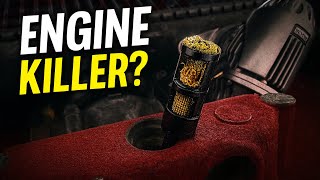
If the OCV tests good electronically, check for oil starvation. Remove the banjo bolt feeding oil to the OCV and inspect the internal mesh filter. If clogged with sludge, clean it or remove it entirely to prevent future blockage.
Tools: Socket/wrench set, shop towels, brake cleaner (Intermediate) - Test the Kickdown Relay and Circuit (Ford) [PRO TIP]
Swap the kickdown relay with an identical non-critical relay (like the horn) to see if the problem moves. For definitive testing, remove the relay and measure coil pin resistance (50-200 ohms). Check the power terminal in the socket for 12V with the key on, and verify the PCM sends a ground signal to the control terminal when the accelerator is pressed.
Tools: Owner's manual, multimeter, fuse box diagram (Intermediate) - Perform an Engine Compression Test (Misfire Diagnosis)
If spark and fuel test good, perform a compression test to measure cylinder sealing integrity. A significantly lower result on cylinder 6 points to worn piston rings, a burnt exhaust valve, or a leaking head gasket, requiring major engine repairs.
Tools: Compression tester kit, basic hand tools (Professional) - Advanced: Analyze Scan Tool Live Data (Subaru)
Monitor 'AVCS Actual Cam Angle' and 'AVCS Desired Cam Angle' for Bank 1. At idle, both should be near 0 degrees. While driving, 'Actual' must closely follow 'Desired'. If 'Actual' is stuck at 0, it confirms a fault in the OCV, oil supply, or AVCS phaser.
Tools: Advanced bi-directional scan tool (Advanced) - Advanced: Test Fuel Injector Resistance (Honda/Acura)
Disconnect the electrical connector from the cylinder 6 injector. Measure resistance across the two pins. A typical high-impedance injector reads between 10 and 18 Ohms. An 'OL' (infinite resistance) or near-zero reading indicates a failed injector coil requiring replacement.
Tools: Multimeter, socket set, torque wrench, intake gaskets (Advanced) - Advanced: Quantitative Compression Test (Honda/Acura)
On a Honda J35 V6, look for a minimum pressure of 135 PSI per cylinder. Variation between the highest and lowest cylinder must not exceed 29 PSI. Readings outside these specs indicate a definitive mechanical engine problem.
Tools: Compression tester kit, basic hand tools, scanner to disable fuel (Advanced)
When This Code Triggers (Freeze-Frame Conditions)
- Engine Coolant Temp: 180-210°F (Engine is at full operating temperature when the fault logs.)
- Engine RPM: 1500-3000 RPM (The code sets during steady-state cruise or light acceleration, not typically at idle or full throttle.)
- Engine Load: 25-60% (Indicates the engine is under a moderate, consistent load, typical of highway cruising.)
- Vehicle Speed: 40-65 mph (Corresponds with RPM and load conditions, confirming the fault occurred during normal driving.)
Related Codes
- P0306 — The generic OBD-II code for 'Cylinder 6 Misfire Detected.' For Honda, Acura, and Saab, P1306 is the manufacturer-specific version of this exact fault and is diagnosed identically.
- P219B — On Honda/Acura vehicles, 'Bank 2 Air-Fuel Ratio Imbalance' strongly corroborates the faulty fuel injector issue when paired with P1306, as the failing injector causes a rich or lean condition on that bank.
- P1307 — The counterpart to P1306. On Fords, it indicates a 'Kickdown Relay Hold Circuit Fault'. On Subarus, it indicates a 'Short Circuit' in the OCV solenoid, whereas P1306 indicates an 'Open Circuit'.
- P0300 — Indicates a 'Random/Multiple Cylinder Misfire' affecting the whole engine. If seen with P1306, the initial single-cylinder problem is now severe enough to affect other cylinders.
Climate & Environmental Factors
- Cold Weather: Cold temperatures exacerbate issues leading to misfires. Thicker engine oil affects systems like Subaru's AVCS. Older ignition components exhibit higher internal resistance, producing a weaker spark, and leaky fuel injectors become more noticeable on cold starts.
- High Humidity: Moisture penetrates non-sealed electrical components like relays and fuse boxes. This causes corrosion on terminals, increasing resistance and causing intermittent or total failure of components like the Ford kickdown relay.
How to Talk to a Mechanic About This Code
Say this: "State your vehicle's year, make, and model. For Honda/Acura: 'I have a P1306 code, which is a cylinder 6 misfire. I'm aware of TSB 21-010 for fuel injectors. Can you run my VIN to see if it's covered by the warranty extension?' For Subaru: 'I have a P1306 code, an open circuit for the Bank 1 Oil Control Valve. Please start by testing the solenoid's resistance and checking the electrical connector for oil before quoting a replacement.' For Ford: 'I have a P1306 pointing to the kickdown relay. Can we start by swapping the relay with a known good one to see if the problem moves?'"
This language establishes you as an informed consumer. It directs the mechanic to the most likely cause, acknowledges known issues (like TSBs), and proposes a logical, cost-effective diagnostic path, reducing unnecessary exploratory diagnostics.
Avoid saying:
- 'My check engine light is on, can you just fix it?'
- 'I don't know anything about cars, just tell me what it needs.'
- 'Do whatever you think is best.'
Questions to ask before authorizing the repair:
- Can you provide a written estimate with a clear breakdown of parts and labor?
- If the diagnosis is a faulty part, can you show me the failed part after it's replaced?
- What is the warranty on the parts and the labor for this specific repair?
- Have you confirmed the root cause, or are we replacing a part hoping it's the fix?
Where to Take It: Dealer vs Independent vs Chain
- Dealer:
Best for: Honda/Acura vehicles (2016-2020) to check for and claim warranty coverage on fuel injectors (TSB 21-010)., Any vehicle still under its original powertrain or emissions warranty., Complex, software-related issues on newer cars requiring proprietary tools and updates.
Downsides: Labor rates are typically 1.5-2x higher than independent shops., Less flexible on out-of-warranty repairs and defaults to expensive component replacements. (Typical cost: +50% vs. baseline) - Independent Shop:
The best choice for most P1306 scenarios, especially out-of-warranty Ford and Subaru vehicles. For Honda/Acura, visit the dealer FIRST to check for warranty coverage.
Best for: Out-of-warranty repairs where cost is a major factor., Common, well-documented problems like the Ford kickdown relay or Subaru OCV replacement., Building a long-term relationship with a technician who knows your vehicle's history.
Downsides: Quality and expertise vary widely; vetting the shop's reputation and ASE certifications is crucial., Lacks the latest manufacturer-specific tools for very new or complex models. (Typical cost: +0% vs. baseline) - Chain Shop:
Acceptable for a simple part swap if you diagnosed the problem yourself. AVOID for initial diagnosis, especially for Honda and Subaru variants.
Best for: Simple, straightforward repairs like swapping an easily accessible ignition coil or relay.
Downsides: Technician skill and diagnostic ability are inconsistent., Business model incentivizes upselling unnecessary services., Not recommended for diagnosing intermittent or manufacturer-specific issues like a Subaru AVCS fault. (Typical cost: -10% vs. baseline)
When to Walk Away From the Repair
Consider replacing the vehicle if the estimated repair cost exceeds 50% of its current private-party value.
- Car worth $15000, fix is $1200: Fix it. The repair cost for the Honda injector issue is well below the threshold.
- Car worth $4000, fix is $2500: Walk away. The misfire damaged the catalytic converter, pushing the total repair cost over 60% of the car's value.
- Car worth $6000, fix is $3000: Borderline. This is the 50% mark. Get a second opinion before authorizing the repair.
What Scan Tool You Need for This Code
Minimum: A code reader providing specific manufacturer code descriptions. A generic reader showing only 'P1306' without context leads to misdiagnosis.
P1306 has drastically different meanings depending on the brand. You need to know what the code means for YOUR car. For Subaru and misfire diagnostics, live data graphing is essential.
Budget: BlueDriver Pro (~$100) — Pairs with your smartphone to read and clear codes, provides manufacturer-specific definitions, and graphs live data to help diagnose misfires. A strong choice for DIY diagnosis.
Mid-range: Innova 5610 / Foxwell NT510 Elite (~$250) — Offers bi-directional controls. Critical for Subaru, allowing you to command the OCV solenoid to activate. Accesses deeper manufacturer PIDs, like desired vs. actual cam angle.
Professional: Autel MaxiCOM MK808S / Launch X431 Series (~$450-600) — Provides full professional-level bidirectional control and access to all vehicle modules. Ideal for diagnosing complex wiring issues or ruling out the PCM.
Rent vs buy: For a one-time diagnosis, auto parts stores scan codes for free. They also offer tool loaner programs for advanced scanners. Buy a scanner only if you perform regular diagnostics.
How to Clear the Code After You Fix It
- Use an OBD-II scan tool to clear the P1306 and any related fault codes.
- Ensure the fuel tank is between 1/4 and 3/4 full.
- Perform a complete OBD-II drive cycle to allow the system's readiness monitors to run and self-test.
Drive cycle (~30 minutes): Start with a cold engine (off for 8+ hours). Idle for 2-3 minutes with A/C and rear defroster on. Drive for 10-15 minutes at a steady highway speed (approx. 55 mph). Drive for 10-15 minutes in stop-and-go city traffic. Allow the vehicle to cool down.
Readiness monitors affected: Catalyst Monitor, Evaporative System Monitor, Oxygen Sensor Monitor, Misfire Monitor
Before emissions retest: drive at least 100 miles to fully set monitors.
Watch out for:
- Disconnecting the battery clears the code but resets all readiness monitors to 'Not Ready,' guaranteeing an emissions test failure.
- The code returns immediately or within a few miles if the root cause remains unfixed.
- Failing to complete a full drive cycle leaves critical monitors like the Catalyst and EVAP systems in a 'Not Ready' state.
Will This Fail Emissions / State Inspection?
Yes — this code typically fails an OBD-II emissions inspection.
- California: An illuminated Check Engine Light triggers an automatic failure. A full drive cycle must set all readiness monitors to 'Ready' before a retest. California does not allow 'Not Ready' monitors for most vehicles.
- New York: The NYS DMV inspection includes an OBD-II scan. An active P1306 code causes an immediate failure.
- Texas: In counties requiring emissions testing, an illuminated Check Engine Light results in an automatic failure. You cannot register the vehicle until repaired.
Most Commonly Affected Vehicles
- Honda Pilot, Odyssey, Ridgeline (2016-2020) — On the 3.5L Earth Dreams V6, P1306 (or P0306) is almost always caused by faulty fuel injectors. Honda acknowledged this with TSB 21-010 and issued a warranty extension.
- Acura MDX, TLX, RDX (V6) (2016-2020) — Utilizes the same 3.5L V6 engine and suffers from the identical fuel injector problems as Honda. The same TSBs and warranty extensions apply.
- Subaru WRX, Legacy GT, Forester XT, Impreza, Crosstrek (2004-2021) — Affects models with AVCS-equipped engines. P1306 points to an open circuit in the Bank 1 OCV. TSB 02-170-17R notes oil leaking into the harness connector as a frequent cause.
- Ford Explorer, Ranger, Taurus, F-150, Crown Victoria (1990-2009) — Primarily seen on older models with 4-speed automatic transmissions. The code points directly to the kickdown relay circuit in the main power distribution box.
- Saab 9-5 (1999-2003) — On V6-equipped models, P1306 is defined as a catalyst-damaging misfire on cylinder 6. Diagnosis follows standard misfire procedures.
- Jaguar / Land Rover XF, LR2, Range Rover Evoque (2012-2015) — Rare, but appears with P1315 ('Persistent Misfire'). Points to a failing high-pressure fuel pump (HPFP) or an ECM software issue (TSBs JTB00410NAS1 and JTB00445NAS1).
- Volkswagen Passat, Touareg (2001-2004) — On W8 or W12 engines, P1306 indicates 'Cylinder 9 Ignition Circuit Short to Positive,' pointing to the coil or wiring for that specific cylinder.
- Daewoo Leganza, Nubira (1999-2002) — Defined as 'Phase Sensor - Low Input,' indicating a fault in the Camshaft Position Sensor circuit, not a misfire or relay issue.
Manufacturer-Specific Notes
- Honda/Acura: On 2016-2020 3.5L V6 models, P1306 almost always means faulty fuel injectors. Under Service Bulletin 21-010, Honda extended the warranty to 10 years/150,000 miles for this issue. Call a dealership with your VIN to check coverage before paying for repairs.
- Subaru: P1306 means an 'Open Circuit' for the Bank 1 OCV. Technicians check two things first: oil inside the electrical connector (TSB 02-170-17R) and the tiny mesh filter inside the oil supply banjo bolt.
- Ford: This code is specific to the 'pull-in' or initial activation of the kickdown relay. A related code, P1307, refers to the 'hold' circuit, helping technicians determine exactly when the relay fails.
- Jaguar/Land Rover: A misfire code like P1315 on affected models is frequently triggered by a failing high-pressure fuel pump (HPFP) or outdated ECM software, not spark plugs or coils. Consult TSBs JTB00410NAS1 and JTB00445NAS1.
Real Owner Stories
2017 Honda Odyssey at 120K miles with P030x codes
Owner experienced two separate incidents of misfires with fouled plugs and failed ignition coils within a year.
Outcome: The dealer initially refused the warranty repair because the car was not actively misfiring. The service department eventually replicated the problem and performed the repair under the extended warranty.
Lesson: Be persistent with known warranty extension issues. Documented prior repair attempts for the same codes are crucial. A cooperative dealership service department is your best advocate.
2004 Subaru STI with P1307 and P1309 (related to P1306)
The check engine light illuminated, and the ECU entered limp mode. A scan revealed codes for both left and right Oil Control Valves (OCVs).
Outcome: The owner noted both OCVs failed simultaneously, pointing to a shared wiring or power supply issue rather than two independent solenoid failures. They replaced the valves as an immediate fix.
Lesson: When bilateral components fail simultaneously, investigate shared circuits. Check the main power feed or ground before replacing both parts, as a single wiring fault is often the root cause.
DIY Oil Change on Subaru Crosstrek leads to engine/transmission issues
After a DIY oil change, the car would not function correctly. The owner mistakenly drained the transmission fluid instead of the engine oil.
Outcome: The vehicle required towing to a dealership. The engine was overfilled with oil, and the CVT transmission was empty, requiring professional service to correct fluid levels.
Lesson: Never start your vehicle right after an oil change if a new, serious problem appears. Verify you identified the correct drain plug on Subarus to avoid severe component damage.
How to Prevent This Code From Triggering
- Change synthetic engine oil at recommended intervals (Per manufacturer's schedule) — Clean, high-quality oil prevents sludge formation that clogs the tiny passages in Subaru Oil Control Valves (OCVs) and their filters, a primary cause of AVCS-related codes.
- Use Top Tier rated gasoline (Every fill-up) — Fuels with higher detergent levels prevent and clean carbon deposits on Honda/Acura direct fuel injectors, addressing the root cause of the P1306 misfire issue.
- Remove Subaru OCV banjo bolt filters (Once, during an oil change or other service) — These small mesh filters clog with sludge, starving the OCV of oil and triggering codes like P1306. Removing them eliminates this common failure point.
- Apply dielectric grease to relay terminals (When replacing a relay or if corrosion is found) — Applying dielectric grease to a new Ford kickdown relay's pins seals out moisture and prevents future corrosion-related failures in the fuse box.
- Avoid frequent short trips and extended idling (Daily habit) — Short drives prevent engine oil from reaching full operating temperature, allowing moisture and fuel to contaminate the oil and accelerate sludge formation.
Frequently Asked Questions
Can I drive with a P1306 code?
It is highly inadvisable. A flashing check engine light means you risk destroying your catalytic converter, a repair costing over $2,000. Even for non-misfire versions, poor performance and stalling pose a safety hazard.
What's the difference between P1306 and P0306?
P0306 is the universal code for a cylinder 6 misfire. P1306 is a manufacturer-specific code that means the same thing for Honda and Acura. For Ford, Subaru, and VW, P1306 means something completely different, like a relay or sensor circuit fault.
Why is my check engine light flashing?
A flashing check engine light is a universal warning for a severe engine misfire actively damaging your catalytic converter. The PCM detects raw fuel dumping into the hot exhaust. Pull over and turn off the engine immediately to prevent catastrophic failure.
Is a P1306 repair covered by warranty?
For many 2016-2020 Honda and Acura vehicles, the common fuel injector cause is covered by a 10-year/150,000-mile warranty extension (TSB 21-010). Subaru OCV issues may fall under the 5-year/60,000-mile powertrain warranty. Always call a dealership with your VIN to check coverage.
I replaced the coil and spark plug, but the P1306 misfire code is back. What's next?
If you ruled out spark by swapping the coil and installing a new plug, test the fuel injector next. If the injector receives a signal and clicks, perform an engine compression test on cylinder 6 to check for internal mechanical faults.
What's the difference between an 'open' and a 'short' on a Subaru OCV code?
P1306 indicates an 'Open' circuit, meaning a broken wire or a broken coil inside the OCV. P1307 indicates a 'Short' circuit, meaning the signal wire is touching ground or another wire.
Can dirty engine oil really cause a P1306 code on my Subaru?
Yes. The AVCS system relies entirely on oil pressure to function. Sludgy oil clogs the small passages in the Oil Control Valve (OCV) or its banjo bolt filter, triggering a performance fault.
How do I find cylinder 6 on my engine?
For most Honda/Acura V6 engines, Bank 1 (cylinders 1-2-3) is against the firewall, and Bank 2 (cylinders 4-5-6) is against the radiator. Cylinder 6 is typically on the driver's side end of the front bank. Always verify with a diagram for your specific engine.
Key Takeaways
- Verify your vehicle's specific P1306 definition before diagnosing, as it means a cylinder 6 misfire on Hondas, an OCV open circuit on Subarus, and a kickdown relay fault on Fords.
- Check for warranty coverage under TSB 21-010 if you drive a 2016-2020 Honda or Acura 3.5L V6, as P1306 almost guarantees a faulty fuel injector covered up to 150,000 miles.
- Inspect the Bank 1 Oil Control Valve (OCV) connector for oil contamination and check the banjo bolt filter for sludge if diagnosing a Subaru.
- Swap the transmission kickdown relay with an identical non-critical relay (like the horn) to quickly isolate the fault on 1990s-2000s Ford models.
- Stop driving immediately if the check engine light flashes, as raw fuel from the misfire will destroy the catalytic converter and add $1,500 to $2,500 to your repair bill.
Helpful Videos
Shop the Parts Behind P1306
Below are the parts most often responsible for code P1306, ranked by how frequently each one is the actual culprit (per the diagnosis above). Tap any to see what we have for your vehicle.



The information in this article is provided for general reference and educational purposes only. Vehicle specifications, procedures, and part compatibility can vary by production date, trim level, and region. Always consult your vehicle's factory service manual and verify part numbers before purchasing or performing repairs. Safety-critical components such as airbags, seat belts, and braking systems should be installed by a qualified professional.
- 🧭 Diagnostic Flowchart
- 🎬 Helpful Videos
- 🛍️ Shop This Part
- What Does P1306 Mean?
- Can I Drive With P1306?
- Common Causes
- Symptoms
- Common Fixes & Costs
- DIY vs Professional
- Used vs. New Parts: Buying Guide
- What Happens If You Wait — Timeline
- Cost of Not Fixing It
- Diagnosis Steps
- When This Code Triggers (Freeze-Frame Conditions)
- Related Codes
- Climate & Environmental Factors
- How to Talk to a Mechanic About This Code
- Where to Take It: Dealer vs Independent vs Chain
- When to Walk Away From the Repair
- What Scan Tool You Need for This Code
- How to Clear the Code After You Fix It
- Will This Fail Emissions / State Inspection?
- Most Commonly Affected Vehicles
- Manufacturer-Specific Notes
- Real Owner Stories
- 2017 Honda Odyssey at 120K miles with P030x codes
- 2004 Subaru STI with P1307 and P1309 (related to P1306)
- DIY Oil Change on Subaru Crosstrek leads to engine/transmission issues
- How to Prevent This Code From Triggering
- Frequently Asked Questions
- Can I drive with a P1306 code?
- What's the difference between P1306 and P0306?
- Why is my check engine light flashing?
- Is a P1306 repair covered by warranty?
- I replaced the coil and spark plug, but the P1306 misfire code is back. What's next?
- What's the difference between an 'open' and a 'short' on a Subaru OCV code?
- Can dirty engine oil really cause a P1306 code on my Subaru?
- How do I find cylinder 6 on my engine?
- Key Takeaways
- 🎟️ Get 5% Off