

P1326 on 2017-2020 Genesis G80 3.3L: Knock Sensor Detection System (KSDS) Explained
This code means the Knock Sensor Detection System (KSDS) has detected vibrations that could indicate engine bearing failure, forcing the car into a protective 'limp mode'. Do not drive the vehicle. This issue is almost always handled by a Genesis dealer under a special warranty extension, often resulting in a free software update or, if necessary, an engine replacement.
- P1326 is a critical code indicating a potential for catastrophic engine failure. Do not drive the vehicle.
- Immediately have the vehicle towed to a Genesis dealership. Do not clear the code, as it is needed for the warranty process.
- This repair is almost always covered free of charge under a Genesis warranty extension specifically for this issue.
- The fix is a dealer-only procedure, involving either a software update or a complete engine replacement.
- This is not a DIY repair. Attempting to fix it yourself will likely void the extended warranty coverage.
What's Unique About the 2017-2020 Genesis G80
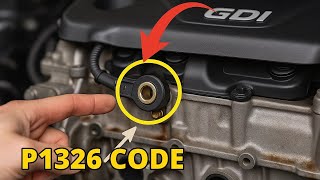
Hyundai, Kia, and Genesis implemented the KSDS via software updates (Campaign 953) as a direct response to widespread engine issues, particularly on their Theta II engines, which had a history of premature bearing failures from manufacturing debris. While the G80's Lambda II V6 is a different engine family, the protective strategy is the same. This code is not a typical knock sensor fault but is a specific logic code from this added monitoring system designed to detect bearing wear before severe engine damage occurs. 🎬 Watch: This video explains the KSDS logic and bearing failure. Its purpose is to provide an early warning and trigger a specific dealer-led diagnostic and warranty process, which often includes a lifetime engine warranty extension for this specific failure.
Symptoms You May Notice
- Flashing Check Engine Light (MIL)
- Vehicle enters 'limp mode' (severely reduced power and acceleration)
- Engine RPM limited to approximately 1800-2000 RPM
- Audible chime from the dashboard when the code first sets
- Engine may stall or idle roughly
- In advanced cases, a metallic knocking or tapping sound from the engine
- Replacing the knock sensor without performing the full diagnostic procedure. The sensor is often just the messenger, and replacing it will not fix an underlying mechanical issue or a software-related trigger. The dealer must follow the TSB flow chart, starting with software checks and the Bearing Clearance Test.
Most Likely Causes
- Internal Connecting Rod Bearing Wear 🔴 High Probability This engine family has a known history of premature bearing wear, which prompted the creation of the KSDS monitoring system. The system is specifically designed to detect this failure. Insufficient lubrication or oil contamination can accelerate this wear.
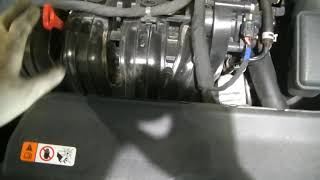
How to confirm: The dealer will perform a bearing clearance test (BCT) using a special service tool that applies pressure and vacuum to the piston to measure clearance. An oil and oil filter inspection for metallic debris is also a key indicator. A video from a technician demonstrates this process.
Typical fix: Engine replacement, typically with a new long block assembly. This is usually covered at no cost to the owner under Hyundai/Genesis's extended warranty campaign for this issue.
Est. part cost: $0 (under warranty) - KSDS Software Update Required 🟡 Medium Probability The KSDS is a retrofitted software solution. Early versions could be overly sensitive. The first step in the dealer's diagnostic process is always to ensure the latest software is installed.
How to confirm: A Genesis dealer will check the vehicle's VIN against their internal system (WebDCS) for open campaigns and verify the current software version on the Engine Control Module (ECM).
Typical fix: Dealer performs a free software update to the latest KSDS calibration as part of Service Campaign 953 or a superseding campaign.
Est. part cost: $0 (under campaign) - Faulty Knock Sensor or Wiring ⚪ Low Probability → Shop Ignition Knock (Detonation) Sensor While less common, a failing knock sensor or a damaged/corroded wiring harness can send erratic signals that the KSDS software might misinterpret as bearing failure. The diagnostic procedure specifically includes a 'Wiring Signal Interference Check' for this reason.
How to confirm: If the bearing clearance test passes and the software is up to date, the technician will inspect the knock sensor and its circuit for faults. The TSB for P1326 outlines a specific wiring check before condemning the engine.
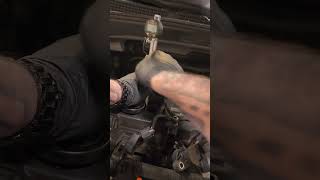
Typical fix: Replace the knock sensor and/or repair the damaged wiring harness. The knock sensor on the 3.3T V6 is located under the intake manifold, requiring significant disassembly to access. 🎬 Watch: How to diagnose and replace a faulty knock sensor.
Est. part cost: $50-$150
Diagnosis Steps
- Confirm the presence of code P1326 and a flashing check engine light.
- DO NOT CLEAR THE CODE. The active code is required for the dealer to process the warranty claim.
- Immediately stop driving the vehicle and have it towed to an authorized Genesis dealership.
- The dealer will verify the code and check the vehicle's VIN for eligibility under extended warranty campaigns (e.g., Campaign 953, T3G, T6G).
- The first step is typically to update the KSDS software to the latest version if not already done.
- If the code returns or if required by the campaign, the dealer will perform a Bearing Clearance Test (BCT) to check for mechanical engine wear.
- The diagnostic procedure may also include a 'Wiring Signal Interference Check' to rule out electrical faults.
- If the BCT fails, the dealer will initiate a prior approval request with Genesis for a full engine replacement under warranty.
- If the BCT passes, the technician will then investigate the knock sensor and its circuit for faults.
Parts You'll Likely Need
- Engine Long Block Assembly — This is the required part if the bearing clearance test fails, indicating terminal internal engine wear.
Trusted brands: Genesis OE
OEM price range: $8000-$12000
Aftermarket price range: N/A - Knock Sensor
(OEM #39320-3L000)— Replaced only if the engine passes the bearing test but the sensor or its circuit is diagnosed as faulty.
Trusted brands: Genesis OE, Bosch
OEM price range: $100-$151.02
Aftermarket price range: $50-$120
Related Codes That Often Appear With This One
- P0300-P0308 — If bearing wear is severe, it can cause crankshaft and piston play that leads to misfires.
- P0014 — Metal debris from failing bearings can clog oil passages and affect the variable valve timing (CVVT) system, leading to camshaft timing codes.
- P0016, P0017 — Severe bearing wear can affect crankshaft position, leading to correlation errors between the crank and cam sensors, especially if the timing chain has stretched or jumped due to oil pressure issues.
Technical Service Bulletins (TSBs) & Recalls
- Campaign 953: Product Improvement Campaign to install Knock Sensor Detection System (KSDS) software. This was the initial campaign to add the P1326 logic.
- TSB 22-01-023H (Campaign T6G): Outlines the procedure for engine bearing inspection and replacement for vehicles that have DTC P1326 after the initial KSDS update.
- TSB 20-01-024H (Campaign T3G): Earlier TSB for engine inspection/replacement related to DTC P1326, often referencing TSB 19-01-006H or similar procedures.
- TSB 19-01-006H: Details the inspection procedure for DTC P1326, including wiring checks and engine replacement criteria, primarily for Theta II engines but the principles are similar.
Platform-Specific Known Issues
- This code is directly tied to Hyundai/Genesis Product Improvement Campaign 953 and subsequent warranty extensions (like TSBs T3G and T6G). These campaigns provide a software update for the KSDS and extend the engine warranty, often to 15 years/150,000 miles or even a lifetime warranty for this specific failure, covering the engine replacement at no cost to the owner.
Mechanic-Grade Diagnostic Values
- Bearing Clearance Tester (SST) Air Pressures — expected: Shop air supply: 50 psi minimum; Apply Pressure (AP): 0.1 ~ 0.11MPa; Vacuum (VC): -0.073 ~ -0.083MPa.. Failure: Readings outside these ranges indicate the test equipment is not calibrated and the BCT results will be invalid.
- Knock Sensor Mounting Bolt Torque — expected: 15 ft-lbs. Failure: Incorrect torque can alter the sensor's sensitivity, leading to false signals or missed detections of actual engine knock.
- Engine Oil Temperature for Wiring Signal Interference Check — expected: 176°F (80°C) or greater. Failure: Test will not proceed or will be inaccurate if the engine is not at full operating temperature.
- Knock Sensor Wiring Repair Limit — expected: Cut the wiring approximately 20 - 40 mm (0.7 - 1.5 inches) away from the connector.. Failure: Cutting past 40 mm may damage a shielded portion of the wire designed to prevent external noise, potentially causing future false codes.
Scan Tool Commands That Help
- Genesis GDS (Global Diagnostic System): Special Inspection -> Bearing Clearance Test (BCT) — This is the mandatory first mechanical test when P1326 is present. It uses a special tool to measure connecting rod bearing play and produces a 'Pass' or 'No Pass' result, which dictates the entire repair path (engine replacement vs. further diagnosis).
- Genesis GDS (Global Diagnostic System): S/W Management -> Wiring Signal Interference Check — This function is used if the Bearing Clearance Test passes. It helps determine if electrical noise from other components, like fuel injectors, is causing a false P1326 trigger before replacing the knock sensor or harness.
- Genesis GDS (Global Diagnostic System): S/W Management -> Reset Adaptive Values — This is a critical final step after replacing the knock sensor. Failing to reset the ECM's learned values can cause the P1326 code to return even with a new, functional sensor.
- Genesis GDS (Global Diagnostic System): ECU Upgrade — Used to apply the initial KSDS software update (Campaign 953/966) or any subsequent logic updates. This is the first check a dealer performs.
Wiring & Ground Locations
- Knock Sensor Location — Underneath the intake manifold, often near the #3 fuel injector.. Access requires significant disassembly (intake manifold removal). Its proximity to the fuel injector harness makes correct wire routing critical to avoid electrical interference that can cause a false P1326.
- Knock Sensor Harness Routing — From the sensor, under the intake, to the main engine harness.. The knock sensor harness must be routed away from the fuel injector harness. If they touch, the knock sensor can pick up electrical feedback from the injector pulses and misinterpret it as engine knock, triggering a false P1326 code.
- Engine Compartment Ground (General) — A primary engine ground point (e.g., G01) is typically located on the left fender in the engine compartment.. While not specific to the P1326 diagnostic tree, a poor main engine ground can cause unstable readings across multiple sensors. It should be checked as part of any general electrical diagnosis.
Real Owner Repair Stories
- Reddit user in r/Hyundai (Vehicle with over 100,000 km) — P1326 code triggered, vehicle went into limp mode.
❌ Tried (didn't work) N/A - Taken directly to dealer.
✅ What actually fixed it The dealer performed the Bearing Clearance Test, which the engine passed. The knock sensor was then replaced under warranty, and the software was confirmed to be up to date. This resolved the code. - Reddit user in r/kia (2016 Kia Optima with 165,000 miles) — Audible knock, flashing check engine light, P1326, and limp mode.
❌ Tried (didn't work) The dealer performed a Bearing Clearance Test, which the engine passed. This did not lead to an engine replacement, which the owner expected.
✅ What actually fixed it The dealer updated the software and performed a long road test. The outcome was unresolved from the owner's perspective, as they were concerned the engine would still fail despite passing the BCT, highlighting a common scenario where the dealer follows protocol but the owner lacks confidence in the repair. - YouTube video by SES Garge (2017 Hyundai Sonata 2.4L) — Flashing check engine light, P1326, limp mode.
❌ Tried (didn't work) Verifying the software was already the latest version.
✅ What actually fixed it The technician performed the Bearing Clearance Test, which the engine passed. Following the TSB, the technician then replaced the knock sensor, which required removing the intake manifold. After installation, the technician used a GDS scanner to 'Reset Adaptive Values', which is a critical final step. This resolved the code.
When the Usual Fixes Don't Work
- In some documented cases, a vehicle will present with P1326, pass the mandatory Bearing Clearance Test (BCT), and receive a new knock sensor and/or software update as prescribed by the TSB. However, the owner may still hear an audible knocking noise, or the P1326 code may return. In these instances, some owners have reported that Hyundai/Genesis corporate has denied a warranty engine replacement because the BCT was passed, leaving the owner with a car they believe is unsafe. This indicates that while the dealer's diagnostic path is rigid, it may not catch every failure mode, and a 'Pass' on the BCT is the ultimate deciding factor for warranty coverage, sometimes against other evidence like audible knocks.
Model Year Variations Within This Range
- 2017-2020: The primary variation is not year-to-year, but whether the vehicle has had the KSDS software installed via Campaign 953. An early-build 2017 would require the update to be performed at a dealership to enable P1326 logic, while a later-build 2020 may have had equivalent software from the factory. The diagnostic procedure for P1326 is identical regardless of year, provided the KSDS software is present.
Diagnostic Flowchart
Other Known Issues on This Vehicle
Issues unrelated to this code that are worth knowing about as an owner of this generation:
- Panoramic Sunroof Rattle/Creak 🟡 Low — Very common across the entire DH generation. Noise is often temperature-dependent and may occur when the sunshade is open. (Ref: TSB 19-BD-001H-1 provides a detailed procedure for lubricating and adjusting the sunroof assembly to fix noises.)
- Leaking Turbocharger Oil Feed Pipe 🔴 High — Common enough to warrant a recall. The leak drips oil onto the hot exhaust manifold, creating a fire risk. (Ref: Recall 019G (NHTSA 21V-592) supersedes a previous recall to replace the left turbocharger oil feed pipe due to deterioration.)
- Intermittent Electronic Parking Brake (EPB) Fault 🟠 Medium — Multiple owners report the EPB failing to auto-disengage when shifting into gear, often showing orange warning lights. Cycling the ignition typically resolves it temporarily. (Ref: No specific TSB, but owner forums suggest checking for low brake fluid or faulty wiring/connectors at the wheel caliper motor as potential causes.)
- Sticky or Notchy Steering Feel 🟠 Medium — Some owners have reported a 'sticking' feeling in the steering rack, particularly on the highway. This can be a costly repair if out of warranty. (Ref: No specific TSB, but owner experiences indicate that steering rack replacement is the common dealer fix.)
- Low-Pressure Fuel Pump Failure 🔴 High — While the main recalls affect 2021+ models, the underlying issue of impeller deformation in the low-pressure fuel pump can cause stalling and loss of power. (Ref: NHTSA Campaign 23V-630 (and expansions) covers many Genesis models, though primarily post-2020. Owners of earlier models should be aware of the symptoms.)
Used vs. New Parts: Buying Guide for This Vehicle
When a used part is the smart pick: For this specific P1326 issue, sourcing a used part is almost never a smart choice. The primary failure is a worn engine, and a used engine from a donor vehicle of the same era is highly likely to suffer from the same inherent connecting rod bearing defect. A used knock sensor might be considered, but the labor to access it (intake manifold removal) makes installing a new part for reliability far more logical.
What to inspect on the donor part:
- For a used engine, this is not recommended. Any sign of metallic flakes or sludge in the oil or oil filter of a donor engine is a definitive red flag for bearing failure.
- For a used knock sensor, inspect the connector for corrosion, cracks, or damaged pins.
OEM-only on this vehicle (don't cheap out):
- Engine Long Block: The warranty replacement is always a new OEM long block. Due to the widespread nature of the bearing issue, aftermarket or remanufactured engines are a significant risk unless they come with a comprehensive warranty that specifically covers this known failure mode.
Aftermarket brands forum-validated for this vehicle:
- For the knock sensor, Bosch is a reputable OEM supplier and a reliable alternative to the Genesis-branded part.
Brands owners have reported issues with on this vehicle:
- Avoid unbranded, no-name knock sensors from online marketplaces. An unreliable sensor can lead to a false P1326 trigger and limp mode, or fail to detect a real issue.
Real Owner Stories
Aggregated from forums and TSBs cited above. Mileages and costs reflect what owners reported in those sources.
2017-2020 Genesis G80 3.3L Lambda II T-GDI V6
Symptoms: The vehicle entered 'limp mode' with severely reduced power and acceleration, and the engine RPM was limited to approximately 1800-2000 RPM. A flashing Check Engine Light (MIL) was present.
What fixed it: Dealer performed a Bearing Clearance Test (BCT) which failed; the engine was replaced with a new long block assembly under the extended warranty campaign.
Cost: $0
Source hint: genesisowners.com forum discussions
2017-2023 Kia Stinger GT 3.3L V6
Symptoms: Flashing MIL and limp mode behavior identical to the G80. Owners reported the KSDS software triggered due to potential bearing failure.
What fixed it: Engine replacement under warranty after the dealer followed the P1326 diagnostic process and confirmed mechanical wear.
Cost: $0
Source hint: stingerforum.org threads on P1326 and Campaign 953
2017-2020 Genesis G80 3.3L Lambda II T-GDI V6
Symptoms: Check engine light flashing and an audible chime from the dashboard when the code first set.
What fixed it: Dealer verified the VIN against WebDCS for open campaigns and performed a free software update to the latest KSDS calibration (Campaign 953).
Cost: $0
Source hint: genesisowners.com forum discussions
Related OBD-II Codes
Frequently Asked Questions
Is my 2017-2020 Genesis G80 3.3L covered for engine replacement if P1326 appears?
What specific TSBs cover the P1326 diagnostic process for the Lambda II T-GDI engine?
Can I just clear the P1326 code and keep driving my G80?
What is the 'Bearing Clearance Test' (BCT) the dealer mentioned?
Is there a software-only fix for P1326 on the Genesis G80?
Does the recall for the turbocharger oil feed pipe cause P1326?
Helpful Videos

We Have This Part in Stock


The information in this article is provided for general reference and educational purposes only. Vehicle specifications, procedures, and part compatibility can vary by production date, trim level, and region. Always consult your vehicle's factory service manual and verify part numbers before purchasing or performing repairs. Safety-critical components such as airbags, seat belts, and braking systems should be installed by a qualified professional.
- Genesis G80:
- 🧭 Diagnostic Flowchart
- 🎬 Helpful Videos
- 🛍️ Shop This Part
- What's Unique About the 2017-2020 Genesis G80
- Symptoms You May Notice
- Most Likely Causes
- Diagnosis Steps
- Parts You'll Likely Need
- Related Codes That Often Appear With This One
- Technical Service Bulletins (TSBs) & Recalls
- Platform-Specific Known Issues
- Mechanic-Grade Diagnostic Values
- Scan Tool Commands That Help
- Wiring & Ground Locations
- Real Owner Repair Stories
- When the Usual Fixes Don't Work
- Model Year Variations Within This Range
- Other Known Issues on This Vehicle
- Used vs. New Parts: Buying Guide for This Vehicle
- Real Owner Stories
- 2017-2020 Genesis G80 3.3L Lambda II T-GDI V6
- 2017-2023 Kia Stinger GT 3.3L V6
- 2017-2020 Genesis G80 3.3L Lambda II T-GDI V6
- Related OBD-II Codes
- Frequently Asked Questions
- 🎟️ Get 5% Off