

P1326 on 2019 Kia Sorento: Knock System Warning, Limp Mode, and Engine Failure Risk
The P1326 code on a 2019 Kia Sorento indicates the Knock Sensor Detection System (KSDS) has detected vibrations consistent with internal engine bearing wear. This is a critical warning that triggers limp mode. Do not clear the code; drive slowly and directly to a Kia dealership for diagnosis under a potential lifetime engine warranty for the engine short block.
- P1326 is a critical code indicating a high probability of internal engine failure.
- Do not clear the code or delay service; take it to a Kia dealer immediately.
- The repair may be a free engine replacement under a lifetime warranty if the vehicle qualifies.
- The warranty is contingent on the KSDS software update having been previously installed.
What's Unique About the 2019-2019 Kia SORENTO
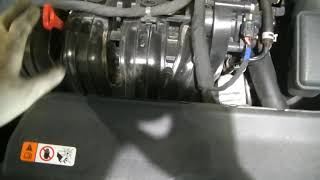
The 2019 Sorento with the 2.4L GDI or 2.0L T-GDI Theta II engine is part of a large group of Kia and Hyundai vehicles known for premature engine bearing failure. This was allegedly caused by manufacturing defects leaving metal debris in the engine. In response to class-action lawsuits, notably *In re: Hyundai and Kia Engine Litigation II*, Kia rolled out the KSDS software update and a significantly extended warranty—potentially a lifetime warranty for the engine short block for certain failures. Therefore, a P1326 code on this vehicle is not just a diagnostic trouble code; it is the specific trigger for a warranty claim process 🎬 Watch: This video explains the Theta II bearing failure logic. that can lead to a free engine replacement if specific criteria are met at a dealership.
Diagnostic Flowchart
Tap your situation to follow the diagnostic path that matches what you're seeing on this vehicle.
Symptoms You May Notice
- Flashing Check Engine Light.
- Vehicle enters 'limp mode,' refusing to accelerate or go over 2000 RPM and ~60 MPH. [1, 10, 27, ODI #11622440]
- Loss of power and struggling to climb hills. [ODI #11715656]
- Engine stalling or jumping during acceleration. [ODI #11622440]
- Audible metallic knocking or rattling from the engine, which may get progressively worse.
- Rough idle or stalling.
- Sudden loss of power while driving on the highway.
- Replacing only the knock sensor without a proper diagnosis. The P1326 code is a *detection* of a mechanical problem; the sensor is usually just doing its job. Replacing it without performing the dealer-mandated bearing clearance test can lead to the code returning and leave the driver with a failing engine.
Most Likely Causes
- Excessive Connecting Rod Bearing Wear 🔴 High Probability Manufacturing defects, such as metal debris left in the engine during production, can lead to oil starvation and premature failure of the connecting rod bearings in certain Kia Theta II GDI engines. Poor lubrication or contaminated oil can accelerate this wear.
How to confirm: A Kia dealership must perform a specific bearing clearance test using the special service tool (SST KQ231-2T110QQK) as outlined in TSBs like PI2002Y/Z and PI1805Y/Z. The presence of code P1326 itself is the primary indicator that the KSDS software has detected this failure mode.
Typical fix: If the bearing clearance test fails, the fix is a complete engine short block or long block replacement, often covered under Kia's extended/lifetime warranty program.
Est. part cost: $0 (if under warranty) - $7000+
Rare But Worth Checking
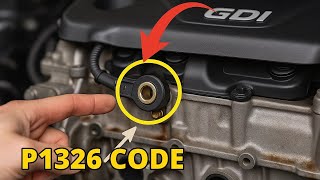
- Faulty Knock Sensor or Wiring: → Shop Ignition Knock (Detonation) Sensor While the code points to bearing wear, there are cases where the sensor itself or its wiring harness is the problem. A dealer will perform a 'Wiring Signal Interference Check' per TSB PI1803W/X to rule this out before condemning the engine. If the bearing clearance test passes, the knock sensor circuit is the next likely culprit. Some owners report 🎬 See how to diagnose and replace a faulty knock sensor. this code appearing after heavy rain or car washes, suggesting water intrusion into the sensor's wiring.
- Outdated Engine Control Unit (ECU) Software: If the vehicle never received the initial KSDS software update (e.g., PI1802, PI1803), the P1326 logic would not be active. However, issues with the software can sometimes be a factor, and a reflash to the latest version is part of the diagnostic process. The warranty extension is contingent on the KSDS update having been performed.
Diagnosis Steps
- DO NOT clear the code. The active P1326 code is required for the dealer to initiate the warranty process, and a Vehicle Diagnosis Number (VDN) must be created with the code present.
- Check with a Kia dealer using your VIN to see if the KSDS software update (e.g., Campaign PI1803, PI2002) was performed and if your vehicle is covered by the lifetime engine warranty.
- Take the vehicle to a Kia dealership for official diagnosis. Towing is recommended over driving in limp mode.
- The dealer will confirm the P1326 code and, per TSB PI1803W/X, perform a 'Wiring Signal Interference Check' using the KDS diagnostic tool to rule out electrical issues.
- If the wiring is good, the dealer will perform an Engine Bearing Clearance Test using special service tool KQ231-2T110QQK, which applies air and vacuum to the cylinders to measure wear.
- If the test fails, the engine will be replaced under warranty (if eligible). The dealer will likely open a Techline case with Kia for authorization.
- If the test passes, the technician will diagnose the knock sensor and its circuit for faults, which may involve replacing the sensor or its extension harness.
Parts You'll Likely Need
- Engine Long Block Assembly — This is the authorized repair by Kia when the P1326 🎬 Watch: One owner's experience getting a free engine replacement. code is triggered and the bearing clearance test confirms internal engine damage. [14, 23, ODI #11715656]
Trusted brands: Genuine Kia (New or Remanufactured)
OEM price range: $5000-$8000+ - Knock Sensor
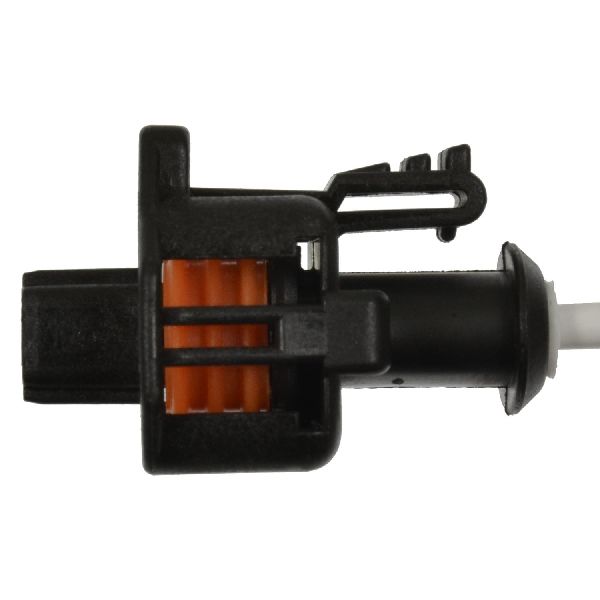
(OEM #39250-2G100 (for 2.4L L4) or 39250-2G700 (for 2.0L Turbo))— In the less common event that the engine passes the bearing clearance test, the sensor itself may be faulty. Part number varies by engine.
Trusted brands: Genuine Kia, Bosch
OEM price range: $73-$112
Aftermarket price range: $80-$150 - Engine Bearing Clearance Tester
(OEM #KQ231-2T110QQK)— This is a special service tool (SST) required by the dealer to perform the mandatory bearing clearance test. Not a replacement part for the consumer.
Trusted brands: Kia Special Service Tool
OEM price range: N/A
Related Codes That Often Appear With This One
- P0420 (Catalyst System Efficiency Below Threshold): This can sometimes appear alongside P1326, potentially due to oil consumption issues associated with the engine wear, which can damage the catalytic converter.
Technical Service Bulletins (TSBs) & Recalls
- PI2002Y/Z: Provides engine replacement instructions for vehicles that return with DTC P1326 after the KSDS update, detailing the use of the Engine Bearing Clearance Tester.
- PI1803W/X: Details the diagnostic procedure, including the 'Wiring Signal Interference Check,' to be performed when P1326 is present. This TSB is a primary guide for dealers.
- PI1802: The original campaign for the 'Knock Sensor Detection System - ECU Logic Improvement'.
- PI1805Y/Z: A subsequent repair action for 2019 Sorento models specifically, outlining the P1326 diagnostic flow, including the bearing clearance test.
- SST067: Provides detailed procedures for using and calibrating the Engine Bearing Clearance Tester (BCT) tool.
Platform-Specific Known Issues
- Engine Class Action Settlement & Lifetime Warranty: Many 2012-2019 Sorentos are covered by a lifetime warranty for the engine short block assembly for failures caused by connecting rod bearing wear, as part of the *In re: Hyundai and Kia Engine Litigation II* settlement. This coverage is contingent on the vehicle having received the KSDS software update (e.g., before Nov 4, 2023 for certain benefits). Eligibility can be complex and may depend on maintenance history, though Kia states they will not deny a claim *solely* for lack of records.
- Knock Sensor Detection System (KSDS) Campaign: → Shop Ignition Knock (Detonation) Sensor Kia initiated multiple product improvement campaigns (PI1802, PI1803, PI2002) to install KSDS software on these vehicles. This software is specifically designed to detect the vibrations that trigger code P1326 and put the car in limp mode to prevent a catastrophic engine fire or seizure.
Mechanic-Grade Diagnostic Values
- Knock Sensor Mounting Bolt Torque — expected: 15-17 ft-lbs. Failure: Improper torque can cause the piezoelectric sensor to generate incorrect vibration readings, either too sensitive or not sensitive enough.
- Engine Oil Temperature for Dealer Tests — expected: At or above 176°F (80°C), with some TSBs specifying 185°F (85°C). Failure: The KDS/GDS software will not allow the 'Wiring Signal Interference Check' or 'Engine Noise Inspection' to proceed if the engine is not at full operating temperature, as cold oil can mask bearing noise.
- Engine RPM for KDS Engine Noise Test — expected: Hold at 1,900-2,100 RPM for 2.4L engine or 1,900-2,200 RPM for 2.0T engine.. Failure: The KDS-guided test requires holding the engine at this specific RPM range for the special microphone tool to accurately measure noise levels and determine a 'PASS' or 'NO PASS' result.
- Knock Sensor Signal (Manual Test) — expected: Produces a small AC millivolt signal when the sensor body is lightly tapped with a metal tool.. Failure: If the sensor produces no voltage signal when tapped, it is likely internally faulty. Note: Resistance checks are often inconclusive for piezoelectric sensors.
Scan Tool Commands That Help
- Kia KDS / GDS: Wiring Signal Interference Check — This is the mandatory first diagnostic step after confirming P1326 is active. It's a 3-minute automated test at idle to check for electrical noise in the knock sensor circuit. A 'NOT OK' result directs the technician to install a new shielded extension harness before proceeding.
- Kia KDS / GDS: Engine Noise Inspection / Bearing Clearance Test (BCT) — This is the second step if the 'Wiring Signal Interference Check' result is 'OK'. It uses a special service tool (microphone in dipstick tube or air/vacuum tester) to definitively test for bearing wear. A 'NO PASS' or 'FAIL' result condemns the engine and authorizes replacement under warranty.
- Kia KDS / GDS: Create Vehicle Diagnosis Number (VDN) — This is a mandatory administrative step for the dealer technician. According to TSBs PI1802W/X and PI1803W/X, a VDN must be created with DTC P1326 present, or warranty claim submission issues may occur.
- Kia KDS / GDS: Reset Adaptive Values — This function, found in the 'Software Management' menu, must be performed after replacing a knock sensor. It clears the ECU's learned knock patterns to prevent the code from returning erroneously with a new, functional sensor.
Wiring & Ground Locations
- Knock Sensor — On the back of the engine block (firewall side), underneath the intake manifold, typically near the cylinder #3 fuel injector.. This is the primary sensor that detects the specific vibration frequency that triggers P1326. Its location makes replacement labor-intensive, as the intake manifold must be removed for access.
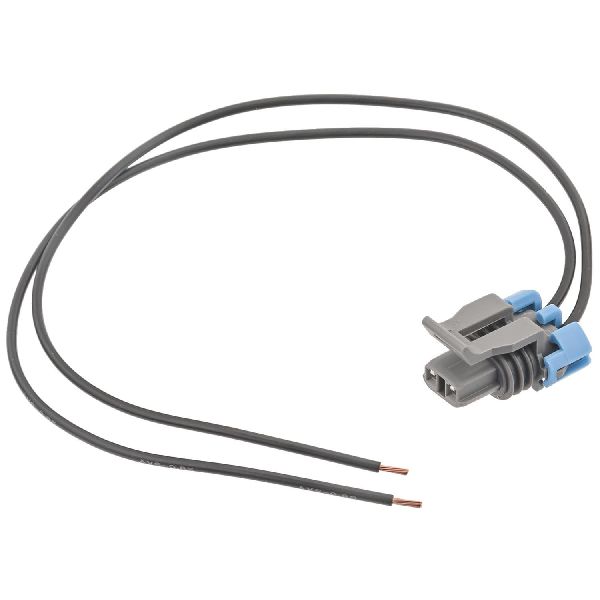
- Knock Sensor Extension Harness — An external, shielded harness that is cable-tied to the main engine harness, running from the ECU connector area along the intake manifold to the knock sensor.. Kia issued TSBs (e.g., PI1803W/X) to install this harness to prevent electromagnetic interference from other components, like fuel injectors, which could cause a false P1326. The diagnostic procedure requires checking if this harness is already installed.
- Ground Point GC101 / GC102 — Various ground points are located on the engine block, cylinder head, and chassis near the fuse panel. For the 2.4L GDI, GC101 and GC102 are key engine grounds.. A poor engine ground can introduce electrical noise into sensor circuits. While not a primary cause, a corroded or loose ground could potentially contribute to a failed 'Wiring Signal Interference Check'.
- PCM Connector Pins (Knock Sensor) — On the main Powertrain Control Module (PCM) connector. For a 2018 Sorento 2.4L, the Knock Sensor Signal is on Pin 63 (Green wire) and the Knock Sensor Ground/Shield is on Pin 95 (White wire).. Technicians may need to test for continuity or voltage directly at the PCM pins to diagnose a wiring harness issue between the sensor and the control module, especially if the extension harness is already installed.
Real Owner Repair Stories
- Reddit user in r/kia (2016 Kia Optima, 165,000 miles) — Heard a knock while accelerating uphill, followed by flashing check engine light and limp mode (RPM limited to 1,750).
❌ Tried (didn't work) The dealership confirmed code P1326 but performed a software update which cleared the code, despite the owner's concerns about the audible knock.
✅ What actually fixed it Unresolved at the time of posting. The engine passed the dealer's 'bearing clearance test,' so Kia would not replace the engine. The owner was left in a situation where the car was deemed 'fixed' by the dealer, but they feared the imminent failure would occur again far from home. This highlights a common owner frustration where the dealer test may not align with real-world symptoms. - Reddit user in r/Hyundai (2016 Hyundai Sonata Hybrid, 147,000 miles) — Audible engine knocking sound when warm and driving (not at idle). Eventually, the car threw code P1326 and was towed to the dealer.
❌ Tried (didn't work) The dealer performed the bearing clearance test, which passed. They then replaced the knock sensor as the prescribed fix.
✅ What actually fixed it The knock sensor replacement did NOT fix the underlying issue. The owner reported they could still hear the knocking sound after the repair, leaving them concerned the code would return after the 150,000-mile warranty extension expired. This is a classic example of misdiagnosis where the sensor is replaced but the mechanical fault causing the noise remains.
When the Usual Fixes Don't Work
- While the vast majority of P1326 cases on these engines point to terminal bearing failure, there are numerous owner accounts of a frustrating 'gray area.' In these cases, the vehicle sets the P1326 code and enters limp mode, but subsequently passes the dealer-mandated Bearing Clearance Test (BCT). Per Kia's official procedure, if the BCT passes, the next step is to check the wiring and potentially replace the knock sensor. However, owners report that even after a knock sensor replacement, the underlying mechanical noise can persist, leading to a cycle of repeat visits and a fear of driving a vehicle that Kia has deemed 'repaired' but the owner feels is unsafe.
OEM Part Supersession History
91400 2T000QQK→91400 2T100QQK— This is the part number for the Knock Sensor Extension Harness Kit used in the wiring repair procedure.
Helpful Videos


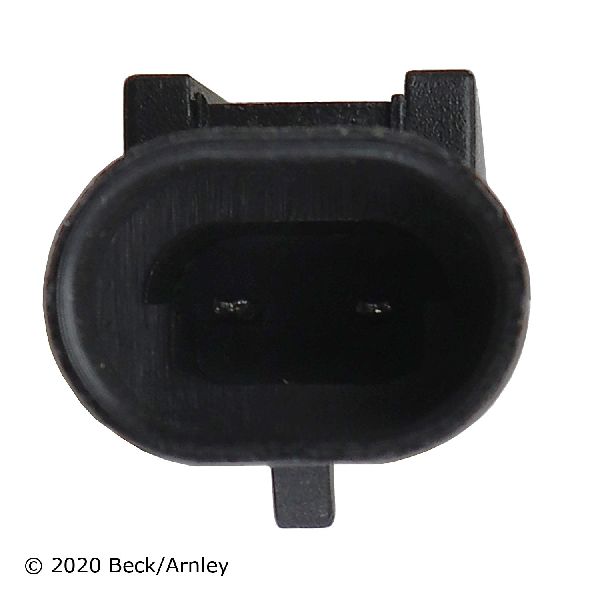
We Have This Part in Stock


The information in this article is provided for general reference and educational purposes only. Vehicle specifications, procedures, and part compatibility can vary by production date, trim level, and region. Always consult your vehicle's factory service manual and verify part numbers before purchasing or performing repairs. Safety-critical components such as airbags, seat belts, and braking systems should be installed by a qualified professional.
- Kia SORENTO:
- 🧭 Diagnostic Flowchart
- 🎬 Helpful Videos
- 🛍️ Shop This Part
- What's Unique About the 2019-2019 Kia SORENTO
- Symptoms You May Notice
- Most Likely Causes
- Rare But Worth Checking
- Diagnosis Steps
- Parts You'll Likely Need
- Related Codes That Often Appear With This One
- Technical Service Bulletins (TSBs) & Recalls
- Platform-Specific Known Issues
- Mechanic-Grade Diagnostic Values
- Scan Tool Commands That Help
- Wiring & Ground Locations
- Real Owner Repair Stories
- When the Usual Fixes Don't Work
- OEM Part Supersession History
- 🎟️ Get 5% Off