

P1404 on 1995-2001 Ford Explorer: EGR Closed Position Performance Fixes
On a 1995-2001 Ford Explorer, P1404 almost always means the EGR valve is stuck slightly open due to carbon buildup. Cleaning the EGR valve and its passages is the most common fix and can often be done for the cost of a gasket and cleaner. Disconnecting the battery for 30 minutes after the repair is crucial to reset the PCM's learned values.
- P1404 means the computer sees the EGR valve as not fully closed when it should be.
- The most probable cause is physical obstruction from carbon buildup. Start by removing and thoroughly cleaning the EGR valve and its mounting ports.
- Always use a new gasket when reinstalling the EGR valve to prevent leaks.
- If cleaning doesn't solve the problem, the EGR valve itself may be faulty. Test it with a vacuum pump before replacing.
- While less likely to cause this specific code, be aware that the DPFE sensor is a common failure item on these trucks and can cause various EGR issues.
What's Unique About the 1995-2001 Ford Explorer
The second-generation Ford Explorer, like many Fords from this era, uses a DPFE (Differential Pressure Feedback EGR) sensor to monitor EGR flow. While this code points to the EGR valve's position, the entire system is interconnected. Carbon buildup is a very frequent issue, physically preventing the valve from seating. Owners often find that a thorough cleaning of the valve and intake passages resolves the issue without needing to replace expensive parts. It is also critical to perform a PCM reset by disconnecting the battery after cleaning or replacement, as the old learned 'closed' voltage value can cause the code to return immediately even with a perfectly functioning valve.
Symptoms You May Notice
- Rough or unstable idle, sometimes stalling
- Hesitation or stumbling during acceleration
- Engine pinging or knocking sounds, especially under load
- Reduced fuel economy
- Check Engine Light is on
- Failure to pass an emissions test
- Black smoke from the tailpipe in some cases
- Replacing the DPFE sensor when the actual problem is carbon-clogged EGR passages. Always inspect and clean the passages before replacing parts.
- Replacing the EGR valve but failing to disconnect the battery to clear the PCM's memory. The PCM will retain the old, incorrect 'closed' voltage reading and immediately set the P1404 code again.
Most Likely Causes
- Carbon Buildup in EGR Valve or Passages 🔴 High Probability → Shop Exhaust Gas Recirculation (EGR) Valve The EGR system naturally recirculates exhaust soot, which can accumulate over time, especially with short-trip driving. This buildup physically blocks the EGR valve's pintle from fully seating, causing it to remain slightly open.
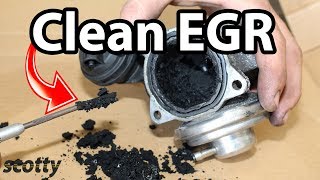
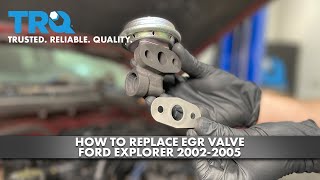
How to confirm: Remove the EGR valve (typically two 10mm bolts) and visually inspect it and the intake manifold ports for heavy, chunky black soot and carbon deposits. Check if the pintle moves freely by hand or with a vacuum pump.
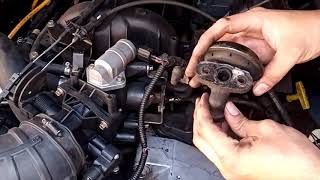
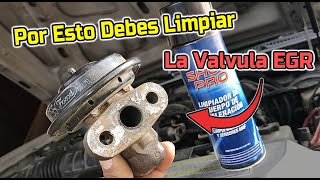
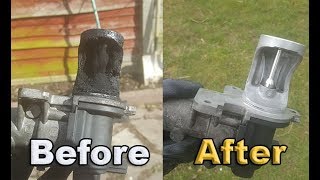
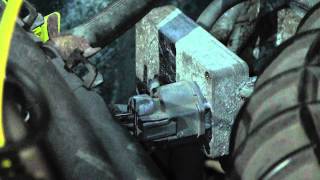
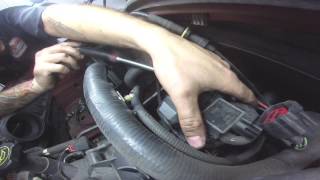
Typical fix: Thoroughly clean the EGR valve with carburetor cleaner, 🎬 Watch: Step-by-step guide to cleaning your EGR valve a wire brush, and picks. Scrape the carbon out of the mounting passages on the intake manifold. Replace the EGR gasket.
Est. part cost: $5-$15 for a gasket and cleaner - Faulty or Sticking EGR Valve 🟡 Medium Probability → Shop Exhaust Gas Recirculation (EGR) Valve The valve is a mechanical part operating in a high-heat environment. The internal diaphragm can rupture or the spring can weaken, causing it to stick or fail to close properly.
How to confirm: After cleaning, apply 10-15 inHg of vacuum to the EGR valve's port with a hand pump. It should open smoothly and hold vacuum without leaking down. When vacuum is released, it should snap shut decisively. If it's slow, sticky, or doesn't hold vacuum, it's failing.
Typical fix: Replace the EGR valve and gasket. Disconnect the battery for 30 minutes to force the PCM to relearn the new valve's closed position.
Est. part cost: $50-$150 - Defective DPFE Sensor ⚪ Low Probability The DPFE (Differential Pressure Feedback EGR) sensor is a known weak point on this generation of Ford trucks. It's exposed to heat and moisture from the exhaust, causing internal failure. While it more commonly sets a P0401 code, it can provide incorrect data that contributes to other EGR faults.
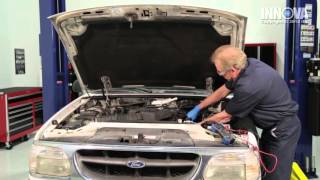
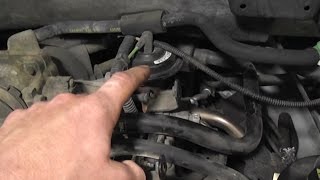
How to confirm: With the key on and engine off, backprobe the DPFE sensor's signal wire (typically the middle wire). The voltage should be around 0.5-1.0V. 🎬 See how to diagnose a faulty DPFE sensor If it's reading high (e.g., over 1.2V) at idle or is unresponsive when you apply vacuum to the EGR system, the sensor is likely bad.
Typical fix: Replace the DPFE sensor and the two silicone hoses that connect it to the EGR tube.
Est. part cost: $40-$90
Rare But Worth Checking
- Cracked or Disconnected EGR Vacuum Hoses: The small rubber hoses that control the EGR valve can become brittle and crack over time, causing vacuum leaks that affect EGR operation. Always inspect them when working on the system.
- Faulty EGR Vacuum Regulator (EVR) Solenoid: This electronic solenoid controls the vacuum supplied to the EGR valve. If it fails, it can cause the EGR to operate at the wrong times, though this is less common than the valve or sensor failing.
Diagnosis Steps
- Check for other codes. Address any other codes, especially those related to lean conditions (P0171/P0174) or other EGR codes (P0401), first.
- Inspect Vacuum Hoses. Visually inspect all vacuum lines running to the EGR valve and the EVR solenoid for cracks, brittleness, or loose connections.
- Remove and Inspect EGR Valve. Disconnect the battery. Remove the two 10mm bolts holding the EGR valve to the intake. Look for heavy carbon buildup on the pintle and in the valve itself. Check the intake manifold ports for blockages.
- Clean the System. Thoroughly clean the EGR valve with carburetor cleaner and a wire brush. Carefully scrape all carbon buildup from the intake manifold ports. Ensure the valve's pintle can move freely.
- Test the EGR Valve. Use a hand vacuum pump to apply 10-15 inHg of vacuum to the valve's nipple. The pintle should retract smoothly. The valve should hold this vacuum without leaking down. If it doesn't open or hold vacuum, it needs to be replaced.
- Reinstall and Reset. Install the cleaned or new EGR valve with a new gasket. Reconnect the battery (after it has been disconnected for at least 30 minutes to clear the PCM's learned values). Clear any remaining codes with a scanner.
- Drive and Verify. Drive the vehicle for at least 15-20 minutes, including some highway driving, to allow the PCM to complete its self-tests and confirm the repair.
- Test DPFE Sensor (if code returns). If the P1404 code comes back, test the DPFE sensor's voltage output to ensure it is within specification (0.5-1.0V KOEO) and responds correctly to vacuum.
Parts You'll Likely Need
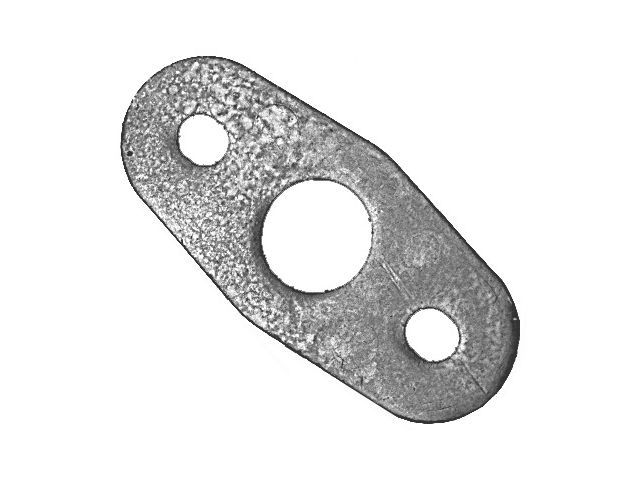
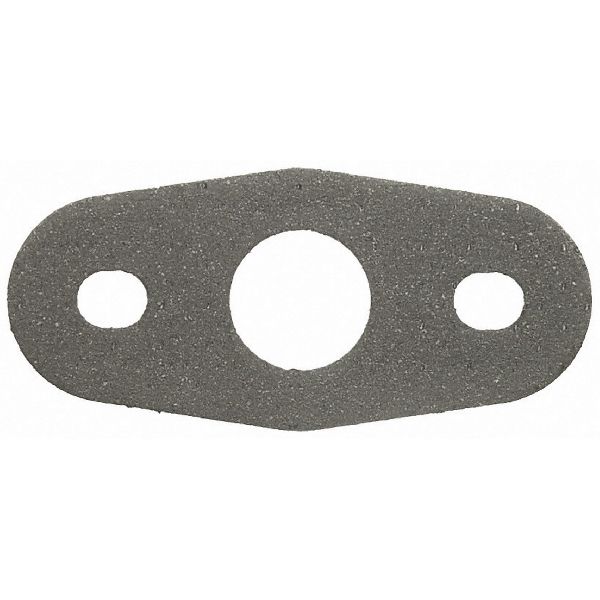
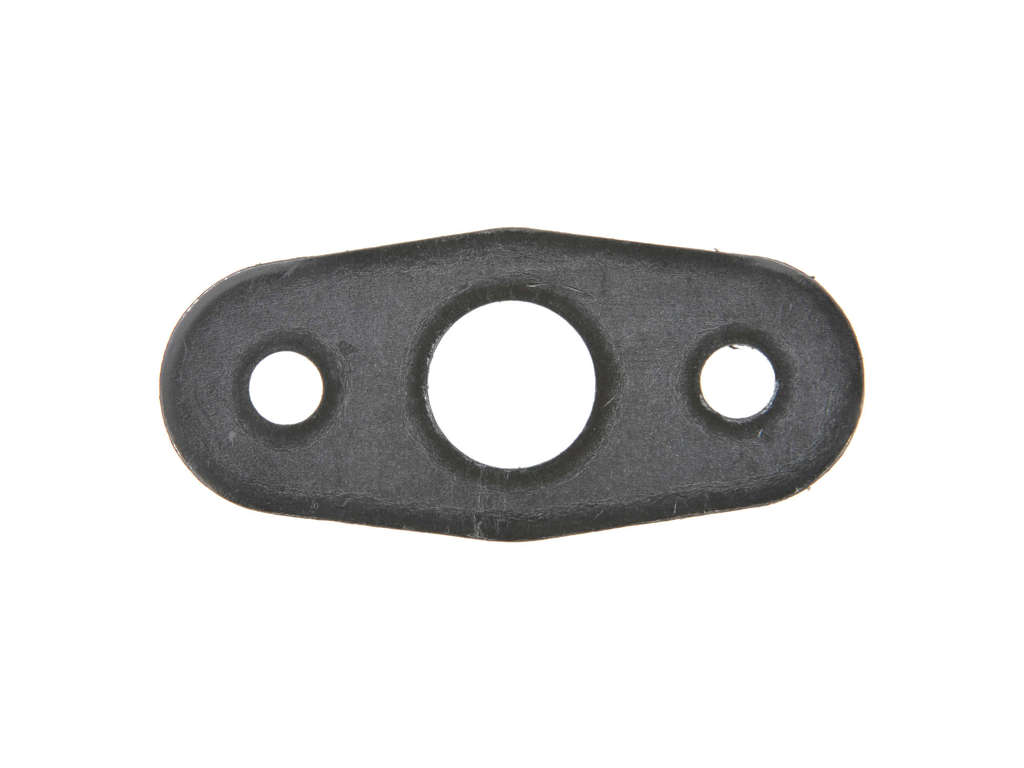
- EGR Valve Gasket
(OEM #F77Z-9E461-AA (varies by engine))— A new gasket is required anytime the EGR valve is removed to prevent vacuum and exhaust leaks.
Trusted brands: Motorcraft, Fel-Pro, ACDelco
OEM price range: $5-$10
Aftermarket price range: $2-$8 - EGR Valve
(OEM #Motorcraft CX1631 / F77Z-9D475-F2A (for 4.0L SOHC))— This is the part that gets stuck open due to carbon or internal failure, causing the P1404 code.
Trusted brands: Motorcraft, Standard Motor Products, Delphi
OEM price range: $100-$180
Aftermarket price range: $50-$120 - DPFE Sensor
(OEM #Motorcraft DPFE-15 / F77Z-9J460-AB)— A common failure point in the Ford EGR system. If it sends incorrect position or flow data to the PCM, it can cause EGR-related codes. Ford updated this part from a metal housing to a more reliable plastic one.
Trusted brands: Motorcraft, Bosch, Walker Products
OEM price range: $70-$120
Aftermarket price range: $40-$90
Related Codes That Often Appear With This One
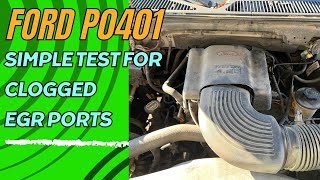
- P0401 — P0401 indicates insufficient EGR flow. Clogged passages or a faulty DPFE sensor can cause 🎬 Watch: How to clear clogged Ford EGR ports both codes to appear as the system struggles to function correctly.
- P0171/P0174 — If the EGR valve is stuck open, it creates a vacuum leak, allowing unmetered air into the intake manifold. This can cause the engine to run lean, triggering these codes.
Platform-Specific Known Issues
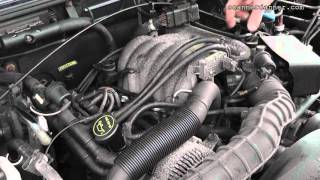
- On the 5.0L V8, access to the EGR valve and its passages can be more restricted than on the 4.0L V6, sometimes requiring removal of the throttle body for adequate cleaning access.
- Owners frequently report solving this code by simply removing and cleaning the original EGR valve, highlighting the prevalence of carbon buildup over actual part failure. A replacement is often not necessary if the valve's diaphragm is intact.
Mechanic-Grade Diagnostic Values
- EGR Vacuum Regulator (EVR) Solenoid Resistance — expected: 20 to 70 ohms. Failure: A reading outside this range indicates a faulty solenoid coil.
- DPFE Sensor Signal Voltage (KOEO) — expected: 0.2 to 1.3 Volts (Ford expanded the spec to accommodate newer plastic sensors which read higher, ~1.0V, than older metal ones, ~0.5V). Failure: A voltage reading significantly outside this range, or a reading that is high (e.g., 4.5V) with the engine running at idle, points to a bad sensor or a wiring issue.
- DPFE Sensor Reference Voltage (KOEO, at connector) — expected: ~5.0 Volts. Failure: Lack of 5V reference indicates a wiring or PCM issue, not a failed sensor.
Wiring & Ground Locations
- G108 — Left side of radiator support.. This is a primary engine compartment ground. A poor connection here can cause erratic voltage readings for various sensors in the EGR system.
- G121 — Rear of engine compartment, at the center of the firewall.. This ground is physically close to the DPFE sensor and EGR components. Corrosion or a loose connection can directly impact the sensor signals returning to the PCM.
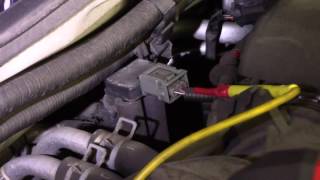
- EVR Solenoid Connector — Left side of the engine.. One wire on the EVR solenoid connector is a 12V feed (often Red/Yellow), while the other is the control ground from the PCM. Verifying 12V power here is a key step in diagnosing a non-responsive solenoid.
Real Owner Repair Stories
- JK-Forum.com user (Jeep JK Wrangler (similar EGR function and failure mode)) — P1404 Check Engine Light.
❌ Tried (didn't work) Initial inspection showed the EGR valve pintle was stuck.
✅ What actually fixed it The owner removed the EGR valve. After finding no replacement parts in stock, they disassembled the electronic portion from the valve body. They then used carburetor cleaner and manually worked the stuck pintle/piston until it moved freely. After reassembly and installation, the P1404 code was resolved without buying any parts.
OEM Part Supersession History
F77Z-9J460-AB (Metal Housing)→DPFE-15 (Plastic Housing)— The original metal-cased DPFE sensors were prone to failure from internal corrosion caused by exhaust moisture. Ford redesigned the part with a plastic housing to improve durability.
Heads up: The newer plastic sensor has a different Key-On-Engine-Off (KOEO) voltage (~1.0V) compared to the old metal one (~0.5V). The PCM's acceptable range was expanded by Ford to 0.2-1.3V to accommodate this change. This can sometimes cause a code during a KOEO self-test, but it should not set a Check Engine Light during normal driving.
Model Year Variations Within This Range
- 1995-Early 1997 (5.0L V8): These engines used an intake manifold with provisions for an internal EGR setup, even though they used an external valve.
- Late 1997-2001 (5.0L V8): These later 5.0L engines used a revised intake manifold designed only for the external EGR system and had no internal EGR passages cast into them. They also featured revised GT40P cylinder heads.
- 1995-2001 (4.0L V6): The 4.0L engine was available in two versions: the older Overhead Valve (OHV) design and the newer Single Overhead Cam (SOHC) design which appeared in 1997. While the EGR system's function is the same, the physical location and part numbers for the valve and related components can differ between the two engine types.
Diagnostic Flowchart
Other Known Issues on This Vehicle
Issues unrelated to this code that are worth knowing about as an owner of this generation:
- 4.0L SOHC V6 Timing Chain Cassette Failure 🔴 High — Very common, typically between 100,000 and 180,000 miles. Presents as a rattling or grinding noise ('death rattle') from the engine, especially at startup or certain RPMs. (Ref: Multiple TSBs issued, including 02-7-6, which addressed tensioner and guide replacement.)
- 5R55E Automatic Transmission Failures 🔴 High — Widespread across all second-generation models. Symptoms include harsh shifts, delayed engagement, loss of gears, or complete failure, often due to worn solenoid blocks or valve body issues. (Ref: Numerous TSBs were released to address software updates and specific component failures.)
- Cracked Plastic Intake Manifold (Late 4.0L SOHC / 5.0L V8) 🟠 Medium — Common on later models in the generation. The plastic intake can crack, typically near the thermostat housing or EGR ports, causing significant coolant leaks and potential overheating.
- Leaking Intake Manifold Gaskets 🟠 Medium — The O-ring style gaskets for the upper and lower intake manifolds are known to harden and shrink over time, causing vacuum leaks that lead to rough idling and lean codes (P0171/P0174).
- Broken Heater Blend Door 🟡 Low — Extremely common failure where the plastic blend door inside the HVAC case breaks, resulting in the heater being stuck on the hottest setting regardless of the temperature selection.
Used vs. New Parts: Buying Guide for This Vehicle
When a used part is the smart pick: A used EGR valve from a junkyard can be a viable option if it comes from a lower-mileage vehicle and you can verify its pintle moves freely before purchase. Since the primary failure is often carbon buildup, a used part can be cleaned and function perfectly well. Other components like vacuum lines or connectors are also good candidates for used parts.
Donor-vehicle mileage cap: roughly under 80000 miles for the part to have meaningful remaining life.
What to inspect on the donor part:
- For an EGR valve, bring a hand vacuum pump to the junkyard. Apply vacuum to the nipple and ensure the pintle retracts and holds vacuum.
- Visually inspect the EGR passages on the donor engine's intake manifold; if they are severely clogged, the valve has likely ingested a lot of carbon.
- Check the silicone hoses for the DPFE sensor for any cracks, brittleness, or swelling. They should be soft and pliable.
OEM-only on this vehicle (don't cheap out):
- DPFE Sensor: While some aftermarket brands are reliable, this is a notoriously problematic part. Many forum users and mechanics strongly recommend using a genuine Motorcraft DPFE sensor (DPFE-15) to avoid premature failure and incorrect readings that can lead to further misdiagnosis.
Aftermarket brands forum-validated for this vehicle:
- Standard Motor Products (SMP) and Delphi are generally considered reliable aftermarket brands for EGR system components like the valve or EVR solenoid.
- Fel-Pro is a trusted brand for the EGR valve gasket.
Brands owners have reported issues with on this vehicle:
- Unnamed, low-cost "white box" DPFE sensors sold on auction sites are frequently reported to fail quickly or be dead-on-arrival.
Real Owner Stories
Aggregated from forums and TSBs cited above. Mileages and costs reflect what owners reported in those sources.
Ford Explorer 4.0L V6
Symptoms: P1404 EGR Valve Closed Position Performance code; users stressed that cleaning just the valve wasn't enough.
What fixed it: Thoroughly cleaning the EGR valve and specifically the intake manifold ports to remove carbon blockages.
Source hint: ExplorerForum.com thread titled 'P1404 EGR Valve Closed Position Performance'
Ford Ranger 4.0L V6
Symptoms: P1404 code present; owner needed to rule out the sensor before mechanical teardown.
What fixed it: Testing the DPFE sensor voltage to ensure it was within spec before removing and cleaning the EGR valve.
Source hint: Ford-Trucks.com Ranger & B-Series section
Ford Explorer (Second Generation)
Symptoms: Extensive EGR flow problems and P1404 code; common on Ford trucks of this era.
What fixed it: Diagnosis of the entire system, often involving the DPFE sensor and EGR flow passages.
Source hint: Reddit r/MechanicAdvice
Related OBD-II Codes
Frequently Asked Questions
Is there a TSB for the rattling noise I hear on my 4.0L SOHC V6 along with the P1404 code?
I have a 5.0L V8 Explorer; why is it so hard to reach the EGR valve to clean it?
Can I just clean the EGR valve on my Explorer instead of buying a new one?
Why does my Explorer idle roughly and stall when this code is present?
Could a bad DPFE sensor be causing my P1404 code?
Will disconnecting my battery help fix the P1404 code after I clean the valve?
Helpful Videos
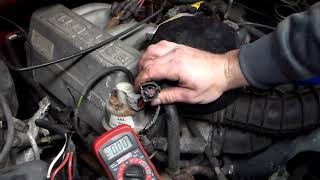
We Have This Part in Stock


The information in this article is provided for general reference and educational purposes only. Vehicle specifications, procedures, and part compatibility can vary by production date, trim level, and region. Always consult your vehicle's factory service manual and verify part numbers before purchasing or performing repairs. Safety-critical components such as airbags, seat belts, and braking systems should be installed by a qualified professional.
- Ford Explorer:
- 🧭 Diagnostic Flowchart
- 🎬 Helpful Videos
- 🛍️ Shop This Part
- What's Unique About the 1995-2001 Ford Explorer
- Symptoms You May Notice
- Most Likely Causes
- Rare But Worth Checking
- Diagnosis Steps
- Parts You'll Likely Need
- Related Codes That Often Appear With This One
- Platform-Specific Known Issues
- Mechanic-Grade Diagnostic Values
- Wiring & Ground Locations
- Real Owner Repair Stories
- OEM Part Supersession History
- Model Year Variations Within This Range
- Other Known Issues on This Vehicle
- Used vs. New Parts: Buying Guide for This Vehicle
- Real Owner Stories
- Ford Explorer 4.0L V6
- Ford Ranger 4.0L V6
- Ford Explorer (Second Generation)
- Related OBD-II Codes
- Frequently Asked Questions
- 🎟️ Get 5% Off