

P1404 on 2000-2006 Hyundai Accent 1.6L: DMTL Heater Circuit Causes and Fixes
This code points to a problem with the heater inside the EVAP system's leak detection pump (DMTL). The most common fix is replacing the entire DMTL pump assembly, located near the charcoal canister by the rear driver's side wheel. Before replacing, check the EVAP fuse. The most common fix is replacing the pump. Expect to pay $70-$150 for an aftermarket part.
- P1404 on a 2000-2006 Accent is for the EVAP system's DMTL pump heater, NOT the EGR valve.
- The issue almost never causes any driving symptoms other than the Check Engine Light, though it can sometimes make refueling difficult.
- The most common fix is to replace the DMTL pump (OEM # 31455-25500), which is located behind the rear driver's side wheel.
- Before buying parts, check the EVAP system fuse first and inspect the pump's connector for corrosion.
- This code will result in a failed emissions test, so it needs to be resolved to stay compliant.
What's Unique About the 2000-2006 Hyundai Accent
Many generic OBD-II code readers and even some mechanics will incorrectly define P1404 as an EGR (Exhaust Gas Recirculation) valve issue. However, for this specific generation of gasoline-powered Hyundai Accent, P1404 is officially defined as a fault with the DMTL heater circuit. Some configurations of this vehicle may not even be equipped with an EGR valve, which causes significant confusion for owners and technicians alike. Always ignore the EGR definition and focus on the EVAP system's DMTL pump located at the rear of the vehicle.
Generation note: The 2000-2006 year range covers the first generation facelift (LC, 2000-2003) and the second generation (LC2, 2003-2006). The 1.6L G4ED engine was used from 2001 onwards. For the purpose of this code, the diagnosis and repair of the DMTL system are consistent across these model years.
Symptoms You May Notice
- Check Engine Light is on.
- No noticeable drivability issues (e.g., rough idle, stalling, or loss of power).
- Difficulty filling the fuel tank (gas pump nozzle clicks off repeatedly).
- Replacing the EGR valve. Many gasoline-powered Accents in this range do not have an EGR valve, and P1404 is not an EGR code for this car.
- Replacing the gas cap. While a bad gas cap can cause other EVAP codes (typically for large leaks), it is not related to the DMTL heater circuit fault.
Most Likely Causes
- Failed DMTL Pump Assembly 🔴 High Probability The DMTL pump is located behind the rear wheel, where it is exposed to water, salt, and road debris. Over time, moisture can get inside, causing the internal heater element and motor to corrode and fail. Technicians have noted that the DMTL pump on this platform is not very reliable.
How to confirm: After checking the fuse, access the DMTL pump. Unplug its 4-pin electrical connector and use a multimeter to test the resistance across the two pins for the heater circuit. An open circuit (infinite resistance) indicates a failed heater. Alternatively, with the connector plugged in and ignition on, check for battery voltage on the power wire (often red/yellow). The heater circuit should draw approximately 0.3A when activated by the ECM (or by manually grounding the control wire, often blue/black).
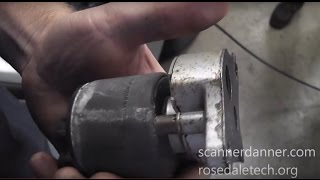
Typical fix: Replace the entire DMTL pump assembly. 🎬 Watch: This walkthrough shows how to replace the vent valve. It is sold as a single, sealed unit.
Est. part cost: $70-$150 - Damaged Wiring or Connector 🟡 Medium Probability The wiring harness leading to the DMTL pump can be damaged by road debris or suffer from corrosion due to its exposed location. Forum users have reported finding rusted or damaged connectors at the pump.
How to confirm: Visually inspect the wiring harness and connector for any breaks, chafing, or green/white corrosion on the pins. Perform a continuity test on the power and ground wires from the pump connector back to a known good point.
Typical fix: Repair the broken or corroded section of wire. If the connector is damaged, it may need to be replaced with a pigtail.
Est. part cost: $5-$30 - Blown Fuse or Faulty Relay ⚪ Low Probability
How to confirm: Consult the owner's manual or a service manual to identify the fuse that protects the EVAP system or DMTL circuit (often labeled 'EMIS' or similar). Visually inspect the fuse and test for continuity.
Typical fix: Replace the blown fuse. If the fuse blows again immediately, it indicates a short circuit in the system that must be diagnosed.
Est. part cost: $1-$5
Rare But Worth Checking
- Faulty Powertrain Control Module (PCM): → Shop Engine Control Module (ECM) This is extremely rare. The PCM should only be considered after all other possibilities, including the pump and wiring, have been exhaustively tested and ruled out.
Diagnosis Steps
- Confirm the code with an OBD-II scanner.
- CRITICAL FIRST STEP: Do not inspect the engine bay for an EGR valve. This code relates to the EVAP system at the rear of the vehicle.
- Locate the fuse for the EVAP system/DMTL pump in the vehicle's fuse box and verify it is not blown.
- Safely raise and support the rear of the vehicle. Locate the DMTL pump, which is mounted to the charcoal canister assembly, 🎬 See how to access and remove the charcoal canister assembly. typically behind the driver's side rear wheel.
- Disconnect the 4-pin electrical connector from the DMTL pump.
- Inspect the connector and pump pins for corrosion, moisture, or damage.
- Using a multimeter, measure the resistance between the heater circuit pins on the pump itself. An infinite reading (open circuit) means the heater coil is broken and the pump must be replaced.
- If resistance is within spec, check for power and ground at the connector. With the ignition on, check for battery voltage on the power wire (often red/yellow). Lack of power indicates a wiring or fuse issue upstream.
- To test the control side, you can use a capable scan tool to command the heater on. Alternatively, you can manually (and carefully) provide a ground to the control wire (often blue/black) and check if the circuit draws the specified current (approx. 0.3A). If power is present but the circuit doesn't work, a wiring fault is likely.
- If wiring and fuses are good, and the heater circuit resistance is out of spec or fails the current draw test, the DMTL pump is faulty and needs to be replaced.
Parts You'll Likely Need
- EVAP System Leak Detection Pump (DMTL Pump)
(OEM #31455-25500)— The internal heater element fails from age and corrosion, which is the direct cause of the P1404 code. The pump is a sealed unit, requiring full replacement.
Trusted brands: Dorman, Standard Motor Products (SMP), Duralast
OEM price range: $180-$250
Aftermarket price range: $70-$150
Related Codes That Often Appear With This One
- P1401 — P1401 is for DMTL Performance. If the pump fails its performance check, it may be flagged alongside the heater circuit code.
- P1402 — P1402 indicates a fault in the DMTL motor circuit, which is inside the same assembly as the heater. A failure of the entire unit due to corrosion or water intrusion can trigger both codes.
Technical Service Bulletins (TSBs) & Recalls
- No specific TSBs for the P1404 code on the 2000-2006 Accent were found in public databases. TSBs for newer Hyundai models (e.g., 2024 Tucson/Sonata) referencing P1404 relate to different EGR valve issues and are not applicable here. 🎬 Watch: Why P1404 is often misdiagnosed as an EGR issue.
Platform-Specific Known Issues
- DMTL Pump Unreliability: Forum discussions among automotive technicians suggest the DMTL pump on this platform is not very reliable and can be a common failure point due to its exposed location and susceptibility to moisture.
Mechanic-Grade Diagnostic Values
- DMTL Pump Connector Pin Voltages (Key On, Engine Running) — expected: Pin 1: ~4.2V, Pin 2: 0V (Ground), Pin 3: ~3.6V, Pin 4: ~14.2V (Battery Voltage). Failure: Significant deviation from these voltages can indicate a wiring issue or a problem with the PCM driver for the component.
Scan Tool Commands That Help
- Hyundai GDS (Global Diagnostic System): Actuation Test — After verifying power and ground at the DMTL connector, a technician can use the GDS scan tool to command the DMTL heater circuit on and off. This directly tests the control circuit from the PCM and the heater element itself without manual jumper wires.
- General Maintenance: Battery Disconnect / Reset — On some vehicles, particularly older computer systems, disconnecting the battery for several minutes after replacing a component can be necessary to clear learned values and force the PCM to recognize the new part's baseline readings. While not specific to Hyundai, it is a valuable general diagnostic step if a code returns immediately after a part replacement.
Wiring & Ground Locations
- DMTL Pump Connector — At the DMTL pump, which is mounted to the charcoal canister assembly behind the driver's side rear wheel.. This 4-pin connector and its wiring are exposed to road spray and debris, making them highly susceptible to corrosion and physical damage, which can cause an open or short in the heater circuit.
- Chassis Ground Points — Common locations for chassis grounds include the firewall, under the dash behind kick panels, and on the frame itself near the component. A dedicated ground strap typically runs from the engine block to the chassis.. A poor ground connection for the EVAP system can cause incorrect voltage readings and intermittent circuit faults, potentially triggering a P1404 code even if the DMTL pump and its wiring are intact.
Real Owner Repair Stories
- Hyundai-Forums.com user 'JohnJoe' (2003 Hyundai Accent 1.6L) — Check Engine Light with code P1402 (DMTL Motor Fault).
✅ What actually fixed it Upon inspection, the user discovered the DMTL pump had been physically damaged by a previous owner who 'had taken a hack saw to it and wen put back together they used gasket maker on it.' Replacing the mangled DMTL pump assembly resolved the issue. - 2CarPros user 'luckydog1949' (2003 Hyundai Accent GL 1.6L) — Check Engine Light (initially reported P1404, corrected to P1401, also had P0442) and extreme difficulty filling the fuel tank.
❌ Tried (didn't work) Initial diagnosis was confused by the incorrect P1404 definition.
✅ What actually fixed it The owner replaced the EVAP canister, the DM-TL pump, and the purge control valve. This combination of parts fixed the fueling issue and cleared all related EVAP codes.
OEM Part Supersession History
31455-25500→No supersession found.— This appears to be the consistent part number for the specified vehicle range.
Model Year Variations Within This Range
- 2000: Aftermarket parts listings for the DMTL pump specify applicability for the 2000 Hyundai Accent is 'From 7/08/00'. This indicates a mid-year change, and owners of 2000 models built before this date should double-check part compatibility.
Diagnostic Flowchart
Used vs. New Parts: Buying Guide for This Vehicle
When a used part is the smart pick: A used DMTL pump is a risky purchase. The primary failure mode is internal corrosion from moisture and road salt exposure. A used part should only be considered if it is sourced from a vehicle in a dry, salt-free climate with documented low mileage, and even then, it carries a high risk of premature failure.
Donor-vehicle mileage cap: roughly under 60000 miles for the part to have meaningful remaining life.
What to inspect on the donor part:
- Inspect the electrical connector pins for any signs of green or white corrosion.
- Check the plastic housing for cracks or signs of being tampered with (e.g., pry marks, non-factory sealants).
- If possible, test the resistance of the heater circuit pins before purchase to ensure it's not an open circuit.
Aftermarket brands forum-validated for this vehicle:
- Bosch: Generally regarded as a high-quality OEM supplier and aftermarket brand.
- Standard Motor Products (SMP): Often considered a reliable brand that frequently re-boxes OEM-quality parts.
Brands owners have reported issues with on this vehicle:
- Dorman: While widely available and often the cheapest option, mechanics and users report inconsistent quality control, with some parts failing prematurely or having fitment issues. It can be a gamble.
Real Owner Stories
Aggregated from forums and TSBs cited above. Mileages and costs reflect what owners reported in those sources.
2003 Hyundai Accent GL
Symptoms: The Check Engine Light came on, but the owner noticed no drivability problems, stating 'The car runs the same'. The owner was incorrectly told the issue was an EGR valve, which the car does not have.
What fixed it: None
Source hint: CarKiller / Ask Scotty Community
2002 Accent
Symptoms: A user with related codes P1402/P1403 reported difficulty filling the gas tank.
What fixed it: Another owner in the same discussion with a similar issue found and repaired a rusted electrical connector on the DMTL module.
Source hint: Hyundai-Forums.com
2001 Accent
Symptoms: Check Engine Light was on for the related code P1402, indicating a DMTL motor fault.
What fixed it: The owner was advised that the issue was emissions-related and would not cause driving problems but would prevent the car from passing an emissions test. A specific repair was not mentioned.
Source hint: Reddit r/MechanicAdvice
Related OBD-II Codes
Frequently Asked Questions
I was told P1404 is an EGR valve code, but I can't find one on my 2003 Accent. What's wrong?
Is it safe to drive my Accent with the P1404 code and the Check Engine Light on?
Why does my gas pump keep clicking off when I try to fill my Accent's tank? Is this related to P1404?
Where is the DMTL pump located on a 2000-2006 Accent?
Why does the DMTL pump fail so often on these cars?
Are there any official recalls or TSBs for code P1404 on my 2005 Accent?
Helpful Videos
We Have This Part in Stock


The information in this article is provided for general reference and educational purposes only. Vehicle specifications, procedures, and part compatibility can vary by production date, trim level, and region. Always consult your vehicle's factory service manual and verify part numbers before purchasing or performing repairs. Safety-critical components such as airbags, seat belts, and braking systems should be installed by a qualified professional.
- Hyundai Accent:
- 🧭 Diagnostic Flowchart
- 🎬 Helpful Videos
- 🛍️ Shop This Part
- What's Unique About the 2000-2006 Hyundai Accent
- Symptoms You May Notice
- Most Likely Causes
- Rare But Worth Checking
- Diagnosis Steps
- Parts You'll Likely Need
- Related Codes That Often Appear With This One
- Technical Service Bulletins (TSBs) & Recalls
- Platform-Specific Known Issues
- Mechanic-Grade Diagnostic Values
- Scan Tool Commands That Help
- Wiring & Ground Locations
- Real Owner Repair Stories
- OEM Part Supersession History
- Model Year Variations Within This Range
- Used vs. New Parts: Buying Guide for This Vehicle
- Real Owner Stories
- 2003 Hyundai Accent GL
- 2002 Accent
- 2001 Accent
- Related OBD-II Codes
- Frequently Asked Questions
- 🎟️ Get 5% Off