

P1404 on 2020 Jeep Gladiator: EGR Close Position Performance Causes and Fixes
P1404 on a 2020 Jeep Gladiator indicates the EGR valve is not fully closing when commanded. The most common cause is carbon buildup sticking the valve's pintle open. Replacing the EGR valve assembly is the most reliable fix, though cleaning is sometimes successful. A PCM reprogram or a specific "Sequence EGR reset" using a dealer-level scan tool is often required after replacement to clear the code permanently.
- P1404 on your Gladiator means the EGR valve is stuck slightly open.
- The most likely cause is carbon buildup, and the most reliable fix is replacing the EGR valve assembly.
- After replacing the part, you may need a mechanic with a high-end scan tool to perform an EGR reset or update the PCM software to clear the code permanently.
- This is a moderately difficult DIY job; the main challenge is accessing the bolts on the EGR valve.
- Don't forget to replace the EGR gasket to prevent exhaust leaks.
What's Unique About the 2020-2020 Jeep GLADIATOR
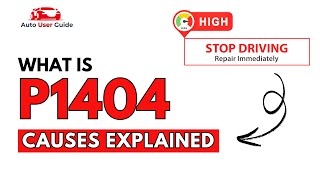
On the Jeep Gladiator (JT) and its sibling platform, the Wrangler (JL), the P1404 code is a well-documented issue. 🎬 Watch: A quick breakdown of what causes the P1404 code. A key characteristic for this platform is that simply replacing the EGR valve may not extinguish the code. Forum posts from JL and JT owners confirm that a PCM reprogram or a "Sequence EGR reset" using a dealer-level scan tool (like wiTECH) was necessary after installing a new valve. This suggests the PCM is sensitive to the calibration of the new part and must perform a relearn procedure to accept its new closed position values. Disconnecting the battery is not sufficient 🎬 See why a new valve alone might not fix the code. to perform this reset.
Diagnostic Flowchart
Tap your situation to follow the diagnostic path that matches what you're seeing on this vehicle.
Symptoms You May Notice
- Check Engine Light (MIL) is on
- Rough or unstable idle
- Engine stalling, especially at idle
- Hesitation or loss of power during acceleration
- Engine pinging or knocking sounds, especially at low RPM (1000-1500).
- Disabled Engine Start-Stop (ESS) system.
- Reduced fuel economy
- Replacing oxygen sensors. While EGR issues can affect the air-fuel ratio and potentially trigger other codes, P1404 points specifically to the EGR valve's position, not the resulting exhaust gas content.
- Assuming a vacuum leak is the only cause of a rough idle. A leaking EGR valve acts as a vacuum leak, but the source is the EGR system itself, not a cracked hose elsewhere.
- Replacing the EGR valve without performing the necessary PCM relearn/reset procedure. This can cause the P1404 code to return immediately even with a perfectly good new part.
Most Likely Causes
- Carbon buildup causing the EGR valve to stick open 🔴 High Probability → Shop Exhaust Gas Recirculation (EGR) Valve The 3.6L Pentastar engine can be susceptible to carbon deposits in the intake and emissions systems. These heavy black soot deposits can physically prevent the EGR valve's pintle from seating correctly, causing a constant leak of exhaust gas into the intake.
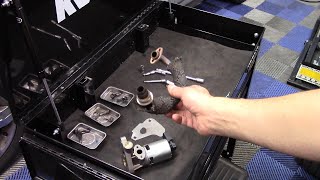
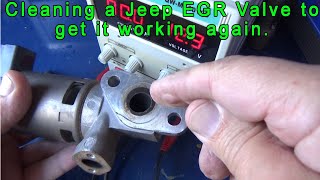
How to confirm: Remove the EGR valve and visually inspect the pintle and EGR passages for heavy black soot and carbon chunks. Check if the pintle moves freely or if it is seized/sticky. A Wrangler owner reported successfully cleaning the valve to fix the code.
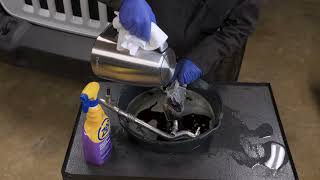
Typical fix: Thoroughly clean the EGR valve and passages with a dedicated carbon cleaner. If cleaning is unsuccessful or the valve is worn, replacement is necessary. A new gasket should be used upon reinstallation.
Est. part cost: $10-$25 for cleaning supplies - Faulty EGR Valve Assembly 🔴 High Probability → Shop Exhaust Gas Recirculation (EGR) Valve The internal position sensor can fail, providing incorrect readings to the PCM even if the valve itself is mechanically sound. Additionally, the internal motor or the valve seat can wear out or fail out-of-the-box, leading to a permanent leak even in a new part.
How to confirm: With a capable scan tool, command the EGR valve to close (0% duty cycle) and observe the position sensor voltage/percentage. If it doesn't report a fully closed state, the valve is likely faulty. You can also test a removed valve by applying 12V to the solenoid pins (pins 4 and 6) and listening for a click or checking for airflow.
Typical fix: Replace the entire EGR valve assembly. Using a Mopar OEM part is strongly recommended to avoid compatibility issues and premature failure seen with some aftermarket parts. A PCM reset or relearn procedure is often necessary post-installation.
Est. part cost: $250-$400 - PCM Software Update Required 🟡 Medium Probability
How to confirm: A dealership or a well-equipped independent shop can check for available PCM software updates by referencing the vehicle's VIN. TSB 18-048-22 specifically addresses P1404 and involves a PCM flash.
Typical fix: Flash the PCM with the latest software version. This is a dealer or professional-level repair that often resolves the code, especially if other codes are present.
Est. part cost: $0 (if under warranty) - $200
Rare But Worth Checking
- Damaged wiring or connector at the EGR valve: → Shop Exhaust Gas Recirculation (EGR) Valve While less common than a faulty valve, it's worth checking. Look for corrosion, bent pins, or frayed wires at the EGR valve's electrical connector, as this can cause incorrect signals.
- Clogged EGR Cooler or Passages: → Shop Exhaust Gas Recirculation (EGR) Valve In some cases, particularly if a P0401 (Insufficient Flow) code is also present, the EGR cooler or the passages in the intake manifold can become clogged with carbon, affecting the system's performance even if the valve itself is functional.
Diagnosis Steps
- Verify the code with an OBD-II scanner. Note any other codes present, as they may be related per TSB 18-048-22.
- Visually inspect the EGR valve's electrical connector and wiring harness for damage, corrosion, or loose connections.
- Using a scan tool with live data and bidirectional controls, monitor the EGR Position Sensor reading (typically as a voltage or percentage).
- Command the EGR valve to close (0% duty cycle). The position sensor should read a very low value specified by the manufacturer (e.g., near 0%). If it reads significantly higher, the valve is not closing.
- Command the EGR valve to open to various percentages (e.g., 25%, 50%, 75%) and observe if the position sensor reading follows the command and if the engine idle quality changes or stalls (which is expected).
- If the valve appears stuck or the sensor reading is erratic, remove the EGR valve from the engine.
- Inspect the valve and the port on the engine for heavy carbon buildup. Clean any deposits found.
- If the valve is clean but still suspected to be faulty, perform a bench test or replace it. Be aware that even new aftermarket valves can be faulty out of the box.
- After cleaning or replacement, clear the codes. If the code returns immediately, a specific "Sequence EGR reset" or "EGR valve replaced" routine must be performed with a professional scan tool to recalibrate the PCM.
- Check with a dealer if the vehicle's VIN is eligible for the software update outlined in TSB 18-048-22.
Parts You'll Likely Need
- EGR Valve
(OEM #05281410AG)— This is the most common failure point, either due to carbon buildup causing it to stick or an internal sensor failure. Replacement is the most reliable fix. The OEM part number 05281410AG supersedes previous versions 5281410AD, 5281410AE, and 5281410AF.
Trusted brands: Mopar
OEM price range: $270-$400
Aftermarket price range: $150-$330 - EGR Valve Gasket/Seal — The seal should always be replaced when the EGR valve is removed to prevent exhaust leaks. Some replacement valves may not include a new one.
Trusted brands: Mopar, Standard Motor Products
OEM price range: $10-$20
Aftermarket price range: $5-$15
Related Codes That Often Appear With This One
- P0300 — Random/Multiple Cylinder Misfire. A leaking EGR valve allows unmetered exhaust gas into the intake manifold at idle, diluting the air-fuel mixture and causing instability that can lead to misfires. TSB 18-048-22 notes that if P0300 is present with other codes, a specific hardware repair (right intake camshaft replacement) may be required in addition to a software flash.
- P0456 — A small EVAP system leak. This code is mentioned alongside P1404 in TSB #18-048-22, suggesting they can appear concurrently as part of a set of faults addressed by a PCM software update.
- P1206 — Fuel Pump Control Module Open Circuit. Also mentioned in TSB #18-048-22 with P1404, indicating a possible relationship addressed by a PCM software update. The TSB notes that after the flash, this code may be replaced by P025A.
Technical Service Bulletins (TSBs) & Recalls
- 18-048-22 Rev. A: Supersedes previous versions. Involves a PCM software flash to address P1404 and a list of other DTCs. If P0300 is also present, this TSB requires replacement of the right intake camshaft.
- 1805519: This appears to be an older or alternative numbering for a TSB that also lists P1404. The most current and relevant TSB is 18-048-22 Rev. A.
Platform-Specific Known Issues
- TSB #18-048-22 Rev. A (May 11, 2022) lists P1404 as a key DTC addressed by a PCM software update for 2020 Gladiators with the 3.6L engine. It's often found with other codes like P0300, P0456, and P1206.
- Forum discussions for the related JL Wrangler platform indicate that after replacing the EGR valve, a PCM reflash or a specific EGR reset procedure may be required to resolve the code, which is not a typical requirement on older vehicles.
- Owners on JeepGladiatorForum.com report that this code disables the Engine Start-Stop (ESS) system as a failsafe. There is debate on forums about whether the EGR valve is covered under the 5-year/60,000-mile powertrain warranty or the longer 8-year/80,000-mile federal emissions warranty; it appears to fall under the basic 3-year/36,000-mile warranty in the US, though some dealers have offered goodwill coverage.
Mechanic-Grade Diagnostic Values
- EGR Valve Solenoid Coil Resistance — expected: Approximately 7.0 - 7.6 Ohms at 70°F. Failure: An open circuit (infinite resistance) or a short (near zero resistance) indicates a failed solenoid coil.
- EGR Solenoid Actuation Voltage — expected: 12 Volts, pulse-width modulated (PWM) by the PCM. Failure: No voltage from the PCM when commanded open via a scan tool, or voltage present when commanded closed, points to a wiring or PCM driver issue.
Scan Tool Commands That Help
- wiTECH (Dealer/Professional Scan Tool): Sequence EGR reset / EGR System Test — This function is required after replacing the EGR valve on JL/JT platforms. It allows the PCM to relearn the closed-position voltage of the new valve. Failure to perform this reset is a common reason for the P1404 code returning immediately after repair.
- High-End Bidirectional Scan Tool (e.g., Autel, Snap-on): EGR Valve Replaced / EGR Actuator Test — Used to command the EGR valve to specific percentages (e.g., 0%, 25%, 50%) to test the valve's mechanical movement and the position sensor's response. This is a critical step to confirm if the valve is physically sticking or if the sensor is reporting incorrectly.
Wiring & Ground Locations
- EGR Valve Connector — On the EGR valve itself, located at the rear of the passenger-side cylinder head, behind the throttle body.. This 6-pin connector provides power to the solenoid and returns position sensor data to the PCM. Damage or corrosion here can directly cause the P1404 code. Pin 4 is the solenoid ground, and Pin 6 is the PCM-controlled power feed for the solenoid.
Real Owner Repair Stories
- JL Wrangler Forums user (2021 Jeep Wrangler Rubicon (JL)) — Check Engine Light with code P1404.
❌ Tried (didn't work) Replacing the EGR valve with a new OEM part., Disconnecting the battery to clear the code.
✅ What actually fixed it Taking the vehicle to a mechanic to perform a "Sequence EGR reset" and flash the PCM. The code was cleared and did not return. The total cost for the programming was $185. - Jeep Gladiator Forum user (2021 Jeep Gladiator Rubicon, ~50,000 miles) — Check Engine Light, disabled Start/Stop system, code P1404.
❌ Tried (didn't work) Initial diagnosis.
✅ What actually fixed it The dealership replaced the EGR valve under warranty (as a goodwill gesture, despite being over the 36k mile warranty). The user noted a friend's advice that a reset is required after replacement and disconnecting the battery is not sufficient. - YouTube video (Schrodinger's Box) (Jeep (older model, but demonstrates principle)) — P1404 and P0300 (Random Misfire).
❌ Tried (didn't work) The owner had already replaced the EGR valve with a new aftermarket part, but the code persisted.
✅ What actually fixed it Through bench testing, the technician found the brand new aftermarket EGR valve was faulty and did not seal completely when commanded closed (air could be blown through it at 0% duty cycle). Replacing it with a second, known-good new valve fixed the issue. This highlights the risk of faulty new parts, especially from aftermarket sources.
OEM Part Supersession History
5281410AD, 5281410AE, 5281410AF→05281410AG— Standard part revision and improvement by the manufacturer.
Heads up: The newest part number, 05281410AG, is the correct and recommended replacement for all previous versions for the 2020 Gladiator.
Helpful Videos
Used OEM Parts in Stock
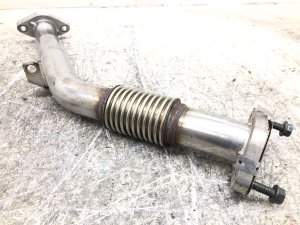
New Aftermarket Parts Available


The information in this article is provided for general reference and educational purposes only. Vehicle specifications, procedures, and part compatibility can vary by production date, trim level, and region. Always consult your vehicle's factory service manual and verify part numbers before purchasing or performing repairs. Safety-critical components such as airbags, seat belts, and braking systems should be installed by a qualified professional.
- Jeep GLADIATOR:
- 🧭 Diagnostic Flowchart
- 🎬 Helpful Videos
- 🛍️ Shop This Part
- What's Unique About the 2020-2020 Jeep GLADIATOR
- Symptoms You May Notice
- Most Likely Causes
- Rare But Worth Checking
- Diagnosis Steps
- Parts You'll Likely Need
- Related Codes That Often Appear With This One
- Technical Service Bulletins (TSBs) & Recalls
- Platform-Specific Known Issues
- Mechanic-Grade Diagnostic Values
- Scan Tool Commands That Help
- Wiring & Ground Locations
- Real Owner Repair Stories
- OEM Part Supersession History
- 🎟️ Get 5% Off