

OBD-II Code P1423: Secondary Air Injection System Incorrect Flow / Fuel Tank Gross Leak
What P1423 means, why it triggers, and how to fix it comprehensively
- On Toyota and Lexus vehicles, P1423 indicates a massive EVAP leak, which is fixed 80% of the time by replacing a loose or faulty $25 gas cap.
- For Audi, BMW, and VW models, P1423 flags a Secondary Air Injection failure; always check the 40A or 50A air pump fuse before buying a $300 replacement pump.
- Never replace a failed secondary air pump without also installing a new $50-$150 check valve, as a stuck-open valve allows exhaust moisture to destroy the new pump.
- You can safely drive with a P1423 code, but your vehicle will automatically fail state emissions testing, and ignoring it for over 6 months risks a $1,500 catalytic converter replacement.
What Does P1423 Mean?

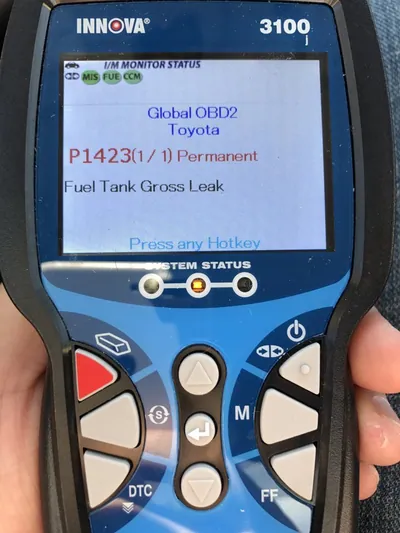
P1423 is a manufacturer-specific code with two distinct meanings. On German vehicles (Audi, VW, BMW), it means the Secondary Air Injection (SAI) system has insufficient flow. This system pumps fresh air into the exhaust for 30-90 seconds on cold starts to heat the catalytic converter. On Toyota and Lexus vehicles, P1423 indicates a 'Fuel Tank Gross Leak' within the evaporative emission (EVAP) system.
Technical definition: For European makes, P1423 is defined as 'Secondary Air Injection System: Bank 1: Insufficient Flow Detected,' meaning the upstream oxygen sensor did not detect the expected lean condition when the air pump activated. For Toyota and Lexus, it is defined as 'Evaporative Emission System Gross Leak Detected,' indicating the system cannot hold a vacuum during its self-test.
Can I Drive With P1423?
Yes, But With Caution. Yes, you can drive with this code, but you will automatically fail an emissions test. Short-term driving won't noticeably affect engine performance. However, driving for hundreds of miles with a malfunctioning secondary air system prevents the catalytic converter from warming up correctly, leading to premature failure—a repair that costs $800 to $2,500. Address the issue promptly to avoid these cascading costs.
Common Causes

- Loose or faulty gas cap (Toyota/Lexus) (Common On Specific Models) — On Toyota and Lexus models, this code almost exclusively flags a massive EVAP leak caused by a loose, missing, or degraded gas cap. Even a tangled cap tether prevents a proper seal.
- Blown Air Pump Fuse or Relay (Common) — Before condemning expensive parts on German cars, check the electrical supply. A blown high-amperage fuse (often 40A or 50A) or a burnt relay completely disables the air pump. A blown fuse usually indicates a seized pump motor.
- Defective secondary air injection pump (Very Common) — The electric air pump fails from bearing wear or, more commonly, water intrusion. When the check valve fails, hot exhaust condensation flows backward into the pump, rusting the internal motor until it seizes.
- Faulty secondary air injection check valve (Combi Valve) (Common) — This one-way valve prevents exhaust gases from flowing back into the air pump. If it sticks closed, air cannot enter the exhaust. If it sticks open, it destroys the air pump with corrosive exhaust moisture.
- Leaking or cracked vacuum hoses (Common) — The small rubber vacuum hoses that actuate the combi valve become brittle and crack from engine heat. A cracked hose prevents the valve from opening, resulting in zero air flow.
- Clogged air passages in cylinder head (Less Common) — Carbon buildup clogs the tiny injection ports inside the cylinder head or exhaust manifold. This restricts air flow and triggers the code even if the pump, relay, and valves function perfectly.
- Defective Upstream Oxygen (O2) Sensor (Rare) — The ECU verifies SAI operation by watching the upstream O2 sensor for a sudden lean spike. A sluggish or failing O2 sensor misses this extra air, tricking the computer into setting a false P1423 flow code.
Symptoms
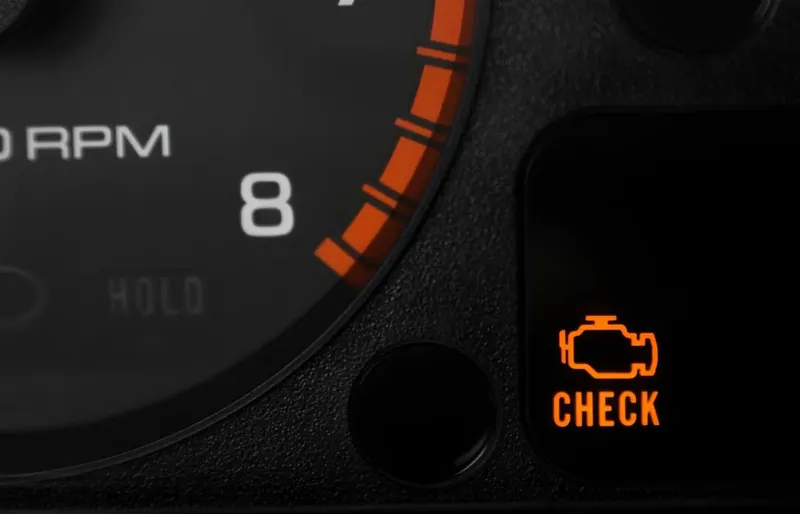
- Check Engine Light is on — This is the primary symptom. The active code immediately disqualifies the vehicle from passing state emissions or smog inspections.
- Missing or abnormal noise on cold start — A healthy secondary air pump sounds like a vacuum cleaner for 60 seconds after a cold start. A failing pump makes a loud grinding or whining noise. A seized pump is completely silent.
- Rough idle on a cold start — The engine hesitates or idles roughly for the first minute after a cold start because the catalytic converter isn't receiving the oxygen needed to burn off rich startup fuel.
- Failed emissions test — The secondary air and EVAP systems are critical emissions monitors. A P1423 code forces these monitors into a 'Not Ready' state, guaranteeing an inspection failure.
Diagnostic Flowchart
Tap your situation to follow the diagnostic path that matches what you're seeing on this code.
Common Fixes & Costs
- Replace the gas cap (Toyota/Lexus) — Parts: $15-$60, Labor: $0, ~0.1 hr book time (DIY)
- Replace Air Pump Fuse/Relay — Parts: $5-$40, Labor: $0-$50, ~0.2 hr book time (Beginner)
- Replace the secondary air injection pump — Parts: $150-$600, Labor: $100-$250, ~1.5 hr book time (Intermediate)
- Replace the secondary air injection check valve — Parts: $50-$200, Labor: $100-$200, ~1.2 hr book time (Intermediate)
- Replace cracked or leaking hoses — Parts: $10-$50, Labor: $50-$150, ~0.8 hr book time (DIY)
DIY vs Professional
- Replace Gas Cap 🟢 Beginner
Tools: None - Replace Fuse/Relay 🟢 Beginner
Tools: Fuse puller, Multimeter - Replace Vacuum Hoses 🟢 Beginner
Tools: Pliers, Flashlight, Utility knife - Replace Check Valve (Combi Valve) 🟢 Beginner
Tools: Ratchet set, Pliers, Gasket scraper - Replace Secondary Air Pump 🟢 Beginner
Tools: Ratchet set, Torx bits, Jack and stands
Used vs. New Parts: Buying Guide
When a used part is worth it: Buying a used secondary air pump from a salvage yard makes sense for older, out-of-warranty vehicles where a new OEM pump exceeds $500.
Donor-vehicle mileage cap: roughly under 80000 miles for the part to have meaningful remaining life.
Donor quality checklist:
- Verify the part number matches your original unit exactly.
- Inspect the used pump's inlet and outlet ports. If you see rust, muddy residue, or water stains, do not buy it.
- Apply 12V power to the pump before purchasing to ensure it spins smoothly without grinding.
Decision logic:
- If A new aftermarket pump from a reputable brand (Pierburg, Bosch) is under $200 → Buy new for the warranty and peace of mind.
- If The vehicle is over 10 years old and an OEM pump costs over $500 → Buy a tested, used pump from a low-mileage donor vehicle.
- If You are replacing the pump → ALWAYS buy a brand new check valve. Never use a used check valve.
Warranty tradeoff: Used pumps typically offer a 30-day warranty. New aftermarket parts offer 1-year warranties. If a used pump fails, you pay the labor cost twice.
Worst-case if a used part fails: $250 if a used pump fails shortly after installation, requiring repeat labor.
What Happens If You Wait — Timeline
- 0-1 month: Code P1423 sets. For SAI faults, the pump may sound louder than usual on cold starts. Engine performance remains normal. (MPG impact: 0%% · Added cost: $0)
- 1-4 months: SAI pump bearings fail completely, or the motor seizes from rust. The catalytic converter heats up slowly, increasing cold-start emissions. (MPG impact: 0-2%% · Added cost: $0)
- 4-12 months: The catalytic converter's efficiency drops from repeated cold-soak abuse. The engine may idle roughly on cold starts. (MPG impact: 2-5%% · Added cost: $800-$2500 (Catalytic converter replacement becomes likely).)
- 12+ months: The catalytic converter substrate melts or clogs, creating massive exhaust backpressure. The vehicle loses significant power and may stall. (MPG impact: 15-25%% · Added cost: $1500-$3000+ (Requires new catalytic converters and potential O2 sensor replacement).)
Cost of Not Fixing It
- Immediate: Guaranteed failure of an OBD-II emissions or smog test. The Check Engine Light remains illuminated, masking new, potentially severe engine problems. (Added cost: 0)
- 1-6 months: Continued cold starts without a functional SAI system force the catalytic converter to process raw fuel while cold, degrading its internal precious metals. (Added cost: $0)
- 6+ months: The catalytic converter substrate melts or clogs from improper operating temperatures. This creates massive exhaust backpressure, killing engine power and requiring full replacement. (Added cost: $800-$2500)
Diagnosis Steps

- Check the Gas Cap (Toyota/Lexus)
For Toyota/Lexus vehicles, tighten the gas cap until it clicks. Inspect the rubber O-ring seal for dry rot or cracks. Ensure the plastic tether isn't pinched under the threads. If damaged, replace it with an OEM cap.
Tools: None (Beginner) - Check the Fuses and Relays
Locate the secondary air pump fuse (often a 40A or 50A Maxi fuse) and relay in the engine bay fuse box. Pull the fuse and check for a broken filament. Swap the relay with an identical one from a non-critical system (like the horn) to test it.
Tools: Fuse puller, Multimeter (Beginner) - Listen to the Air Pump
Have an assistant start the car after it has sat overnight. Stand by the open hood and listen. You must hear the pump run for 30-90 seconds. Silence indicates an electrical failure or seized motor. Grinding indicates failing bearings.
Tools: An assistant (Beginner) - Inspect All Hoses for Leaks
Trace the large plastic hoses from the air pump to the combi valve. Check for splits or disconnected joints. Next, inspect the small-diameter vacuum lines running to the combi valve for heat cracks.
Tools: Flashlight (Intermediate) - Test the Check Valve (Combi Valve)
With a cold engine off, disconnect the large air hose from the combi valve inlet. Start the engine briefly. You should NOT feel exhaust gas pulsing out of the valve. If you feel exhaust, the valve is stuck open and must be replaced.
Tools: Pliers, Screwdriver (Intermediate) - Command Pump Activation with a Scan Tool
Use a bi-directional scanner to manually command the SAI pump ON. Check the pump's electrical connector with a multimeter. If it receives 12V and ground but doesn't spin, the pump is dead. If it lacks 12V, the wiring or relay is at fault.
Tools: Bi-directional scan tool, Multimeter (Advanced) - Check O2 Sensor Voltage During SAI Test
Graph the live voltage of the upstream O2 sensor (Bank 1 Sensor 1) on a cold start. When the SAI pump activates, voltage must drop below 0.2V (lean). If voltage stays high (rich), air isn't reaching the exhaust stream.
Tools: Graphing scan tool (Advanced) - Inspect for Clogged Passages
If the pump, relay, hoses, and combi valve function perfectly, the internal cylinder head passages are clogged. Remove the combi valve and probe the port with a flexible wire, or use a chemical carbon solvent to dissolve the blockage.
Tools: Flexible wire, Chemical cleaner (Advanced) - Advanced: Toyota EVAP System Smoke Test
If a new gas cap doesn't fix a Toyota P1423, connect a smoke machine to the EVAP service port. Pressurize the system and look for smoke escaping from the charcoal canister, purge valve, or filler neck to pinpoint the gross leak.
Tools: Bi-directional scan tool, Smoke machine (Advanced)
When This Code Triggers (Freeze-Frame Conditions)
- Engine Coolant Temp: 45-95°F (7-35°C) (The ECU only runs the SAI monitor during a true cold start. If coolant is too warm, the test aborts.)
- Fuel Level: 15-85% (For Toyota EVAP faults, the monitor refuses to run if the gas tank is completely full or nearly empty.)
- Engine State: Off (Cold Soak) (Both SAI and EVAP monitors require the vehicle to sit undisturbed for 8+ hours to equalize temperatures before testing.)
Related Codes
- P0410 — The generic OBD-II code for 'Secondary Air Injection System Malfunction.' P1423 is simply the manufacturer-specific, more detailed version of this exact same fault.
- P1411 — Indicates 'Secondary Air Injection System, Bank 2, Insufficient Flow.' If you have a V-engine and see both P1423 and P1411, the failure is a shared component like the main air pump or relay, not the individual bank valves.
- P0455 — The generic code for 'EVAP System Gross Leak.' On Toyota/Lexus, P1423 and P0455 appear together to confirm a massive vacuum leak, usually at the gas cap.
Climate & Environmental Factors
- Cold Climates: The SAI system runs exclusively on cold starts. Vehicles in colder regions experience longer and more frequent pump cycles, accelerating bearing wear. Extreme cold also makes plastic vacuum hoses brittle and prone to snapping.
- High Humidity and Rain: Moisture is the primary killer of the SAI pump. In humid climates, a failing check valve rapidly introduces corrosive water condensation into the electric pump motor, causing it to rust and seize.
- Short-Trip Driving: Driving primarily for short trips prevents the exhaust system from getting hot enough to evaporate condensation. This residual moisture travels backward through aging check valves, destroying the air pump.
How to Talk to a Mechanic About This Code
Say this: "For a German car: 'I have a P1423 secondary air injection code. Please test the pump, relay, and fuse, and check the combi valve for leaks before recommending a pump replacement.' For a Toyota/Lexus: 'I have a P1423 EVAP code. I've already replaced the gas cap with an OEM unit. Can you perform a smoke test to find the leak?'"
This proves you understand the system architecture. It forces the technician to perform step-by-step diagnostics rather than blindly quoting you for the most expensive component.
Avoid saying:
- 'My check engine light is on, can you fix it?' (Invites expensive, open-ended diagnostic fees)
- 'I need a new air pump.' (They will install it, even if a $5 fuse was the actual problem)
- 'Just do whatever it takes to pass emissions.'
Questions to ask before authorizing the repair:
- For an SAI fault: Did you test the combi valve? If you replace the pump without replacing a bad valve, the new pump will fail.
- For an EVAP fault: Where exactly did the smoke escape from during the smoke test?
- Are you using OEM or aftermarket parts, and what is the warranty on the repair?
Where to Take It: Dealer vs Independent vs Chain
- Dealer:
Best for: Vehicles under warranty (including Subaru/BMW extended emissions warranties), Complex carbon cleaning of cylinder head passages on Audi/VW models
Downsides: Highest labor rates (often $150-$250/hour), Will strictly use expensive OEM parts, doubling the repair cost (Typical cost: +50% vs. baseline) - Independent Shop:
The best fit. An experienced independent Euro or Asian specialist can diagnose and repair SAI and EVAP faults accurately for half the cost of a dealership.
Best for: Most out-of-warranty P1423 repairs, Replacing air pumps, combi valves, and performing EVAP smoke tests
Downsides: Must find a shop specializing in your specific brand (e.g., a dedicated Euro shop for BMWs) (Typical cost: +0% vs. baseline) - Chain Shop:
AVOID. Chain shops are likely to misdiagnose nuanced SAI or EVAP system issues, leading to expensive, ineffective repairs.
Best for: Reading the code for free
Downsides: Technicians often lack the specialized knowledge to diagnose complex SAI flow issues or perform EVAP smoke tests, High risk of misdiagnosis and unnecessary parts replacement (Typical cost: -10% vs. baseline)
When to Walk Away From the Repair
If the estimated repair cost exceeds 40% of the car's private-party value, seriously consider selling the vehicle, especially if it requires complex cylinder head carbon cleaning.
- Car worth $3000, fix is $1500: Walk away. The repair cost is 50% of the car's value. Sell it as-is.
- Car worth $10000, fix is $800: Fix it. The repair restores a critical emissions system and retains vehicle value.
- Car worth $5000, fix is $1200: Borderline. Get a second opinion from an independent specialist to see if a cheaper repair (like a used pump) is viable.
What Scan Tool You Need for This Code
Minimum: A scanner with live data graphing for O2 sensors and bi-directional control to manually activate the secondary air pump.
A $20 code reader only gives you the P1423 code. You need live O2 sensor data to verify air flow, and bi-directional control to command the pump ON without waiting for a cold start.
Budget: BlueDriver Pro (~$120) — Connects via Bluetooth. Reads codes and graphs live O2 sensor data to verify if the SAI system is actually pushing air into the exhaust. Lacks bi-directional control.
Mid-range: Foxwell NT510 Elite (~$170) — Offers brand-specific bi-directional control. You can manually activate the secondary air pump or EVAP solenoids from the scanner, saving hours of diagnostic guesswork.
Professional: Autel MaxiCOM MK808 (~$380) — Provides OEM-level diagnostics, full bi-directional controls, and the ability to run automated EVAP and SAI system self-tests to verify repairs.
Rent vs buy: Buy a midrange scanner like the Foxwell if you own a German car. The ability to command the pump ON pays for the tool during your first diagnosis.
How to Clear the Code After You Fix It
- Use an OBD-II scan tool to clear the fault codes.
- For Toyota EVAP faults, ensure the new OEM gas cap is clicked tight.
- Perform a cold-start drive cycle to force the ECU to re-test the system.
Drive cycle (~30 minutes): Let the car sit overnight (8+ hours). Start the engine and let it idle for 3 minutes. Drive in stop-and-go traffic for 5 minutes, then maintain a steady 55-65 mph on the highway for 15 minutes. Let the car idle in park for 2 minutes before shutting off.
Readiness monitors affected: Secondary Air System, Evaporative System (EVAP), Catalyst
Before emissions retest: drive at least 50 miles to fully set monitors.
Watch out for:
- Clearing the code with a scanner resets all readiness monitors to 'Not Ready', guaranteeing an instant emissions test failure until you complete a full drive cycle.
- A 'permanent' P1423 code cannot be erased by a scanner; it only disappears after the ECU runs its own self-test and verifies the repair was successful.
Will This Fail Emissions / State Inspection?
Yes — this code typically fails an OBD-II emissions inspection.
- California: An active P1423 code causes an automatic smog check failure. After repairs, the SAI monitor must read 'Ready' before re-testing.
- New York: Vehicles fail the NYVIP3 inspection if the Check Engine Light is on. For 2001+ models, you are allowed one 'Not Ready' monitor, but P1423 often blocks multiple monitors, ensuring a failure.
- Texas: In emissions-testing counties, P1423 results in an automatic failure. The vehicle cannot pass until repaired and the drive cycle is completed.
Most Commonly Affected Vehicles
- Audi A4, A6, S4, A8, Q7 (2000-2008) — Highly prone to cracked vacuum lines, water-damaged air pumps from failed combi valves, and carbon-clogged cylinder head ports. The 2.7T and 4.2 V8 engines are notorious for tight access.
- Volkswagen Golf, Passat, Jetta, Touareg (1998-2009) — Shares the same SAI architecture as Audi. Brittle plastic vacuum hoses and stuck combi valves are the primary culprits.
- BMW 3 Series (E46), 5 Series (E39), X3 (E83), X5 (E53) (1998-2010) — Secondary air pump failures due to internal rust are extremely frequent. The plastic rivets holding the pump housing together also snap, causing massive air leaks.
- Subaru Forester, Impreza, Legacy, Outback (2006-2012) — Known for secondary air valves seizing open or closed. Subaru issued TSB 09-58-14R and extended warranties to 10 years/120,000 miles for this specific failure.
- Toyota Prius, Highlander, Tundra, Camry (2010-2016) — On these models, P1423 means 'Fuel Tank Gross Leak.' It is almost always caused by a loose gas cap or overfilling the fuel tank, which saturates the EVAP canister.
- Lexus RX 450h, HS 250h (2010-2012) — Lexus issued TSB L-SB-0005-12 specifically addressing P1423, directing technicians to inspect and replace the fuel cap before performing complex EVAP diagnostics.
Manufacturer-Specific Notes
- Audi/Volkswagen: P1423 is frequently accompanied by P1411 on V6/V8 engines. Technicians must use VCDS (VAG-COM) software to run the SAI system self-test in Basic Settings Group 077 to force the readiness monitor to pass after repairs.
- Toyota/Lexus: P1423 has absolutely nothing to do with the air injection system on these brands. It strictly flags an EVAP gross leak. Do not waste time looking for an air pump; check the gas cap immediately.
- BMW: When replacing a seized BMW air pump, you must replace the check valve. Furthermore, the rubber isolation mounts holding the pump degrade and snap; order new mounts to prevent the new pump from rattling against the chassis.
Real Owner Stories
2012 Toyota Prius with P1423
The Check Engine Light illuminated. A scan revealed code P1423, defined as 'Fuel Tank Gross Leak'.
What they tried:
- Tightened the gas cap, but the light remained on after several days of driving.
- Considered replacing the expensive charcoal canister.
Outcome: A dealership smoke test confirmed the gas cap's rubber seal was dry-rotted. Replacing the cap with a $30 OEM unit fixed the leak. The light required a specific overnight cold-soak drive cycle to clear permanently.
Lesson: On Toyota/Lexus, P1423 is almost always the gas cap. Tightening an old, degraded cap won't fix a bad seal. Replace it with OEM parts and be patient while the ECU runs its overnight EVAP test.
2004 BMW 325i (E46) with P1423 & P1421
Check Engine Light on with codes for both secondary air banks. The owner noticed the usual 'vacuum cleaner' sound was missing on cold starts.
What they tried:
- Checked the 50A fuse in the E-box; it was blown.
- Replaced the fuse, but it blew again immediately upon cold start.
Outcome: Removed the air pump and found it seized solid with rusty water. Replaced the pump ($200) and the combi valve ($100) that had failed and allowed exhaust moisture to destroy the pump.
Lesson: A repeatedly blowing fuse indicates a dead short or seized motor. On German cars, water intrusion from a failed check valve is the #1 cause of pump seizure. Always replace the check valve when replacing the pump.
2002 Audi A6 3.0L with P1423
Check Engine Light on for 'insufficient flow'. The air pump sounded healthy and ran for 60 seconds on cold starts.
What they tried:
- Replaced the air pump, relay, and combi valves.
- Replaced all vacuum lines. The code returned immediately.
Outcome: A specialist shop determined the internal air passages inside the cylinder head were completely clogged with carbon. The shop used chemical solvents and flexible wire to clean the ports without removing the cylinder heads, saving thousands.
Lesson: If the pump, relay, and valves function perfectly, suspect carbon-clogged cylinder head ports. Do not throw parts at the car; verify air flow reaches the exhaust stream using an O2 sensor graph.
How to Prevent This Code From Triggering
- Replace the SAI check valve (combi valve) preventively. (Every 80,000-100,000 miles.) — The check valve is the only barrier protecting the expensive electric air pump from corrosive exhaust moisture. Replacing it before it fails saves the pump.
- Stop 'topping off' your fuel tank. (Every fill-up.) — Forcing extra fuel into the tank after the nozzle clicks off saturates the EVAP charcoal canister with liquid gas, destroying valves and triggering gross leak codes like P1423.
- Inspect and replace brittle vacuum hoses. (Every 60,000 miles.) — The tiny vacuum hoses controlling the combi valve bake in engine heat. Replacing them with high-temp silicone prevents vacuum leaks that disable the SAI system.
Frequently Asked Questions
What is a secondary air injection system?
It's an emissions control system that pumps fresh air directly into the exhaust manifold for the first 30-90 seconds after a cold engine start. This extra oxygen helps burn off unburnt fuel and allows the catalytic converter to reach operating temperature more quickly, reducing harmful emissions.
What are the most common mistakes when diagnosing P1423?
A common mistake is replacing the expensive secondary air pump without first checking its 40A or 50A fuse. Another pitfall is replacing the pump but ignoring the faulty check valve that allowed water to destroy the original unit. Finally, technicians sometimes overlook carbon-clogged air passages in the cylinder head, which perfectly mimics a dead pump.
Is it safe to drive with a P1423 code?
Yes, it is safe for short-term driving, and your car's performance will not noticeably drop. However, you must fix it to pass an emissions test. Long-term driving prevents the catalytic converter from warming up properly, risking a $1,500 replacement.
Can I fix a P1423 code myself?
Simple fixes like tightening a gas cap, replacing a fuse, or swapping an accessible vacuum hose are highly DIY-friendly. Replacing the air pump or check valve requires intermediate skills depending on their location. If the cylinder head passages are clogged, leave the complex engine disassembly to a professional.
How much does it cost to fix a P1423 code?
A new OEM gas cap for a Toyota costs under $40. Replacing a blown fuse or relay costs less than $20. A full secondary air pump and check valve replacement at an independent shop typically runs $500 to $900, but can exceed $1,500 at a luxury dealership.
Will a P1423 code clear itself?
If the cause was a temporary issue like a loose gas cap, the check engine light turns off by itself after several driving cycles. If a hardware fault exists, the code remains until you repair the broken component. Even after clearing with a scanner, a 'permanent' code stays in the ECU until the system successfully passes its automatic self-test.
Can a bad oxygen sensor cause a P1423 code?
Yes, though it is rare. The engine computer uses the upstream oxygen sensor to verify the secondary air system is adding oxygen to the exhaust. If the O2 sensor is old or lazy, it fails to detect the extra air, tricking the computer into triggering a false P1423 code.
What is 'Bank 1' in the P1423 code definition?
Bank 1 refers to the side of the engine containing cylinder number one. On an inline engine, there is only one bank. If you have a V6 or V8 engine and only see a P1423 code, the problem is isolated to the components serving that specific side.
Key Takeaways
- On Toyota and Lexus vehicles, P1423 indicates a massive EVAP leak, which is fixed 80% of the time by replacing a loose or faulty $25 gas cap.
- For Audi, BMW, and VW models, P1423 flags a Secondary Air Injection failure; always check the 40A or 50A air pump fuse before buying a $300 replacement pump.
- Never replace a failed secondary air pump without also installing a new $50-$150 check valve, as a stuck-open valve allows exhaust moisture to destroy the new pump.
- You can safely drive with a P1423 code, but your vehicle will automatically fail state emissions testing, and ignoring it for over 6 months risks a $1,500 catalytic converter replacement.
Helpful Videos

Shop the Parts Behind P1423
Below are the parts most often responsible for code P1423, ranked by how frequently each one is the actual culprit (per the diagnosis above). Tap any to see what we have for your vehicle.



The information in this article is provided for general reference and educational purposes only. Vehicle specifications, procedures, and part compatibility can vary by production date, trim level, and region. Always consult your vehicle's factory service manual and verify part numbers before purchasing or performing repairs. Safety-critical components such as airbags, seat belts, and braking systems should be installed by a qualified professional.
- 🧭 Diagnostic Flowchart
- 🎬 Helpful Videos
- 🛍️ Shop This Part
- What Does P1423 Mean?
- Can I Drive With P1423?
- Common Causes
- Symptoms
- Common Fixes & Costs
- DIY vs Professional
- Used vs. New Parts: Buying Guide
- What Happens If You Wait — Timeline
- Cost of Not Fixing It
- Diagnosis Steps
- When This Code Triggers (Freeze-Frame Conditions)
- Related Codes
- Climate & Environmental Factors
- How to Talk to a Mechanic About This Code
- Where to Take It: Dealer vs Independent vs Chain
- When to Walk Away From the Repair
- What Scan Tool You Need for This Code
- How to Clear the Code After You Fix It
- Will This Fail Emissions / State Inspection?
- Most Commonly Affected Vehicles
- Manufacturer-Specific Notes
- Real Owner Stories
- 2012 Toyota Prius with P1423
- 2004 BMW 325i (E46) with P1423 & P1421
- 2002 Audi A6 3.0L with P1423
- How to Prevent This Code From Triggering
- Frequently Asked Questions
- What is a secondary air injection system?
- What are the most common mistakes when diagnosing P1423?
- Is it safe to drive with a P1423 code?
- Can I fix a P1423 code myself?
- How much does it cost to fix a P1423 code?
- Will a P1423 code clear itself?
- Can a bad oxygen sensor cause a P1423 code?
- What is 'Bank 1' in the P1423 code definition?
- Key Takeaways
- 🎟️ Get 5% Off