

P1429 on 2011-2016 Chevrolet Cruze 1.4L: Brake Vacuum Pump Circuit Failure
On a 2011-2016 Cruze 1.4L, P1429 indicates a problem with the electric brake vacuum pump circuit, causing a hard brake pedal. The most common fix is replacing the brake booster vacuum pipe assembly, which contains a failure-prone microswitch. Check the 20A fuse in the engine bay first. This was a known issue leading to GM Safety Recall 12213.
- P1429 on a Gen 1 Cruze 1.4L is a critical safety issue that means your power brakes may not work.
- Do not drive the vehicle until it is repaired.
- The most likely cause is a failed microswitch, which is part of the brake booster vacuum pipe assembly and was subject to a safety recall for 2011-2012 models.
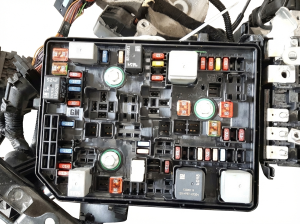
- Always check the 20A J-case fuse (F25) in the under-hood fuse box as a first step.
What's Unique About the 2011-2016 Chevrolet Cruze
The first-generation Cruze 1.4L relies on a separate electric vacuum pump (EVP) for brake assist, unlike many naturally aspirated cars. This system's reliability was poor enough to warrant a GM safety recall (12213) for the 2011-2012 models due to a faulty microswitch that controls the pump. The recall documents state that silicon residue could form on the switch contacts, preventing the pump from activating. This makes the switch, and the assembly it's part of, a primary suspect, rather than the pump itself, which is a common misdiagnosis.
Generation note: The 2011-2016 year range covers the first generation of the Chevrolet Cruze. In 2016, this model was sold as the 'Cruze Limited' alongside the redesigned second-generation model. This guide applies only to the first-generation platform with the 1.4L LUJ engine and its electric vacuum pump. The second-generation (2016+) 1.4L LE2 engine uses a different mechanical vacuum pump.
Symptoms You May Notice
- Extremely hard brake pedal, especially at idle or low speeds.
- Increased stopping distance required.
- Check Engine Light is on.
- A buzzing noise from the pump may be heard running continuously, or no noise at all when it should be running.
- Replacing the brake booster. The booster itself is rarely the cause of the hard pedal on this vehicle; the problem is the lack of vacuum being supplied to it.
- Replacing the vacuum pump when the actual fault is the microswitch or a blown fuse.
Most Likely Causes
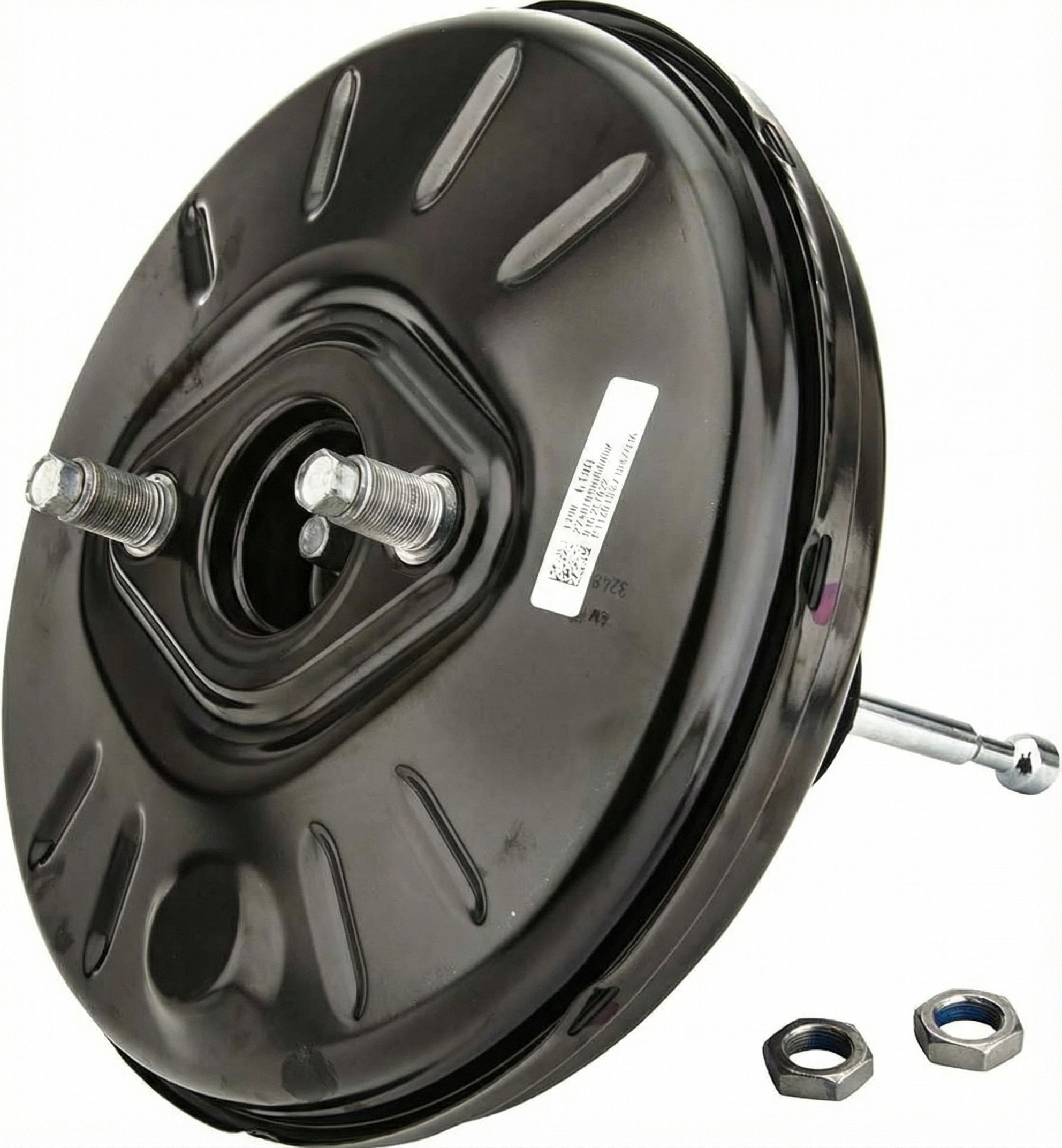
- Faulty Brake Booster Vacuum Pipe Microswitch 🔴 High Probability → Shop Power Brake Booster This was the subject of GM Safety Recall 12213 (NHTSA ID 13V360000). The original microswitch was prone to contamination from silicon off-gassing, which coated the contacts and prevented it from commanding the vacuum pump to turn on. This led to an intermittent or total loss of brake assist.
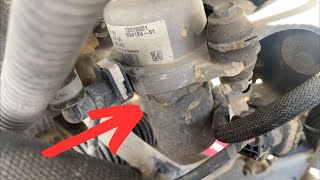
How to confirm: With the ignition on (engine off), pump the brake pedal several times to deplete vacuum. The electric vacuum pump (located near the driver's side front wheel) should be heard running. If it does not run, and the fuse is good, the switch is the most likely culprit.
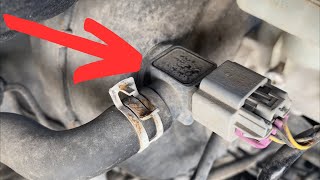
Typical fix: Replace the entire power brake booster vacuum pipe assembly 🎬 See how to replace the vacuum pipe and sensor, which includes the updated microswitch. This was the official remedy for the recall.
Est. part cost: $40-$120 - Blown Electric Vacuum Pump Fuse 🟡 Medium Probability A failing or seized vacuum pump motor can draw excess current and blow the fuse. This can happen as a result of the motor wearing out or from running continuously due to a separate fault (like a restricted vent hose).
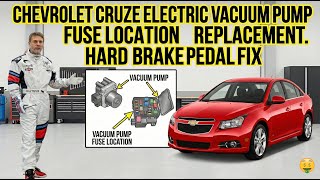
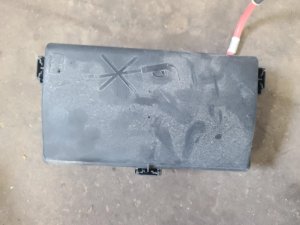
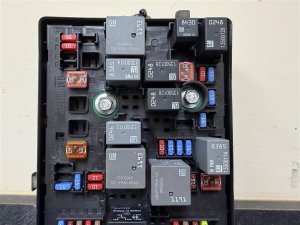
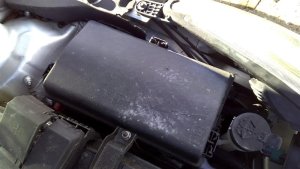
How to confirm: Check fuse F25, a 20A J-case 🎬 Watch: How to locate and check the vacuum pump fuse (cartridge) fuse, in the under-hood fuse box. Test for continuity with a multimeter. The fuse box is located on the driver's side of the engine bay.
Typical fix: Replace the fuse. If the new fuse blows immediately, the vacuum pump motor is shorted and must be replaced.
Est. part cost: $5-$10 - Failed Electric Vacuum Pump (EVP) 🟡 Medium Probability The electric motor in the pump can wear out and fail over time, especially if it has been running excessively due to a faulty switch or restricted vent hose.
How to confirm: If the fuse and microswitch are confirmed to be good, but the pump does not run, test for power and ground at the pump's electrical connector. If power and ground are present when the switch should be calling for the pump to run, the pump motor has failed.
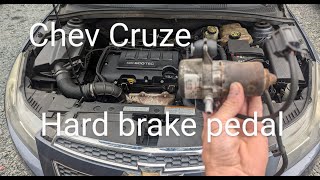
Typical fix: Replace the electric vacuum pump assembly. 🎬 Watch this step-by-step vacuum pump replacement walkthrough
Est. part cost: $150-$250 - Restricted or Misrouted EVP Vent Hose ⚪ Low Probability GM TSB PI0797A notes that the pump's vent hose can be trapped or misrouted from the factory, causing the pump to run continuously and eventually burn out.
How to confirm: If the pump runs for more than 20 seconds and doesn't shut off, disconnect the 9mm rubber vent hose from the back of the pump. If the pump stops immediately, the hose is restricted. Inspect its routing and clear any obstructions.
Typical fix: Reroute the vent hose to its correct position, ensuring it is not kinked or blocked.
Est. part cost: $0
Diagnosis Steps
- Verify the primary symptom: an extremely hard brake pedal.
- Check fuse F25 (20A J-case) in the under-hood fuse box. Replace if blown. If it blows again, suspect a failed pump motor.
- With the ignition in the 'Run' position (engine off), pump the brake pedal 3-4 times. Listen for the electric vacuum pump to turn on near the driver's side front wheel well. It should run for 10-20 seconds and shut off.
- If the pump does not run, the vacuum pipe's microswitch is the most likely cause. It is recommended to replace the entire vacuum pipe assembly per the GM recall.
- If the pump runs continuously (longer than 20 seconds), check for a restricted vent hose as described in TSB PI0797A.
- If the fuse is good and the switch is suspected to be working, but the pump still doesn't run, access the pump connector and test for B+ voltage and a good ground when the pump should be active.
- If power and ground are present at the connector, the electric vacuum pump has failed and requires replacement.
Parts You'll Likely Need
- Power Brake Booster Vacuum Pipe
(OEM #13457666)— This assembly includes the failure-prone microswitch that controls the vacuum pump. This was the official fix for GM Safety Recall 12213. This part number supersedes previous numbers 13375241 and 13286530.
Trusted brands: ACDelco, GM Genuine
OEM price range: $50-$120
Aftermarket price range: $30-$70 - Electric Brake Vacuum Pump
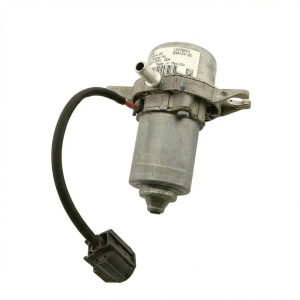
(OEM #84488713)— If the fuse is good and the control switch is working, the pump motor itself may have failed.
Trusted brands: ACDelco, Dorman, GM Genuine
OEM price range: $200-$300
Aftermarket price range: $120-$200 - 20A J-Case Fuse — A simple and inexpensive first check. A shorted pump motor will blow this fuse.
Trusted brands: Bussmann, Littlefuse
OEM price range: $5-$10
Aftermarket price range: $3-$8
Related Codes That Often Appear With This One
- P0556 — P0556 refers to the 'Brake Booster Pressure Sensor Circuit Range/Performance'. If the vacuum pump fails to run (due to P1429), the pressure sensor will detect an incorrect vacuum level, triggering P0556 as a direct result.
Technical Service Bulletins (TSBs) & Recalls
- PI0797A: Preliminary information bulletin from GM detailing diagnosis for a hard brake pedal condition, pointing to a faulty brake booster vacuum switch or a restricted pump vent hose.
- TSB Bulletin #15-NA-080: Notes that some customers may comment on a check engine light illuminated and a technician may find DTC P1429 set.
- TSB Bulletin #SB-32340-B: A manufacturer service bulletin for a different model (Volt) notes that P1429 may set incorrectly and a software update is available to reprogram the engine control module.
- TSB Bulletin #GCUS-3-421: Similar to other manufacturer bulletins, this notes a condition where DTC P1429 may set incorrectly and requires an engine control module software update.
Platform-Specific Known Issues
- Safety Recall 12213 (NHTSA ID 13V360000) was issued for 2011-2012 models to replace the power brake booster vacuum pipe assembly due to a faulty microswitch that could lead to a loss of power brake assist. The recall noted 27 reports of low-speed crashes potentially related to this issue.
Mechanic-Grade Diagnostic Values
- Voltage at Pin 1 of B19C Brake Booster Vacuum Switch connector — expected: B+ (Battery Voltage) with ignition in RUN. Failure: No voltage indicates a problem in the power supply circuit to the switch.
- Voltage at Pin 2 of Electric Vacuum Pump (EVP) connector — expected: B+ (Battery Voltage) when the vacuum switch is closed (demanding pump operation). Failure: No voltage when the pump should be running (and switch has power) points to a failed switch or wiring between switch and pump.
- Resistance of Electric Vacuum Pump motor windings — expected: 1.8Ω - 2.4Ω. Failure: A reading outside this range indicates damaged internal windings in the pump motor.
- Electric Vacuum Pump (EVP) run time — expected: Approximately 10 seconds, with a maximum of 20 seconds after depleting vacuum.. Failure: Running longer than 20 seconds suggests a restricted vent hose; not running at all suggests a circuit or component failure.
Wiring & Ground Locations
- G120 — On the left (driver's side) strut tower in the engine bay.. This is the primary ground point for the electric vacuum pump (EVP) motor and its internal relay. A corroded or loose connection at G120 can prevent the pump from running, even if the fuse and switch are good.
- B19C Brake Booster Vacuum Switch Connector — Integrated into the power brake booster vacuum pipe assembly.. This is the connector for the microswitch that controls the pump. Pin 1 is the B+ power feed, and Pin 2 is the switched power output to the pump. Testing voltage here is key to differentiating a switch failure from a power supply or pump failure.
Real Owner Repair Stories
- YouTube channel 'P Street Garage' (2013 Chevrolet Cruze) — Extremely hard brake pedal, especially at idle. The car would not stop and would continue to move in reverse or drive unless the engine was revved to create vacuum.
❌ Tried (didn't work) The owner initially suspected the microswitch but found it was working. He purchased a new switch but did not initially need it.
✅ What actually fixed it The electric vacuum pump motor itself had failed. After confirming the switch was sending power, he replaced the pump assembly, which fully restored normal brake pedal feel and function at idle.
OEM Part Supersession History
13286530→13375241, then 13457666— Revision to address the failing microswitch design that was prone to silicon contamination, as identified in GM Safety Recall 12213.
Heads up: When replacing, it is critical to use the latest part number (13457666) to ensure the updated, more reliable microswitch is installed.
Model Year Variations Within This Range
- 2011-2012: These model years were specifically named in GM Safety Recall 12213 (NHTSA ID 13V360000) for the failing microswitch in the power brake booster vacuum pipe assembly. While the part can fail on later years, the recall was limited to these initial models.
Diagnostic Flowchart
Other Known Issues on This Vehicle
Issues unrelated to this code that are worth knowing about as an owner of this generation:
- PCV System Failure (Valve Cover & Intake Manifold) 🔴 High — Extremely common. A check valve in the intake manifold fails, which then causes a diaphragm in the valve cover to rupture, creating a major vacuum leak. Often presents with a hissing noise and lean codes (P0171). (Ref: Special Coverage N202299080 (Extends warranty on valve cover to 10yr/120k miles on certain models).)
- Cooling System Leaks (Water Pump & Thermostat Housing) 🔴 High — Very common. The plastic thermostat housing and water pump are prone to cracking and leaking coolant, which can lead to overheating. Aftermarket aluminum housings are a popular upgrade. (Ref: Special Coverage 14371B (Extends warranty on water pump to 10yr/150k miles on 2011-2014 models).)
- Valve Cover Oil Leaks 🟠 Medium — Common. The valve cover gasket frequently leaks oil onto the exhaust manifold, causing a burning oil smell. This is often exacerbated by the PCV system failure increasing crankcase pressure.
- Faulty Negative Battery Cable 🟠 Medium — Common enough to warrant a special coverage program. An insufficient crimp on the negative battery terminal can cause various electrical issues, including no-start conditions or flickering lights. (Ref: Special Coverage 14311 (Extends warranty to 10yr/120k miles).)
- Turbocharger Failure 🟠 Medium — Occurs with some regularity, often presenting as an underboost code (P0299). Can be caused by a failed wastegate actuator, cracked wastegate, or oil starvation issues.
Used vs. New Parts: Buying Guide for This Vehicle
When a used part is the smart pick: A used electric vacuum pump (the motor assembly itself) can be a cost-effective option if it comes from a low-mileage, collision-damaged vehicle. The pump motor is a relatively durable component if not subjected to continuous operation from other faults.
Donor-vehicle mileage cap: roughly under 75000 miles for the part to have meaningful remaining life.
What to inspect on the donor part:
- Check for physical damage to the housing or electrical connector.
- If possible, bench-test the pump with a 12V source to ensure it runs smoothly before purchase.
- Ask for the VIN of the donor car to verify mileage and ensure it wasn't from a flood-damaged vehicle.
OEM-only on this vehicle (don't cheap out):
- Power Brake Booster Vacuum Pipe Assembly (with microswitch)
Aftermarket brands forum-validated for this vehicle:
- ACDelco (Professional or GM Genuine)
- Dorman (for the electric vacuum pump)
Brands owners have reported issues with on this vehicle:
- Avoid unbranded, 'white-box' vacuum pipe assemblies from online marketplaces. The quality and reliability of the integrated microswitch are critical for safety, and these parts often use substandard components that fail prematurely.
Real Owner Stories
Aggregated from forums and TSBs cited above. Mileages and costs reflect what owners reported in those sources.
2012 Chevrolet Cruze 1.4L LUJ
Symptoms: Owner experienced a loss of power brake assist during low-speed maneuvers, resulting in a hard brake pedal.
What fixed it: Replacement of the power brake booster vacuum pipe assembly as part of Safety Recall 12213.
Source hint: Safety Recall 12213 (NHTSA ID 13V360000)
2014 Chevrolet Cruze 1.4L LUJ
Symptoms: The electric vacuum pump was heard running continuously (longer than 20 seconds) and wouldn't shut off.
What fixed it: Rerouting the 9mm rubber vent hose which was trapped/restricted from the factory.
Source hint: TSB PI0797A
2011 Chevrolet Cruze 1.4L LUJ
Symptoms: Check Engine Light on with code P1429 and an extremely hard brake pedal at idle.
What fixed it: Replaced the vacuum pipe assembly containing the microswitch after confirming the pump didn't run when the pedal was pumped.
Source hint: CruzeTalk.com threads regarding P1429 and microswitch failure
Related OBD-II Codes
Frequently Asked Questions
Is there a recall for the hard brake pedal issue on my 2011-2012 Chevrolet Cruze?
My 2014 Cruze has a hard pedal and P1429; does TSB PI0797A apply to me?
Which fuse should I check if my electric vacuum pump isn't running?
Can a PCV system failure cause vacuum issues on the 1.4L LUJ engine?
Why does my vacuum pump keep running for more than 20 seconds after I turn the car off?
Is the water pump on my 2013 Cruze covered under a special warranty?
Helpful Videos
We Have This Part in Stock

The information in this article is provided for general reference and educational purposes only. Vehicle specifications, procedures, and part compatibility can vary by production date, trim level, and region. Always consult your vehicle's factory service manual and verify part numbers before purchasing or performing repairs. Safety-critical components such as airbags, seat belts, and braking systems should be installed by a qualified professional.
- Chevrolet Cruze:
- 🧭 Diagnostic Flowchart
- 🎬 Helpful Videos
- 🛍️ Shop This Part
- What's Unique About the 2011-2016 Chevrolet Cruze
- Symptoms You May Notice
- Most Likely Causes
- Diagnosis Steps
- Parts You'll Likely Need
- Related Codes That Often Appear With This One
- Technical Service Bulletins (TSBs) & Recalls
- Platform-Specific Known Issues
- Mechanic-Grade Diagnostic Values
- Wiring & Ground Locations
- Real Owner Repair Stories
- OEM Part Supersession History
- Model Year Variations Within This Range
- Other Known Issues on This Vehicle
- Used vs. New Parts: Buying Guide for This Vehicle
- Real Owner Stories
- 2012 Chevrolet Cruze 1.4L LUJ
- 2014 Chevrolet Cruze 1.4L LUJ
- 2011 Chevrolet Cruze 1.4L LUJ
- Related OBD-II Codes
- Frequently Asked Questions
- 🎟️ Get 5% Off