

P1429 on 2016-2022 Volkswagen Passat: Brake Vacuum Pump Open Circuit Causes and Fixes
On a 2016-2022 VW Passat, code P1429 means the electric brake vacuum pump has an electrical fault, causing a hard brake pedal. The most likely fix is replacing the failed electric vacuum pump itself. Before replacing, always check the pump's fuse (often a 5A fuse at position SB9 in the engine bay fuse box).
- P1429 indicates a serious electrical fault in the brake vacuum pump circuit that makes the vehicle unsafe to drive.
- The most common cause is the failure of the electric vacuum pump itself, followed by a blown fuse.
- This code is almost always paired with P0556; fixing the P1429 fault will resolve both.
- Always check the fuse (often SB9, 5A, in the engine bay fuse box) before replacing more expensive components.
What's Unique About the 2016-2022 Volkswagen Passat
The Passat of this era, like many modern VW/Audi vehicles with turbocharged engines, relies on a supplemental electric pump for consistent brake feel and performance. The P1429 code is a well-documented issue across the VW lineup using the EA888 engine and MQB platform. The key thing to know is that this code almost always appears with P0556 (Brake Booster Pressure Sensor). The P0556 code is a symptom, not the cause; it gets triggered because the sensor correctly reports a lack of vacuum when the pump fails to run due to the P1429 electrical fault. Fixing the root cause of P1429 will clear both codes.
Generation note: The 2016-2022 North American Passat (NMS) is a single generation but received a major facelift for 2016 and another for 2020. The engine changed from the 1.8T EA888 Gen 3 (2016-2017) to the 2.0T EA888 Gen 3B (2018-2022). However, the auxiliary electric brake vacuum pump system is used across this entire year range, and the causes and fixes for P1429 are consistent.
Symptoms You May Notice
- Hard brake pedal that is difficult to press.
- Significantly increased stopping distance.
- Check Engine Light illuminated.
- "Brake booster faulty" message on the instrument cluster (in some cases).
- Loss of driver-assist features like Adaptive Cruise Control (ACC) that rely on the braking system.
- Replacing the Brake Booster Pressure Sensor. This sensor triggers code P0556, which is a *result* of the pump not working. Replacing the sensor will not fix the P1429 open circuit fault.
- Replacing the Brake Booster. The booster itself is rarely the problem. The issue is a lack of vacuum being supplied *to* the booster due to the electrical fault with the pump.
Most Likely Causes
- Failed Electric Brake Vacuum Pump 🔴 High Probability → Shop Vacuum Pump The electric motor inside the pump assembly is a common failure point due to wear and tear, leading to an internal open circuit. The pump is mounted on the subframe, exposing it to road debris and vibration.
How to confirm: After confirming the fuse is good, test for 12V power and a good ground at the pump's 2-pin electrical connector with the ignition on. If power and ground are present but the pump does not run when commanded by a scan tool, it has failed internally. A multimeter test across the pump's two terminals will show an open loop (infinite resistance).
Typical fix: Replace the electric brake vacuum pump assembly.
Est. part cost: $250-$500 - Blown Fuse 🟡 Medium Probability A failing pump motor can draw excess current and blow the fuse, or the fuse can fail from age. This should always be the first check.
How to confirm: Locate the fuse for the brake vacuum pump (V192). On a Passat, this is often a 5A fuse in position SB9 in the engine bay fuse box (E-Box) next to a battery. Visually inspect it or test for continuity with a multimeter. Always consult a vehicle-specific diagram to be certain.
Typical fix: Replace the blown fuse. If the new fuse blows immediately, the pump motor is shorted and must be replaced.
Est. part cost: $1-$5 - Damaged Wiring or Connector ⚪ Low Probability Engine bay heat and vibrations can cause wires to become brittle and break over time. The connector at the pump, located on the subframe, is also exposed to the elements, road salt, and potential debris strikes.
How to confirm: Visually inspect the wiring harness leading to the vacuum pump for any signs of breaks, chafing, or corrosion. Check that the connector is securely plugged in and the terminals are clean. A break is most common right at the connector where the wire flexes.
Typical fix: Repair the broken section of wire or replace the connector pigtail.
Est. part cost: $15-$60
Rare But Worth Checking
- Faulty Control Relay: The relay (J57) that sends power to the pump can fail, creating an open circuit even if the pump and fuse are good. This is less common than pump failure but is a possible cause. Its exact location should be verified with a vehicle-specific wiring diagram.
- Faulty Brake Booster Control Module (J542): → Shop Power Brake Booster In some cases, the control module responsible for activating the pump can fail, leading to an open circuit code. This is a rare and more complex diagnosis.
Diagnosis Steps
- Read fault codes with an OBD-II scanner to confirm P1429 is present, likely accompanied by P0556.
- Locate the fuse box in the engine compartment. Identify and inspect the fuse for the brake vacuum pump (often SB9, a 5A fuse). Replace it if it's blown.
- If the fuse is good, safely raise and support the vehicle to access the electric vacuum pump, which is typically mounted on the driver's side of the front subframe.
- Visually inspect the pump's electrical connector and the surrounding wiring for any obvious damage, corrosion, or loose connections. Pay close attention to the wires right at the connector.
- Using a multimeter, disconnect the pump and check for battery voltage (12V) on one pin and good ground (near 0 ohms to chassis) on the other pin of the harness-side connector when the ignition is on.
- If voltage and ground are present at the connector, the open circuit is inside the pump itself, and the pump needs to be replaced.
- If voltage or ground is missing, trace the wiring back to find the break or check the control relay (J57).
Parts You'll Likely Need
- Electric Brake Vacuum Pump
(OEM #5Q0919026BH)— This is the most common failure. The internal motor wears out, creating the 'open circuit' condition detected by the ECM.
Trusted brands: Pierburg (OEM Supplier), Bosch, Hella, Genuine VW
OEM price range: $350-$500
Aftermarket price range: $200-$400
Related Codes That Often Appear With This One
- P0556 — Stands for 'Brake Booster Pressure Sensor Circuit Range/Performance'. This code is triggered as a direct result of the P1429 fault. When the vacuum pump's circuit is open (P1429), the pump doesn't run, causing the pressure sensor to report an illogical reading (P0556). Fixing P1429 will resolve P0556.
Technical Service Bulletins (TSBs) & Recalls
- VIN4APIN20190628: Informational TSB for technicians regarding customer complaints of the Check Engine Light on with DTC P1429 and/or P0556.
- VIN4APIN20190617: Similar informational TSB noting the combination of P1429 and P0556 faults, as well as potential noise from the heat shield.
- TSB Bulletin #VIN4APIN20191122: A manufacturer service bulletin noting customer reports of the Malfunction Indicator Lamp (MIL) illuminating with P1429 and/or P0556.
- TSB Bulletin #VIN4APIN20190805: An additional manufacturer record documenting customer complaints of the MIL-on condition specifically involving the P1429 and P0556 fault codes.
Platform-Specific Known Issues
- Volkswagen has issued multiple Technical Service Bulletins (TSBs) acknowledging that codes P1429 and P0556 frequently appear together, confirming it's a recognized issue across the MQB platform.
- A recall was issued for some 2015-2016 models for a different failure where the camshaft lobe driving the *mechanical* vacuum pump could fail. While P1429 relates to the *electric* pump, this history shows the brake vacuum system is a known sensitive area for this platform.
Mechanic-Grade Diagnostic Values
- Electric Vacuum Pump (V192) Motor Resistance — expected: A specific Ohm value for a good pump is not officially published, but it should show continuity (a low resistance value).. Failure: An 'Open Loop' (O.L.) or infinite resistance reading on a multimeter across the pump's two electrical pins indicates an internal open circuit in the motor.
- Voltage at Pump Connector — expected: Approximately 12V (battery voltage) at the power pin and near 0V at the ground pin when the pump is commanded on (or with key on, engine off).. Failure: Absence of 12V (with a good fuse) points to a wiring break or faulty relay. High voltage on the ground pin indicates a bad ground connection.
Scan Tool Commands That Help
- VCDS (VAG-COM) / ODIS: Engine (01) -> Output Tests (03) -> Brake Vacuum Pump (V192) Activation — This is the definitive test to determine if the pump motor runs when commanded directly by the ECM. If the pump has 12V power and ground but does not run during this test, the pump itself has failed.
- VCDS (VAG-COM) / ODIS: ABS Brakes (03) -> Measuring Value Blocks (MVB) — Used to monitor the live pressure reading from the Brake Booster Pressure Sensor (G294). This helps verify if the pump is generating vacuum when it runs and confirms the sensor is responding correctly after the repair.
Wiring & Ground Locations
- Pump Connector (2-pin) — Directly on the electric vacuum pump, which is mounted to the driver's side of the front subframe.. This is the primary test point for voltage and ground. Pin 1 is typically the 12V+ supply from the relay/fuse, and Pin 2 is the ground. An open circuit is often found here due to a broken wire or internal pump failure.
- Ground Point 15 — On the cylinder head.. The ECM and various sensors rely on clean engine grounds. While the pump may ground to the chassis, a poor engine ground can introduce electrical noise or voltage drops that affect the control circuit.
- Ground Point 652 — Main engine/transmission to chassis ground strap, often on the left frame rail in the engine bay.. A corroded or loose main ground strap can cause intermittent or total failure of high-draw components like the vacuum pump, leading to an open circuit fault under load.
Real Owner Repair Stories
- Ross-Tech Forums User (2012 VW Sharan 1.4TSI (Similar system logic)) — No brake servo assist on initial startup. Pump was not running.
❌ Tried (didn't work) Tested the original pump by wiring it directly to a battery; it was dead. Replaced the vacuum pump and its relay with new parts, but the new pump still would not activate.
✅ What actually fixed it The user discovered in the ABS module adaptations that the vacuum pump was set to 'deactivated'. The fix required using VCDS to find the correct software coding value for the ABS module to 'enable' the vacuum pump, which allowed the new pump to function. - Reddit user in r/Volkswagen (VW with EA888 Gen 3 engine) — Multiple, seemingly random and severe electrical issues and fault codes.
❌ Tried (didn't work) A dealership diagnosed the issue as a failed ECU and engine wiring harness, quoting a very expensive repair.
✅ What actually fixed it The owner found a detached ground wire on the exhaust manifold. Re-securing the ground nut fixed all the electrical problems instantly. This highlights how a single failed ground can mimic catastrophic component failure.
OEM Part Supersession History
5Q0919026BH→Unknown— Part numbers for components like this are often revised to improve reliability or change suppliers.
Heads up: While a direct supersession for this exact part number was not found, other VW vacuum pumps have multiple revisions (e.g., 06L145100B -> 06L145100F -> 06L145100N). Always verify the correct part number for your vehicle's VIN before ordering to ensure compatibility.
Model Year Variations Within This Range
- 2016-2022: The engine changed from the 1.8T EA888 Gen 3 (2016-2017) to the 2.0T EA888 Gen 3B 'B-Cycle' (2018-2022). However, both engines utilize the same supplemental electric brake vacuum pump system. The diagnosis and common failures for code P1429 remain consistent across this entire year range for the Passat.
Diagnostic Flowchart
Used vs. New Parts: Buying Guide for This Vehicle
When a used part is the smart pick: A used pump is a significant gamble, as the primary failure mode is internal motor wear. It should only be considered if it comes from a verified, very low-mileage donor vehicle (e.g., a rear-end collision) and the cost is substantially lower than a new aftermarket unit.
Donor-vehicle mileage cap: roughly under 40000 miles for the part to have meaningful remaining life.
What to inspect on the donor part:
- Verify the mileage of the donor vehicle.
- Inspect the part for any physical damage, especially to the plastic housing and electrical connector.
- Check for heavy corrosion on the motor casing or mounting points.
- If possible, test the pump with a 12V source before purchase to ensure the motor runs.
OEM-only on this vehicle (don't cheap out):
- No parts for this specific repair are strictly 'OEM-only', as reputable OEM suppliers sell the same part under their own brand.
Aftermarket brands forum-validated for this vehicle:
- Pierburg: Widely cited as the Original Equipment Manufacturer (OEM) for VW. Buying a Pierburg-branded pump is often identical to the Genuine VW part at a lower cost.
- Bosch: A well-regarded OEM supplier with a strong reputation for electrical components.
- Hella: Another reputable German aftermarket brand often available as an alternative.
Brands owners have reported issues with on this vehicle:
- Unnamed or 'white-box' brands from online marketplaces should be avoided. Forum discussions often warn against suspiciously cheap parts that fail prematurely.
Real Owner Stories
Aggregated from forums and TSBs cited above. Mileages and costs reflect what owners reported in those sources.
2016 Volkswagen GTI
Symptoms: P1429/P0556 codes and a hard pedal.
What fixed it: After verifying the fuse was intact, they replaced the electric vacuum pump (Pierburg brand), which completely resolved the issue.
Source hint: VWVortex user report cited in 'common_causes'
2016 Volkswagen GTI
Symptoms: Hard brake pedal, "Brake booster faulty" error, codes P1429 and P0556.
What fixed it: Diagnosed and successfully fixed the issue by replacing the electric vacuum pump.
Source hint: VWVortex Forums - 'Hard brake pedal, "Brake booster faulty" error, codes P1429 and P0556'
Related OBD-II Codes
Frequently Asked Questions
My Passat is showing both P1429 and P0556 codes. Is this a common problem?
What is the absolute first thing I should check for a P1429 code on my 2017 Passat?
I have a hard brake pedal and the dash says 'Brake booster faulty'. Is this related to the P1429 Check Engine Light code?
Where is the electric brake vacuum pump located on my Passat?
If I need to replace the vacuum pump, is there a recommended brand besides the official VW part?
My friend's VW GTI had this exact P1429 issue. Does my Passat use the same parts?
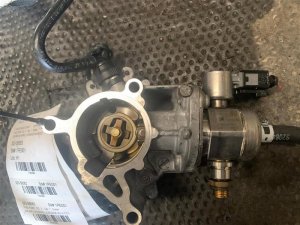
We Have This Part in Stock

The information in this article is provided for general reference and educational purposes only. Vehicle specifications, procedures, and part compatibility can vary by production date, trim level, and region. Always consult your vehicle's factory service manual and verify part numbers before purchasing or performing repairs. Safety-critical components such as airbags, seat belts, and braking systems should be installed by a qualified professional.
- Volkswagen Passat:
- 🧭 Diagnostic Flowchart
- 🛍️ Shop This Part
- What's Unique About the 2016-2022 Volkswagen Passat
- Symptoms You May Notice
- Most Likely Causes
- Rare But Worth Checking
- Diagnosis Steps
- Parts You'll Likely Need
- Related Codes That Often Appear With This One
- Technical Service Bulletins (TSBs) & Recalls
- Platform-Specific Known Issues
- Mechanic-Grade Diagnostic Values
- Scan Tool Commands That Help
- Wiring & Ground Locations
- Real Owner Repair Stories
- OEM Part Supersession History
- Model Year Variations Within This Range
- Used vs. New Parts: Buying Guide for This Vehicle
- Real Owner Stories
- 2016 Volkswagen GTI
- 2016 Volkswagen GTI
- Related OBD-II Codes
- Frequently Asked Questions
- 🎟️ Get 5% Off