

P1440 on 2009-2017 Chevrolet Traverse: Why It's Really P1441 and How to Fix It
The code P1440 on a 2009-2017 Traverse is almost always a misreading for the real code, P1441. This is caused by a faulty EVAP Purge Solenoid Valve that gets stuck open. It's a common, easy-to-access part on top of the engine that costs about $25-$50 to replace yourself.
- Don't be confused by P1440; the real issue on your Traverse is code P1441 or, more commonly, P0496.
- The problem is almost certainly a stuck-open EVAP Purge Solenoid Valve, a very common failure.
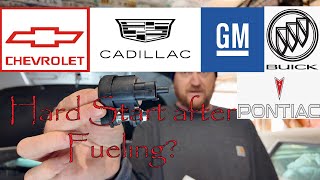
- The most telling symptom is difficulty starting the engine immediately after getting gas.
- This is one of the easiest and cheapest Check Engine Light fixes for a DIYer. The part is on top of the engine and takes 10-15 minutes to replace.
- Before buying, you can confirm the failure by removing the old valve and seeing if you can blow air through it. If you can, it's bad.
What's Unique About the 2009-2017 Chevrolet Traverse
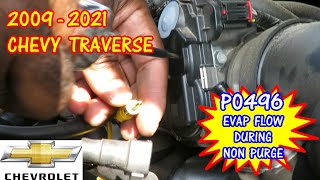
On many GM vehicles, including the Traverse and its platform mates (GMC Acadia, Buick Enclave, Saturn Outlook), the EVAP Purge Solenoid Valve is a very common failure item. It tends to fail by sticking open, which directly causes the P1441 or the identical P0496 code. 🎬 Watch: A detailed breakdown of the P0496 code and fix. While generic scanners might show a P1440 or other EVAP codes, the specific 'Flow During Non-Purge' condition of P1441/P0496 points directly to this common failure point, making diagnosis more straightforward than on other vehicles where EVAP issues can be more ambiguous.
Generation note: The 2009-2017 year range covers the entire first generation of the Chevrolet Traverse. This issue and its fix are common across all years of this generation, including models with the earlier LLT V6 (2009-2012) and the later LFX V6 (2013-2017). The purge valve is located in the same easy-to-access spot on top of the engine for both engine versions.
Symptoms You May Notice
- Check Engine Light is on
- Rough, unstable, or surging idle
- Difficulty starting the engine, particularly after filling the gas tank 🎬 See why your car struggles to start after getting gas.
- Slight decrease in fuel economy
- Possible fuel smell
- Stalling at low speeds or when coming to a stop
- Replacing the gas cap. While a bad gas cap can cause many EVAP codes (like P0455 or P0457), it is not the cause of P1441, which is about uncommanded *flow*, not a system leak detected during a pressure test.
- Replacing the O2 sensors. The rough idle from the unmetered vacuum leak can sometimes be misdiagnosed as a sensor issue, but the root cause is the extra fuel vapor from the stuck purge valve.
Most Likely Causes
- Faulty EVAP Purge Solenoid Valve (Stuck Open) 🔴 High Probability → Shop Vapor Canister This specific part has a high failure rate on GM's 3.6L V6 engine platform. It commonly gets stuck in the open position due to internal wear or contamination, allowing uncommanded fuel vapor into the intake.
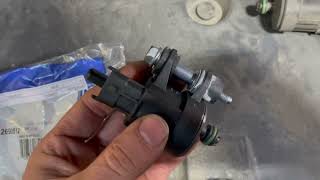
How to confirm: Remove the valve from the engine (it's on top, near the throttle body, held by one 10mm bolt). With the valve disconnected, try to blow through it. If air passes through, it is stuck open and has failed. A healthy, de-energized valve should be closed and block airflow. A hand vacuum pump can also be used; a bad valve will not hold a vacuum.
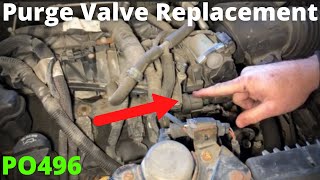
Typical fix: Replace the EVAP Purge Solenoid Valve. This is a 10-minute DIY job. 🎬 Watch this step-by-step guide to replacing the purge valve.
Est. part cost: $25-$60
Rare But Worth Checking
- Faulty EVAP Vent Solenoid: → Shop Vapor Canister This valve is located near the charcoal canister by the fuel tank. If it gets stuck open, it can sometimes contribute to EVAP system flow issues, though it more commonly causes other codes like P0449.
- Saturated Charcoal Canister: → Shop Vapor Canister Consistently overfilling the fuel tank (topping off after the pump clicks) can force liquid gasoline into the charcoal canister, ruining it. This can cause blockages and send charcoal pellets through the system, damaging both the vent and purge valves.
- Leaking EVAP Hoses: Cracked or disconnected hoses in the EVAP system can cause leaks, though this typically sets codes like P0442 (small leak) or P0455 (gross leak) rather than P1441.
- Wiring Harness Issue: Rarely, a short in the wiring harness could provide constant power to the purge solenoid, holding it open. This would mimic a failed valve but is much less common.
Diagnosis Steps
- Confirm the code with a quality OBD-II scanner. If it shows P1440, assume it means P1441 or P0496 for this vehicle.
- Locate the EVAP Purge Solenoid Valve on the top of the engine. First, remove the plastic engine cover by unscrewing the oil cap and pulling the cover straight up.
- The purge valve is mounted to the intake manifold, typically with a single 10mm bolt. It will have one electrical connector and two hoses attached.
- Disconnect the electrical connector and the two hoses. The larger hose has a green quick-connect tab that you press to release.
- Remove the 10mm bolt and pull the valve out of its port on the intake manifold.
- Attempt to blow through the valve from either port. If you can pass air through it, the valve is stuck open and must be replaced. A new valve will not allow air to pass through.
- If the valve tests good, inspect the EVAP hoses connected to it for cracks or loose fittings.
- If the valve and hoses are good, the issue could be a short in the wiring harness providing constant power to the valve, holding it open. This is less common.
- Install the new purge valve, reconnect hoses and the electrical connector.
- Clear the trouble codes with the scanner and perform a drive cycle to ensure the Check Engine Light does not return. Note that the EVAP monitor can take several days of driving to run its self-test.
Parts You'll Likely Need
- Vapor Canister Purge Solenoid Valve
(OEM #12690512)— This is the primary cause of code P1441/P0496. It fails by sticking open, allowing fuel vapor to flow when it should be closed. Note: The original GM part number was 12610560, which was superseded by 12690512, and later by numbers like 12737252. It is best to use the latest revision.
Trusted brands: ACDelco (GM Original Equipment), Dorman (e.g., 911-082), Bosch, Standard Motor Products
OEM price range: $40-$60
Aftermarket price range: $25-$45
Related Codes That Often Appear With This One
- P0496 — This is another GM-specific code for 'EVAP Flow During a Non-Purge Condition'. It is functionally identical to P1441 and points to the same problem. Many scanners will report P0496 instead of P1441 for this exact issue.
- P0171 / P0174 — A stuck-open purge valve creates a vacuum leak. The engine computer sees the extra, unmetered air/vapor and tries to compensate by adding fuel, which can eventually max out the fuel trims and trigger 'System Too Lean' codes for Bank 1 and/or Bank 2.
Technical Service Bulletins (TSBs) & Recalls
- TSB 17-NA-409: While for a different model (Impala), this TSB notes that oil contamination from a cam cover gasket can cause the purge valve to stick, leading to code P0496. This highlights a potential source of contamination that could cause the failure.
Mechanic-Grade Diagnostic Values
- EVAP Purge Solenoid Coil Resistance — expected: 15-30 Ohms. Failure: An open circuit (infinite resistance) or a short (near zero resistance) indicates a failed solenoid coil.
- EVAP Purge Solenoid Connector Voltage (Key On, Engine Off) — expected: One pin should have 12V+ (battery voltage). The other is the ground-side control from the ECM.. Failure: No voltage on the power pin indicates a wiring or fuse issue upstream from the solenoid.
- Scan Tool Fuel Tank Pressure (FTP) Sensor Reading (during Purge/Seal test) — expected: When the system is sealed and purge is commanded, vacuum should build (pressure drops into negative inches of H2O). When sealed with no purge, vacuum should hold steady.. Failure: If vacuum builds with the purge command at 0% (non-purge), it confirms un-commanded flow, pointing to a stuck-open purge valve.
Scan Tool Commands That Help
- GM GDS2 / Tech-II or equivalent professional scanner: EVAP Purge/Seal — This is the primary diagnostic function for P1441/P0496. The technician commands the EVAP system to seal (closing both purge and vent valves) and monitors the Fuel Tank Pressure (FTP) sensor. If vacuum builds with the purge valve commanded closed, it proves the valve is stuck open and leaking vacuum from the intake.
- GM GDS2 / Tech-II or equivalent professional scanner: Purge Solenoid Control (%) — Allows a technician to manually cycle the purge solenoid from 0% to 100% while monitoring engine data. Commanding it on should cause a brief rich condition and a change in short-term fuel trims as vapors are introduced. No change suggests a clogged line or a non-functioning (but not stuck open) valve.
Wiring & Ground Locations
- G110 — Right front of the engine, mounted to the cylinder head.. This is a major engine ground. While not a common cause for this specific code, a loose or corroded ground here can cause erratic behavior from any component controlled by the Engine Control Module (ECM), including the purge solenoid. It's a 'good to check' item if electrical issues are suspected.
- EVAP Purge Solenoid Connector — On the purge solenoid itself, top of the engine near the throttle body.. This is the primary point for electrical testing. One wire is ignition voltage (typically pink on GM harnesses) and the other is the control (ground signal) from the ECM. Verifying 12V here is the first step in diagnosing a potential wiring issue vs. a failed part.
Real Owner Repair Stories
- Review on Amazon for ACDelco Part 12690512 (2012 GMC Acadia Denali (platform mate) with 92,000 miles) — Check Engine Light with code P0496.
✅ What actually fixed it Replacing the EVAP purge solenoid valve with a new ACDelco part (12690512) resolved the code. The owner noted the automatic start feature, which is disabled by this code, began working again after the fix. - Review on Amazon for ACDelco Part 12690512 (2013 Chevrolet Traverse with 99,000 miles) — Check Engine Light with code P0496.
✅ What actually fixed it The owner confirmed the old valve was bad by being able to blow air through it. Replacing it with the OEM ACDelco part fixed the issue.
OEM Part Supersession History
12610560→12690512, then 12661763, and most recently 12737252— Revisions typically involve improved internal materials, such as better sealing materials or spring tension, to increase longevity and prevent the common 'stuck open' failure.
Heads up: All listed part numbers are physically and functionally interchangeable for this vehicle generation. It is always best practice to use the latest available revision (12737252) for the most updated design.
Model Year Variations Within This Range
- 2009-2012 (LLT) vs. 2013-2017 (LFX): While the P0496/P1441 code and its cause (stuck purge valve) are identical, the engines have key differences. The LFX (2013+) features a composite intake manifold (vs. aluminum on LLT), integrated exhaust manifolds (no separate headers), and a different ECM (Delphi vs. Bosch). However, for this specific repair, the purge valve part number, location, and replacement procedure remain the same across both engine versions.
Diagnostic Flowchart
Other Known Issues on This Vehicle
Issues unrelated to this code that are worth knowing about as an owner of this generation:
- Premature Timing Chain Wear 🔴 High — Very common, especially on 2009-2012 LLT engines, often appearing between 70k-120k miles. Can lead to catastrophic engine failure if ignored. (Ref: Special Coverage Adjustment 11340C extended warranty to 10 years/120,000 miles. TSB 12-06-01-009D provides updated parts kits.)
- Cracked 3-5-R Transmission Wave Plate 🔴 High — Common on early models (especially 2009) with the 6T70/6T75 transmission, causing loss of 3rd, 5th, and Reverse gears. (Ref: Special Coverage Adjustment 14404B extended warranty to 10 years/120,000 miles (now expired).)
- Power Steering Pump/Rack Failure 🟠 Medium — Widespread issue causing whining noises, fluid leaks, and/or loss of power assist at low speeds. (Ref: Special Coverage Adjustment 14329 extended warranty for some 2009-2011 models. TSB 13-02-32-001G addresses noise in extreme cold.)
- Excessive Oil Consumption 🟠 Medium — Affects earlier models (2009-2012 LLT) due to PCV system design, which can lead to sludge and contribute to timing chain wear.
- Water Pump Leak 🟠 Medium — The water pump is known to fail and leak coolant. Because it is driven by the timing chain, replacement is labor-intensive.
- Intake Valve Carbon Buildup 🟡 Low — As a direct-injection engine (both LLT and LFX), carbon deposits accumulate on the back of the intake valves over time, which can cause misfires or a rough idle.
Used vs. New Parts: Buying Guide for This Vehicle
When a used part is the smart pick: Never. The EVAP purge solenoid is a low-cost, high-failure electronic component. The risk of getting a used part that has already failed or is near the end of its service life is extremely high. The cost savings are minimal compared to the likelihood of having to do the job again.
What to inspect on the donor part:
- Not applicable as buying used is not recommended.
OEM-only on this vehicle (don't cheap out):
- While not strictly 'OEM-only', using the GM Original Equipment (ACDelco) part is highly recommended. The price difference is often small, and it ensures you get the latest design revisions that address the common failure mode.
Aftermarket brands forum-validated for this vehicle:
- Standard Motor Products (SMP) is a generally respected aftermarket brand.
- Bosch is often the original manufacturer for GM for this type of part.
Brands owners have reported issues with on this vehicle:
- Dorman has a mixed reputation among technicians and DIYers; some report premature failures on electronic parts compared to OEM or other premium aftermarket brands.
- Unbranded, no-name parts from online marketplaces should be avoided due to inconsistent quality control.
Real Owner Stories
Aggregated from forums and TSBs cited above. Mileages and costs reflect what owners reported in those sources.
2010 Chevrolet Traverse 3.6L V6
Symptoms: The engine would turn over but would not start immediately after refueling at the gas station.
What fixed it: Replacement of the stuck-open EVAP purge solenoid valve.
Source hint: Car Talk Community - 'Traverse won't start after fill-up'
Chevrolet Traverse 3.6L V6
Symptoms: Recurring P0496 code; the owner replaced the purge valve once, but the issue returned shortly after.
What fixed it: The owner noted that charcoal particles from a damaged canister can cause repeat failures of the new valve.
Source hint: Chevrolet Forum - 'My P0496 Solution'
Related OBD-II Codes
Frequently Asked Questions
My 2010 Traverse won't start after I fill up the gas tank. Is this related to code P1440?
Is there a specific part number I should look for when replacing the purge valve on my Traverse?
Does TSB 17-NA-409 apply to the P1440/P0496 issue on my 3.6L V6?
Can I use a used purge valve from a donor GMC Acadia or Buick Enclave?
I replaced the valve but the code came back. Could something else be wrong?
Is the timing chain issue on my 2009 Traverse covered by a warranty extension?
Helpful Videos
Used OEM Parts in Stock
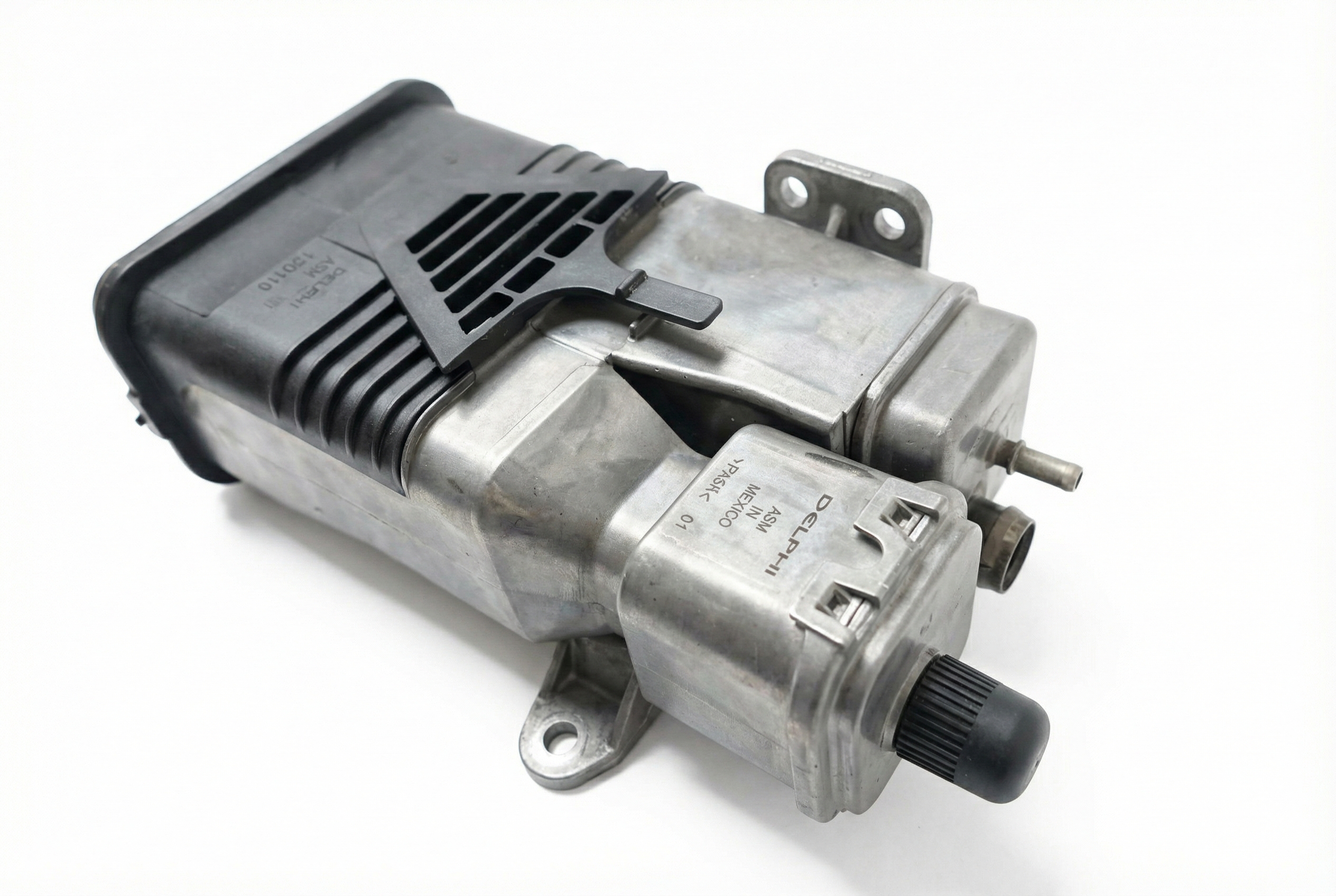
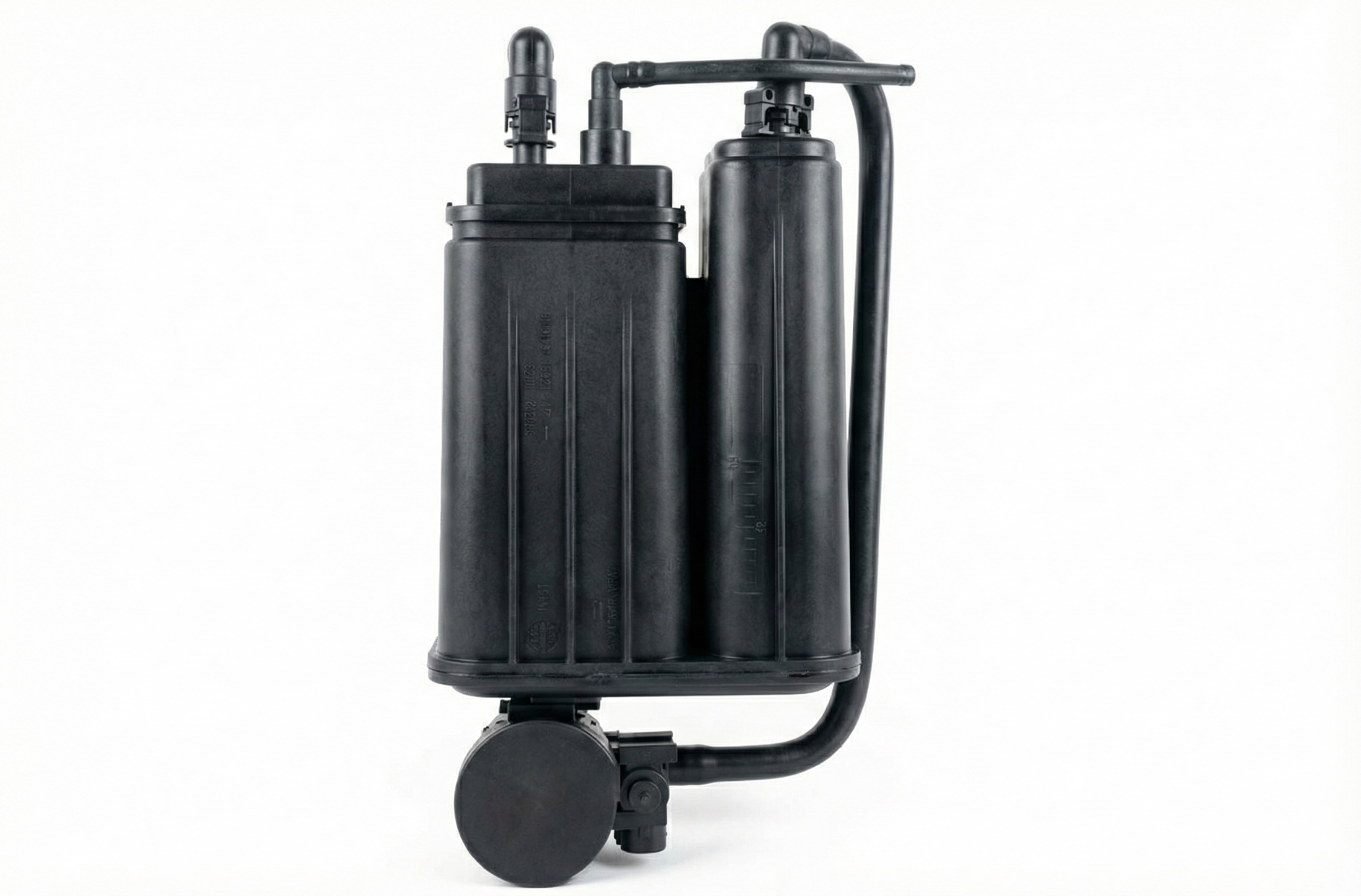
New Aftermarket Parts Available

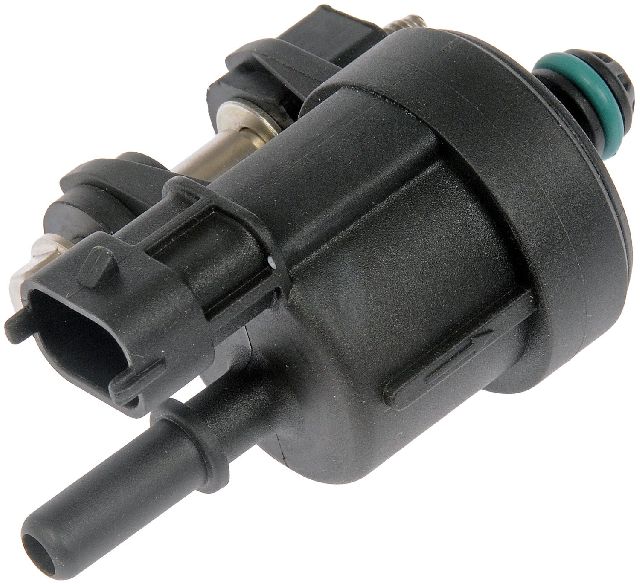

The information in this article is provided for general reference and educational purposes only. Vehicle specifications, procedures, and part compatibility can vary by production date, trim level, and region. Always consult your vehicle's factory service manual and verify part numbers before purchasing or performing repairs. Safety-critical components such as airbags, seat belts, and braking systems should be installed by a qualified professional.
- Chevrolet Traverse:
- 🧭 Diagnostic Flowchart
- 🎬 Helpful Videos
- 🛍️ Shop This Part
- What's Unique About the 2009-2017 Chevrolet Traverse
- Symptoms You May Notice
- Most Likely Causes
- Rare But Worth Checking
- Diagnosis Steps
- Parts You'll Likely Need
- Related Codes That Often Appear With This One
- Technical Service Bulletins (TSBs) & Recalls
- Mechanic-Grade Diagnostic Values
- Scan Tool Commands That Help
- Wiring & Ground Locations
- Real Owner Repair Stories
- OEM Part Supersession History
- Model Year Variations Within This Range
- Other Known Issues on This Vehicle
- Used vs. New Parts: Buying Guide for This Vehicle
- Real Owner Stories
- 2010 Chevrolet Traverse 3.6L V6
- Chevrolet Traverse 3.6L V6
- Related OBD-II Codes
- Frequently Asked Questions
- 🎟️ Get 5% Off