

P1440 on 2011-2019 Ford Fiesta: EVAP Vacuum Trouble Causes and Fixes
On a 2011-2019 Ford Fiesta with the 1.6L engine, code P1440 almost always indicates a failing vapor canister purge valve. The most telling symptom is the car being difficult to start, sputtering, or stalling right after refueling. Replacing the purge valve assembly is the common and effective fix, costing around $40-$75 for an OEM part and is a DIY-friendly repair.
- Code P1440 on a Ford Fiesta points to an EVAP system vacuum problem.
- The most common symptom by far is the engine struggling to start right after you put gas in it. If you have this symptom, the purge valve is almost certainly the problem.
- The most likely fix is replacing the vapor canister purge valve, which is a DIY-friendly job that takes less than an hour.
- This code is often seen with P1450; they both point to the same common failure.
- Always verify the correct part number for your specific year and engine using your VIN before ordering.
What's Unique About the 2008-2019 Ford Fiesta
While many manufacturers use P1440 to mean 'Purge Valve Stuck Open', Ford's definition is more general. On the Fiesta, this code is very frequently accompanied by the more specific P1450 code ('Unable to Bleed Up Fuel Tank Vacuum') and the classic symptom of the engine struggling to start after getting gas. This is because the purge valve sticks open, allowing un-metered fuel vapors to flood the intake manifold during refueling, creating a rich air-fuel mixture that causes the engine to stumble or stall. Additionally, 2011-2013 models use a Natural Vacuum Leak Detection (NVLD) system that tests for leaks when the engine is off, while later models use an engine-running test; however, the purge valve remains the most common failure point for both system types.
Generation note: The Ford Fiesta was sold in the US from model years 2011-2019, which is all one generation (B299 platform). The user prompt's 2008-2010 range applies to the global model not sold in the US. The primary engine in the US was the 1.6L Ti-VCT, which is the engine most associated with this issue. There is a key emissions system difference: 2011-2013 models use a Natural Vacuum Leak Detection (NVLD) system, while 2014-2019 models use a more traditional engine-on vacuum test. Despite this, the most common cause, a faulty purge valve, is the same across all years. The performance ST model can also experience this issue.
Symptoms You May Notice
- Check Engine Light is on
- Engine is difficult to start, sputters, or stalls immediately after refueling. This is the most definitive symptom. 🎬 Watch this video to see the hard start symptom in action.
- Rough idle, especially after starting the engine or coming to a stop.
- Slightly reduced fuel efficiency.
- Audible whoosh of air when opening the capless fuel filler
- Fuel smell in or around the cabin, as vapors are not being properly contained.
- Replacing the fuel tank pressure sensor. While a sensor can fail, it is much less common than the purge valve failing on this specific vehicle.
- Replacing the gas cap. The Ford Fiesta has a capless system, so there is no cap to replace. The issue would be with the seal of the filler neck itself, which is a less common failure point for this code.
Most Likely Causes
- Faulty Vapor Canister Purge Valve 🔴 High Probability → Shop Vapor Canister This is a widely documented failure point on the Fiesta platform, often sticking open. The symptom of stalling after refueling is a near-certain indicator of this specific failure, as it allows fuel vapor to flood the engine when it's not expecting it.
How to confirm: The easiest confirmation is the 'hard start after refueling' symptom. Alternatively, with the engine off, unplug the electrical connector and the two hoses. Try to blow through the valve. If air passes through, it is stuck open and faulty. A scan tool can also be used to command the valve and check its response.
Typical fix: Replace the vapor canister purge valve. It is typically sold as an assembly with attached hoses for a direct fit.
Est. part cost: $40 - $75
Rare But Worth Checking
- Blocked or Kinked EVAP Hose: A hose between the purge valve, canister, or fuel tank could be pinched or blocked, preventing vacuum from bleeding off. This can happen from road debris or improper servicing.
- Faulty EVAP Canister Vent Solenoid: → Shop Vapor Canister The vent solenoid is normally open to allow fresh air into the system. If it gets stuck closed, it can trap vacuum in the system, triggering a P1440 or P1450 code. This part is located near the fuel tank, by the charcoal canister.
- Saturated Charcoal Canister: → Shop Vapor Canister Consistently overfilling the fuel tank after the pump clicks off ('topping off') can force liquid gasoline into the charcoal canister. This can saturate the charcoal, causing blockages and a slurry that can damage other EVAP components.
- Debris in Capless Fuel Filler Neck: → Shop Fuel Filler Neck The Fiesta uses a capless fuel filler system. If the spring-loaded door does not seal properly due to dirt or debris, it can cause a leak. A common DIY attempt is to cycle the flap with a funnel to clear debris. However, this more commonly sets small leak codes like P0456 rather than vacuum codes like P1440.
- Faulty Powertrain Control Module (PCM) Software: For some Ford models, like the 1.0L EcoBoost Focus, a TSB (16-0055) was issued for a P1450 code that was fixed by a PCM software update. While not specifically for the Fiesta 1.6L, it shows a precedent for software-related EVAP codes.
Diagnosis Steps
- Check for the most common symptom: Does the car run rough or fail to start immediately after you get gas? If yes, the vapor canister purge valve is the prime suspect.
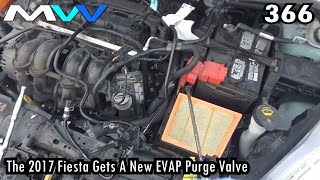
- If the refueling symptom is not present, visually inspect the EVAP purge valve and its connected hoses in the engine bay. It is located on top of the engine. Look for any obvious cracks, loose connections, or kinks.
- Inspect the capless fuel filler neck for any debris that may prevent it from sealing correctly. Use the funnel provided with the vehicle to open and close the flap several times to dislodge any dirt.
- Using a capable OBD-II scanner, command the canister purge valve (sometimes listed as VMV - Vapor Management Valve) to open and close. Listen for an audible click from the valve. If it doesn't click, it may have an electrical or internal failure.
- If the valve clicks but the problem persists, remove the valve. With it disconnected from the vehicle, try to blow through it. A normally-closed purge valve should not allow air to pass. If it does, it's stuck open and needs replacement. This is the most common failure mode.
- If the purge valve seems to be working correctly, the next step is to inspect all EVAP lines running from the engine bay to the charcoal canister (located near the fuel tank) for damage or blockages.
- If no visible faults are found, a smoke test is the most effective way to find a leak or restriction in the EVAP system. This involves feeding low-pressure smoke into the system and looking for where it escapes. Note that a smoke test may not identify a stuck-open purge valve, as the 'leak' is internal to the intake manifold, not to the atmosphere.
Parts You'll Likely Need
- Vapor Canister Purge Valve / Solenoid Assembly
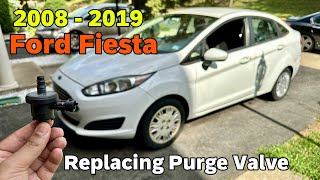
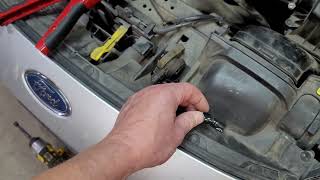
(OEM #C1BZ-9C915-A)— This is the most common failure part for code P1440 and the related P1450. It often comes as an assembly with the necessary hoses. The part number C1BZ-9C915-A (also cross-referenced as CX2456) is the correct assembly for the 2014-2019 Fiesta. The part 9U5Z-9C915-H is for other Ford models and is not the correct assembly for the Fiesta, though the valve itself may be similar. 🎬 Watch how to replace just the valve to save money. Always verify with a VIN.
Trusted brands: Motorcraft, Dorman (994-038), Standard Motor Products (CP803)
OEM price range: $40-$75
Aftermarket price range: $20-$50
Related Codes That Often Appear With This One
- P1450 — P1450 (Unable to Bleed Up Fuel Tank Vacuum) is a more specific version of the same fault. They are very commonly seen together and almost always point to a faulty purge valve on the Fiesta.
- P0456 — A P0456 (EVAP System Small Leak Detected) can sometimes appear if the purge valve is not sealing correctly or if there is an issue with the capless filler neck.
- P0496 — P0496 (EVAP Flow During Non-Purge Condition) is another code that points directly to a purge valve that is stuck open or leaking, and is sometimes seen alongside P1440/P1450.
Technical Service Bulletins (TSBs) & Recalls
- Recall 18S32 / NHTSA 18V735: While for the Ford Focus, this recall details the exact failure mode (stuck canister purge valve) that is common on the Fiesta, leading to excessive vacuum, potential tank deformation, and codes like P1450.
- TSB 16-0055: Issued for 2015-2016 Focus 1.0L EcoBoost models for code P1450, fixed by a PCM reprogram. This shows a history of Ford addressing EVAP codes via software, though no such TSB exists for the Fiesta 1.6L for this specific issue.
Platform-Specific Known Issues
- Ford issued Safety Recall 18S32 for some 2012-2018 Focus models due to a stuck canister purge valve causing fuel tank deformation. While the Fiesta was not included, the failure mechanism is identical and highlights the prevalence of this issue on Ford vehicles of this era.
- On Fiesta ST models, some owners who install aftermarket intakes for 2014-2015 models on a 2016+ car may trigger a P144C code, which is related to the EVAP system. This requires a specific 'fix' kit or a full 2015-style EVAP harness to adapt the lines.
Mechanic-Grade Diagnostic Values
- Vapor Canister Purge Valve (VMV) resistance — expected: 30 to 38 ohms (for standard type) or 2.5 to 6 ohms (for electronic type). Other sources suggest a general range of 15-30 ohms.. Failure: A reading significantly outside the expected range, or an open/infinite reading, indicates a faulty valve coil.
- EVAP Canister Vent Solenoid resistance — expected: 48 to 65 ohms.. Failure: A reading outside this range indicates a faulty solenoid.
- Fuel Tank Pressure (FTP) sensor voltage (KOEO) — expected: 2.6 to 2.65 Volts with the system vented to atmosphere (e.g., fuel cap off).. Failure: A static voltage significantly different from this baseline may indicate a biased sensor or a wiring issue.
- Fuel Tank Pressure (FTP) sensor live data during purge — expected: -2.0 to -4.0 inches of water (inH2O).. Failure: Pressure reading that does not change or goes far more negative than expected when the purge valve is commanded open.
- Fuel Tank Pressure (FTP) sensor live data during EVAP leak test — expected: PCM pulls vacuum to approximately -8.0 inches of water (inH2O) and monitors for decay.. Failure: Inability to reach the target vacuum, or reaching it and having it not bleed off when commanded, points to a valve or blockage issue.
Scan Tool Commands That Help
- Ford IDS (or equivalent high-level scanner): Powertrain > Data Logger > EVAP PIDs > Bidirectional Control — This allows a technician to manually command the Vapor Management Valve (Purge Valve) and Canister Vent Valve open or closed while monitoring Fuel Tank Pressure voltage to confirm if the valves are physically responding to commands.
- Ford IDS: Toolbox > Powertrain > EVAP System Test — This is an automated test that runs the PCM's onboard EVAP monitor routine, sealing the system, pulling a vacuum, and checking for leaks or blockages. It provides a pass/fail result.
- Snap-on (or similar professional scanner): Functional Tests > Cold Soak Bypass — This function allows a technician to force the EVAP monitor to run without needing to meet the cold-soak requirement, speeding up diagnosis and repair verification.
Wiring & Ground Locations
- G100 — Left side of the engine compartment, on the inner fender.. This is a primary chassis ground. A poor connection here can cause a variety of electrical issues for engine and emissions components.
- G101 — On the left front body support, under the air intake filter box.. This is the main ECM/PCM ground point. A loose or corroded G101 is a known cause of phantom electrical issues and incorrect sensor readings.
- G102 — On the left front transmission support/mount.. Provides a ground path for the engine/transmission assembly to the chassis. A bad connection can affect sensors mounted on the engine block.
- G104 — On the left front of the engine compartment, near the battery junction box.. Another key engine compartment ground point that serves multiple components.
Real Owner Repair Stories
- YouTube channel 'Mobile Car Mechanic' (2016 Ford Fiesta 1.6L) — Check Engine Light with code P1450 (Unable to bleed back to the tank).
❌ Tried (didn't work) The video proceeds directly to the most likely fix based on research.
✅ What actually fixed it Replaced the vapor canister purge valve assembly located on top of the engine. The creator noted this is the widely accepted fix for this code based on online research.
"I Checked Everything" — The Actual Cause
- A standard EVAP smoke test may show no leaks even with a P1440/P1450 code present. This is because the most common failure, a stuck-open purge valve, creates an internal leak from the EVAP system directly into the engine's intake manifold. This is not a leak to the atmosphere that smoke would reveal. The correct diagnostic step is not a smoke test, but rather checking for engine vacuum being pulled through the purge valve when it is commanded closed (or disconnected electrically).
Model Year Variations Within This Range
- 2011-2013: These models use a Natural Vacuum Leak Detection (NVLD) system, which performs its leak check with the engine off after a cool-down period. This differs from the engine-on vacuum test used in later models.
- 2016-2019 (Fiesta ST): The EVAP harness and connections were changed for the 2016 model year. Installing an aftermarket cold air intake designed for a 2014-2015 ST onto a 2016+ ST without an adapter harness or a full 2015-style EVAP line conversion will cause EVAP-related codes (like P144C).
Diagnostic Flowchart
Real Owner Stories
Aggregated from forums and TSBs cited above. Mileages and costs reflect what owners reported in those sources.
Ford Fiesta ST
Symptoms: Stumbling after fueling and an active P1450 code.
What fixed it: Replacing the purge valve assembly. The check engine light turned off on its own after a few days.
Source hint: Fiesta ST Forum thread titled 'Engine Code P1450'
Ford Fiesta
Symptoms: P1450 code that returned even after replacing the purge valve.
What fixed it: Diagnosing a saturated charcoal canister caused by over-filling the gas tank, or a kinked/damaged EVAP line.
Source hint: Ford Fiesta Forum thread titled 'P1450'
2017 Ford Fiesta
Symptoms: The car doesn't like to start after fueling. It eventually starts, but only after 20 embarrassing minutes of trying.
What fixed it: Replacing the failed purge valve, as this is a textbook symptom of the valve sticking open.
Source hint: Reddit r/MechanicAdvice thread titled '2017 Ford Fiesta Not Starting After Fueling'
2019 Ford Fiesta
Symptoms: Having to rev the engine to get it to run after filling up with gas.
What fixed it: Replacing the purge valve. Another user noted it was a relatively easy fix that took about 10 minutes to do themselves.
Source hint: Reddit r/FordFiesta thread titled 'Won't start after getting gas?? Help!!'
Related OBD-II Codes
Frequently Asked Questions
Does Ford Recall 18S32 apply to my Fiesta for this EVAP issue?
Why does my Fiesta stall or struggle to start right after I put gas in it?
I installed an aftermarket intake on my Fiesta ST and got an EVAP code. Is this related?
How much does it cost to fix the purge valve on a 2008-2019 Fiesta?
I replaced the purge valve but the code came back. What else could it be?
Can a software update fix this code like TSB 16-0055?
Helpful Videos

We Have This Part in Stock

The information in this article is provided for general reference and educational purposes only. Vehicle specifications, procedures, and part compatibility can vary by production date, trim level, and region. Always consult your vehicle's factory service manual and verify part numbers before purchasing or performing repairs. Safety-critical components such as airbags, seat belts, and braking systems should be installed by a qualified professional.
- Ford Fiesta:
- 🧭 Diagnostic Flowchart
- 🎬 Helpful Videos
- 🛍️ Shop This Part
- What's Unique About the 2008-2019 Ford Fiesta
- Symptoms You May Notice
- Most Likely Causes
- Rare But Worth Checking
- Diagnosis Steps
- Parts You'll Likely Need
- Related Codes That Often Appear With This One
- Technical Service Bulletins (TSBs) & Recalls
- Platform-Specific Known Issues
- Mechanic-Grade Diagnostic Values
- Scan Tool Commands That Help
- Wiring & Ground Locations
- Real Owner Repair Stories
- "I Checked Everything" — The Actual Cause
- Model Year Variations Within This Range
- Real Owner Stories
- Ford Fiesta ST
- Ford Fiesta
- 2017 Ford Fiesta
- 2019 Ford Fiesta
- Related OBD-II Codes
- Frequently Asked Questions
- 🎟️ Get 5% Off