

P1440 on 2008-2019 Mazda 6: EVAP System Faults, Causes, and Fixes
P1440 on a Mazda 6 indicates a fault in the evaporative emissions (EVAP) system, often related to purge flow. Before replacing parts, check for two major recalls: one for Yellow Sac spiders in the vent line on 2010-2012 models (Recall 7214C) and another for fuel tank overfilling on 2014 models (Recall 7414D). Otherwise, the issue is often a faulty gas cap or EVAP purge solenoid.
- P1440 on a Mazda 6 points to a problem in the EVAP system, but its exact definition can vary.
- Before any other diagnosis, check if your vehicle is affected by Mazda recalls for spider webs in the vent line (2010-2012) or fuel canister saturation (2014).
- The most common DIY fixes after checking recalls are tightening or replacing the gas cap and testing/replacing the EVAP purge solenoid in the engine bay.
- A smoke test is the most reliable method for finding small leaks in EVAP hoses if the cause is not obvious.
What's Unique About the 2008-2019 Mazda 6
The Mazda 6 has two well-documented, and unusual, EVAP system issues covered by recalls that can trigger fault codes like P1440. On 2010-2012 models with the 2.5L engine, the Yellow Sac spider is attracted to hydrocarbons and has been known to build webs in the EVAP canister vent line, causing a blockage. For 2014 models built between October 2012 and May 2013, an issue with the fuel tank design can allow over-fueling, which saturates the charcoal canister with liquid fuel. These specific, real-world problems are critical to check before assuming a more common part failure.
Generation note: This guide covers the second generation (2008-2013) and third generation (2014-2019) Mazda 6. Notably, specific EVAP system recalls apply to certain years. A recall for spider webs in the vent line affects 2010-2012 models with the 2.5L engine built from September 14, 2009, through May 2, 2011 (Recall 7214C). 🎬 Watch: Why spiders are attracted to these Mazda vent lines. A recall for fuel canister saturation affects 2014 models built from October 25, 2012, through May 9, 2013 (Recall 7414D).
Symptoms You May Notice
- Check Engine Light is on
- A noticeable smell of fuel around the vehicle
- Difficulty starting the engine, especially after refueling
- Slightly reduced fuel efficiency
- Gas pump nozzle clicks off repeatedly when trying to refuel
- In rare cases with a blocked vent line, negative pressure can cause a fuel tank to crack, leading to a potential fuel leak
- Replacing the charcoal canister without first checking for the 2014 model year recall (7414D) or confirming it's saturated with fuel.
- Replacing the purge valve without first checking the gas cap and inspecting for the 2010-2012 spider web recall (7214C).
Most Likely Causes
- Spider web in EVAP canister vent line 🔴 High Probability → Shop Vapor Canister This is a known issue for 2010-2012 Mazda 6 models with the 2.5L engine, as documented in Mazda Recall 7214C. The Yellow Sac spider is attracted to the hydrocarbons in the vent line and can build a web, causing a restriction.
How to confirm: Visually inspect the EVAP canister vent line for blockages or webs. This may require raising the vehicle to access the canister and its hoses near the fuel tank. The recall repair must be performed by a dealer.
Typical fix: The official recall fix involves dealers inspecting and cleaning the vent line, reprogramming the Powertrain Control Module (PCM) to alter the EVAP system's pressure logic, and in some cases, installing a spring or cover to prevent future intrusion. If a web is found, the fuel tank may also be replaced.
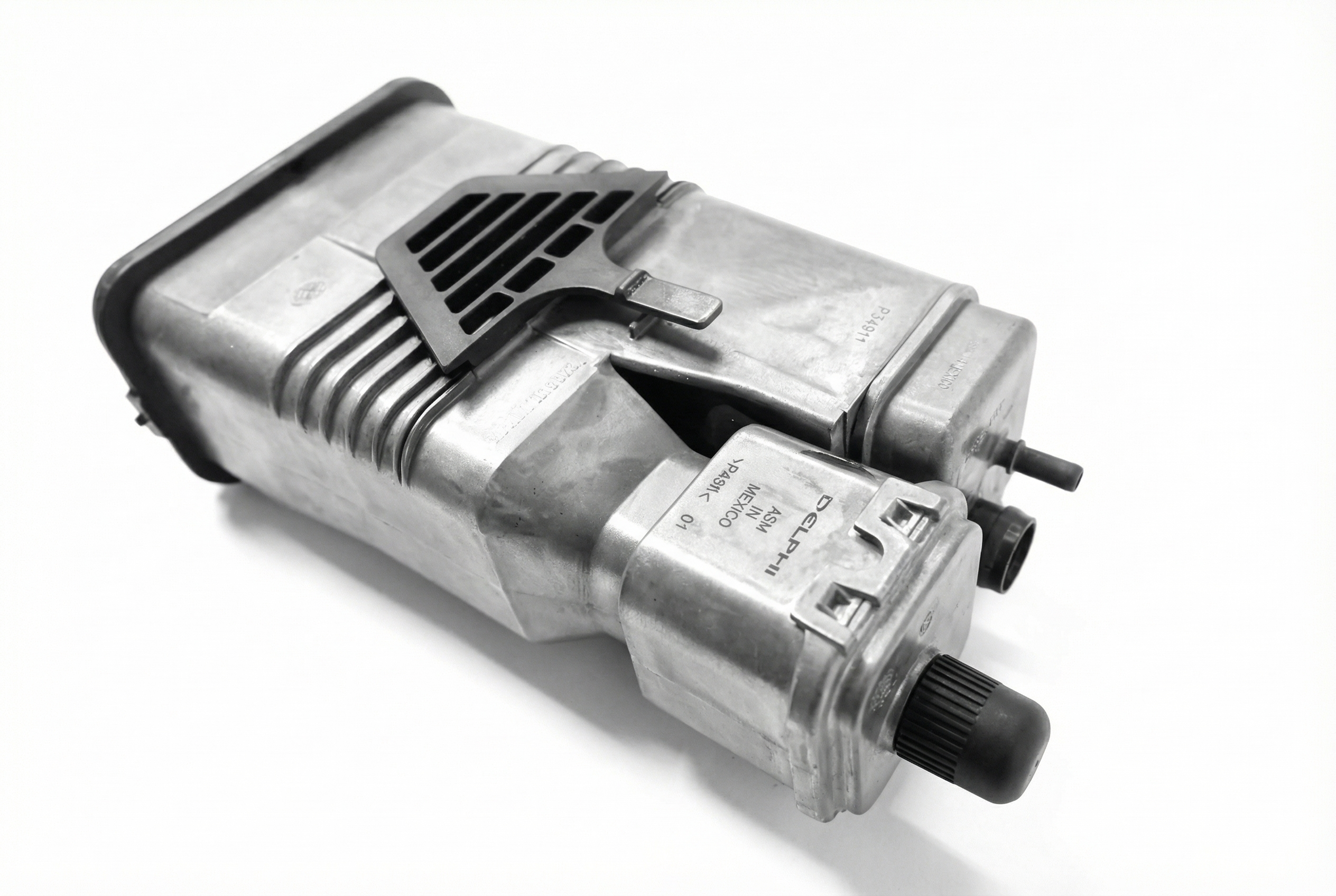
Est. part cost: $0 if covered by recall. - Saturated Charcoal Canister due to Over-Fueling 🔴 High Probability → Shop Vapor Canister This is a known issue for 2014 Mazda 6 models built between October 25, 2012 and May 9, 2013, covered by Mazda Recall 7414D. The design could allow the fuel tank to be filled beyond its intended capacity, causing liquid fuel to flow into the charcoal canister, especially after a large temperature change.
How to confirm: The recall procedure involves a dealer inspecting the charcoal canister for fuel saturation, which may involve weighing it. A strong fuel odor near the canister 🎬 Watch this guide on testing and replacing the charcoal canister. is also an indicator. Check your VIN with a Mazda dealer to see if the recall applies and is open.
Typical fix: The official recall fix involves installing a shut-off valve adapter in the fuel tank and, if the canister is saturated, replacing the charcoal canister assembly, free of charge.
Est. part cost: $300-$450 for a new charcoal canister if not covered by the recall. - Loose or faulty gas cap 🟡 Medium Probability → Shop Fuel Tank Cap
How to confirm: Ensure the gas cap is tightened until it clicks. Inspect the rubber O-ring seal on the cap for any cracks, tearing, or signs of deterioration. This is the first and easiest check for any EVAP code.
Typical fix: Tighten the cap and clear the code. If the code returns or the seal is damaged, replace the gas cap with a new, high-quality OEM part to ensure a proper seal.
Est. part cost: $15-$40 - Failed EVAP Purge Solenoid/Valve 🟡 Medium Probability → Shop Vapor Canister The purge solenoid is a common failure point in many EVAP systems. It can get stuck open or closed, disrupting the flow of fuel vapors and causing the computer to detect a flow malfunction.
How to confirm: The purge solenoid is usually located in the engine bay, on or near the intake manifold. It can be tested with a handheld vacuum pump to see if it holds vacuum when closed (de-energized). A bidirectional scan tool can also command the valve to open and close to check its function. You can also test the solenoid's resistance with a multimeter (typically 15-30 Ohms).
Typical fix: Replacement of the purge solenoid. This is typically an easy part to access and replace, often held by one or two bolts and an electrical connector.
Est. part cost: $40-$100 - Cracked or disconnected EVAP hose ⚪ Low Probability
How to confirm: Visually inspect all accessible EVAP system hoses, from the engine bay to the charcoal canister at the rear of the car. Look for brittle, cracked, or disconnected lines. A smoke test is the most effective way to find small, hard-to-see leaks.
Typical fix: Replace the damaged section of hose.
Est. part cost: $10-$50
Rare But Worth Checking
- Failed Fuel Tank Pressure Sensor: → Shop Fuel Tank The sensor itself can fail and send incorrect data to the computer, making it think there is a leak or flow problem when there isn't one. This should be considered after all other leak sources and valve functions have been ruled out.
Diagnosis Steps
- Contact a Mazda dealer with your VIN to confirm if your vehicle falls under Recall 7214C (2010-2012 2.5L for spiders) or Recall 7414D (2014 2.5L for fuel tank overfill). If an open recall exists, have the dealer perform the repair first.
- Inspect the gas cap. Ensure it is tight and the seal is in good condition. A cracked or missing seal is a common failure point.
- If the vehicle is a 2010-2012 model, visually inspect the EVAP canister vent line for spider webs or other obstructions, even if the recall status is unknown.
- Visually inspect all EVAP hoses and lines between the engine, fuel tank, and charcoal canister for obvious cracks, damage, or disconnections.
- Locate the EVAP purge solenoid in the engine bay. With the engine running, unplug its electrical connector. If you can feel vacuum at the valve's inlet port with your finger, the valve is stuck open 🎬 See how to test your purge valve without any tools. and needs to be replaced.
- If no obvious faults are found, perform a smoke test on the EVAP system. This involves introducing low-pressure smoke into the system via the service port and looking for where it escapes, revealing the location of any leaks.
- If no leaks are found and the purge valve tests good, further diagnosis of the vent solenoid, charcoal canister, and fuel tank pressure sensor may be required, which may necessitate a professional technician.
Parts You'll Likely Need
- Vapor Canister Purge Solenoid
(OEM #2nd Gen (2009-2013 2.5L): CA01-18-740A | 3rd Gen (2014+): PE01-18-751)— This valve is a common failure point that can get stuck open or closed, triggering an EVAP fault code.
Trusted brands: Mazda (OEM), Standard Motor Products, Bosch, Dorman
OEM price range: $70-$150
Aftermarket price range: $40-$100 - Charcoal Canister
(OEM #PY8G-13-96Z (replaces PY1F-13-96Z))— On 2014 models, this part is prone to saturation from fuel due to a design flaw covered by a recall. On other models, it can fail by cracking or becoming internally clogged over time.
Trusted brands: Mazda (OEM)
OEM price range: $300-$450
Aftermarket price range: $200-$350 - Fuel Cap — A worn out or damaged gas cap seal is a very common cause for all types of EVAP codes. It is the first, cheapest, and easiest part to check and replace.
Trusted brands: Mazda (OEM), Gates, Stant
OEM price range: $25-$45
Aftermarket price range: $15-$30
Related Codes That Often Appear With This One
- P0442 — Indicates a small leak in the EVAP system, which has many of the same causes as P1440.
- P0455 — Indicates a large leak in the EVAP system, often caused by a very loose gas cap or a disconnected hose.
- P0443 — Specifically points to a malfunction in the EVAP purge control valve circuit, a common cause for general EVAP codes like P1440.
- P144A — A very similar code, used more by Ford but seen on Mazdas, indicating a restriction in the EVAP purge line. The causes and diagnosis are nearly identical.
Technical Service Bulletins (TSBs) & Recalls
- Recall 7214C - Evaporative Canister Vent Line Restriction
- Recall 7414D - Fuel Tank Over-Fill / Charcoal Canister Saturation
Platform-Specific Known Issues
- Recall 7214C: On 2010-2012 Mazda 6 (2.5L), spiders can build webs in the EVAP canister vent line, causing a restriction and potentially leading to a cracked fuel tank.
- Recall 7414D: On 2014 Mazda 6 (2.5L), over-fueling can saturate the charcoal canister with liquid fuel, leading to EVAP system failure and a potential fuel leak.
Mechanic-Grade Diagnostic Values
- Purge Solenoid Coil Resistance — expected: Approximately 21-36 Ohms at room temperature.. Failure: An open circuit (infinite resistance) or a reading far outside the expected range indicates a faulty coil.
- Purge Solenoid Power Supply Wire Voltage — expected: Battery voltage (approx. 12.4V) with key on, engine off.. Failure: No voltage indicates a problem with the power supply from the fuse or relay.
- Purge Solenoid Control Wire Voltage (unplugged) — expected: Should read battery voltage (approx. 12V) when the solenoid is unplugged and the key is on.. Failure: A reading of 0 volts when unplugged points to an open circuit within the solenoid's coil.
- Purge Solenoid Vacuum Test — expected: The valve should hold vacuum (e.g., 15-20 inHg) without dropping when de-energized (unplugged).. Failure: If the valve cannot hold vacuum, it is leaking internally and is stuck open.
Hidden / Shadow Codes Worth Checking
- Mode $06, Test ID $54: While not a shadow code, Mode $06 data can provide early warnings. Test ID $54 on some Ford/Mazda platforms relates to the misfire monitor, but other IDs like $2B and $3A can relate to EVAP monitor tests, such as vapor generation or leak checks. A failure here can precede a full-blown DTC. (see via A professional scan tool that can access OBD-II Mode $06 data. The enhanced side of the powertrain menu will often translate the hexadecimal IDs into plain English.)
Scan Tool Commands That Help
- Mazda Modular Diagnostic System (M-MDS) or equivalent professional scanner: EVAP System Test (KOEO) — This is a guided test run by the scan tool to check for EVAP leaks without having to perform a full drive cycle. It pressurizes the system and monitors for pressure changes. Note that Mazda discontinued this M-MDS function on some models after IDS version 100, favoring a manual smoke test instead.
- Bidirectional Scan Tool: Purge Valve Active Test / Duty Cycle Control — This command allows the technician to manually open and close the purge solenoid. While commanding it open, you should hear a click and see a corresponding change in fuel trims or O2 sensor readings as the vapors enter the intake. If there's no click or no change in engine data, it points to a failed solenoid or a blockage.
Wiring & Ground Locations
- G1 / G2 / G13 — For first-generation (up to 2008) and early second-generation models, key grounds are located: G1 (at left side of engine compt), G2 (behind left end of dash), and G13 (at left rear door sill). A bad ground can cause erratic behavior in any electronically controlled component, including the purge solenoid.. The purge solenoid is a ground-side switched component. The PCM provides the ground to activate it. A poor engine or chassis ground can create voltage drops and resistance, preventing the solenoid from operating correctly and potentially triggering a circuit or performance code.
- Purge Solenoid Connector — Located on the purge solenoid itself, in the engine bay near the intake manifold. It is a 2-wire connector.. This is the primary point for electrical testing. One pin will have battery voltage with the key on, and the other is the control wire that the PCM pulses to ground. Rodent damage to these wires is a known issue.
- Ground point under driver headlight — On the Mazdaspeed 6, and likely similar on the standard Mazda 6, there is a multi-wire ground point on the frame underneath the driver's side headlight assembly.. This is a major chassis ground point. Corrosion or looseness here can cause a wide range of seemingly unrelated electrical issues, including problems with PCM-controlled solenoids.
Real Owner Repair Stories
- Reddit user on r/CX5 (2023 Mazda CX-5 Signature Turbo (similar EVAP system design)) — Check Engine Light after moving to a rural area.
✅ What actually fixed it The user discovered that a mouse had chewed through the gray and yellow wires leading to the EVAP purge valve connector. Repairing the wiring harness resolved the issue. - Maxima Forums user (Nissan Maxima (different vehicle, but identical P1440 symptom and component)) — Persistent P1440 code after replacing solenoids.
❌ Tried (didn't work) Replacing solenoids.
✅ What actually fixed it The user removed the EVAP canister vent control valve (located at the rear by the canister) and tapped it on the ground. Debris and gunk came out, freeing a stuck plunger. After reinstalling the cleaned valve, the code was cleared and did not return.
"I Checked Everything" — The Actual Cause
- In cases where a smoke test shows no leaks, the P1440 code is often not caused by a physical leak but by a functional failure. The most common culprit in this scenario is a purge solenoid that is mechanically sound (doesn't leak) but is electrically failed (open coil) or a vent valve that is stuck closed, preventing the system from drawing a vacuum during the self-test. A bidirectional scan tool can help identify this by attempting to command the valves open/closed; if the command is sent but the valve doesn't respond (no click, no change in pressure), the valve itself is likely faulty.
OEM Part Supersession History
PY1F-13-96Z→PY8G-13-96Z— Updated part for the charcoal canister on 2014 Mazda 6 models, likely related to the recall (7414D) for fuel saturation.
Heads up: The original part number is associated with the recall for fuel tank overfilling. The superseded part should be used for any replacement.
Model Year Variations Within This Range
- 2009-2013 (Gen 2) vs 2014+ (Gen 3): The purge solenoid part numbers are different between generations. Gen 2 (2.5L) uses part number CA01-18-740A, while Gen 3 uses PE01-18-751. While they perform the same function, their mounting and connectors may differ.
- 2010-2016: Mazda officially discontinued the automated EVAP system leak test function within its M-MDS diagnostic tool for models including the 2009-2017 Mazda 6. Post-update (IDS Version 100+), technicians are instructed to use a manual smoke/leak tester instead of the KOEO automated test.
Diagnostic Flowchart
Used vs. New Parts: Buying Guide for This Vehicle
When a used part is the smart pick: For purely mechanical and non-electronic parts like specific brackets or undamaged hoses, a used part can be a cost-effective choice. However, for the key electronic components related to P1440, used parts are a significant gamble.
Donor-vehicle mileage cap: roughly under 80000 miles for the part to have meaningful remaining life.
What to inspect on the donor part:
- For a purge solenoid, check for cracks in the plastic housing and ensure the electrical connector pins are clean and not corroded.
- For a charcoal canister, inspect for any physical cracks, especially around the hose nipples. Avoid any canister that smells strongly of raw fuel, as it's likely saturated and faulty.
- Check the date code on the part if visible; a newer part is always preferable.
OEM-only on this vehicle (don't cheap out):
- Gas Cap: While many aftermarket options exist, forum users and mechanics frequently report that only an OEM gas cap provides a consistently reliable seal to pass the EVAP system's sensitive pressure tests.
- Charcoal Canister: Due to the specific recalls and potential for saturation, using a new OEM canister (especially the superseded part number for 2014 models) is the safest bet to ensure the problem is resolved long-term.
Aftermarket brands forum-validated for this vehicle:
- Standard Motor Products (SMP)
- Bosch
- Dorman (for purge solenoids)
Brands owners have reported issues with on this vehicle:
- No-name, unbranded electronic parts from online marketplaces should be avoided, as their internal components and quality control are often subpar, leading to premature failure.
Real Owner Stories
Aggregated from forums and TSBs cited above. Mileages and costs reflect what owners reported in those sources.
2011 Mazda 6 2.5L
Symptoms: Check Engine Light was on, there was a noticeable fuel smell, and the gas pump nozzle would click off repeatedly when trying to refuel.
What fixed it: The dealer performed the repair for Recall 7214C, which involved cleaning a spider web out of the EVAP canister vent line and reprogramming the Powertrain Control Module (PCM).
Cost: $0-$0
Source hint: Recall 7214C - Evaporative Canister Vent Line Restriction
2014 Mazda 6 2.5L
Symptoms: The Check Engine Light came on and there was a strong fuel odor near the rear of the vehicle. The car also had some difficulty starting right after getting gas.
What fixed it: The vehicle was covered under Recall 7414D. The dealer installed a shut-off valve adapter in the fuel tank and replaced the fuel-saturated charcoal canister assembly free of charge.
Cost: $0-$0
Source hint: Recall 7414D - Fuel Tank Over-Fill / Charcoal Canister Saturation
Related OBD-II Codes
Frequently Asked Questions
I have a 2011 Mazda 6 with a P1440 code. Does the spider web recall apply to my car?
My 2014 Mazda 6 smells like fuel and has a P1440 code. What could be the cause?
Is it safe to drive my Mazda 6 with a P1440 code?
Why does the gas pump keep clicking off when I try to refuel my Mazda 6?
I checked the recalls and they don't apply. What's the first thing I should check for P1440?
Where is the EVAP purge solenoid located on a Mazda 6?
Helpful Videos


We Have This Part in Stock

The information in this article is provided for general reference and educational purposes only. Vehicle specifications, procedures, and part compatibility can vary by production date, trim level, and region. Always consult your vehicle's factory service manual and verify part numbers before purchasing or performing repairs. Safety-critical components such as airbags, seat belts, and braking systems should be installed by a qualified professional.
- Mazda 6:
- 🧭 Diagnostic Flowchart
- 🎬 Helpful Videos
- 🛍️ Shop This Part
- What's Unique About the 2008-2019 Mazda 6
- Symptoms You May Notice
- Most Likely Causes
- Rare But Worth Checking
- Diagnosis Steps
- Parts You'll Likely Need
- Related Codes That Often Appear With This One
- Technical Service Bulletins (TSBs) & Recalls
- Platform-Specific Known Issues
- Mechanic-Grade Diagnostic Values
- Hidden / Shadow Codes Worth Checking
- Scan Tool Commands That Help
- Wiring & Ground Locations
- Real Owner Repair Stories
- "I Checked Everything" — The Actual Cause
- OEM Part Supersession History
- Model Year Variations Within This Range
- Used vs. New Parts: Buying Guide for This Vehicle
- Real Owner Stories
- 2011 Mazda 6 2.5L
- 2014 Mazda 6 2.5L
- Related OBD-II Codes
- Frequently Asked Questions
- 🎟️ Get 5% Off