

P1441 on 1995-2005 GMC Jimmy 4.3L V6: Causes and Fixes for EVAP System Flow
On a GMC Jimmy with a 4.3L V6, code P1441 almost always points to a faulty EVAP Purge Solenoid Valve that is stuck open. It's an affordable part, typically under $50, and is easy to replace on top of the engine. A simple hand vacuum pump test can confirm the failure before replacement.
- P1441 on your GMC Jimmy means the EVAP purge valve is likely stuck open.
- This is a very common and easy-to-fix problem, with the faulty part located right on top of the engine.
- You can confirm the failure with a simple vacuum or blow-through test before buying any parts.
- The correct replacement part is an EVAP Purge Solenoid Valve, not a vent valve or gas cap.
- This is a DIY-friendly repair that can be completed in under 15 minutes with basic tools.
- Check for black charcoal granules in the EVAP lines when replacing the valve; if present, the canister must also be replaced.
What's Unique About the 1995-2005 GMC Jimmy
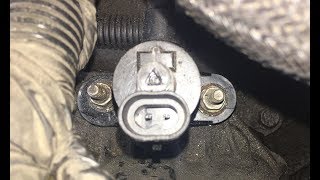
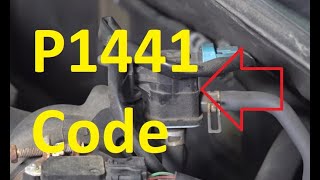
On the GM 4.3L V6 platform of this era, the EVAP system is relatively simple. The most common failure point by a wide margin is the purge solenoid valve located directly on top of the engine's intake manifold. This component is known to fail by sticking open, which directly causes the P1441 code. 🎬 Watch: A detailed breakdown of P1441 causes and fixes. Its location exposes it to significant heat and vibration, contributing to its high failure rate. While other EVAP issues can occur, this specific code on this specific engine is very strongly correlated with this single part.
Symptoms You May Notice
- Check Engine Light is on
- Slightly reduced fuel economy
- Faint fuel odor, especially after refueling
- Difficulty starting the engine right after filling the gas tank
- Rough idling in some cases
- In rare cases, a no-start condition if the EVAP issue is severe and combined with other problems.
- Replacing the gas cap. A bad gas cap typically causes a small or large leak code (like P0442 or P0455), not a flow-during-non-purge code.
- Replacing the charcoal canister. While the canister can become saturated or break down, it's usually a secondary problem or cause. The canister itself doesn't cause the P1441 flow condition unless its debris has jammed the purge valve open.
Most Likely Causes
- Faulty EVAP Purge Solenoid Valve 🔴 High Probability → Shop Vapor Canister The purge solenoid on the 4.3L V6 is a known high-failure item. It is a normally-closed valve that can get stuck open due to age, debris, or internal failure, allowing unregulated vapor flow. Its location on the hot intake manifold contributes to wear and tear.
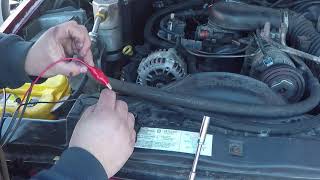
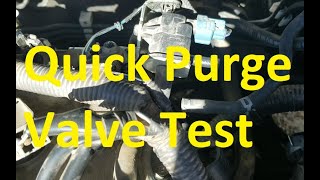
How to confirm: Disconnect the valve's electrical connector and the vacuum lines. With the engine off, try to blow through the valve or apply vacuum with a hand pump to the port leading to the intake manifold. If air passes through or it fails to hold a vacuum, it is stuck open and faulty. 🎬 See how to test your purge valve without any tools.
Typical fix: Replace the EVAP Purge Solenoid Valve. It is located on top of the engine intake manifold and is typically held by a single bracket, making for a quick replacement. 🎬 Watch: Step-by-step purge valve removal and installation guide.
Est. part cost: $20-$50 - Damaged or Disconnected EVAP Hoses ⚪ Low Probability Rubber and plastic lines can become brittle and crack over 20+ years, especially in the engine bay. A cracked line between the purge solenoid and the intake manifold could theoretically cause a vacuum leak, though this is less common for P1441 than a faulty valve.
How to confirm: Visually inspect all vacuum lines connected to the purge solenoid and running towards the charcoal canister for cracks, kinks, or loose connections.
Typical fix: Replace the damaged section of hose.
Est. part cost: $5-$20 - Charcoal Debris from Canister ⚪ Low Probability Over time, the charcoal canister can degrade, and small pieces of charcoal can break loose. These particles can travel up the EVAP line and physically jam the purge solenoid valve open.
How to confirm: When removing the old purge solenoid, disconnect the hose that runs back to the charcoal canister and inspect it for black, charcoal-like granules. If debris is present, the canister is likely failing.
Typical fix: If charcoal is found, you must replace the purge solenoid, clean out all EVAP lines thoroughly with compressed air, and replace the charcoal canister to prevent a repeat failure.
Est. part cost: $50-$150 (for canister and valve)
Rare But Worth Checking
- Faulty EVAP Vent Solenoid: → Shop Vapor Canister This valve is located near the charcoal canister by the fuel tank. It is normally open and closes to seal the system for testing. While it can fail, it typically produces other codes like P0446. It's a less likely cause for P1441 specifically.
- Wiring Issue to Purge Solenoid: → Shop Vapor Canister A short or break in the wiring could theoretically cause issues, but it's much less common than the valve itself failing mechanically. Check for power and ground at the connector if a new valve doesn't fix the code.
Diagnosis Steps
- Verify the code P1441 is present using an OBD-II scanner.
- Locate the EVAP Purge Solenoid Valve on top of the engine's intake manifold. It will have two hoses and an electrical connector.
- Inspect the vacuum hoses connected to the purge valve for any visible cracks, loose fittings, or damage.
- With the engine off, disconnect the electrical connector and both hoses from the purge valve.
- Attempt to blow air through the valve. A good, normally-closed valve should not allow any air to pass through.
- Alternatively, use a hand vacuum pump on the port that leads to the engine. The valve should hold a vacuum. If it does not, it is stuck open and must be replaced.
- While the hoses are off, inspect the port coming from the charcoal canister for any black charcoal granules. If found, the canister is failing and must be replaced along with the valve, and the lines must be cleared.
- If the valve tests good, check the wiring harness for 12v power on one pin with the key on, and check the other wire for continuity back to the PCM.
- If the valve and wiring are good, a smoke test of the EVAP system may be needed to find an unusual leak path, but this is highly unlikely for this specific code.
Parts You'll Likely Need
- EVAP Vapor Canister Purge Solenoid Valve
(OEM #ACDelco 214-641 (Supersedes multiple older numbers))— This is the most common failure point for code P1441 on this vehicle, as it gets stuck open and allows fuel vapor to flow when it shouldn't.
Trusted brands: ACDelco, Delphi, Standard Motor Products
OEM price range: $30-$50
Aftermarket price range: $20-$40
Platform-Specific Known Issues
- Charcoal Canister Degradation: → Shop Vapor Canister In some cases, particularly on higher-mileage vehicles, the activated charcoal inside the EVAP canister can break apart. These small black granules can be drawn into the EVAP lines, ultimately lodging in the purge solenoid and forcing it to stick open, which triggers the P1441 code. If this happens, simply replacing the valve is not enough; the canister must also be replaced and the lines blown out to prevent an immediate repeat failure.
Mechanic-Grade Diagnostic Values
- EVAP Purge Solenoid Coil Resistance — expected: 18 to 30 Ohms. Failure: A reading significantly outside this range, such as an open circuit (infinite resistance) or a short (near zero ohms), indicates a failed solenoid coil. Some GM service documents state any reading under 20 ohms is a failure.
- EVAP Purge Solenoid Connector Voltage (Key On, Engine Off) — expected: 12V+ on the Pink wire (power supply). Failure: No voltage on the power supply wire indicates a blown fuse or a break in the power feed circuit.
- EVAP Purge Solenoid Control Circuit (Key On, Engine Off) — expected: The Dark Green/White wire should show an open circuit (no ground) when tested with an ohmmeter to ground.. Failure: If the control wire shows continuity to ground when the solenoid is commanded OFF, there is a short to ground in the wiring or a fault within the PCM.
- Scan Tool Commanded Purge — expected: With the engine running, commanding the purge solenoid OFF should result in 0" of vacuum on a gauge attached to the solenoid's outlet port.. Failure: If vacuum is present when the solenoid is commanded OFF, the valve is mechanically stuck open and must be replaced.
Scan Tool Commands That Help
- Tech2 / High-End Bidirectional Scanner: EVAP Purge/Seal or EVAP Service Bay Test — This function allows the technician to command the EVAP purge solenoid on and off while the engine is running. It is used to verify if the solenoid clicks and responds to commands, and to check for vacuum flow with a gauge when the solenoid is commanded off. This definitively tests the solenoid's electrical and mechanical function without removing it.
Wiring & Ground Locations
- EVAP Purge Solenoid Connector — On top of the intake manifold, connected to the purge solenoid.. This 2-pin connector provides power and control. Pin A (Pink wire) is the 12V+ ignition supply. Pin B (Dark Green/White wire) is the ground-side control from the PCM. Checking for power at Pin A and for a short-to-ground on Pin B are key electrical diagnostic steps if a new valve doesn't fix the code.
- G103 / G119 (Varies by year) — On the right front side of the engine block, often near the thermostat housing or on the front of the block itself.. This is a primary engine ground point. While not directly for the purge solenoid's control circuit (which is grounded through the PCM), a poor engine block ground can cause erratic behavior in all engine sensors and actuators, including the PCM itself, potentially leading to incorrect diagnostics or codes. Ensuring this ground is clean and tight is a good practice when troubleshooting any engine-related electrical issue.
Real Owner Repair Stories
- YouTube user 'Evap Purge' (2003 GMC Jimmy 4.3L V6) — Check Engine Light with code P0446 (later found P1441 was also likely present), and a hard-to-start condition after refueling.
❌ Tried (didn't work) Initial diagnosis focused only on the hard start symptom.
✅ What actually fixed it The primary cause of the hard start was a stuck-open EVAP purge solenoid, which directly causes P1441. However, after replacing it, the P0446 code remained. The final fix required replacing the Fuel Tank Pressure (FTP) sensor as well, which was stuck at 0.2V. This indicates that on these vehicles, a stuck purge valve can sometimes be accompanied by a separate FTP sensor fault.
OEM Part Supersession History
GM 1997301→GM 1997278— Part revision or supplier change.GM 1997278→ACDelco 214-641— This is the current primary ACDelco service replacement part number for the original GM part.
Heads up: The physical design of the solenoid changed over the years. Early models (approx. 1995-1999) often used a valve held by two bolts. Later models (approx. 2000-2005) used a single bolt and bracket assembly. While electrically similar, the mounting is different. The ACDelco 214-641 is typically the later style, and may require slight modification or reuse of the old bracket for an earlier vehicle. Always verify fitment by visual comparison before discarding the old part.
Model Year Variations Within This Range
- 1995-1999 (approx.): The EVAP purge solenoid was often a two-bolt design that fastened directly to the intake manifold.
- 2000-2005 (approx.): The purge solenoid design was changed to a version that sits in a bracket held by a single 10mm bolt, making replacement slightly different. The part itself may look different but functions identically.
Diagnostic Flowchart
Other Known Issues on This Vehicle
Issues unrelated to this code that are worth knowing about as an owner of this generation:
- Lower Intake Manifold Gasket Leaks 🔴 High → Shop Engine Intake Manifold — Extremely common, often occurs after 80,000-100,000 miles. Leaks coolant internally and/or externally. (Ref: While no specific recall, numerous TSBs exist for similar GM engines. The issue is widely documented in forums and repair videos.)
- Central Port 'Spider' Injector Failure 🟠 Medium — Common failure, especially on pre-1996 CPI systems and later CSFI systems. Leads to misfires, hard starting, and fuel pressure leaks. (Ref: GM offered an updated Multi-port Fuel Injection (MFI) conversion kit to replace the problematic poppet valve system.)
- 4WD Vacuum Actuator / Switch Failure 🟡 Low — Very common. The vacuum actuator under the battery tray fails, or the vacuum switch on the transfer case leaks, causing the 4WD to not engage.
- Worn Front Steering/Suspension Components 🟠 Medium — Idler arms, pitman arms, and ball joints wear out frequently, leading to loose steering, wandering, and clunking noises.
- Distributor Cap & Rotor Corrosion 🟡 Low — The distributor's location at the rear of the engine traps heat and moisture, causing corrosion on the cap terminals and leading to misfires, especially in damp weather. (Ref: A GM TSB acknowledges the moisture issue and recommends inspection and improved venting.)
- Fuel Pump Failure 🔴 High — Common failure item, often after 100,000 miles. Replacing the fuel filter regularly is recommended to prolong pump life.
Used vs. New Parts: Buying Guide for This Vehicle
When a used part is the smart pick: For this specific repair, a used part is generally not recommended. The EVAP purge solenoid is a known high-failure item due to heat and wear. A used part from a junkyard has an unknown history and is likely to have a very limited remaining service life, making the small cost savings not worth the risk of a repeat failure.
Donor-vehicle mileage cap: roughly under 50000 miles for the part to have meaningful remaining life.
What to inspect on the donor part:
- If buying used is unavoidable, test it before purchase using a hand vacuum pump. It must hold vacuum with no power applied.
- Inspect the plastic housing for any cracks or heat-related brittleness.
- Check the electrical connector pins for corrosion.
Aftermarket brands forum-validated for this vehicle:
- ACDelco (OEM supplier)
- Delphi
- Standard Motor Products (SMP)
- Dorman
Brands owners have reported issues with on this vehicle:
- No-name, unbranded parts from online marketplaces should be avoided, as their internal valve quality and coil windings may not meet OEM specifications, leading to premature failure.
Real Owner Stories
Aggregated from forums and TSBs cited above. Mileages and costs reflect what owners reported in those sources.
1997 Chevrolet Blazer 4.3L V6
Symptoms: The Check Engine Light was on with a P1441 code. When the purge solenoid was removed, a large amount of charcoal granules poured out of the connected EVAP line.
What fixed it: The problem was resolved by replacing the bad charcoal vapor canister and the purge solenoid that had been jammed open by the debris.
Source hint: Blazer Forum: P1441: Charcoal in Vapor Lines / Bad Canister
Related OBD-II Codes
Frequently Asked Questions
What is the most common reason for a P1441 code on my 4.3L V6 Jimmy?
My Jimmy is hard to start right after I fill it with gas and the Check Engine Light is on. Is this related to the P1441 code?
I replaced the purge solenoid for P1441, but the code came back. What could I have missed?
How can I test the EVAP purge solenoid on my Jimmy myself to see if it's bad?
Where exactly is the EVAP purge solenoid located on the 4.3L V6 engine?
Does this P1441 problem also affect the Chevy Blazer or S-10 pickup?
Helpful Videos
Used OEM Parts in Stock
New Aftermarket Parts Available


The information in this article is provided for general reference and educational purposes only. Vehicle specifications, procedures, and part compatibility can vary by production date, trim level, and region. Always consult your vehicle's factory service manual and verify part numbers before purchasing or performing repairs. Safety-critical components such as airbags, seat belts, and braking systems should be installed by a qualified professional.
- GMC Jimmy:
- 🧭 Diagnostic Flowchart
- 🎬 Helpful Videos
- 🛍️ Shop This Part
- What's Unique About the 1995-2005 GMC Jimmy
- Symptoms You May Notice
- Most Likely Causes
- Rare But Worth Checking
- Diagnosis Steps
- Parts You'll Likely Need
- Platform-Specific Known Issues
- Mechanic-Grade Diagnostic Values
- Scan Tool Commands That Help
- Wiring & Ground Locations
- Real Owner Repair Stories
- OEM Part Supersession History
- Model Year Variations Within This Range
- Other Known Issues on This Vehicle
- Used vs. New Parts: Buying Guide for This Vehicle
- Real Owner Stories
- 1997 Chevrolet Blazer 4.3L V6
- Related OBD-II Codes
- Frequently Asked Questions
- 🎟️ Get 5% Off