

P1450 on 2006-2016 Chevrolet Impala: Why It's Actually Code P0496 and How to Fix It
If your scanner shows P1450 on an Impala, it's likely a tool error. The real GM code for these symptoms is P0496. This is almost always caused by a stuck-open EVAP purge valve, especially if your car is hard to start after getting gas. The fix is a new purge valve, costing $25-$75 for an OEM part, and is a very easy 20-minute DIY job.
- The code P1450 is not used on Chevrolet; the correct code for the symptoms is P0496.
- The classic symptom of a P0496 code is a long crank or hard start right after you get gas.
- The problem is almost always a faulty EVAP purge valve, which is stuck open.
- Replacing the purge valve is a very simple and inexpensive DIY repair that takes less than 30 minutes.
- Before buying the part, call a GM dealer with your VIN to see if your car is covered by a special warranty extension (like N192210240) for the purge valve.
What's Unique About the 2006-2016 Chevrolet Impala
The issue of a stuck-open purge valve causing a P0496 code is extremely common across many GM vehicles, and the Impala is no exception. For the 10th generation Impala (2014-2018) with the 3.6L LFX engine and aluminum camshaft covers, GM issued a Technical Service Bulletin (TSB 17-NA-409) acknowledging that an oil leak from the cam cover gasket can seep onto the purge valve, causing it to fail. The failure rate was high enough that GM also created Special Coverage programs like N192210240 and N222369620 to extend the warranty on this specific part for certain model years.
Generation note: This guide covers the 9th generation (2006-2016 'Limited') and 10th generation (2014-2020) Impala. The primary cause, a faulty EVAP purge valve, is common to both. However, a specific TSB (17-NA-409) regarding oil leaks contaminating the valve applies mainly to 2014-2018 models with the 3.6L LFX engine.
Symptoms You May Notice
- Check Engine Light is on
- Engine is hard to start or has a long crank time immediately after refueling.
- Rough or unstable idle, especially after starting or refueling.
- Slight decrease in fuel economy
- Audible loud clicking noise from the engine bay, even when the engine is off.
- Replacing the gas cap. A bad gas cap typically causes a small or large leak code (like P0442 or P0455), not a P0496 flow code.
- Replacing the fuel tank pressure (FTP) sensor. While possible, an FTP sensor failure is far less common than a purge valve failure for this specific code and symptom set.
Most Likely Causes
- Vapor Canister Purge Valve/Solenoid Stuck Open 🔴 High Probability → Shop Vapor Canister This part has a very high failure rate on many GM platforms, including the Impala. On 2014-2018 models with the 3.6L LFX engine, it can be contaminated by oil from a leaking camshaft cover gasket, a defect acknowledged by GM in TSB 17-NA-409.
How to confirm: With the engine running, disconnect the electrical connector and the EVAP hose from the purge valve. Place your finger over the port on the valve; if you feel suction, the valve is stuck open and must be replaced. You can also remove the valve and try to blow through it; if air passes, it's faulty.
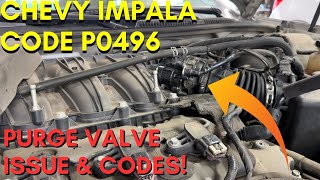
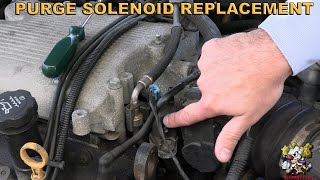
Typical fix: Replace the vapor canister purge valve. This is a simple repair, usually involving one 10mm bolt and two connections, and takes less than 20 minutes. 🎬 See this 3.6L V6 purge valve replacement walkthrough
Est. part cost: $25-$75
Rare But Worth Checking
- Faulty EVAP Canister Vent Solenoid: → Shop Vapor Canister This valve is located near the charcoal canister by the fuel tank. If it gets stuck closed, it can cause abnormal vacuum levels in the system, but it's much less common than a failed purge valve for code P0496.
- Blocked or Kinked EVAP Hose: A restriction in the EVAP lines can trap vacuum and trigger this code. A visual inspection and/or a smoke test would be needed to confirm.
- Faulty Fuel Tank Pressure (FTP) Sensor: → Shop Fuel Tank Rarely, the FTP sensor itself can send incorrect readings, making the ECU believe there is flow when there isn't. This is uncommon compared to the mechanical failure of the purge valve.
Diagnosis Steps
- Confirm the code with an OBD-II scanner. Note if P0496 is present, possibly with P0442, P0443, P0171, or P0300.
- Verify the primary symptom: Does the car struggle to start only after refueling? If yes, the purge valve is the prime suspect.
- Locate the EVAP purge valve. On both the 9th and 10th gen Impalas, it's typically on top of the engine, near the throttle body.
- Start the engine.
- Disconnect the electrical plug from the purge valve.
- Disconnect the EVAP line that runs from the charcoal canister to the valve. This may have a white or grey clip you need to press.
- Place your finger over the inlet port on the valve itself. There should be NO vacuum or suction.
- If you feel suction, the valve is internally stuck open and has failed the test. It must be replaced.
- If there is no suction, the problem may be more complex, such as an intermittent fault or a wiring issue, and may require further professional diagnosis.
Parts You'll Likely Need
- Vapor Canister Purge Valve / Solenoid
(OEM #ACDelco 12690512 (or superseding part numbers like 12737252) for 3.6L V6 models; ACDelco 214-1680 (GM 12597567) for 3.5L/3.9L V6 models.)— This is the component that fails in over 95% of cases for code P0496, causing a hard start after refueling.
Trusted brands: ACDelco, GM Genuine Parts, Dorman (e.g., 911-082)
OEM price range: $25-$75
Aftermarket price range: $20-$50
Related Codes That Often Appear With This One
- P0442 — Stands for 'Small EVAP Leak.' A stuck-open purge valve is a type of leak, so it's common to see both codes together. TSB 17-NA-409 specifically groups P0496 and P0442.
- P0443 — Stands for 'EVAP Purge Control Valve Circuit Malfunction.' This points to an electrical problem with the valve or its wiring and can appear with P0496 if the failure is both mechanical and electrical.
- P0171 / P0174 — Stands for 'System Too Lean.' A stuck-open purge valve creates a vacuum leak, allowing unmetered air and vapor into the intake, which can disrupt the air-fuel ratio and trigger lean codes.
- P0300 — Stands for 'Random/Multiple Misfire Detected.' The lean condition or fuel vapor flood caused by the stuck purge valve can lead to unstable combustion and misfires.
Technical Service Bulletins (TSBs) & Recalls
- 17-NA-409: Malfunction Indicator Lamp (MIL) Illuminated - DTC P0442, P0496 and/or P0455 Set.
- N192210240: Special Coverage Adjustment for EVAP Purge Valve.
- N222369620: Special Coverage Adjustment for EVAP Purge Valve on later models.
Platform-Specific Known Issues
- TSB 17-NA-409: Oil Contamination of Purge Valve: → Shop Vapor Canister For 2014-2018 Impalas with the 3.6L LFX engine and aluminum camshaft covers, a leaking cam cover gasket can cause oil to be pulled into the PCV system and contaminate the purge valve, causing it to stick. The official fix requires replacing the cam cover gasket (Part #12688703) in addition to the purge valve.
- Special Coverage N192210240: GM issued this program for 2016-2017 Impalas (among other models) extending the warranty on the EVAP purge valve to 10 years or 120,000 miles. Owners should check with a GM dealer using their VIN to see if their vehicle is covered for a free replacement.
- Special Coverage N222369620: A later special coverage program for the 2020 Impala (and 2019 Cadillac XTS) that extends the warranty for the same purge valve issue to 15 years or 150,000 miles.
Mechanic-Grade Diagnostic Values
- EVAP Purge Valve Solenoid Coil Resistance — expected: 15-30 Ohms. Failure: A reading of infinite resistance (Open Loop/OL) or near-zero resistance (short) indicates a failed coil. Note: This electrical test does not detect a mechanically stuck valve, which is the more common failure.
- EVAP Purge Valve Connector Voltage — expected: Battery voltage (approx. 12V+) on one pin with Key On, Engine Off.. Failure: No voltage suggests a blown fuse (e.g., 'EMIS' fuse) or a break in the power wire.
- Fuel Tank Pressure (FTP) Sensor Voltage (via Scan Tool) — expected: Approximately 1.5V - 2.5V with the engine off and gas cap removed (at atmospheric pressure).. Failure: The P0496 code sets when the ECM sees the voltage rise (indicating vacuum) when it shouldn't, for example, detecting a vacuum greater than 10 inches of H2O for 5 seconds when the purge valve is commanded closed.
Scan Tool Commands That Help
- GDS2 (GM Global Diagnostic System 2): EVAP Purge/Seal — This bidirectional command allows a technician to manually command the purge valve open/closed and seal the vent valve. It is used to verify the function of the solenoids and to perform a system leak test with a smoke machine or by observing the FTP sensor data.
- GDS2 (GM Global Diagnostic System 2): Engine Output Controls > EVAP Purge Solenoid Valve — This function allows the technician to command the purge valve to a specific duty cycle (e.g., 0% to 100%) while monitoring the FTP sensor and short/long term fuel trims. This can confirm if the valve is responding to commands and how the system reacts to vapor flow.
Wiring & Ground Locations
- G111 (9th Gen) — On the transmission-to-engine bolt, located above the starter motor.. This is a primary engine and transmission ground. A poor connection here can cause a variety of seemingly unrelated electrical issues and incorrect sensor readings for components grounded to the engine block.
- G115 (9th Gen) — On the transmission case, below the brake booster.. Another critical ground point for engine and powertrain components. Verifying this ground is clean and tight is a valid step in advanced electrical diagnosis if direct component testing is inconclusive.
- Purge Valve Connector (9th Gen, 3.5L) — Connector for the EVAP purge solenoid, located in front of the throttle body.. The Dark Green/White wire is the control wire from the ECM (Pin 8 on ECM Connector X1). The Pink/Black wire is the 12V+ ignition power supply. Testing for power and ground pulse on these wires can diagnose a circuit fault.
Real Owner Repair Stories
- YouTube channel 'Falcon's Garage' (2012 Chevrolet Impala 3.6L) — Check Engine Light with codes P0496, P0443 (purge circuit), P0174 (lean Bank 2), and P0300 (random misfire).
❌ Tried (didn't work) The technician immediately suspected the purge valve based on the combination of codes.
✅ What actually fixed it The technician confirmed the purge valve was stuck open by feeling for vacuum at the valve's inlet port with the engine running. Replacing the EVAP purge valve (a single 10mm bolt) and clearing the codes resolved all four DTCs.
OEM Part Supersession History
12610560→12690512, then 12737252— Standard part evolution for improved durability or manufacturing efficiency.12597567 (ACDelco 214-1680)→Current replacement for 9th Gen 3.5L/3.9L V6 models.— N/A
Heads up: This part is for the 9th generation pushrod V6 engines and is not interchangeable with the 10th generation 3.6L direct-injection engine's valve.
Model Year Variations Within This Range
- 2006-2013 (and 2014-2016 'Limited'): These 9th generation models primarily used the 3.5L and 3.9L V6 engines. The purge valve is ACDelco P/N 214-1680 (GM 12597567) and is located in front of the throttle body.
- 2014-2020: These 10th generation models primarily used the 3.6L LFX V6. The purge valve is ACDelco P/N 12690512 (or its successors) and is located on top of the intake manifold, closer to the firewall. This generation is subject to TSB 17-NA-409 regarding oil contamination.
Diagnostic Flowchart
Other Known Issues on This Vehicle
Issues unrelated to this code that are worth knowing about as an owner of this generation:
- 4T65-E / 6T70 Transmission Failure or Shudder 🔴 High — Widespread on 9th gen (2006-2011) models, often manifesting as harsh shifting, slipping, or complete failure before 120,000 miles. (Ref: Multiple TSBs exist, including 08-07-30-040B for harsh engagement.)
- Power Steering Leaks (Pump, Hoses, Rack) 🔴 High — Extremely common on 9th gen models. Pump leaks can drip onto and destroy other components, while rack leaks often seep into the boots without dripping on the ground.
- HVAC Blend Door Actuator Failure 🟠 Medium — Extremely common across all 2006-2016 models. Symptoms include a loud clicking/ticking from the dashboard and inability to control air temperature or direction. Often fails repeatedly.
- 3.6L LFX Timing Chain Stretch/Wear 🔴 High — A well-documented problem on 2012-2016 models, often appearing between 70,000 and 120,000 miles. Can be exacerbated by extended oil change intervals. Leads to rattling on startup and cam/crank correlation codes. (Ref: GM revised chain designs, but issues can still occur.)
- PassLock Anti-Theft System Faults 🟠 Medium — Common on 9th gen models. The system can erroneously disable the fuel system, causing a no-start condition where the car cranks but won't fire.
Used vs. New Parts: Buying Guide for This Vehicle
When a used part is the smart pick: For this specific repair, a used part is strongly discouraged. The EVAP purge valve is a known high-failure-rate item on GM vehicles. The cost of a new, warrantied OEM or quality aftermarket part is low enough that the risk of getting a used part that is already failing or will fail shortly is not worth the small savings.
What to inspect on the donor part:
- Not applicable, as a used part is not recommended.
OEM-only on this vehicle (don't cheap out):
- While not strictly 'OEM-only', using a GM Genuine or ACDelco branded purge valve is highly recommended. Forum and mechanic reports indicate that some budget aftermarket valves have a high rate of premature failure, sometimes within months.
Aftermarket brands forum-validated for this vehicle:
- Dorman (e.g., 911-082) is a widely available aftermarket alternative, though OEM/ACDelco is generally preferred by specialists for longevity.
Brands owners have reported issues with on this vehicle:
- Unnamed, no-brand parts from online marketplaces should be avoided, as their internal components may not meet the required specifications for sealing and durability, leading to a quick repeat of the P0496 code.
Real Owner Stories
Aggregated from forums and TSBs cited above. Mileages and costs reflect what owners reported in those sources.
2016 Chevrolet Impala
Symptoms: Hard start after refueling and a check engine light.
What fixed it: Replacing the purge valve; the owner noted the part cost about $50 and took 20 minutes to install.
Cost: $50-$50
Source hint: Reddit r/Impala - Hard start after refuel
2014-2018 Chevrolet Impala 3.6L LFX
Symptoms: Malfunction Indicator Lamp (MIL) illuminated with codes P0442, P0496, or P0455; valve contaminated by oil.
What fixed it: Replacing the camshaft cover gasket (Part #12688703) and the purge valve.
Source hint: TSB 17-NA-409: Malfunction Indicator Lamp (MIL) Illuminated - DTC P0442, P0496 and/or P0455 Set.
Chevrolet Sonic (GM Platform Mate)
Symptoms: After filling the tank, the car would crank for 10-15 seconds before starting; once running, the idle was shaky and sputtered like it would stall.
What fixed it: Replacing the purge valve.
Source hint: Sonic Owners Forum - Cel P0496
Chevrolet Trailblazer (GM Platform Mate)
Symptoms: Repeat failure of the purge valve after only two months of use.
What fixed it: The owner suggested that debris from a deteriorating charcoal canister was contaminating the new valves, requiring inspection further down the EVAP line.
Source hint: Chevrolet Forum - My P0496 Solution
Related OBD-II Codes
Frequently Asked Questions
Does GM Special Coverage N192210240 apply to my 2016 Chevrolet Impala?
I have a 2015 Impala with the 3.6L LFX engine; why does my purge valve keep failing according to TSB 17-NA-409?
Is there a specific part number I should look for when replacing the purge valve on my 2014 Impala 3.6L?
Can I replace the EVAP purge valve myself on a 10th gen Impala?
Why does my Impala struggle to start only after I fill up at the gas station?
Helpful Videos
Used OEM Parts in Stock

New Aftermarket Parts Available


The information in this article is provided for general reference and educational purposes only. Vehicle specifications, procedures, and part compatibility can vary by production date, trim level, and region. Always consult your vehicle's factory service manual and verify part numbers before purchasing or performing repairs. Safety-critical components such as airbags, seat belts, and braking systems should be installed by a qualified professional.
- Chevrolet Impala:
- 🧭 Diagnostic Flowchart
- 🎬 Helpful Videos
- 🛍️ Shop This Part
- What's Unique About the 2006-2016 Chevrolet Impala
- Symptoms You May Notice
- Most Likely Causes
- Rare But Worth Checking
- Diagnosis Steps
- Parts You'll Likely Need
- Related Codes That Often Appear With This One
- Technical Service Bulletins (TSBs) & Recalls
- Platform-Specific Known Issues
- Mechanic-Grade Diagnostic Values
- Scan Tool Commands That Help
- Wiring & Ground Locations
- Real Owner Repair Stories
- OEM Part Supersession History
- Model Year Variations Within This Range
- Other Known Issues on This Vehicle
- Used vs. New Parts: Buying Guide for This Vehicle
- Real Owner Stories
- 2016 Chevrolet Impala
- 2014-2018 Chevrolet Impala 3.6L LFX
- Chevrolet Sonic (GM Platform Mate)
- Chevrolet Trailblazer (GM Platform Mate)
- Related OBD-II Codes
- Frequently Asked Questions
- 🎟️ Get 5% Off