

P1450 on 2013-2017 Ford C-MAX ENERGI: Causes and Fixes for 'Unable to Bleed Up Fuel Tank Vacuum'
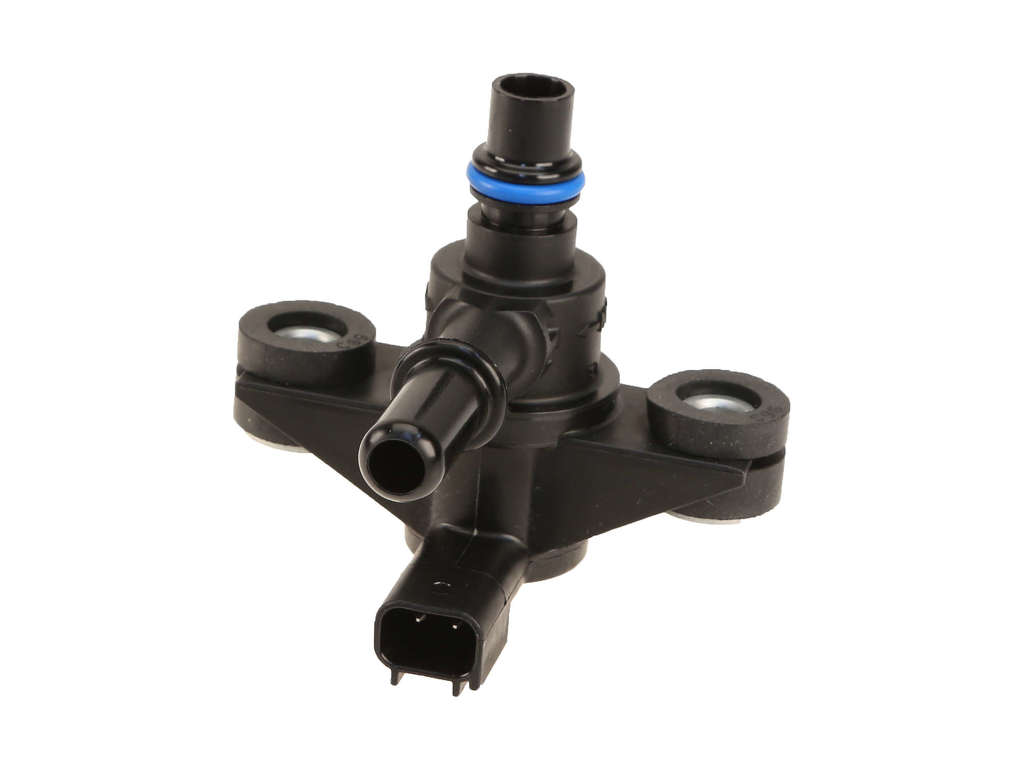
On a 2013-2017 Ford C-MAX ENERGI, code P1450 is almost always caused by a faulty canister purge valve located on top of the engine. This part gets stuck open, causing excess vacuum in the fuel system. It's an inexpensive part and a very easy DIY fix, typically costing $30-$60. This is a well-documented issue across the Ford platform, including the Focus and Fusion, and is addressed by Ford's TSB 19-2207.
- P1450 on a C-MAX ENERGI almost always points to a bad canister purge valve.
- This is a very simple and inexpensive DIY repair; the part is easily accessible on top of the engine.
- Symptoms include a Check Engine Light and potentially difficulty starting the car right after getting gas.
- Do not replace the gas cap; it is not the likely cause for this specific code.
- Ford has issued service bulletins (like TSB 19-2207) confirming this is a known issue with the purge valve on this vehicle.
What's Unique About the 2013-2017 Ford C-MAX ENERGI
The Ford C-MAX, sharing a platform with the Focus and Fusion Hybrid, is highly prone to this specific code due to a common failure of the canister purge valve. Ford has issued multiple Technical Service Bulletins (TSBs) for this exact issue on the C-MAX and similar models. While the code can appear on many Ford vehicles, its prevalence on the 2.0L engine platform used in the C-MAX makes the purge valve the primary suspect, often before any other diagnostic steps are taken. The problem was so widespread on the related Ford Focus that it prompted a safety recall (18S32 / NHTSA 18V735) 🎬 Watch: Quick test and repair for the related Focus issue. for the same issue, which could lead to tank deformation and engine stalling.
Diagnostic Flowchart
Tap your situation to follow the diagnostic path that matches what you're seeing on this vehicle.
Symptoms You May Notice
- Check Engine Light is on.
- Difficulty starting the engine, or a rough, stumbling start, immediately after refueling.
- Rough or unstable idle, especially after coming to a stop or at low speeds.
- A hissing sound or strong inrush of air when opening the fuel filler cap (or inserting the nozzle on capless systems).
- Inaccurate fuel gauge readings or distance-to-empty calculations if the tank has started to deform.
- Replacing the gas cap. A faulty gas cap or an issue with the capless filler neck typically causes a large leak code (like P0455 or P0457), not a code for excessive vacuum like P1450.
Most Likely Causes
- Stuck-Open Canister Purge Valve (CPV) 🔴 High Probability → Shop Vapor Canister This is a well-documented, common failure part on this platform, as acknowledged by Ford's TSB 19-2207 which covers the 2013-2017 C-MAX for this exact code. The valve's internal seal degrades, allowing engine vacuum to constantly pull on the EVAP system. This is a very common failure across many Ford models from this era.
How to confirm: With the engine running, disconnect the electrical connector from the purge valve and then detach the EVAP line. Place your finger over the port on the valve; if you feel suction, the valve is stuck open and must be replaced. This test is definitive because with the electrical connector unplugged, the valve should be closed and no vacuum should be present.
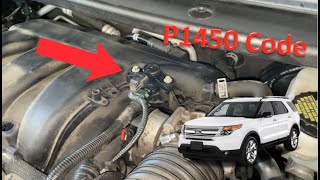
Typical fix: Replace the canister purge valve assembly. It is located on top of the engine and is typically held on by two 8mm bolts, making it a very simple DIY job. 🎬 See this walkthrough on how to replace the purge valve.
Est. part cost: $30-$60 - Blocked EVAP Canister Vent Solenoid or Hose ⚪ Low Probability → Shop Vapor Canister
How to confirm: Inspect the vent hoses running from the charcoal canister (located near the fuel tank) for kinks, collapses, or blockages. Spiders or insects are known to build nests in the vent outlet, causing a clog. A smoke test can confirm if the vent path is restricted. A scan tool can also be used to command the vent valve open and closed to check for proper operation.
Typical fix: Clean the blockage from the vent hose or replace the vent solenoid if it is stuck closed.
Est. part cost: $25-$50 - Fuel-Saturated Charcoal Canister ⚪ Low Probability → Shop Vapor Canister This is typically caused by operator error—habitually 'topping off' the fuel tank after the pump automatically shuts off. Excess fuel can be forced into the charcoal canister, saturating it and preventing air from flowing through.
How to confirm: The canister will feel heavy, and you may smell raw fuel near the canister area. Difficulty refueling (the pump clicks off constantly) is another strong indicator.
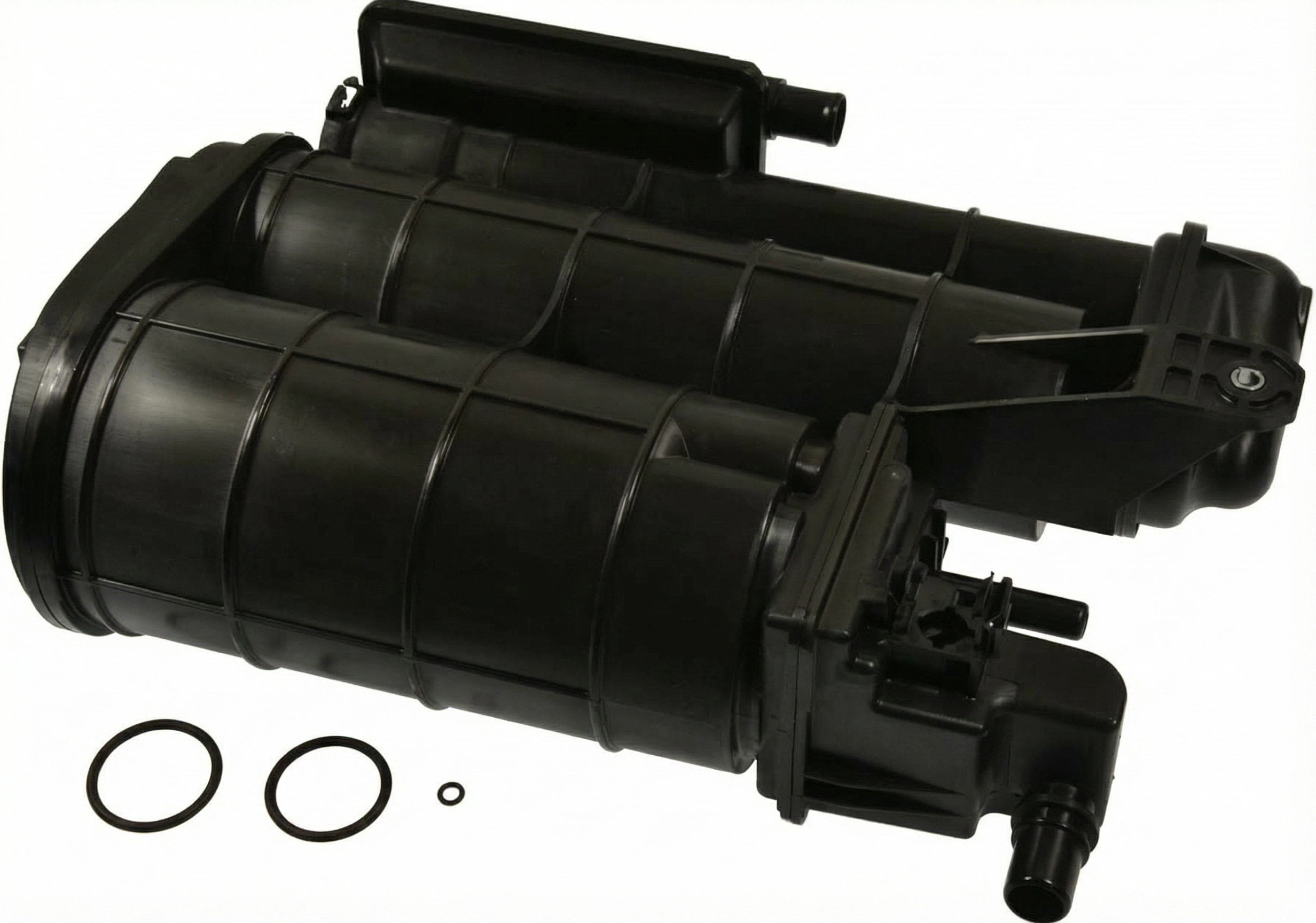
Typical fix: Replace the charcoal vapor canister. Note that for the C-MAX, there are different parts for the Hybrid and Energi models.
Est. part cost: $200-$300
Rare But Worth Checking
- Faulty Fuel Tank Pressure (FTP) Sensor: → Shop Fuel Tank This sensor reports the vacuum level to the computer. If it provides an incorrect reading, the computer may set code P1450 even if there is no actual vacuum issue. This is less common than a mechanical fault like a stuck valve. A technician can verify this by monitoring the sensor's voltage and pressure readings on a live data scan tool.
Diagnosis Steps
- Verify the Check Engine Light is on and code P1450 is present using an OBD-II scanner.
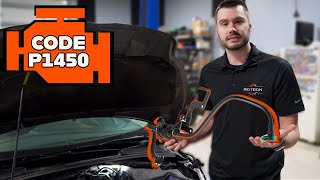
- Perform the purge valve test: 🎬 Watch: Simple diagnosis and repair for the P1450 code. With the engine running, unplug the valve's electrical connector and check for vacuum on the inlet port. If suction is present, replace the valve.
- If the purge valve test passes, visually inspect the EVAP vent hoses near the charcoal canister for any visible kinks, damage, or blockages.
- Check the fresh air vent filter/inlet for obstructions like dirt, debris, or insect nests.
- If no blockage is found, a smoke test may be required to check for internal restrictions in the charcoal canister or a stuck-closed vent solenoid.
- As a final step, monitor the Fuel Tank Pressure (FTP) sensor data on a scan tool to ensure it is reading correctly and not providing skewed data.
Parts You'll Likely Need
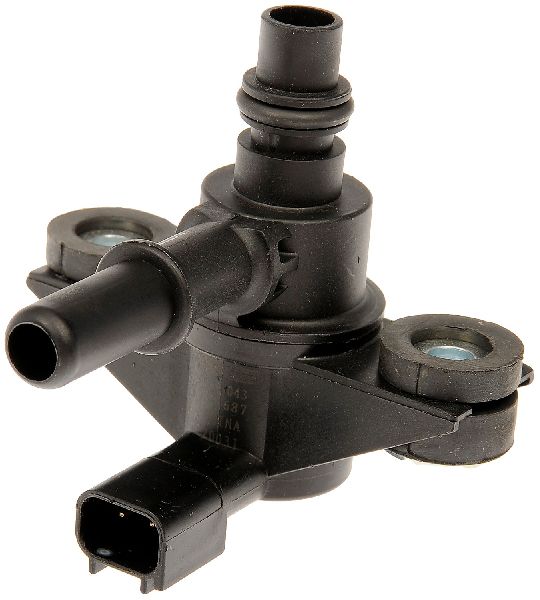
- Vapor Canister Purge Valve
(OEM #AU5Z-9C915-B (Ford), CX2409 (Motorcraft))— This is the most common failure point for code P1450 on the 2013-2017 Ford C-MAX, as documented in multiple service bulletins.
Trusted brands: Motorcraft, Dorman (911-222), Bosch
OEM price range: $45-$65
Aftermarket price range: $25-$45
Related Codes That Often Appear With This One
- P0456 — This indicates a small EVAP leak, which can be triggered by a faulty canister purge valve, as noted in TSB 19-2207.
- P04EF — This code is also related to EVAP system monitoring and is listed alongside P1450 in Ford's Technical Service Bulletin SSM 48301, indicating a related fault.
- P04ED — Another EVAP system code mentioned in TSB SSM 48301, pointing to a common root cause, likely the purge valve.
- P2196 — Indicates the engine is 'Stuck Rich'. This can happen because the stuck-open purge valve is allowing un-metered fuel vapors into the intake, causing a rich condition that the oxygen sensors detect.
Technical Service Bulletins (TSBs) & Recalls
- SSM 48301: Malfunction Indicator Lamp (MIL) illuminated with various EVAP DTCs including P1450.
- 19-2207: Addresses EVAP codes P1450, P0456, etc., on 2013-2017 C-MAX due to a degraded canister purge valve. Recommends replacing the valve and reprogramming the PCM.
Platform-Specific Known Issues
- TSB 19-2207 was issued by Ford for 2013-2017 C-MAX models with various EVAP codes, including P1450, caused by a faulty canister purge valve. The fix involves replacing the valve and updating the PCM software.
- TSB SSM 48301 also notes that P1450 can appear with a group of other EVAP codes on Ford hybrid vehicles, pointing towards a common diagnostic path.
- Owner Experience: Multiple owners on forums and in repair videos confirm that replacing the purge valve (Part No. AU5Z-9C915-B or CX-2409) resolved their P1450 code and the associated symptom of hard starting after refueling.
Mechanic-Grade Diagnostic Values
- Fuel Tank Pressure (FTP) Sensor Voltage (Key On, Engine Off) — expected: 2.4 - 2.8 Volts. Failure: A voltage reading significantly outside this range at rest may indicate a biased sensor. A code may be set if voltage drops below 2.4V when the purge valve is commanded closed.
- Canister Purge Valve (CPV) Solenoid Resistance — expected: Highly variable; reported values range from 10 to 38 ohms.. Failure: There is no single consensus OEM specification in public sources. Some older Ford models specify 30-38 ohms, while owner measurements on newer parts show values as low as 10.5 ohms. An open circuit (infinite resistance) or a dead short (near zero ohms) indicates a definite failure.
- Canister Purge Valve (CPV) Command Voltage — expected: 12 Volts (when commanded ON by scan tool). Failure: Absence of 12V at the connector when the valve is commanded on indicates a wiring or PCM driver issue, not a faulty valve.
Hidden / Shadow Codes Worth Checking
- P1450 00-EC: This is a sub-code that may be displayed on advanced or dealer-level scan tools. While the specific meaning of '00-EC' is not publicly documented, its presence confirms the P1450 fault condition detected by the PCM's enhanced evaporative monitor. (see via Ford IDS, FORScan, or other professional-grade scan tools with manufacturer-specific data capabilities.)
Scan Tool Commands That Help
- Ford IDS, FORScan, other professional scan tools: EVAP System Test / EVAP Purge Solenoid Command — This bidirectional control allows a technician to manually command the purge valve open and closed (or to a specific duty cycle) to check its mechanical function and to monitor the corresponding change in FTP sensor voltage to confirm system response.
- Ford IDS, FORScan, other professional scan tools: EVAP Canister Vent Solenoid Command — This command manually opens and closes the vent valve. It is used to diagnose a blocked vent path. If the tank holds vacuum even when the vent is commanded open, it points to a stuck-closed vent valve or a blockage in the vent line/filter.
- Ford IDS: PCM Reprogramming / Calibration Update — As per TSB 19-2207, after replacing the canister purge valve, the PCM software should be updated to the latest calibration to ensure the EVAP monitor runs with the most current logic and thresholds.
Wiring & Ground Locations
- Engine Compartment Fuse Box — Located in the engine bay.. This box contains multiple fuses that supply power to the Powertrain Control Module (PCM), such as F34, F36, and F46 on 2015+ models. The PCM is responsible for controlling the canister purge valve and monitoring the FTP sensor.
- EVAP System Ground Wire — The specific ground point (e.g., G-number) for the EVAP harness is not identified in public diagrams but is typically located on the chassis or engine block near the component harness.. A poor ground connection for the FTP sensor or purge valve can cause erratic signals or failure to operate, leading to incorrect diagnosis. Verifying ground integrity is a key step in advanced electrical diagnosis after checking for power.
Real Owner Repair Stories
- Reddit - r/MechanicAdvice (Ford vehicle with P1450 (specific model not mentioned, but behavior is identical to C-MAX)) — Check Engine Light with code P1450.
❌ Tried (didn't work) The owner initially replaced the canister purge valve because the old one was leaking air. This cleared the code for a month.
✅ What actually fixed it The P1450 code returned. The new purge valve passed a bench test (it did not leak air when de-energized). However, it had a low resistance reading of 10.5 ohms. The owner was advised that the next diagnostic step was to investigate the EVAP canister vent valve and its filter for a blockage, as this can also cause the code and is the next logical step if the purge valve is confirmed to be sealing correctly. The story highlights that a returning code may point to the secondary cause (vent blockage).
"I Checked Everything" — The Actual Cause
- A standard EVAP smoke test, which pressurizes the system with low-pressure smoke to find leaks to the atmosphere, will often come back clean for a P1450 code. This is because the primary cause is not an external leak, but an *internal* one: the canister purge valve is leaking engine vacuum *into* the EVAP system when it should be closed. The correct test is not a smoke test, but to check for physical suction at the valve's inlet port with the engine running and the valve unplugged.
When the Usual Fixes Don't Work
- While replacing the canister purge valve is the most common fix, it is not a guaranteed solution. One owner of a 2015 Ford Edge with a 2.0L engine (which shares the P1450 issue) reported that replacing the purge valve did not fix the symptom of the engine struggling to start after refueling. This indicates that in some cases, the root cause may lie elsewhere, such as a blocked canister vent valve or a saturated charcoal canister, and further diagnosis is required if the new purge valve does not resolve the symptoms.
OEM Part Supersession History
AU5Z-9C915-A, AU5Z-9C915-B, AU5Z-9C915-C, AU5Z-9C915-D→AU5Z-9C915-E— Part has been revised and updated by Ford over time to improve reliability.
Heads up: The latest version, AU5Z-9C915-E, is the correct service replacement for all previous versions. Motorcraft service numbers CX-2409 and CX-2470 are also superseded by this part.
Model Year Variations Within This Range
- 2013-2018: The Vapor Canister Assembly is different between the standard C-MAX Hybrid and the C-MAX Energi (Plug-in Hybrid) and the parts are not interchangeable. The Energi model has a more complex canister due to the pressurized fuel tank required for its plug-in hybrid system. Standard Hybrid uses part FV6Z-9D653-K; C-MAX Energi uses part CU5Z-9D653-F (or its successor GU5Z-9D653-L). Ordering the wrong part will lead to fitment issues and persistent codes.
Helpful Videos

Used OEM Parts in Stock
New Aftermarket Parts Available


The information in this article is provided for general reference and educational purposes only. Vehicle specifications, procedures, and part compatibility can vary by production date, trim level, and region. Always consult your vehicle's factory service manual and verify part numbers before purchasing or performing repairs. Safety-critical components such as airbags, seat belts, and braking systems should be installed by a qualified professional.
- Ford C-MAX ENERGI:
- 🧭 Diagnostic Flowchart
- 🎬 Helpful Videos
- 🛍️ Shop This Part
- What's Unique About the 2013-2017 Ford C-MAX ENERGI
- Symptoms You May Notice
- Most Likely Causes
- Rare But Worth Checking
- Diagnosis Steps
- Parts You'll Likely Need
- Related Codes That Often Appear With This One
- Technical Service Bulletins (TSBs) & Recalls
- Platform-Specific Known Issues
- Mechanic-Grade Diagnostic Values
- Hidden / Shadow Codes Worth Checking
- Scan Tool Commands That Help
- Wiring & Ground Locations
- Real Owner Repair Stories
- "I Checked Everything" — The Actual Cause
- When the Usual Fixes Don't Work
- OEM Part Supersession History
- Model Year Variations Within This Range
- 🎟️ Get 5% Off