

P1450 on 2007-2017 Ford Expedition: Causes and Fixes for 'Unable to Bleed Up Fuel Tank Vacuum'
On a 2007-2017 Ford Expedition, code P1450 is most often caused by a faulty canister purge valve located in the engine bay. This is a relatively inexpensive part and is a common failure item on many Ford vehicles. Replacing it is a straightforward DIY job. The second most likely cause is a clogged or failed canister vent solenoid near the spare tire.
- P1450 means your Expedition's fuel tank has too much vacuum that it can't get rid of.
- The most likely cause by far is a bad canister purge valve in the engine bay, which is an easy and cheap DIY fix.
- A key symptom is having trouble starting the truck right after you fill up with gas.
- The second most likely cause is a clogged or faulty canister vent solenoid under the vehicle by the spare tire.
- Do not automatically replace the gas cap; it is rarely the cause of this specific code.
What's Unique About the 2007-2017 Ford Expedition
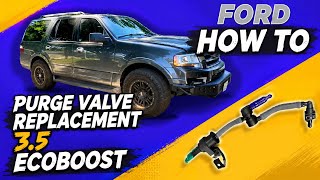
The 2007-2017 Ford Expedition spans two engine generations: the 5.4L 3V Triton V8 (2007-2014) and the 3.5L EcoBoost V6 (2015-2017). 🎬 See how to replace the purge valve on EcoBoost engines. While some EVAP components have different part numbers, the fundamental design and failure modes are consistent across the U324 platform. Like many Ford trucks and SUVs from this era, the canister purge valve is a very common point of failure leading to code P1450. Additionally, as a large SUV that may see use in dusty or off-road conditions, the canister vent solenoid and its filter, located underneath the vehicle by the spare tire, are susceptible to becoming clogged with dirt and debris, which is another primary cause of this code.
Symptoms You May Notice
- Check Engine Light is on
- Difficulty starting the engine right after getting gas, may require pressing the throttle to start.
- A loud 'whoosh' of air rushing into the tank when you open the gas cap
- In some cases, a rough idle or stalling
- Possible strong fuel smell
- Replacing the gas cap. While a faulty gas cap can cause other EVAP codes (like for a small leak), it is not a typical cause for P1450, which is about excessive vacuum, not a lack of it.
Most Likely Causes
- Canister Purge Valve Stuck Open or Leaking 🔴 High Probability → Shop Vapor Canister This is a very common failure part on many Ford vehicles from this period, including the Expedition, F-150, and Explorer. It gets stuck, allowing continuous engine vacuum to pull on the fuel tank when it should be closed.
How to confirm: Locate the purge valve in the engine bay, often on the firewall or intake manifold. With the engine running, disconnect the electrical connector and the hose that runs from the valve back towards the fuel tank. Place your finger over the port on the valve; if you feel any suction, it is leaking internally and must be replaced. A properly functioning valve should be completely closed with no vacuum passing through when electrically disconnected.
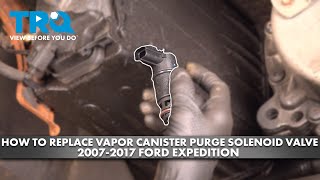
Typical fix: Replace the canister purge valve assembly. This is typically a simple repair involving one electrical connector, one or two hoses, and sometimes two 8mm bolts.
Est. part cost: $25-$60 - Canister Vent Solenoid Stuck Closed or Clogged 🟡 Medium Probability → Shop Vapor Canister The vent solenoid is located under the vehicle near the spare tire, making it vulnerable to road debris, dust, and corrosion which can cause it to stick shut or clog the vent filter.
How to confirm: Visually inspect the vent solenoid and its filter for heavy dirt, debris, or insect nests. A mechanic can command the valve open with a scan tool to check for airflow or use a smoke machine to confirm the vent path is blocked. You can also try to blow through the valve/hose assembly; it should allow air to pass freely when de-energized.
Typical fix: Replace the canister vent solenoid, which is often part of the charcoal canister assembly. Sometimes just cleaning the filter and housing is sufficient if the solenoid itself still functions.
Est. part cost: $40-$120 - Blocked or Kinked EVAP Hoses ⚪ Low Probability Hoses can be pinched or kinked during other repairs or can become brittle and collapse with age. This was noted by a Navigator owner whose mechanic first replaced collapsed hoses above the tank, though it did not solve the P1450 code. Manufacturer service bulletin #TSB 21-2106 notes that a kinked evaporator emissions fresh air vent line can also trigger P1450.
How to confirm: Visually trace the EVAP lines from the engine bay to the charcoal canister (under the vehicle) and to the fuel tank, looking for any obvious kinks, collapses, or damage.
Typical fix: Repair or replace the damaged section of the hose.
Est. part cost: $10-$50 - Faulty Fuel Tank Pressure (FTP) Sensor ⚪ Low Probability → Shop Fuel Tank
How to confirm: Requires a scan tool that can read live data. The FTP sensor voltage should be around 2.5V at atmospheric pressure (engine off). If the reading is biased or doesn't change when a vacuum is applied, the sensor is likely faulty. Due to its location on top of the fuel tank, this is usually diagnosed after the purge and vent valves are confirmed to be working.
Typical fix: Replace the Fuel Tank Pressure sensor. This is a difficult and expensive repair as it is located on top of the fuel tank, which requires dropping the tank for access. One forum member was quoted $1700 by a dealer for this job but did it themselves by dropping the tank. However, NHTSA ODI #11321251 describes a case where replacing the fuel tank pressure solenoid did not resolve the P1450 issue, suggesting other components should be ruled out first.
Est. part cost: $50-$100
Rare But Worth Checking
- Fuel-Saturated or Restricted Charcoal Canister: → Shop Vapor Canister This usually happens from habitually 'topping off' the gas tank after the pump clicks off. Liquid fuel is forced into the canister, which is designed only for vapor, causing it to become a major restriction.
Diagnosis Steps
- Check for a loud 'whoosh' sound when opening the gas cap. This is a strong indicator of the excessive vacuum condition described by P1450.
- Locate the canister purge valve in the engine bay. On the 5.4L, it's often on the firewall.
- Start the engine. Disconnect the electrical connector from the purge valve, then disconnect the EVAP line running from the purge valve towards the rear of the vehicle.
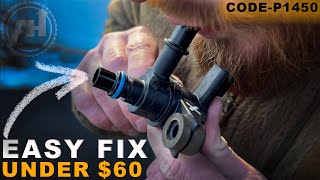
- Test for suction on the valve's port with your finger. If vacuum is present, the purge valve is bad and needs to be replaced. This is the most common fix. 🎬 Watch: A mechanic demonstrates the P1450 fix on a Ford truck. NHTSA ODI #11467127 confirms that a sticking canister purge valve pulling a constant vacuum is a primary cause for P1450.
- If the purge valve is good, the next step is to inspect the canister vent solenoid, located under the vehicle near the spare tire, typically attached to the charcoal canister.
- Visually inspect the vent solenoid and its filter for any blockages like dirt, mud, or spider webs. Clean any debris found.
- If the path is clear, the vent solenoid itself may be stuck closed and require replacement.
- If both valves seem okay, visually inspect all accessible EVAP hoses for sharp bends, kinks, or collapses.
- If the cause is still not found, a professional diagnosis with a scan tool to monitor the Fuel Tank Pressure (FTP) sensor or a smoke machine may be needed.
Parts You'll Likely Need
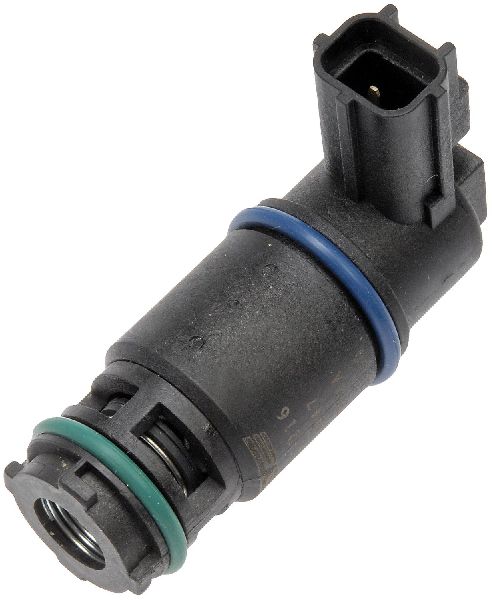
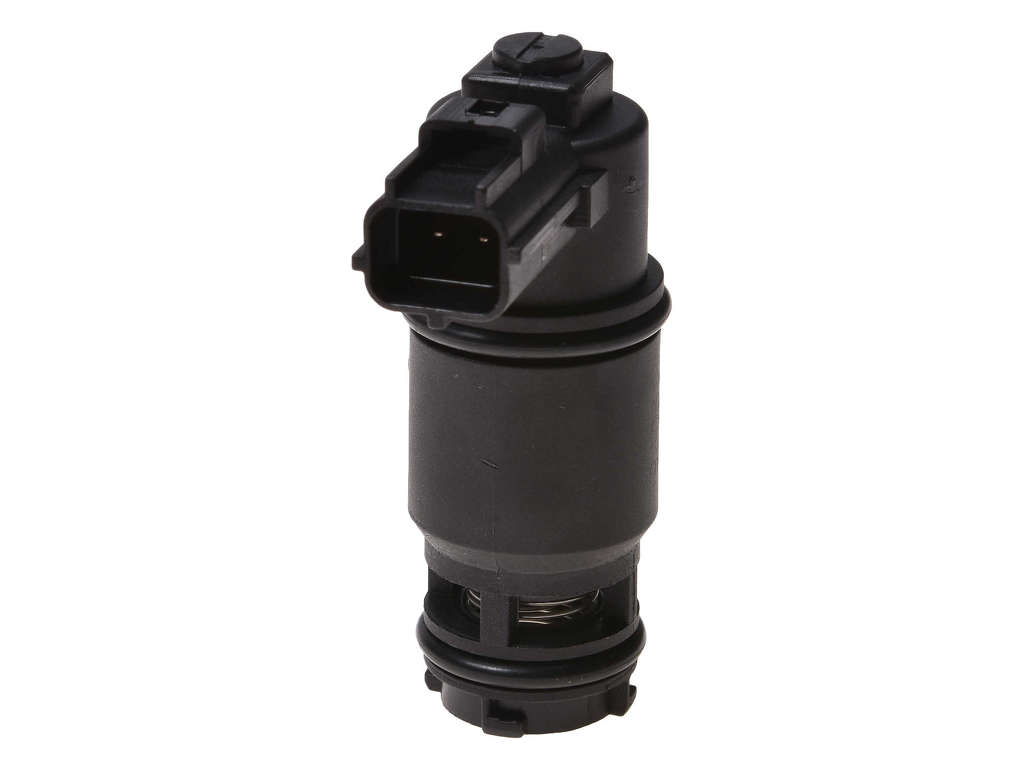
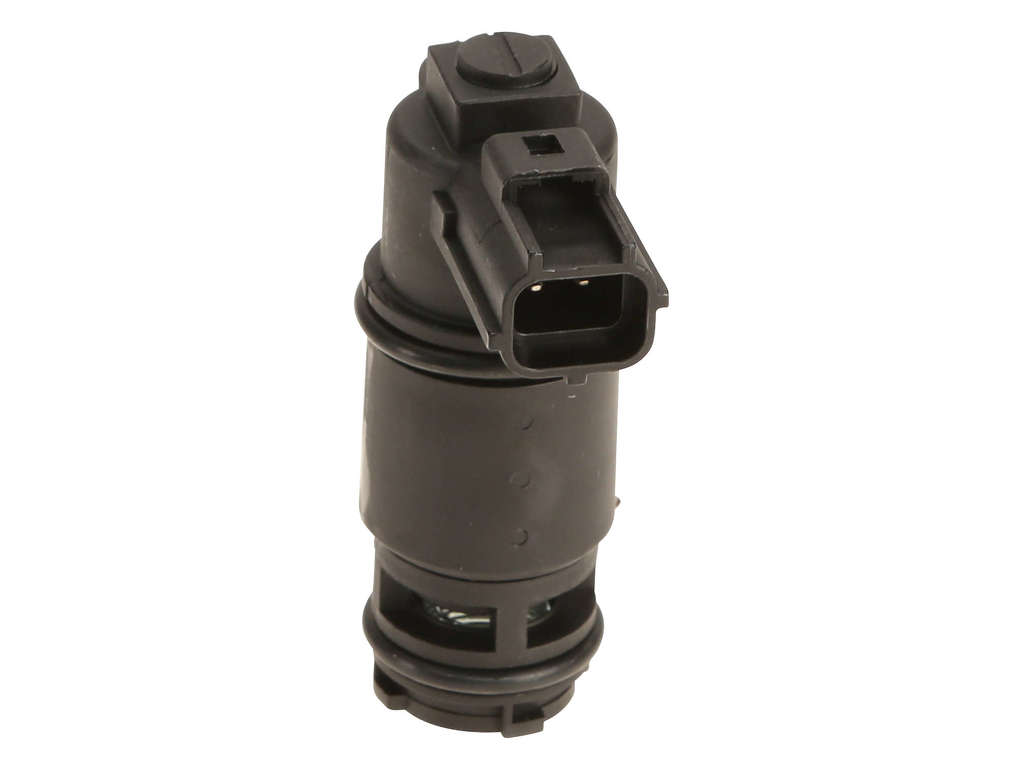
- Canister Purge Valve
(OEM #9U5Z-9C915-H (Motorcraft CX-2409) for many 2009+ models including the 3.5L EcoBoost. Verify fitment for 5.4L models, which may use 6L3Z-9C915-A (pre-2009) or other variants.)— This is the most frequent cause of P1450 on Ford vehicles. It fails by sticking open, allowing constant engine vacuum into the EVAP system.
Trusted brands: Motorcraft, Bosch, Dorman
OEM price range: $40-$70
Aftermarket price range: $25-$50 - Vapor Canister / Canister Vent Solenoid Assembly
(OEM #BL1Z-9D653-A (2007-2014 5.4L V8) or FL1Z-9D653-A (2015-2017 3.5L V6). The vent solenoid is often sold with the canister.)— This part fails by sticking closed or its filter getting clogged, preventing the system from venting vacuum. It's the second most likely culprit.
Trusted brands: Motorcraft, Dorman
OEM price range: $80-$150
Aftermarket price range: $50-$100
Related Codes That Often Appear With This One
- P0455 — A large EVAP leak code can appear alongside P1450 if the system has multiple faults, such as a stuck purge valve and a cracked hose.
- P0456 — A small EVAP leak code might appear if the purge valve is intermittently sticking, causing both leak and vacuum issues during different phases of the EVAP monitor test.
- P2196 — If the purge valve is stuck open, it creates a vacuum leak into the intake manifold, which can cause a rich condition and trigger an O2 sensor code. This was noted in a Ford recall for a similar issue. NHTSA ODI #11580810 also reports P1450 appearing alongside P2196, defined as an O2 sensor stuck rich.
Technical Service Bulletins (TSBs) & Recalls
- Related Ford Safety Recall 18S32: While for 2012-2018 Focus models, this recall addresses a stuck canister purge valve (CPV) causing P1450 and potential fuel tank deformation. This confirms the purge valve as a known issue for Ford during this time frame. A Reddit user with an affected vehicle noted that the dealer initially only performed a PCM update, but the P1450 code returned until the purge valve itself was replaced.
- Bulletin #TSB 21-2106: This bulletin notes that P1450 and other EVAP codes may be due to a kinked evaporator emissions fresh air vent line. The recommended correction is to follow a service procedure to attach a zip tie to the line.
Platform-Specific Known Issues
- Engine-Specific Part Numbers: The canister purge valve and vapor canister assembly have different part numbers for the 5.4L V8 (2007-2014) and the 3.5L EcoBoost V6 (2015-2017). Always verify the part number with your vehicle's VIN before purchasing. For example, the vapor canister for a 5.4L is part BL1Z-9D653-A, while the 3.5L uses FL1Z-9D653-A.
- Expensive FTP Sensor Replacement: If the Fuel Tank Pressure (FTP) sensor is the cause, the repair can be costly. The sensor is located on top of the fuel tank, requiring the tank to be dropped for access. One forum member reported a dealer quote of $1700 for the job, while another was quoted $1100. This makes it critical to rule out the much more common and accessible purge and vent valves first.
Mechanic-Grade Diagnostic Values
- Canister Purge Valve Resistance — expected: 30 to 38 ohms (for standard type). Failure: A reading of 1 ohm indicates a shorted valve. An open circuit (OL) also indicates failure.
- Canister Vent Solenoid Resistance — expected: 48 to 65 ohms. Failure: Readings outside this range indicate a faulty solenoid coil.
- Fuel Tank Pressure (FTP) Sensor Live Data (Engine Off) — expected: Approximately 2.5 Volts at atmospheric pressure.. Failure: A voltage that is significantly biased high or low, or does not change when vacuum is applied, points to a faulty sensor.
Hidden / Shadow Codes Worth Checking
- P1450-00: This is a common way for Ford-specific scan tools to display the P1450 code. The '-00' suffix indicates no subtype information and doesn't change the diagnostic approach. (see via Ford IDS (Integrated Diagnostic System) or FORScan software.)
Scan Tool Commands That Help
- Ford IDS or FORScan: EVAP System Test — This is a comprehensive, automated test that commands the purge and vent solenoids through their cycles to check for leaks and proper function. It's the dealership-level method to verify the entire system's integrity after a repair or during complex diagnosis.
- Ford IDS or FORScan: Output State Control (OSC) for Purge and Vent Solenoids — Allows a technician to manually command the purge valve and vent solenoid on and off. This is used to isolate a specific component. For example, you can command the vent solenoid closed and then use a smoke machine to check if it's sealing properly.
- Advanced Scan Tool (e.g., FORScan): Graphing FTP Sensor vs. Manifold Absolute Pressure (MAP) — With the purge valve electrically disconnected, there should be NO correlation between MAP and FTP readings. If snapping the throttle (changing MAP) causes a slight change in the FTP reading, it confirms the purge valve is mechanically stuck open and leaking vacuum.
Wiring & Ground Locations
- Canister Purge Valve Connector — In the engine bay, connected to the purge valve, often on the firewall or intake manifold.. The connector has two pins. One pin should have battery voltage (VPWR) with the key on. The other pin is the control circuit, which the PCM pulses to ground to open the valve. A damaged connector or wiring can mimic a failed valve. The OEM pigtail connector is available under part number WPT1274.
- Canister Vent Solenoid Connector — Underneath the vehicle near the spare tire, connected to the vent solenoid on the charcoal canister.. This connector and its wiring are exposed to road debris and moisture, making them prone to damage. A bad connection can prevent the vent solenoid from closing, leading to other EVAP codes, or from opening, which can contribute to a P1450.
Real Owner Repair Stories
- Ford F150 Forum user 'ahlbe1cl' (2006 F-150 5.4L (similar EVAP design)) — P1450 code, hard to start after filling the gas tank.
❌ Tried (didn't work) Initial visual inspection of hoses showed no kinks.
✅ What actually fixed it The user removed the entire EVAP canister assembly. A small pre-filter box on top of the assembly was found to be completely filled with dirt. After blowing out the pre-filter and the canister with compressed air, the hard start issue was resolved and the code did not return. - Ford F150 Forum user 'jbone3' (2015 F-150 (similar EVAP design)) — P1450 code and slow fuel filling.
❌ Tried (didn't work) Replacing the charcoal canister (which was saturated and 7-8 lbs heavier than new). This provided a temporary fix for one fill-up before the code returned., Replacing the canister purge valve on the engine.
✅ What actually fixed it The user's problem was not fully resolved in the thread, but the discussion pointed toward a potential blockage in the fuel filler neck or an issue with the capless fuel filler assembly, which was preventing the tank from venting properly during refueling. This highlights that even after replacing common parts, a physical blockage in the vent path can be the root cause. - NHTSA ODI #11343783 — An owner reported a stuck canister purge valve that triggered the P1450 "unable to bleed up fuel tank vacuum" code specifically after filling up at a gas station. The issue was resolved by replacing the canister purge valve.
OEM Part Supersession History
6L3Z-9C915-A→9U5Z-9C915-H (Motorcraft CX-2409)— Part redesign. A technician noted that Ford's purge valve design prior to 2009 was largely trouble-free, but the redesigned part became a common failure item.
Heads up: The newer part number is often used as the service replacement for a wide range of earlier models. Always verify fitment with VIN, but be aware of this common supersession.
Model Year Variations Within This Range
- 2007-2014: These models use the 5.4L 3V V8. The vapor canister assembly is typically part number BL1Z-9D653-A.
- 2015-2017: These models use the 3.5L EcoBoost V6. The vapor canister assembly is typically part number FL1Z-9D653-A. The canister purge valve is also a different part number, though it serves the same function.
Diagnostic Flowchart
Used vs. New Parts: Buying Guide for This Vehicle
When a used part is the smart pick: For this repair, using a used part is generally not recommended for the electronic solenoids (purge valve, vent solenoid) due to their high failure rate and the low cost of new aftermarket parts. A used charcoal canister assembly could be a cost-effective option if it comes from a low-mileage, rust-free donor vehicle, but it carries the risk of being saturated or having a faulty integrated solenoid.
Donor-vehicle mileage cap: roughly under 60000 miles for the part to have meaningful remaining life.
What to inspect on the donor part:
- For a used canister assembly, inspect for any physical cracks or damage.
- Check the vent filter area for excessive dirt, mud, or signs of being submerged in water.
- If possible, weigh the canister; if it feels unusually heavy, it may be saturated with fuel and should be avoided.
- Ensure all hose connection points and mounting tabs are intact.
OEM-only on this vehicle (don't cheap out):
- While not strictly required, using an OEM Motorcraft purge valve is often recommended by forum members for longevity, as some aftermarket versions have questionable reliability.
Aftermarket brands forum-validated for this vehicle:
- Motorcraft (OEM)
- Bosch
Brands owners have reported issues with on this vehicle:
- Dorman has mixed reviews for EVAP components. Some users report perfect fit and function, while others report premature failure or fitment issues. It is often considered a budget-friendly but potentially less reliable option compared to OEM.
Real Owner Stories
Aggregated from forums and TSBs cited above. Mileages and costs reflect what owners reported in those sources.
Ford F-150
Symptoms: I stopped and fueled my truck. Hopped back in to start it and it just cranked. No start... I cranked and gave it some throttle and it started but wouldn't idle.
What fixed it: This is a classic symptom of a failing canister purge valve, which is the most common fix for P1450.
Source hint: Ford F-150 Forum: Hard Start After Fueling
2005 Ford Expedition
Symptoms: Check Engine Light with code P1450.
What fixed it: The dealer diagnosed a bad Fuel Tank Pressure (FTP) sensor. Another owner with the same issue confirmed they fixed it by dropping the fuel tank and replacing the sensor themselves.
Cost: $1100-$1700 (dealer quote)
Source hint: Expedition Forum: Dealer Quotes and FTP Sensor Woes
1997 Ford F-150
Symptoms: OBD-II code P1450.
What fixed it: The owner was advised that a common cause is mud and debris clogging the canister vent (CV) solenoid and its related parts, which are located in front of the spare tire.
Source hint: Ford Truck Enthusiasts: Diagnosing a Clogged Vent Solenoid
2012-2018 Ford Focus
Symptoms: The P1450 code returned even after the dealer performed a PCM update as part of a recall.
What fixed it: The problem was only resolved after the canister purge valve (CPV) itself was replaced.
Source hint: Related Ford Safety Recall 18S32
Documented NHTSA Reports
NHTSA ODI #11467127
Symptoms: Diagnosis for check engine lamp on, run tests for codes P0300 random misfire, P0316 misfire on startup, P1450 cannot bleed fuel tank vacuum.
What fixed it: No misfires were present at the time, but a sticking canister purge valve was found pulling a constant vacuum.
NHTSA ODI #11343783
Symptoms: Stuck canister purge valve which may cause stalling. This always triggered a P1450 "unable to bleed up fuel tank vacuum" code after filling at a gas station.
What fixed it: The owner purchased and replaced the canister purge valve.
NHTSA ODI #11580810
Symptoms: Diagnostic tool returned two powertrain codes: P1450, defined as unable to bleed gas tank - excessive vacuum, and P2196, defined as O2 sensor stuck rich.
NHTSA ODI #11321251
Symptoms: Vehicle stalls and has trouble starting. The owner checked for clogged or cracked fuel lines and found none.
What fixed it: Replacement of the fuel tank pressure solenoid was performed, but the vehicle was still having the same problem.
Related OBD-II Codes
Frequently Asked Questions
My 2015 Expedition is hard to start right after I get gas. Is this related to the P1450 code?
I hear a loud 'whoosh' sound when I open the gas cap on my Expedition. What does that mean?
Where is the most common part that fails for a P1450, the purge valve, located on my 5.4L Expedition?
A mechanic quoted me $1100 to replace the Fuel Tank Pressure (FTP) sensor. Is this a reasonable price?
Are the EVAP parts for my 2016 3.5L EcoBoost the same as the older 5.4L V8 models?
Is there a recall for the P1450 code on my Ford Expedition?
Where is the canister vent solenoid located, and can I check it myself?
Helpful Videos

Used OEM Parts in Stock
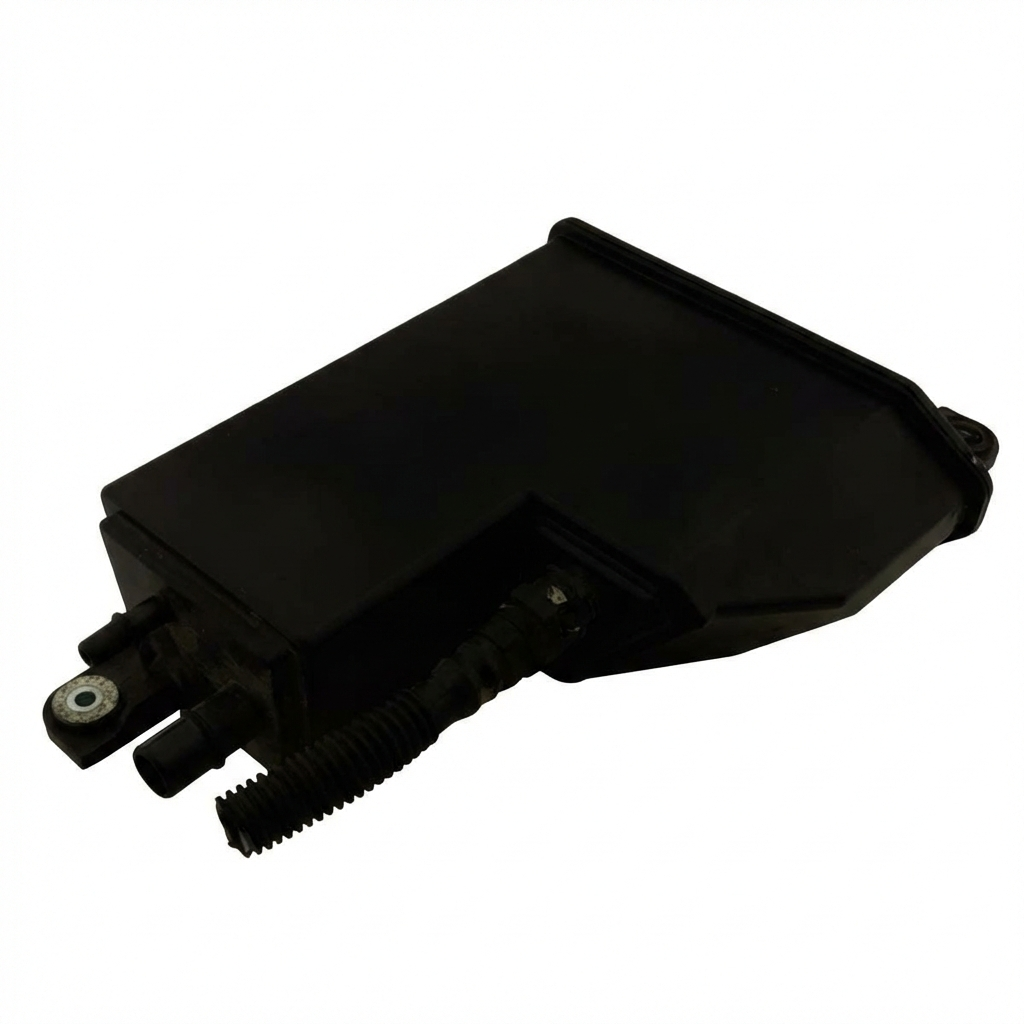
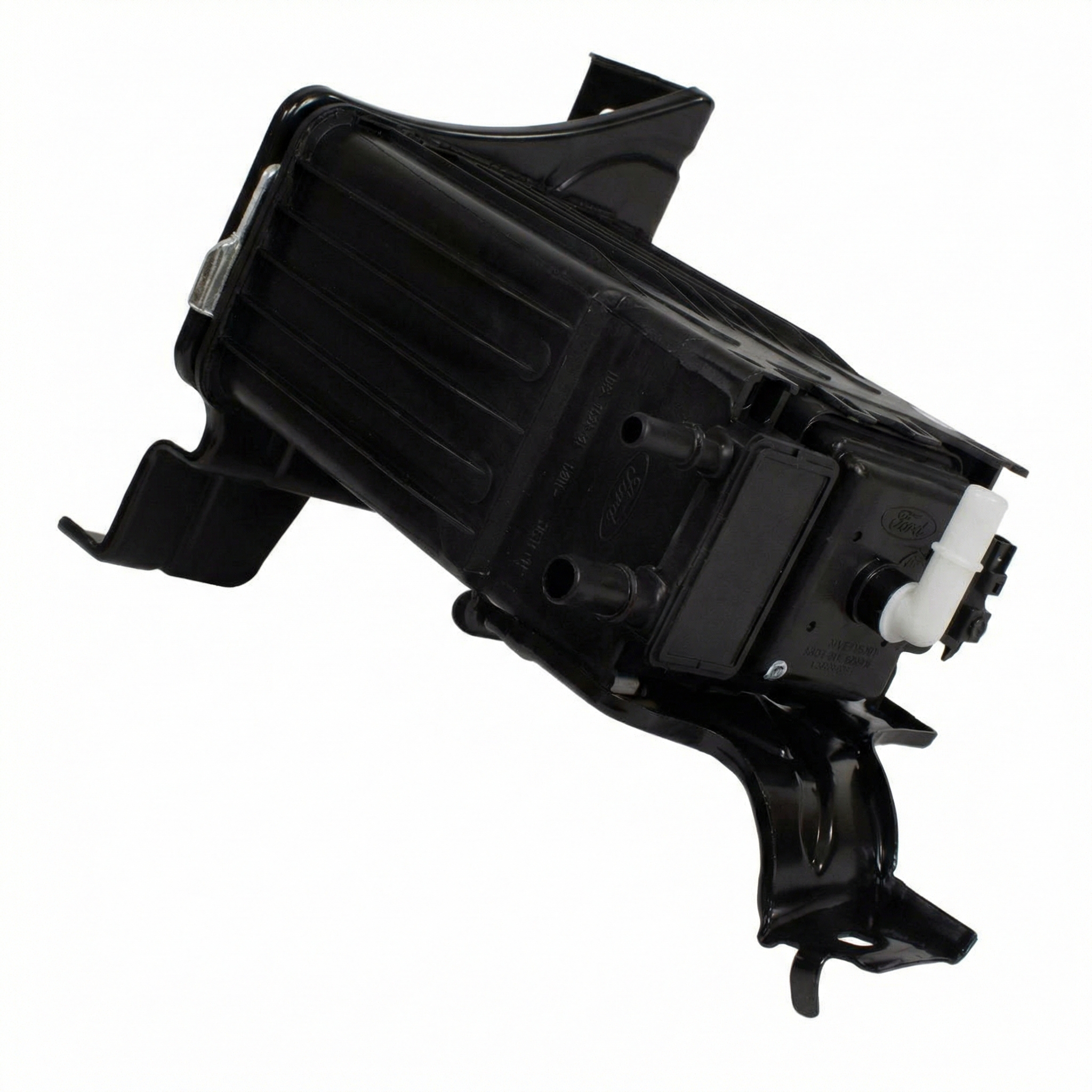
New Aftermarket Parts Available


The information in this article is provided for general reference and educational purposes only. Vehicle specifications, procedures, and part compatibility can vary by production date, trim level, and region. Always consult your vehicle's factory service manual and verify part numbers before purchasing or performing repairs. Safety-critical components such as airbags, seat belts, and braking systems should be installed by a qualified professional.
- Ford Expedition:
- 🧭 Diagnostic Flowchart
- 🎬 Helpful Videos
- 🛍️ Shop This Part
- What's Unique About the 2007-2017 Ford Expedition
- Symptoms You May Notice
- Most Likely Causes
- Rare But Worth Checking
- Diagnosis Steps
- Parts You'll Likely Need
- Related Codes That Often Appear With This One
- Technical Service Bulletins (TSBs) & Recalls
- Platform-Specific Known Issues
- Mechanic-Grade Diagnostic Values
- Hidden / Shadow Codes Worth Checking
- Scan Tool Commands That Help
- Wiring & Ground Locations
- Real Owner Repair Stories
- OEM Part Supersession History
- Model Year Variations Within This Range
- Used vs. New Parts: Buying Guide for This Vehicle
- Real Owner Stories
- Ford F-150
- 2005 Ford Expedition
- 1997 Ford F-150
- 2012-2018 Ford Focus
- Documented NHTSA Reports
- NHTSA ODI #11467127
- NHTSA ODI #11343783
- NHTSA ODI #11580810
- NHTSA ODI #11321251
- Related OBD-II Codes
- Frequently Asked Questions
- 🎟️ Get 5% Off