

P1450 on 2012-2015 Ford Explorer: Causes and Fixes for 'Unable to Bleed Up Fuel Tank Vacuum'
On a 2012-2015 Ford Explorer with the 2.0L EcoBoost engine, code P1450 is almost always caused by a faulty canister purge valve that is stuck open. This is an inexpensive part (around $30-$70) located on the engine and is a very easy DIY fix, typically taking less than 30 minutes. The most common symptom is difficulty starting the engine immediately after refueling.
- P1450 means your Explorer's fuel tank has too much vacuum that it can't release.
- The most likely cause by a wide margin is a faulty canister purge valve on the engine.
- A key symptom is the engine struggling to start right after you get gas.
- You can test the purge valve in minutes with the engine running by checking for suction on its port. If you feel suction, you've found the problem.
- This is a beginner-friendly DIY repair that can be done with basic tools for under $70.
What's Unique About the 2012-2015 Ford Explorer
While P1450 can have several causes, on the fifth-generation Ford Explorer (and many other Ford models from this era), the failure pattern is remarkably consistent. The canister purge valve, a small solenoid on the engine, is the overwhelming culprit. Owners often first suspect a gas cap issue or the more difficult-to-access vent solenoid near the tank, but real-world experience from technicians and owners confirms the purge valve is the part to check first. A common and very specific symptom of this failure is difficulty starting the engine, or a stall, immediately after refueling. For instance, NHTSA ODI #11171843 describes an incident where a vehicle stalled while driving at 25 MPH immediately followed by the illumination of the P1450 warning indicator.
Symptoms You May Notice
- Check Engine Light is on.
- Difficulty starting the engine, or a rough idle/stall, immediately after refueling.
- A 'whoosh' sound from the fuel filler neck when removing the gas cap (if not a capless system), indicating a vacuum.
- A strong fuel smell around the vehicle is possible in some cases.
- In some instances on related platforms, a 'farting' noise from the rear of the car has been reported.
- Replacing the canister vent solenoid first. While it can be the cause, the purge valve on the engine is a much more frequent failure point for this specific code on Ford Explorers and is easier to access and test. A Reddit user with a 2013 Explorer replaced the vent valve first, but the light remained on, with other users pointing to the purge valve as the likely culprit. Similarly, NHTSA ODI #11321251 notes a case where an owner replaced the fuel tank pressure solenoid, yet the vehicle continued to stall and have trouble starting with code P1450.
Most Likely Causes
- Faulty Canister Purge Valve (Stuck Open) 🔴 High Probability → Shop Vapor Canister This specific part on many Ford models of this era, including the 2.0L EcoBoost, is known to fail by sticking open, allowing constant, un-commanded engine vacuum to pull on the fuel tank. This is the cause in over 90% of cases for this code on Fords. NHTSA ODI #11467127 confirms this failure mode on related Ford platforms, where a shop diagnosis found a sticking canister purge valve was pulling a constant vacuum.
How to confirm: With the engine running at idle, locate the purge valve on the engine. Disconnect the EVAP hose leading from the purge valve toward the rear of the vehicle. Place your thumb over the port on the valve where the hose was connected. If you feel any suction, the valve is stuck open and needs to be replaced. The valve should be closed (no vacuum) when the engine is idling and the valve's electrical connector is unplugged.
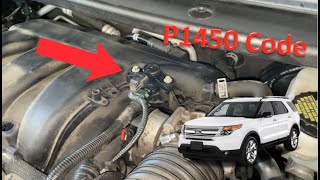
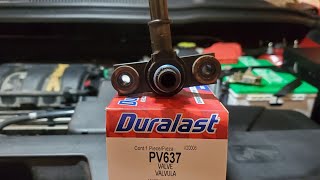
Typical fix: Replace the canister purge valve assembly. It is located on the driver's side of the intake manifold and is typically held by two 8mm bolts. 🎬 Watch: Step-by-step guide to replacing the purge valve.
Est. part cost: $30-$70 - Blocked Canister Vent Solenoid or Hose 🟡 Medium Probability → Shop Vapor Canister The vent path, located near the rear of the vehicle by the charcoal canister (near the spare tire), can become clogged with dust, debris, or even spider webs, preventing fresh air from entering the tank to relieve vacuum.
How to confirm: Inspect the vent solenoid, its filter, and the attached hoses for any visible blockages or kinks. A scan tool can be used to command the vent valve open and closed to check for functionality. The solenoid can also be removed and tested with a power source to see if it actuates.
Typical fix: Clean the blockage from the hose or filter, or replace the canister vent solenoid if it is faulty. Some owners have successfully replaced this part without removing the entire charcoal canister.
Est. part cost: $25-$60 - Issue with Capless Fuel Filler Neck ⚪ Low Probability
How to confirm: Inspect the capless fuel filler opening for debris or damage that may prevent the small internal flap from sealing or venting properly. A technician on a forum suggests cleaning the flap door with a stiff brush and throttle cleaner.
Typical fix: Clean the fuel filler neck opening. If the sealing flap is damaged, the entire filler neck assembly may need replacement.
Est. part cost: $5-$150
Rare But Worth Checking
- Faulty Fuel Tank Pressure (FTP) Sensor: → Shop Fuel Tank The sensor itself can fail and send incorrect vacuum readings to the computer, making the system think there's a problem when there isn't one. This is less common than a mechanical part failure. A scan tool showing neutral pressure with the engine off is a good sign the sensor is working.
- Kinked or Collapsed EVAP Hose: A physical restriction in one of the EVAP system lines can prevent the system from venting properly. A visual inspection of all accessible hoses is recommended. On some Ford models, a TSB was issued for a vent line that was prone to kinking. Manufacturer TSB Bulletin #TSB 21-2106 notes that P1450 can be caused by a kinked evaporator emissions fresh air vent line, which may require a zip tie to correct the routing.
- Saturated Charcoal Canister: → Shop Vapor Canister Repeatedly overfilling the fuel tank (topping off) can force liquid gasoline into the charcoal canister, saturating it and blocking airflow. The canister is not designed to handle liquid fuel. If charcoal bits are found in the purge valve, the canister has failed and must be replaced.
Diagnosis Steps
- Read the code with an OBD-II scanner to confirm P1450 is present.
- Start the engine and let it idle.
- Locate the canister purge valve on the engine, on the driver's side of the intake manifold. It will have two hoses and an electrical connector.
- Disconnect the electrical connector from the purge valve.
- Disconnect the EVAP hose that runs from the purge valve towards the rear of the vehicle.
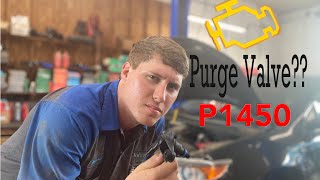
- Place your finger or a vacuum gauge on the port of the purge valve you just disconnected the hose from. If you feel any suction, the purge valve has failed and must be replaced. There should be no vacuum flow at idle with the valve unplugged. 🎬 See a mechanic demonstrate how to diagnose this code.
- If no vacuum is present at the purge valve, the issue lies elsewhere. The next step is to inspect the EVAP vent system at the rear of the vehicle. Check the canister vent solenoid and all associated hoses for blockages, kinks, or damage.
- Inspect the capless fuel filler neck for debris or damage that could prevent a proper seal.
- If all components and hoses appear to be in good condition, the Fuel Tank Pressure (FTP) sensor may be providing inaccurate data.
Parts You'll Likely Need
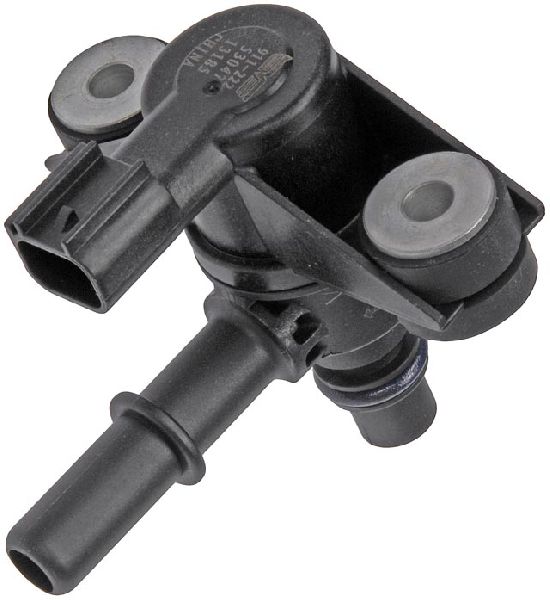
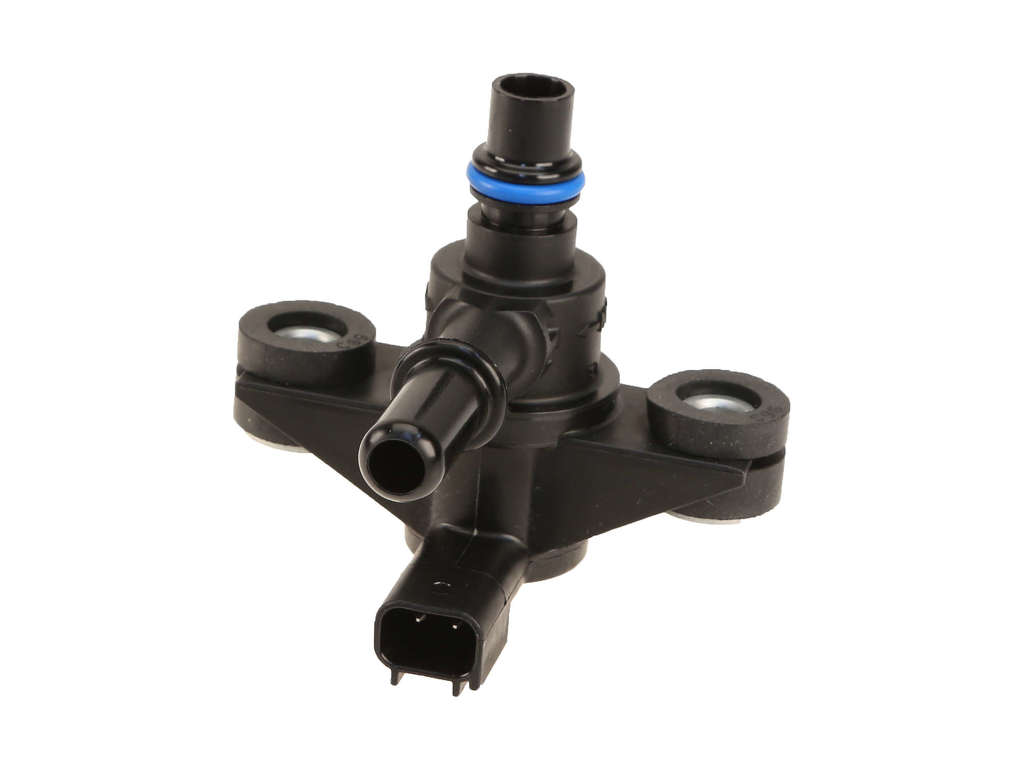
- Canister Purge Valve / Solenoid
(OEM #9U5Z-9C915-H (Motorcraft CX-2349) is a common part number for the 3.5L, but the 2.0L EcoBoost often uses a hose assembly like CV6Z-9D289-S. Verify by VIN.)— This is the most common failure for code P1450 on this vehicle. It fails by sticking open, causing constant engine vacuum to be applied to the fuel tank.
Trusted brands: Motorcraft, Bosch, Dorman, Standard Motor Products
OEM price range: $50-$90
Aftermarket price range: $30-$70
Related Codes That Often Appear With This One
- P0496 — This code for 'EVAP Flow During a Non-Purge Condition' is also caused by a stuck-open purge valve and is functionally very similar to P1450.
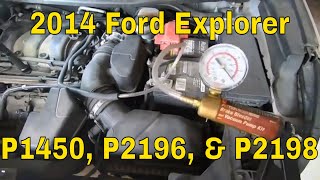
- P2196 / P2198 — A stuck-open purge valve allows un-metered fuel vapor into the engine, creating a rich condition that can trigger 'O2 Sensor Stuck Rich' codes for Bank 1 or Bank 2. 🎬 Watch: Dealing with P1450 and O2 sensor rich codes. NHTSA ODI #11580810 describes a vehicle where P1450 appeared alongside P2196, defined as an O2 sensor stuck rich.
- P0443 — This code indicates an 'Evaporative Emission System Purge Control Valve Circuit' fault. A user on a forum reported this code appeared after they replaced the purge valve, suggesting a potential issue with the new part or its electrical connection.
- P0300 / P0316 — These misfire codes can sometimes accompany P1450. NHTSA ODI #11467127 reports a case where P1450 was found alongside P0300 (random misfire) and P0316 (misfire on startup).
Technical Service Bulletins (TSBs) & Recalls
- TSB 19-2207: While for Hybrid/Energi models (Fusion, C-Max), this TSB directly addresses P1450 caused by a faulty canister purge valve, confirming Ford's acknowledgement of this failure mode. The fix involves replacing the valve and reprogramming the PCM.
- TSB 16-0055: For 1.0L EcoBoost Focus, this TSB addresses P1450 with a PCM reprogram, indicating that sometimes the code can be triggered by software logic, not just a hard part failure.
- Bulletin #TSB 21-2106: This bulletin addresses P1450 and related EVAP codes that may be caused by a kinked evaporator emissions fresh air vent line, recommending the use of a zip tie to secure the line properly.
Platform-Specific Known Issues
- Purge Valve is Part of a Hose Assembly: → Shop Vapor Canister On many 2.0L EcoBoost engines, the purge valve itself is integrated into a larger hose assembly and is not sold as a standalone component from the OEM. Some aftermarket solutions, like Duralast PV1003, offer a redesigned assembly where the valve can be replaced separately in the future, which could simplify subsequent repairs.
Mechanic-Grade Diagnostic Values
- Fuel Tank Pressure (FTP) Sensor Voltage — expected: 2.4V to 2.8V with key on, engine off (at atmospheric pressure).. Failure: A reading significantly outside this range at rest suggests a biased sensor. The P1450 code may trigger if the voltage drops below 2.4V when the purge valve is commanded closed.
- Canister Purge Valve Solenoid Resistance — expected: Approximately 30 to 38 ohms.. Failure: A reading significantly outside this range indicates a faulty solenoid coil. An open or shorted coil will require replacement of the valve.
- Canister Purge Valve Power Supply — expected: 12V (Battery Voltage) at the connector with key on.. Failure: No voltage at the power supply pin indicates a wiring or fuse issue upstream of the valve, not a failure of the valve itself.
Scan Tool Commands That Help
- Professional Scan Tool (e.g., iCarsoft, Autel, Launch): EVAP Purge Valve Actuation Test / Bi-Directional Control — Use this to command the purge valve to 0% (closed) while monitoring FTP sensor data. If vacuum still builds in the tank with the valve commanded closed, it confirms the valve is mechanically stuck open and must be replaced.
- Professional Scan Tool (e.g., iCarsoft, Autel, Launch): EVAP Vent Valve Actuation Test — If the purge valve tests good, use this command to cycle the canister vent valve (near the tank). This helps determine if the vent valve is stuck closed or if the circuit is faulty, which is the second most likely cause of P1450.
Wiring & Ground Locations
- C213 — Behind the driver's side left kick panel, near where the driver's left foot would be.. This is a major inline connector for the canister vent valve circuit. A poor connection or corrosion here can cause an open or short in the vent valve control, leading to a P1450 if the valve fails to open. The wire for the vent valve control changes color at this connector (Green/Violet to Green/Blue).
- C3053 — Under the vehicle, below the 2nd-row seats.. This is the first connector in the harness coming from the canister vent valve. Due to its location under the vehicle, it is highly susceptible to corrosion from the elements, which can interrupt the signal to or from the vent valve.
- Purge Valve Connector — On the canister purge valve, top of the engine.. This 2-wire connector provides power and ground control to the purge valve. It should have 12V on one pin with the key on. The terminals are a blade type. Pigtail replacement connectors are available if the original is damaged.
Real Owner Repair Stories
- Reddit user on r/AutoMechanics (2013 Ford Explorer) — Check Engine Light with code P1450.
❌ Tried (didn't work) Replaced the canister vent valve (located near the fuel tank).
✅ What actually fixed it The issue was the canister purge valve on the engine. A technician in the thread commented, 'I've seen a bunch of purge valves go bad on this engine. Never seen a vent valve go bad,' confirming this common misdiagnosis pattern. - YouTube video by CGR Reviews (2016 Ford Explorer (FPIU) 3.7L V6) — Intermittent P1450 code.
❌ Tried (didn't work) Clearing the code, which would cause it to stay off for a day or two before returning.
✅ What actually fixed it Replacing the canister purge valve on the engine with a Dorman part. The owner reported the check engine light did not return after four to five weeks of driving. - NHTSA ODI #11171843 — An owner reported that while driving at 25 MPH, the vehicle stalled and the P1450 warning indicator illuminated, requiring the vehicle to be pulled off the road and taken to an independent mechanic.
"I Checked Everything" — The Actual Cause
- A standard EVAP smoke test is designed to find vapor leaks to the atmosphere (which cause codes like P0455/P0456) by pressurizing the system. Code P1450 is the opposite problem: excessive vacuum being pulled on the system. A smoke test will almost always pass (show no leaks) on a vehicle with P1450 because the failure is a stuck-open purge valve allowing engine vacuum *into* the tank, not fuel vapor *out of* it. Therefore, a 'clean' smoke test does not rule out the purge valve as the cause for P1450.
OEM Part Supersession History
cv6z9d289c, cv6z9d289d, cv6z9d289f, cv6z9d289h, cv6z9d289r→CV6Z-9D289-S— This is the purge valve and hose assembly for the 2.0L EcoBoost. The high number of superseded part numbers strongly indicates that Ford has released multiple revisions of this part, likely to improve reliability and address the common 'stuck open' failure mode.
Heads up: Always use the latest available part number (CV6Z-9D289-S) or a quality aftermarket equivalent. Installing an older, used version is highly likely to result in a repeat failure.
Diagnostic Flowchart
Other Known Issues on This Vehicle
Issues unrelated to this code that are worth knowing about as an owner of this generation:
- Coolant Intrusion into Cylinders 🔴 High — A known design flaw in some 2.0L EcoBoost engines where a defect in the block allows coolant to leak into the cylinders. This can cause misfires, white exhaust smoke, and eventual catastrophic engine failure. (Ref: TSB 19-2346, 22-2229 (and others) address this issue, which often requires a complete long block engine replacement.)
- Power Transfer Unit (PTU) Failure 🔴 High — Common on AWD models, often after 60,000 miles. The PTU is located near the hot exhaust, causing its 'lifetime' fluid to break down and overheat, leading to seal leaks and internal gear failure. (Ref: No specific recall, but a widely discussed problem. Lack of a drain plug makes servicing difficult. Failure can result in loss of AWD and expensive repairs.)
- Cracked Flexplate 🟠 Medium — Can occur on the 2.0L EcoBoost, causing a rattling or ticking noise from the transmission bellhousing area that might be mistaken for engine noise. (Ref: Ford has issued TSBs for this issue on various models with this engine.)
- MyFord Touch System Failures 🟡 Low — Very common on early models of this generation. The infotainment system is known for freezing, slow response times, and general unresponsiveness, causing frustration for owners. (Ref: Multiple software updates were released, but issues often persist.)
- Interior Door Handle Failure 🟡 Low — A recall was issued because the interior door handle return spring could unseat, causing the handle not to return to its stowed position. (Ref: NHTSA Recall.)
Used vs. New Parts: Buying Guide for This Vehicle
When a used part is the smart pick: For this specific repair (P1450), using a used part from a junkyard is NOT recommended under any circumstances.
What to inspect on the donor part:
- Not applicable. The failure is internal to the solenoid and not visually apparent.
- Given the high failure rate and multiple part number revisions by Ford, a used part is statistically very likely to be faulty or fail soon after installation.
OEM-only on this vehicle (don't cheap out):
- While not strictly 'OEM-only', it is critical to purchase a NEW part. The Motorcraft (OEM) part is the safest bet due to the known issues with this component.
Aftermarket brands forum-validated for this vehicle:
- Bosch
- Standard Motor Products (SMP)
Brands owners have reported issues with on this vehicle:
- Dorman quality can be hit-or-miss according to general forum consensus, though some users report success. Given the low cost of the OEM or premium aftermarket part, it may be worth avoiding the risk of a lower-quality part for this specific component.
Real Owner Stories
Aggregated from forums and TSBs cited above. Mileages and costs reflect what owners reported in those sources.
2013 Ford Explorer 2.0L EcoBoost
Symptoms: Check engine light P1450. Purge valve is a much more common failure than the vent valve for this code.
What fixed it: Replacement of the purge valve.
Source hint: Reddit r/AutoMechanics thread titled 'P1450 code ford explorer 2013'
2013 Ford Explorer 2.0L EcoBoost
Symptoms: Owner replaced both the purge valve and vent valve and was still getting the code.
What fixed it: A user suggested a possible issue with the capless fuel filler neck.
Source hint: Reddit r/Cartalk thread titled '2013 ford explorer p1450'
Ford Edge 2.0L EcoBoost
Symptoms: Classic 'would not start after fueling' symptom.
What fixed it: Purge valve failure replacement.
Source hint: Ford Edge Forum thread titled 'code p1450 problem starting after filling up'
2014 Ford Explorer
Symptoms: While driving 25 MPH, the vehicle stalled and the P1450 warning indicator illuminated.
What fixed it: The vehicle was taken to an independent mechanic for repair after the owner pulled off the road.
Source hint: NHTSA ODI #11171843
Related OBD-II Codes
Frequently Asked Questions
Is the canister purge valve on my 2.0L EcoBoost Explorer sold as a single part?
Does TSB 19-2207 apply to my 2012-2015 Ford Explorer?
Where is the purge valve located on the 2.0L EcoBoost engine?
Can a software update fix the P1450 code on my Ford?
I hear a 'farting' noise from the rear of my car; is this related to P1450?
How can I test if the purge valve is the cause of my P1450 code?
Helpful Videos
Used OEM Parts in Stock
New Aftermarket Parts Available


The information in this article is provided for general reference and educational purposes only. Vehicle specifications, procedures, and part compatibility can vary by production date, trim level, and region. Always consult your vehicle's factory service manual and verify part numbers before purchasing or performing repairs. Safety-critical components such as airbags, seat belts, and braking systems should be installed by a qualified professional.
- Ford Explorer:
- 🧭 Diagnostic Flowchart
- 🎬 Helpful Videos
- 🛍️ Shop This Part
- What's Unique About the 2012-2015 Ford Explorer
- Symptoms You May Notice
- Most Likely Causes
- Rare But Worth Checking
- Diagnosis Steps
- Parts You'll Likely Need
- Related Codes That Often Appear With This One
- Technical Service Bulletins (TSBs) & Recalls
- Platform-Specific Known Issues
- Mechanic-Grade Diagnostic Values
- Scan Tool Commands That Help
- Wiring & Ground Locations
- Real Owner Repair Stories
- "I Checked Everything" — The Actual Cause
- OEM Part Supersession History
- Other Known Issues on This Vehicle
- Used vs. New Parts: Buying Guide for This Vehicle
- Real Owner Stories
- 2013 Ford Explorer 2.0L EcoBoost
- 2013 Ford Explorer 2.0L EcoBoost
- Ford Edge 2.0L EcoBoost
- 2014 Ford Explorer
- Related OBD-II Codes
- Frequently Asked Questions
- 🎟️ Get 5% Off