

P1450 on 2016-2019 Ford Explorer 2.3L: Unable to Bleed Fuel Tank Vacuum Causes and Fixes
On a 2016-2019 Ford Explorer, P1450 is almost always caused by a failed canister purge valve that is stuck open. It's a common, inexpensive part located on top of the engine, and DIY replacement is straightforward, typically costing $30-$60 for the part and taking less than 30 minutes.
- P1450 on your Explorer almost certainly means you need a new canister purge valve.
- This is a very DIY-friendly repair that requires basic tools (an 8mm socket) and less than 30 minutes.
- The main symptom, besides the check engine light, is often difficulty starting the vehicle right after you fill the gas tank.
- You can confirm the failure in minutes by starting the engine, unplugging the valve's electrical connector, and feeling for suction on the valve's inlet port.
- Do not immediately suspect other expensive components like the charcoal canister or the vent solenoid under the car; test the purge valve on the engine first.
What's Unique About the 2016-2019 Ford Explorer
On this generation of Ford Explorer, the P1450 code is exceptionally common, and the root cause is almost always the canister purge valve failing in the open position. This part is a well-documented high-failure item across many Ford models of this era using various engines. Fortunately for owners, the purge valve on the 2.3L EcoBoost engine is located directly on top of the engine, making it one of the easiest and cheapest repairs for a check engine light on this vehicle.
Symptoms You May Notice
- Check Engine Light is illuminated.
- Difficulty starting the engine, especially within minutes of refueling.
- Rough or unstable idle.
- A 'whoosh' sound of rushing air when opening the capless fuel filler neck.
- Slightly reduced fuel economy.
- In some cases, companion codes like P2196 and P2198 (O2 Sensor Stuck Rich) may appear, as the constant flow of fuel vapors from the stuck purge valve creates a rich air-fuel mixture.
- Replacing the gas cap. This vehicle uses a capless fuel filler system, so there is no traditional cap to fail. While the spring-loaded door can have issues (often causing leak codes like P0457), it is not the common cause for P1450.
- Replacing the charcoal canister. While a canister saturated with fuel can cause EVAP problems, it is not the primary cause of P1450. The purge valve should always be tested first as it is the most common and cheapest part to fail. A user on a Reddit forum for mechanics noted they had seen many bad purge valves on this engine but never a bad vent valve.
Most Likely Causes
- Canister Purge Valve Stuck Open 🔴 High Probability → Shop Vapor Canister This is a very common failure point on many Ford vehicles from this era, including the Explorer, Edge, and Mustang. The internal mechanism of the valve fails, allowing constant, un-commanded engine vacuum to be pulled on the fuel tank.
How to confirm: With the engine running, disconnect the electrical connector from the purge valve. Then, disconnect the EVAP hose from the purge valve on top of the engine. Place your finger over the port on the valve itself. If you can feel or hear vacuum suction, it is stuck open and faulty. A properly functioning valve should be closed with no airflow when the electrical connector is unplugged.
Typical fix: Replace the canister purge valve assembly. It is typically held on by two 8mm bolts, making for a quick replacement. 🎬 See this step-by-step guide to replacing the purge valve.
Est. part cost: $30-$60
Rare But Worth Checking
- Blocked EVAP Canister Vent Solenoid or Hose: → Shop Vapor Canister If the purge valve tests good, the next most likely cause is a blockage in the vent path, which prevents fresh air from entering the system to relieve vacuum. This can be caused by dirt, debris, or even spider webs in the vent hose, which is typically located near the charcoal canister under the vehicle. Manufacturer Bulletin #TSB 21-2106 notes that on some Ford platforms, P1450 can be caused by a kinked evaporator emissions fresh air vent line.
- Kinked or Collapsed EVAP Hose: A physically damaged or pinched hose between the engine, charcoal canister, and fuel tank can prevent the system from venting properly.
- Faulty Fuel Tank Pressure (FTP) Sensor: → Shop Fuel Tank In rare cases, the sensor that reports the vacuum level to the computer may be providing incorrect readings, causing the code to be set erroneously.
- Over-filling the Fuel Tank: → Shop Fuel Tank Repeatedly 'topping off' the fuel tank after the pump automatically shuts off can force liquid fuel into the EVAP system, which is designed only for vapor. This can saturate the charcoal canister and potentially damage valves, leading to various EVAP codes.
Diagnosis Steps
- Verify the Check Engine Light is on and code P1450 is present using an OBD-II scanner.
- Locate the canister purge valve on top of the engine, near the intake manifold.
- Start the engine and let it idle.
- Unplug the two-wire electrical connector from the purge valve. This ensures it is not being commanded open by the PCM.
- Carefully disconnect the EVAP hose leading from the charcoal canister to the purge valve.
- Place your finger over the port on the purge valve where the hose was connected. 🎬 Watch: How to perform this simple vacuum suction test. If you feel suction, the valve is stuck open and must be replaced. You may even hear a popping noise as you remove your thumb. NHTSA ODI #11467127 describes a similar diagnostic finding where a sticking canister purge valve was found pulling a constant vacuum.
- If no suction is felt, the purge valve is likely not the issue. The next step would be to inspect the EVAP vent solenoid and its associated hoses near the charcoal canister (under the vehicle) for blockages or damage.
Parts You'll Likely Need
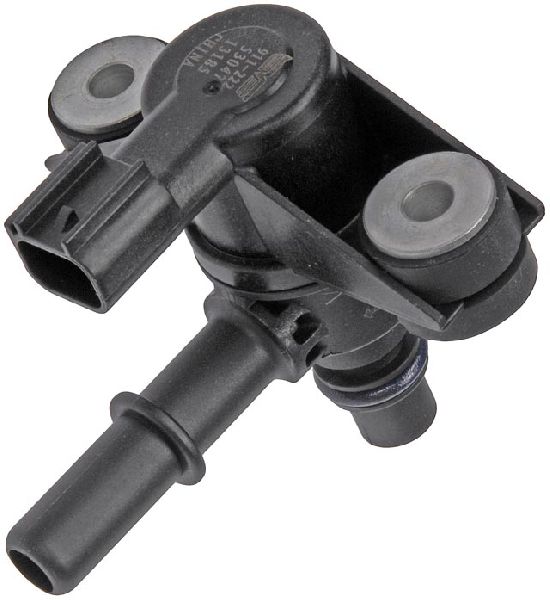
- Canister Purge Valve / Solenoid
(OEM #AU5Z-9C915-B (may be superseded by AU5Z-9C915-E))— This is the overwhelming cause of P1450 on this vehicle. The internal valve fails and remains in the open position, allowing constant, un-commanded engine vacuum into the EVAP system.
Trusted brands: Motorcraft, Bosch, Dorman, Standard Motor Products
OEM price range: $50-$80
Aftermarket price range: $30-$60
Related Codes That Often Appear With This One
- P0456 — P0456 (EVAP System Small Leak Detected) can sometimes appear with P1450. A stuck-open purge valve can be interpreted by the system as a type of leak under certain test conditions.
- P0455 — P0455 (EVAP System Gross Leak Detected) can also be triggered by a stuck-open purge valve, as the system sees a large, un-commanded flow of vapor.
- P2196 / P2198 — P2196 (O2 Sensor Signal Stuck Rich Bank 1) and P2198 (Bank 2, if applicable) can be triggered because the stuck-open purge valve continuously dumps fuel vapors into the intake manifold, causing the engine to run richer than commanded. NHTSA ODI #11580810 confirms the frequent pairing of P1450 (unable to bleed gas tank) with P2196 (O2 sensor stuck rich).
- P144C — P144C (EVAP System Purge Check Valve Performance) is another Ford-specific code that often points directly to a faulty purge valve and can appear alongside P1450.
Technical Service Bulletins (TSBs) & Recalls
- While not for this exact code, TSB 19-2171 for the related 2.3L EcoBoost in the Escape/MKC addresses other EVAP codes (P04F0, P144C) by first checking for simple connection issues with EVAP vapor lines, highlighting the sensitivity of the system.
- The pass 1 mention of TSB 21-2446 and recall 18S32 for other models highlights Ford's general awareness of issues in the EVAP system, though no specific TSB for P1450 on this exact platform was found.
- Manufacturer Bulletin #TSB 21-2106 addresses P1450 and other EVAP codes on similar Ford systems, noting that a kinked evaporator emissions fresh air vent line may be the cause.
Platform-Specific Known Issues
- The canister purge valve is a well-documented, high-failure rate component for this generation of Explorer and other Ford models using similar parts.
- A YouTube video specifically on a 2018 Explorer with P1450 also showed companion codes P2196 and P2198 (O2 sensor stuck rich), confirming the diagnosis of a stuck purge valve causing a rich condition. 🎬 Watch: Real-world diagnosis of P1450 and rich O2 sensor codes.
Mechanic-Grade Diagnostic Values
- Canister Purge Valve Solenoid Resistance — expected: 14 to 38 Ohms. Failure: A reading of infinity (OL) indicates an open circuit, while a reading near zero indicates a shorted coil.
- Canister Vent Solenoid Resistance — expected: 48 to 65 Ohms. Failure: Readings significantly outside this range suggest a faulty solenoid coil.
- Fuel Tank Pressure (FTP) Sensor Voltage (KOEO) — expected: Approximately 2.5V - 2.6V at atmospheric pressure (Key On, Engine Off).. Failure: A voltage that is significantly high or low at rest, or that does not change when vacuum is applied, points to a faulty sensor. If voltage drops below 2.4V at idle with the purge valve commanded to 0%, it indicates the valve is leaking vacuum.
- EVAP System Vacuum (During PCM Test) — expected: Target of approximately -8.0 in. H2O.. Failure: If the vacuum significantly exceeds the target, the PCM may set P1450, indicating a restriction or a stuck-open purge valve.
Scan Tool Commands That Help
- Ford IDS or equivalent professional scanner (iCarsoft, Launch, etc.): EVAP System Test / Purge Valve Bidirectional Control — This is the definitive test to confirm a faulty purge valve. A technician can command the purge valve to 0% (closed). If the Fuel Tank Pressure (FTP) sensor still shows a vacuum building, the valve is mechanically stuck open and must be replaced. Note: Ford's automated test may not run if the fuel level is outside the 15-85% range.
Wiring & Ground Locations
- Canister Purge Valve Connector — On top of the engine, typically near the intake manifold, connected to the purge valve.. This 2-wire connector provides power and a control signal from the PCM. One wire should have battery voltage with the key on. The other is a duty-cycled ground controlled by the PCM. Testing here can rule out wiring issues if a new valve doesn't fix the problem.
- Canister Vent Solenoid Connector — Under the vehicle, near the charcoal canister, which is often located near the fuel tank.. If the purge valve is good, a vent solenoid that is stuck closed or has a wiring issue can also cause P1450. Checking for power and signal at this connector helps diagnose the vent circuit.
Real Owner Repair Stories
- YouTube channel 'The Car Care Nut' (2018 Ford Explorer) — Check Engine Light with codes P1450, P2196 (O2 Sensor Stuck Rich Bank 1), and P2198 (O2 Sensor Stuck Rich Bank 2).
❌ Tried (didn't work) The technician noted that the automated Ford IDS EVAP test would not run because the fuel tank was full (outside the 15-85% required range).
✅ What actually fixed it The technician performed a manual 'thumb test' by starting the engine, disconnecting the purge valve's electrical connector, and feeling for vacuum at the valve's port. Strong vacuum was present, confirming it was stuck open. Replacing the canister purge valve resolved the issue. - Reddit user in r/fordfusion (Ford Fusion (similar EVAP system design)) — P1450 code, engine would not start after refueling.
❌ Tried (didn't work) The owner replaced the canister purge valve, which fixed the hard-starting issue after refueling, but the Check Engine Light remained on.
✅ What actually fixed it The Check Engine Light needed to be manually cleared with a scan tool after the repair. A responding user confirmed the code will not always turn off on its own immediately after the mechanical fault is corrected. - Owner Report NHTSA ODI #11321251 — An owner reported the vehicle stalls and has trouble starting with code P1450.
❌ Tried (didn't work) The owner replaced the fuel tank pressure solenoid, but the vehicle continued to have the same starting problems. - Owner Report NHTSA ODI #11505331 — An owner noted the engine sputters while filling up with fuel and triggers code P1450. They observed that the vehicle often requires leaving the engine running during refueling to avoid issues.
"I Checked Everything" — The Actual Cause
- A smoke test is primarily used to find physical leaks in the EVAP system, which trigger codes like P0455 (gross leak) or P0456 (small leak). Code P1450 is a flow/blockage code, indicating the system cannot bleed off vacuum. A system can be perfectly sealed (and thus pass a smoke test) but still set P1450 if the purge valve is stuck open (constantly applying vacuum) or the vent valve is stuck closed (blocking fresh air from entering). Therefore, a clean smoke test does not rule out the primary causes of P1450 and is not the correct first step for diagnosing this specific code.
OEM Part Supersession History
AU5Z-9C915-A→AU5Z-9C915-B, which was then superseded by AU5Z-9C915-E— Standard part revision and improvement by the manufacturer.
Heads up: While the part is used across many Ford engines (2.3L, 3.5L, 5.0L), the 2.3L EcoBoost sometimes uses a valve that is integrated into a hose assembly. Always verify the correct part number by VIN.
Model Year Variations Within This Range
- 2016-2019: On the 2.3L EcoBoost engine, the canister purge valve may be sold as part of a larger hose assembly, whereas on the 3.5L V6 in the same vehicle, it is typically a standalone valve. This is important to verify when ordering parts.
Diagnostic Flowchart
Other Known Issues on This Vehicle
Issues unrelated to this code that are worth knowing about as an owner of this generation:
- 2.3L EcoBoost Coolant Intrusion 🔴 High — A known design flaw where coolant can leak into the cylinders, often between cylinders 2 and 3. It can lead to misfires, white smoke, and catastrophic engine failure. It has been the subject of TSBs on other models (like the 2.0L) and class-action lawsuits. (Ref: While TSBs like 19-2346 exist for the 2.0L engine's similar issue, there is no specific recall for the 2.3L, but the problem is widely documented by owners.)
- Power Transfer Unit (PTU) Failure 🟠 Medium — On AWD models, the PTU can overheat due to its proximity to the exhaust and a small fluid capacity with no drain plug. This can lead to fluid breakdown and failure of the unit, a costly repair.
- Warped Interior Door Panels 🟡 Low — A common cosmetic issue where the interior door panel trim, particularly on the driver and passenger front doors, can warp and separate near the window.
- Cracked Exhaust Manifold 🟠 Medium — Some owners have reported cracked exhaust manifolds, which can lead to exhaust fumes leaking into the engine bay and potentially the cabin, sometimes described as a 'rotten egg' smell.
- Steering Gear / Rack Failure 🔴 High — Some 5th generation Explorers have experienced issues with the electronic power steering rack, leading to a loss of power assist. While recalls were issued for earlier years, complaints persist for this model range. (Ref: Recalls existed for earlier model years, but the component remains a point of concern.)
Used vs. New Parts: Buying Guide for This Vehicle
When a used part is the smart pick: For the canister purge valve, a used part is generally not recommended. This is a high-failure-rate electronic and mechanical component, and a used part from a junkyard has an unknown history and a high likelihood of either being already faulty or failing soon after installation. Given the low cost of a new aftermarket part ($30-$60), buying new is the smarter choice.
Donor-vehicle mileage cap: roughly under 40000 miles for the part to have meaningful remaining life.
What to inspect on the donor part:
- If buying used is unavoidable, look for a donor vehicle with the lowest possible mileage.
- Visually inspect the plastic housing for cracks or heat damage.
- Ensure the electrical connector pins are clean and free of corrosion.
- Test the part before installation if possible by applying 12V to check for solenoid click and ensuring it's closed with no power.
OEM-only on this vehicle (don't cheap out):
- No parts for this specific P1450 repair are strictly OEM-only. The primary failure component, the purge valve, is widely available from reputable aftermarket brands.
Aftermarket brands forum-validated for this vehicle:
- Motorcraft (OEM)
- Dorman
- Standard Motor Products (SMP)
- Bosch
Brands owners have reported issues with on this vehicle:
- No-name, unbranded parts from online marketplaces should be avoided, as their internal valve quality and durability can be highly inconsistent.
Real Owner Stories
Aggregated from forums and TSBs cited above. Mileages and costs reflect what owners reported in those sources.
2018 Ford Explorer 2.3L EcoBoost
Symptoms: Check engine light was on with codes P1450, P2196, and P2198. The vehicle exhibited a rich running condition due to a leaking purge valve.
What fixed it: Replacement of the canister purge valve after confirming it was stuck open using a 'thumb test' on the valve port while the engine was idling.
Source hint: YouTube video 'Ford Explorer Check Engine Light P1450' by 'The Car Care Nut' (2023-05-21)
2013 Ford Explorer (V6 model)
Symptoms: Owner initially replaced the canister vent valve by mistake, but the P1450 code persisted.
What fixed it: Replacing the canister purge valve, which is the more common failure point for this code on the Explorer platform.
Source hint: Reddit thread on r/AutoMechanics for 'P1450 code Ford Explorer 2013'
2018 Ford Explorer 3.5L (Shared Component)
Symptoms: Check engine light P1450; the repair involved simple hose clips and 8mm bolts.
What fixed it: DIY replacement of the canister purge valve assembly.
Source hint: YouTube video 'P1450 Check Engine light fix ** Quick Easy DIY Repair **' by 'Fix It All' (2018-10-26)
Documented NHTSA Reports
NHTSA ODI #11467127
Symptoms: Diagnosis for check engine lamp on with codes P0300 random misfire, P0316 misfire on startup, and P1450 (cannot bleed fuel tank vacuum).
What fixed it: The shop found a sticking canister purge valve pulling a constant vacuum even when no misfires were present.
NHTSA ODI #11580810
Symptoms: Diagnostic tool returned powertrain codes P1450 (unable to bleed gas tank - excessive vacuum) and P2196 (O2 sensor stuck rich).
What fixed it: These manufacturer-specific codes typically point to the purge valve failure common on this platform.
NHTSA ODI #11321251
Symptoms: Vehicle stalls and has trouble starting with code P1450 present.
What fixed it: The owner attempted replacement of the fuel tank pressure solenoid, but the problem persisted, suggesting the purge valve remained the likely culprit.
NHTSA ODI #11505331
Symptoms: Engine sputters during refueling; code P1450 "unable to bleed up fuel tank vacuum" is triggered.
What fixed it: The owner noted the vehicle requires leaving the engine running when filling up to mitigate the sputtering caused by the vacuum issue.
Related OBD-II Codes
Frequently Asked Questions
Does TSB 19-2171 apply to my 2016-2019 Ford Explorer 2.3L EcoBoost?
Why does my Explorer struggle to start only after I fill up the gas tank?
I'm also seeing codes P2196 and P2198; are these related to the P1450?
Can I use a purge valve from a 3.5L Explorer to fix my 2.3L EcoBoost?
Is there a recall for the P1450 issue on the 2016-2019 Explorer?
What is the 'whoosh' sound I hear when opening my fuel filler?
Helpful Videos

Used OEM Parts in Stock
New Aftermarket Parts Available


The information in this article is provided for general reference and educational purposes only. Vehicle specifications, procedures, and part compatibility can vary by production date, trim level, and region. Always consult your vehicle's factory service manual and verify part numbers before purchasing or performing repairs. Safety-critical components such as airbags, seat belts, and braking systems should be installed by a qualified professional.
- Ford Explorer:
- 🧭 Diagnostic Flowchart
- 🎬 Helpful Videos
- 🛍️ Shop This Part
- What's Unique About the 2016-2019 Ford Explorer
- Symptoms You May Notice
- Most Likely Causes
- Rare But Worth Checking
- Diagnosis Steps
- Parts You'll Likely Need
- Related Codes That Often Appear With This One
- Technical Service Bulletins (TSBs) & Recalls
- Platform-Specific Known Issues
- Mechanic-Grade Diagnostic Values
- Scan Tool Commands That Help
- Wiring & Ground Locations
- Real Owner Repair Stories
- "I Checked Everything" — The Actual Cause
- OEM Part Supersession History
- Model Year Variations Within This Range
- Other Known Issues on This Vehicle
- Used vs. New Parts: Buying Guide for This Vehicle
- Real Owner Stories
- 2018 Ford Explorer 2.3L EcoBoost
- 2013 Ford Explorer (V6 model)
- 2018 Ford Explorer 3.5L (Shared Component)
- Documented NHTSA Reports
- NHTSA ODI #11467127
- NHTSA ODI #11580810
- NHTSA ODI #11321251
- NHTSA ODI #11505331
- Related OBD-II Codes
- Frequently Asked Questions
- 🎟️ Get 5% Off