

P1450 on 2011-2019 Ford Fiesta: Causes and Fixes for 'Unable to Bleed Up Fuel Tank Vacuum'
On a 2011-2019 Ford Fiesta, code P1450 is most often caused by a faulty EVAP canister purge valve that sticks open. Symptoms include a Check Engine Light, stalling or rough idle after refueling, and a 'whoosh' sound when opening the gas cap. Replacing the purge valve assembly is the most common and effective fix, with parts costing between $50 and $150.
- P1450 on a 2011-2019 Fiesta means the fuel tank has excessive vacuum that it cannot release.
- The most likely cause is a faulty EVAP canister purge valve located in the engine bay.
- Common symptoms include a Check Engine Light and the engine stalling or running poorly right after you get gas.
- Diagnosing a stuck-open purge valve is simple: with the engine running, disconnect the valve's electrical plug and check for vacuum on the canister side port. If vacuum is present, the valve is bad.
- If the purge valve is not the issue, inspect the canister vent solenoid (near the rear axle) for blockages.
What's Unique About the 2011-2019 Ford Fiesta

The Ford Fiesta, particularly in this generation, is well-known for this specific issue. The most frequent culprit is the canister purge valve, which is prone to sticking open. This allows constant engine vacuum to be drawn on the fuel tank, leading to the P1450 code. Many owners report symptoms like engine stumbling or stalling immediately after refueling, which is a classic sign of this purge valve failure on the Fiesta. A stuck purge valve was so prevalent on similar Ford platforms that it led to a major recall (18S32) for Ford Focus models, which addressed the same issue that could lead to fuel tank deformation.
Symptoms You May Notice

- Check Engine Light is on
- Engine stalls or runs rough immediately after refueling.
- Difficulty starting the engine after getting gas.
- Audible 'whoosh' sound from the gas cap when opening it, indicating a vacuum.
- Reduced fuel economy
- Strong fuel smell around the vehicle
- RPMs drop to around 500 then recover when decelerating or coming to a stop.
- Replacing the gas cap. While a loose or faulty cap on the capless fuel filler neck can cause other EVAP codes (like P0457 for a leak), P1450 is for excessive vacuum, not a leak, so a new cap is unlikely to fix it.
- Replacing the fuel pump. Symptoms like stalling after fueling might lead some to suspect the fuel pump, but this is rarely the cause of P1450.
Most Likely Causes

- Stuck or Leaking EVAP Canister Purge Valve 🔴 High Probability → Shop Vapor Canister This is a widely documented common failure part on this platform. The valve sticks open, allowing continuous, un-commanded vacuum to the fuel tank. This is the most frequent cause for P1450 across many Ford models.
How to confirm: Disconnect the electrical connector and the hose leading from the purge valve to the EVAP canister. Start the engine. If you can feel vacuum suction from the port on the valve with the engine running and the connector unplugged, it is stuck open and must be replaced. 🎬 Watch: How to test if your purge valve is stuck open.
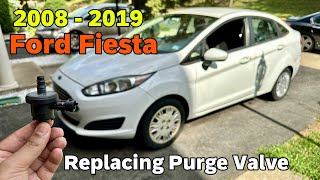
Typical fix: Replace the canister purge valve. On the Fiesta, the valve is part of a hose assembly. While some DIYers cut the old valve out and splice a new one in using heat-shrink clamps, forum users strongly recommend replacing the entire assembly for reliability, as removing the old nylon lines from the valve is extremely difficult. 🎬 See this step-by-step 1.6L purge valve replacement walkthrough.
Est. part cost: $50 - $150 - Blocked EVAP Canister Vent Solenoid or Hose 🟡 Medium Probability → Shop Vapor Canister The vent solenoid, located near the rear of the car by the charcoal canister, can get clogged with dirt, debris, or spider webs, or fail electronically. This prevents the system from venting to the atmosphere to relieve vacuum. This can be a cause if replacing the purge valve does not resolve the code.
How to confirm: Inspect the vent solenoid and its filter for blockages. A scan tool can be used to command the vent solenoid open; if vacuum doesn't release, the solenoid or its path is blocked. A smoke test can also confirm a blockage.
Typical fix: Clean or replace the canister vent solenoid and its associated filter. The solenoid is located on the charcoal canister at the rear of the vehicle.
Est. part cost: $20 - $60 - Clogged or Saturated EVAP Charcoal Canister ⚪ Low Probability → Shop Vapor Canister This usually happens as a secondary failure. Consistently overfilling the fuel tank ('topping off') can force liquid gasoline into the charcoal canister, saturating the charcoal pellets and causing a blockage. A stuck-open purge valve can also contribute to canister damage over time by pulling fuel vapors through it excessively.
How to confirm: Inspect the canister and its lines for signs of liquid fuel. If the canister is saturated, it will feel heavy and may have a strong fuel odor. A smoke test will show no flow through a clogged canister.
Typical fix: Replace the charcoal canister. It is crucial to also fix the root cause (like a bad purge valve or overfilling habit) to prevent the new canister from failing.
Est. part cost: $100 - $150
Rare But Worth Checking
- Kinked or Blocked EVAP Hose: A hose between the fuel tank, canister, and purge valve could be pinched or blocked, possibly from road debris. This is less common but should be checked with a visual inspection and/or smoke test.
- Faulty Fuel Tank Pressure (FTP) Sensor: → Shop Fuel Tank The sensor could be sending incorrect vacuum readings to the computer. This is less likely than a mechanical fault but possible. Diagnosis requires a scan tool to monitor the sensor's live data to see if it's biased.
- Powertrain Control Module (PCM) Software: For some 2015-2016 Ford Focus models with the 1.0L EcoBoost, a TSB (16-0055) was issued for P1450 that required a PCM reflash. While this TSB is not for the Fiesta, it shows a precedent for software-related fixes for this code on Ford platforms. Recall 18S32 for the Focus also involved a PCM reprogram to better detect a stuck purge valve.
Diagnosis Steps

- Read the code with an OBD-II scanner to confirm P1450 is present.
- Check for symptoms: Does the car stall or run rough after refueling? Is there a 'whoosh' when opening the gas cap?
- Locate the EVAP canister purge valve in the engine bay. It's a small solenoid with two hoses and an electrical connector, situated between the engine and battery box.
- Test the purge valve: With the engine running, disconnect the electrical connector and the EVAP hose coming from the rear of the car. Place your finger over the open port on the valve. If you feel any vacuum, the valve is stuck open and must be replaced.
- If the purge valve tests good, move to the rear of the vehicle. Locate the EVAP charcoal canister and the vent solenoid, near the fuel tank.
- Inspect the vent solenoid, its filter, and hoses for any obvious blockages like dirt, mud, or insect nests.
- If no obvious issues are found, a smoke test is the next step. This involves introducing pressurized smoke into the EVAP system to find blockages or hidden leaks. A blocked vent path will prevent smoke from exiting the vent solenoid. 🎬 Watch this simple diagnosis and repair guide for the P1450 code.
- If the vent path is clear but the code persists, use a scan tool to monitor the Fuel Tank Pressure (FTP) sensor data to ensure it is reading correctly.
Parts You'll Likely Need

- EVAP Canister Purge Valve / Solenoid Assembly
(OEM #F2BZ-9C047-C)— This is the most common failure point for code P1450 on the Ford Fiesta. It sticks open, causing excessive vacuum in the fuel tank. This part number replaces the previous version F2BZ-9C047-A. Some Fiesta ST owners have also used D2BZ-9C047-E.
Trusted brands: Motorcraft, Dorman (994-038), Standard Motor Products
OEM price range: $80-$150
Aftermarket price range: $40-$70 - EVAP Canister Vent Solenoid — This part can become clogged or fail, preventing the EVAP system from relieving vacuum, which triggers the P1450 code. This is a common second step if replacing the purge valve doesn't fix the issue.
Trusted brands: Motorcraft, Dorman (911-216)
OEM price range: $40-$60
Aftermarket price range: $20-$40
Related Codes That Often Appear With This One
- P0446 — This code for 'Evaporative Emission Control System Vent Control Circuit' can appear with P1450 if the issue is related to a blocked vent solenoid or canister.
- P219A — This code for 'Bank 1 Air-Fuel Ratio Imbalance' can be triggered by a leaking purge valve, which creates a vacuum leak into the intake manifold, upsetting the air-fuel mixture. Many Fiesta ST owners report seeing P219A alongside P1450.
- P0456 — This code for 'EVAP System Small Leak' can sometimes be triggered by a stuck-open purge valve, as seen in the related Ford Focus recall 18S32.
Technical Service Bulletins (TSBs) & Recalls
- TSB 16-0055: While for the 2015-2016 1.0L EcoBoost Focus, this TSB addressed P1450 with a PCM reflash, showing a precedent for software fixes.
Platform-Specific Known Issues
- A recall (18S32 / NHTSA 18V735) was issued for 2012-2018 Ford Focus models with 2.0L engines, but not the Fiesta. It involved a PCM software update to prevent a stuck purge valve from deforming the fuel tank and, if necessary, replacing the valve, canister, and tank. This recall acknowledges the high failure rate of the purge valve on a similar platform and the potential for tank damage.
- Owner experiences confirm that replacing the entire purge valve and hose assembly is much easier than trying to splice in a new valve, as the plastic lines are difficult to remove without damage.
- Some owners on forums report that even after replacing the purge valve, the issue can return, suggesting the replacement parts may also be prone to failure or that an underlying issue with the vent solenoid exists.
Documented NHTSA Reports
- NHTSA ODI #11197278 describes a vehicle with 48,000 miles that experienced a check engine light for codes P1450 and P0456, resulting in stalling after refueling and performance loss at high speeds.
- NHTSA ODI #11405975 notes that P1450 and P0456 are very common issues that cause the car to fail to start after filling the gas tank, and in some cases, can cause the vehicle to stall while driving.
- NHTSA ODI #11443825 reports a warning indicator for P1450 and P0456 accompanied by an abnormal winding sound and vehicle hesitation while driving.
- NHTSA ODI #11145174 reports that when fueling, the car will not start without a delay, and displays codes P2196 and P1450.
Mechanic-Grade Diagnostic Values
- EVAP Canister Purge Valve Solenoid Coil Resistance — expected: 15 to 30 Ohms is a common range for many Ford vehicles. Some sources give a wider general range of 12 to 130 Ohms.. Failure: A reading of infinite resistance (open circuit) or very low resistance (short circuit) indicates a failed solenoid coil. One owner reported a replacement part failing with a reading of 10.5 Ohms.
- Fuel Tank Pressure (FTP) Sensor Live Data (Engine Off) — expected: Approximately 0.0 inH2O (inches of water) or 2.5 Volts. The pressure should be near atmospheric pressure.. Failure: A significant positive or negative pressure reading with the engine off and gas cap removed suggests a biased or faulty FTP sensor.
- Fuel Tank Pressure (FTP) Sensor Live Data (Engine Running, Purge Valve Disconnected) — expected: The FTP reading should remain stable and not correlate with changes in engine RPM or throttle position.. Failure: If revving the engine causes the FTP value to drop (indicating a vacuum), it confirms the purge valve is leaking vacuum from the intake manifold even when electrically disconnected.
Hidden / Shadow Codes Worth Checking
- P1450-00: This is a sub-type or status byte often displayed on more advanced scan tools like Ford's IDS. The '-00' suffix typically indicates the fault is present at the time of testing but doesn't add new diagnostic information beyond the base P1450 code. (see via Ford IDS (Integrated Diagnostic System) or professional-grade scan tools (e.g., FORScan, high-end Launch/Autel).)
Scan Tool Commands That Help
- Ford IDS, FORScan, or equivalent professional scanner: EVAP System Test — This is a guided, automated test that commands the purge and vent solenoids to open and close in sequence while monitoring the FTP sensor. It can confirm if the system can build and hold vacuum and, crucially for P1450, if it can release it properly. It's a comprehensive way to verify the function of the entire system after a repair.
- Ford IDS, FORScan, or equivalent professional scanner: EVAPCV (Purge Valve) & EVAPVMV (Vent Valve) Duty Cycle Control — This bidirectional control allows a technician to manually command the purge and vent valves open and closed. This is used to isolate a faulty component. For example, you can command the vent valve closed and the purge valve open to see if vacuum builds, then command the purge valve closed and vent valve open to confirm the vacuum releases. If vacuum doesn't release when the vent is commanded open, it points to a blockage or a stuck-closed vent valve.
Wiring & Ground Locations
- EVAP Canister Purge Valve Connector — In the engine bay, on the purge valve assembly, typically between the engine and the battery box.. This connector provides power and control signal from the PCM. A damaged connector or wiring here can prevent the valve from operating, though a stuck-open mechanical failure is more common for P1450.
- EVAP Canister Vent Solenoid Connector — At the rear of the vehicle, on the EVAP canister assembly, near the fuel tank.. A bad connection here can prevent the vent solenoid from opening, trapping vacuum in the tank and causing P1450. This is a key check if a new purge valve doesn't fix the code.
- Main Engine Compartment Ground — A common ground point is located under the air intake filter box.. While not a primary cause, a poor ground connection for the PCM or related sensors can cause erratic behavior and incorrect diagnostic readings. Ensuring main grounds are clean and tight is good practice when troubleshooting persistent electronic codes.
Real Owner Repair Stories
- Fiesta ST Forum user (2017 Ford Fiesta ST) — Check Engine Light with codes P0456 and P1450, near-stalling after fill-ups, car wouldn't start at the gas pump on one occasion.
❌ Tried (didn't work) Cleaning all hose and electrical connections to the canister., Cleaning and lubing the capless fuel filler neck., Waiting 30 seconds after fueling before removing the nozzle.
✅ What actually fixed it Replacing the engine bay purge valve assembly with the correct part number (F2BZ-9C047-C for this specific car) resolved all symptoms and codes. - Reddit user r/FiestaST (Ford Fiesta ST (year not specified)) — P1450 code that persisted after replacing parts.
❌ Tried (didn't work) Replacing the EVAP purge valve harness assembly., Replacing the charcoal canister (which included the vent solenoid).
✅ What actually fixed it The user suspected the replacement purge valve was also faulty, stating they are "horribly unreliable parts." The final resolution was not posted, but the experience highlights that even new parts can be defective, and the purge valve remains the primary suspect even after replacement. - Ford Fiesta Forum user (Ford Fiesta SE (mileage 52k)) — Persistent P1450 code.
❌ Tried (didn't work) Replacing the purge valve., Clearing the codes (they returned).
✅ What actually fixed it The final fix was not posted by the original user, but other experienced users in the thread suggested the next steps were to inspect for kinked/damaged EVAP lines from road debris or to replace the charcoal canister due to saturation from over-filling the fuel tank.
OEM Part Supersession History
F2BZ-9C047-A→F2BZ-9C047-C— Standard part revision, likely for improved reliability or minor manufacturing change.D2BZ-9C047-B→D2BZ-9C047-F— Standard part revision.
Heads up: This part number series (D2BZ-*) is generally for earlier Fiesta models or has a different hose configuration than the F2BZ-* series. Owners have reported ordering the wrong part by mistake.
Model Year Variations Within This Range
- 2016-2019 (Fiesta ST): Some owners of 2016+ Fiesta STs who install aftermarket intakes report needing to use the earlier style purge valve (D2BZ-9C047-E) to prevent a check engine light, even though the factory part for their VIN is different.
- 2011-2013 vs 2014-2019: The physical configuration of the purge valve hose assembly can differ. Part number D2BZ-9C047-E is often cited for earlier models, while F2BZ-9C047-C is for later models. The 'E' part may have more tubes/connectors than the 'C' part. It is critical to visually compare the old part to the new one before purchasing.
Diagnostic Flowchart
Used vs. New Parts: Buying Guide for This Vehicle
When a used part is the smart pick: For this specific P1450 repair, buying a used EVAP purge valve or vent solenoid from a junkyard is NOT recommended. These are known high-failure-rate electronic/mechanical parts. The low cost of a new aftermarket part makes the risk and labor of installing a used part a poor value proposition. A used part may have very little life left or could be faulty from the start.
What to inspect on the donor part:
- Not applicable as used parts are not recommended for this repair.
OEM-only on this vehicle (don't cheap out):
- EVAP Canister Purge Valve Assembly: While aftermarket options exist, the OEM Motorcraft part is often recommended on forums for best reliability, despite the higher cost. Some owners report aftermarket valves failing prematurely.
Aftermarket brands forum-validated for this vehicle:
- Dorman
- Standard Motor Products (SMP)
Brands owners have reported issues with on this vehicle:
- No-name, unbranded parts from online marketplaces are a significant gamble and a common source of defective-on-arrival components.
Real Owner Stories
Aggregated from forums and TSBs cited above. Mileages and costs reflect what owners reported in those sources.
Ford Fiesta ST (MK7)
Symptoms: Check engine light with code P1450, needed to pass smog.
What fixed it: The owner had already replaced the EVAP harness (with purge valve) and the charcoal canister (with vent solenoid) without success. They suspected the replacement purge valve was also faulty, noting they are 'horribly unreliable parts'. Another user suggested checking the 'easy fuel no cap system' for a bad seal.
Source hint: Reddit r/FiestaST thread titled 'Still getting P1450 after evap harness and canister replacement : r/FiestaST - Reddit'
Ford Fiesta ST
Symptoms: Check engine light with codes P1450 and P219A.
What fixed it: The owner resolved the codes by replacing the entire purge valve assembly (Part D2BZ-9C047-E) and strongly advised against trying to splice in just the valve due to the difficulty of removing the old nylon lines.
Source hint: Fiesta ST Forum (fiestastforum.com): Thread titled 'Purge Valve Fix (codes P1450, p219a)'
Ford Fiesta ST
Symptoms: P1450 Check Engine Light persisted after trying common fixes.
What fixed it: Replacing the purge valve assembly alone did not fully resolve the issue. The owner ultimately had to also replace the canister vent solenoid and the charcoal canister to fix the problem.
Source hint: Fiesta ST Forum (fiestastforum.com): Thread titled 'P1450 Check Engine Light - Common fixes tried, other ideas?'
Ford Fiesta
Symptoms: The P1450 code returned after the owner replaced only the purge valve.
What fixed it: The issue was not yet resolved, but other forum members suggested the next steps were to check for a clogged charcoal canister caused by over-filling the fuel tank or to inspect for kinked EVAP lines.
Source hint: Ford Fiesta Forum (fordfiesta.org): Thread titled 'P1450' (March 2024)
Related OBD-II Codes
Frequently Asked Questions
My 2014 Fiesta stalls right after I get gas. Is this related to the P1450 code?
I heard there was a recall for this P1450 issue. Does it apply to my 2016 Ford Fiesta?
What is the most common part that fails and causes P1450 on the Fiesta?
Should I replace just the purge valve itself or the entire hose assembly it's attached to?
Can overfilling my gas tank cause this P1450 code?
I replaced the purge valve, but the check engine light came back on. What should I check next?
A mechanic told me I have to use an OEM Ford purge valve. Is that true?
Helpful Videos



Used OEM Parts in Stock
New Aftermarket Parts Available


The information in this article is provided for general reference and educational purposes only. Vehicle specifications, procedures, and part compatibility can vary by production date, trim level, and region. Always consult your vehicle's factory service manual and verify part numbers before purchasing or performing repairs. Safety-critical components such as airbags, seat belts, and braking systems should be installed by a qualified professional.
- Ford Fiesta:
- 🧭 Diagnostic Flowchart
- 🎬 Helpful Videos
- 🛍️ Shop This Part
- What's Unique About the 2011-2019 Ford Fiesta
- Symptoms You May Notice
- Most Likely Causes
- Rare But Worth Checking
- Diagnosis Steps
- Parts You'll Likely Need
- Related Codes That Often Appear With This One
- Technical Service Bulletins (TSBs) & Recalls
- Platform-Specific Known Issues
- Documented NHTSA Reports
- Mechanic-Grade Diagnostic Values
- Hidden / Shadow Codes Worth Checking
- Scan Tool Commands That Help
- Wiring & Ground Locations
- Real Owner Repair Stories
- OEM Part Supersession History
- Model Year Variations Within This Range
- Used vs. New Parts: Buying Guide for This Vehicle
- Real Owner Stories
- Ford Fiesta ST (MK7)
- Ford Fiesta ST
- Ford Fiesta ST
- Ford Fiesta
- Related OBD-II Codes
- Frequently Asked Questions
- 🎟️ Get 5% Off