

P1450 on 1998-2012 Ford Ranger: Causes and Fixes for 'Unable to Bleed Up Fuel Tank Vacuum'
On a 1998-2012 Ford Ranger, P1450 is almost always caused by a stuck-open EVAP purge valve located in the engine bay. A hard start after refueling is a key symptom. Replacing the purge valve is a common, DIY-friendly fix costing around $25-$60 for the part. The second most common cause is a debris-clogged canister vent solenoid near the spare tire.
- P1450 on your Ranger means the fuel tank has too much vacuum and can't 'breathe' properly.
- The most likely symptom you'll notice is the truck struggling to start right after you get gas.
- Start your diagnosis by checking the EVAP purge valve in the engine bay; it's a 5-minute check that often finds the problem.
- If the purge valve is good, your next step is to inspect the canister vent solenoid (above the spare tire) for blockages or damage.
- This is a very DIY-friendly repair, with the most common parts costing under $60.
What's Unique About the 1998-2012 Ford Ranger
For the Ford Ranger, the P1450 code points to a classic battle between two components at opposite ends of the truck. The most frequent failure is the EVAP purge valve in the engine bay sticking open, allowing constant engine vacuum to be applied to the fuel tank. However, the canister vent solenoid, located above the spare tire, is also a common culprit. Its location makes it highly susceptible to getting clogged with mud, dust, and road debris, or having its wiring damaged, which also prevents the tank from venting properly. A tell-tale symptom on the Ranger is a rough-running or difficult-to-start engine right after you fill up the gas tank. This happens because the stuck-open purge valve allows raw fuel vapor to flood the intake manifold, creating a rich running condition the engine struggles with.
Generation note: The 1998-2012 year range covers the third generation of the Ford Ranger in North America. The causes and fixes for P1450 are consistent across this generation, as the EVAP system design did not change significantly. The issue is also common on its platform-mate, the Mazda B-Series truck.
🎬 Watch: Diagnostic walkthrough for a Ranger with code P1450Symptoms You May Notice
- Check Engine Light is on.
- Difficulty starting the engine, or long crank times, especially immediately after refueling. 🎬 Watch: Why Ford vehicles struggle to start after refueling
- Rough idle or stalling, particularly after a fill-up.
- A loud 'whoosh' of air rushing into the tank when removing the gas cap.
- Reduced fuel economy.
- In some cases, stumbling on deceleration.
- Replacing the gas cap. While a faulty gas cap can cause other EVAP codes (like for small leaks), it is rarely the cause of P1450, which is about the inability to *relieve* vacuum, not a leak.
Most Likely Causes
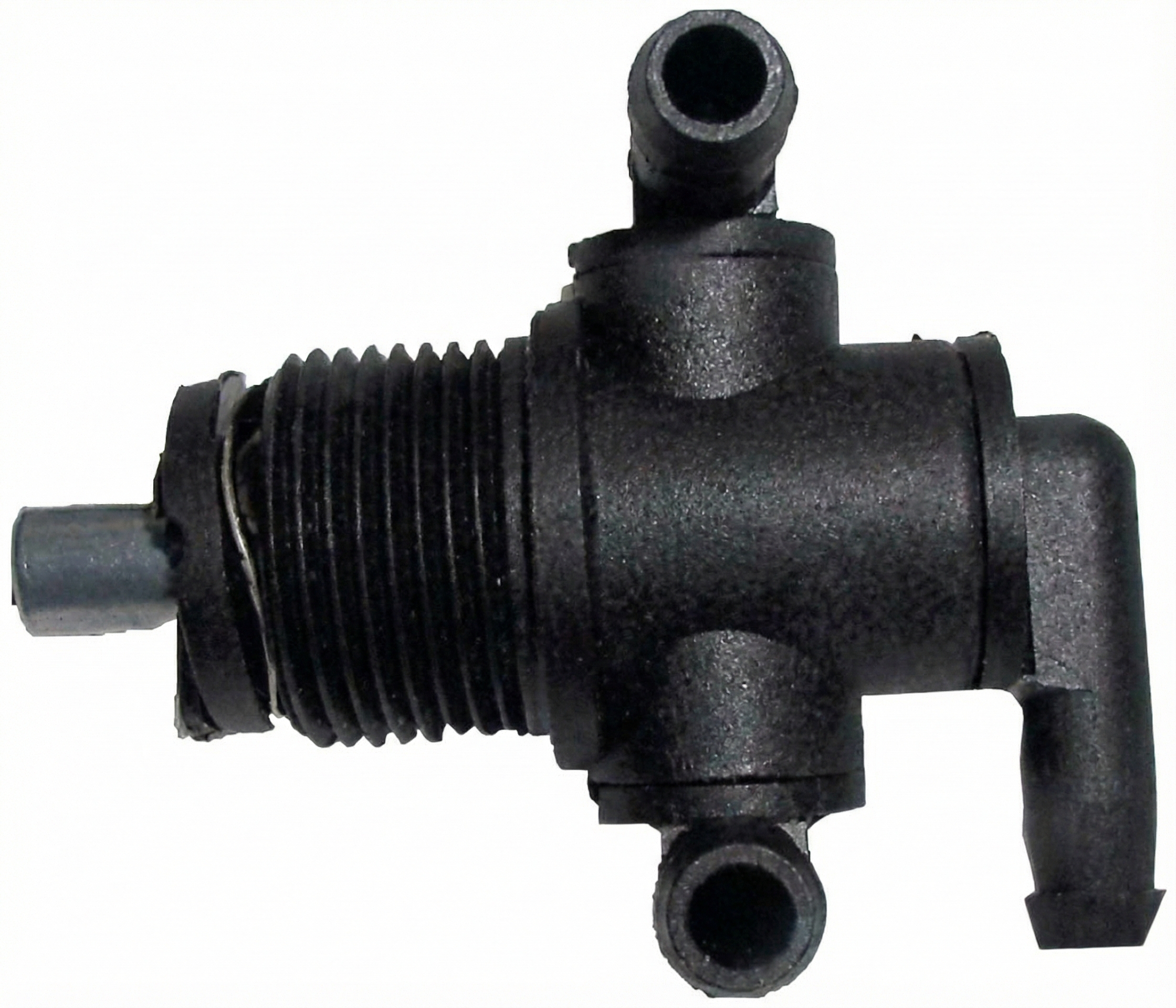
- Stuck-Open EVAP Purge Valve 🔴 High Probability → Shop Vapor Canister This is the most common failure for this code on most Ford vehicles of this era, including the Ranger. The valve fails internally and allows engine vacuum to constantly pull on the fuel tank when it should be sealed.
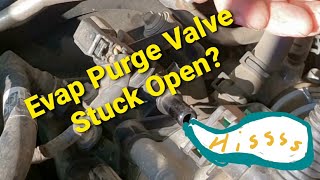
How to confirm: With the engine off, disconnect the EVAP line from the purge valve that runs to the rear of the truck. Use a hand vacuum pump on the valve's port; it should hold vacuum. If it doesn't, it's leaking and bad. Alternatively, you can try to blow through it; if air passes, the valve is stuck open. A simple test with the engine running is to disconnect the hose leading from the valve to the intake manifold and feel for suction with your thumb; if there is suction at idle, the valve is stuck open. 🎬 Watch: Quick video demonstration of this purge valve test
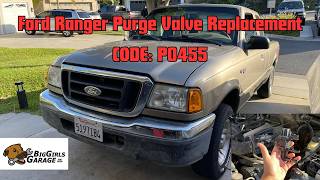
Typical fix: Replace the EVAP purge valve. This part is typically located on or near the intake manifold in the engine bay.
Est. part cost: $25-$60 - Blocked or Stuck-Closed Canister Vent Solenoid 🟡 Medium Probability → Shop Vapor Canister The vent solenoid is located above the spare tire, where it and its filter are exposed to road debris, mud, and water. This debris can clog the assembly or cause the valve to seize, preventing fresh air from entering the tank to relieve vacuum.
How to confirm: Locate the vent solenoid on the charcoal canister above the spare tire. Inspect the valve and its filter for blockage from dirt or debris. You can apply 12V to the solenoid terminals to see if it clicks open and closed. If it doesn't actuate or is packed with dirt, it has failed.
Typical fix: Replace the canister vent solenoid or clean its filter if it's serviceable. The entire charcoal canister may need replacement if the solenoid is integrated and the canister is saturated.
Est. part cost: $30-$75 - Blocked or Kinked EVAP Hoses ⚪ Low Probability Hoses can become brittle and break, or get pinched/clogged over time. The lines running along the frame rail to the rear are most susceptible. In one documented case on The Ranger Station, a user found a 'Dirt Dobber' (mud dauber) nest had clogged a line, causing the P1450 code.
How to confirm: Visually inspect all EVAP hoses running from the engine bay to the fuel tank for obvious kinks, collapses, or blockages. A smoke test is the most effective way to find a restriction.
Typical fix: Repair or replace the damaged section of hose.
Est. part cost: $10-$30
Rare But Worth Checking
- Faulty Fuel Tank Pressure (FTP) Sensor: → Shop Fuel Tank While not common, the sensor that measures tank pressure can fail and send incorrect data to the computer, making it think there's a vacuum issue when there isn't one. This should be considered after the more common mechanical parts have been checked.
- Clogged Charcoal Canister: → Shop Vapor Canister If the fuel tank is habitually over-filled ('topped off'), liquid gasoline can saturate the charcoal canister, destroying the carbon pellets and creating a blockage that prevents the system from venting.
Diagnosis Steps
- Verify the most common symptom: Does the truck have trouble starting immediately after getting gas? If yes, the purge valve is highly suspect.
- Check for a 'whoosh' sound when opening the gas cap after driving. This indicates a vacuum is present in the tank.
- Locate the EVAP purge valve in the engine bay. With the engine running, disconnect the hose between the valve and the intake manifold. If you can feel suction on the valve's port with your finger, the valve is stuck open and needs replacement.
- Alternatively, with the engine off, disconnect the electrical connector and try to blow through the valve. It should be closed and not allow air to pass.
- If the purge valve is good, move to the rear of the truck. You will likely need to lower the spare tire for access.
- Inspect the canister vent solenoid and its associated hoses/filter for any obvious blockages like mud, rust, or insect nests.
- Test the vent solenoid for proper operation using a 12V power source to see if it actuates (clicks).
- If both valves seem to be working, visually inspect all accessible EVAP lines between the front and rear of the truck for kinks or damage.
- If the cause is still not found, the next steps involve a smoke test to find a restriction or testing the Fuel Tank Pressure (FTP) sensor's output with a capable scan tool.
Parts You'll Likely Need
- EVAP Canister Purge Valve / Solenoid
(OEM #CX2695 (Motorcraft))— This is the most frequent cause of P1450 on Ford Rangers. It gets stuck open, allowing constant engine vacuum to pull on the fuel tank.
Trusted brands: Motorcraft, Bosch, Standard Motor Products
OEM price range: $40-$70
Aftermarket price range: $25-$60 - EVAP Canister Vent Solenoid — This is the second most likely cause. It gets stuck closed or clogged with debris from its location near the spare tire, preventing the fuel tank from venting.
Trusted brands: Motorcraft, Dorman
OEM price range: $50-$90
Aftermarket price range: $30-$75
Technical Service Bulletins (TSBs) & Recalls
- While no TSB is specific to the Ranger for P1450, Ford has issued TSB 19-2207 for other models like the Fusion and C-Max, identifying the canister purge valve as the definitive cause for this code. This reinforces the diagnosis that the purge valve is the primary suspect across the Ford lineup.
- Manufacturer TSB Bulletin #TSB 21-2106 for other Ford models notes that P1450 can be caused by a kinked evaporator emissions fresh air vent line, suggesting a similar inspection of vent lines on the Ranger platform.
Platform-Specific Known Issues
- Owner Experience: Mud Dauber Nest Clogs Line: A user on The Ranger Station forum with a 1998 2.5L Ranger reported solving their P1450 code after discovering a mud dauber (insect) nest had completely blocked one of the EVAP lines, preventing the system from venting. This highlights the importance of checking for physical blockages, especially on trucks that may sit for periods or are used in rural environments.
- Owner Experience: Undercoating Clogs Vent: A user on The Ranger Station with a 2004 4.0L Ranger reported the P1450 code appeared immediately after having the undercarriage treated with a rust-proofing spray (Fluid Film). The suspicion was that the spray either clogged the vent solenoid's filter or pinched a vacuum line, leading to the code.
Mechanic-Grade Diagnostic Values
- Fuel Tank Pressure (FTP) Sensor Voltage — expected: 2.4V to 2.8V with key on, engine off (atmospheric pressure). Some professional scan tools like Ford IDS may show a more precise normal range of 2.60V to 2.65V.. Failure: A voltage that is significantly lower than ~2.4V at idle (when no purge is commanded) indicates an unwanted vacuum, likely from a leaking purge valve. A voltage stuck high or low regardless of pressure indicates a faulty sensor or wiring issue.
- EVAP Canister Purge Valve Resistance — expected: Approximately 30 to 90 ohms across the two pins. Some sources cite a tighter range of 26-40 ohms for similar Ford solenoids.. Failure: A reading of OL (Open Loop/infinite resistance) or near 0 ohms (short circuit) indicates a failed solenoid coil.
- EVAP Canister Vent Solenoid Resistance — expected: Approximately 20 to 30 ohms across the two pins.. Failure: Readings significantly outside this range, or OL/short, indicate a failed solenoid coil.
Scan Tool Commands That Help
- Ford IDS (or equivalent professional scan tool like FORScan): Powertrain -> DataLogger -> PID: EVAPCV / EVAPPDC (Purge Valve) & EVAPVMV (Vent Valve) — This allows a technician to perform a bidirectional test. You can manually command the normally-closed purge valve to open and the normally-open vent valve to close, while monitoring the FTP sensor voltage to confirm each component is functioning correctly and sealing the system on command.
- Ford IDS: Toolbox -> Powertrain -> EVAP System Test — This is a guided diagnostic routine that automatically runs the onboard EVAP monitor. It commands the valves and pulls a vacuum on the system to check for large leaks, small leaks, and proper venting, providing a pass/fail result. This is the factory procedure for verifying a repair.
Wiring & Ground Locations
- C1E135 (Purge Valve Connector) — On the EVAP purge valve, located in the engine bay, often near the firewall or intake manifold.. For 2011-2012 models, Pin 1 is a Grey-Brown wire and Pin 2 is a Green-Orange wire. Checking for 12V power on one pin (key on) and the PCM's ground signal on the other is crucial for diagnosing a circuit fault vs. a failed valve.
- Canister Vent Valve Connector — On the canister vent solenoid, located above the spare tire near the charcoal canister.. On 2007 models, the Grey-Red wire should have 12V+ (from a fuse in the engine bay), and the Green-Blue wire is the ground control from the PCM. Damage to this wiring from road debris or rodents is a known issue.
- FTP Sensor Connector — On or near the fuel tank. On later models (2008+), it is integrated into a vapor tube assembly on top of the tank.. This 3-wire sensor requires a 5V reference (VREF), a signal return (ground), and the signal wire itself. A failure in the VREF or ground circuit can cause false P1450 codes.
- Ground Point (Rear) — A common ground point is located on the rear crossmember of the frame.. The canister vent solenoid and fuel tank sending unit/FTP sensor often use a nearby chassis ground. Corrosion or a loose connection at this point can cause intermittent and difficult-to-diagnose EVAP faults.
Real Owner Repair Stories
- YouTube Channel 'The Automotive Doctor Mr. Wilson' (2004 Ford Ranger (4.0L)) — Check Engine Light with an EVAP vent control fault code.
❌ Tried (didn't work) Initial diagnosis focused on checking for a blown fuse before inspecting the component.
✅ What actually fixed it After lowering the spare tire, the technician discovered rodent damage (chewed wires) to the wiring harness leading to the canister vent solenoid. Repairing the chewed wires restored power and ground to the solenoid and fixed the fault. - Ranger-Forums user 'Willy567' (Ford Ranger (year not specified, but consistent with 1998-2012)) — Check Engine Light with code P1450, poor gas mileage, and extended cranking time specifically after refueling.
❌ Tried (didn't work) Initial confusion about the cause.
✅ What actually fixed it The user was advised by another forum member that the hard start after fueling is a classic symptom of a stuck-open purge valve. The fix is to replace the EVAP purge valve located in the engine compartment.
Documented NHTSA Reports
- NHTSA ODI #11467127 describes a diagnosis for P1450 where a sticking canister purge valve was found pulling a constant vacuum, which can also be associated with misfire codes like P0300 and P0316.
- An owner reported in NHTSA ODI #11343783 that a stuck canister purge valve triggered the P1450 code specifically after filling up at a gas station, which was resolved by replacing the valve.
- NHTSA ODI #11321251 notes a case where a vehicle stalled and had trouble starting with code P1450; however, replacing the fuel tank pressure solenoid did not resolve the issue, highlighting the need to check for other vacuum restrictions.
- NHTSA ODI #11580810 records a P1450 code defined as "unable to bleed gas tank - excessive vacuum," which occurred alongside an O2 sensor code (P2196).
OEM Part Supersession History
AU5Z9C915A, AU5Z9C915B, CX2409, CX2470→CX2695 (Motorcraft)— Part consolidation and potential design updates by the manufacturer.
Heads up: CX2695 is the current service part for a wide range of Ford vehicles, including the Ranger, and should be a direct replacement for the older numbers.
Model Year Variations Within This Range
- 2005-2012: Ford began phasing in a more advanced EVAP self-test called Engine Off Natural Vacuum (EONV) starting in 2005. This system can test for small leaks after the vehicle is shut off by monitoring pressure changes as the fuel tank cools. While the primary components causing P1450 remain the same, the diagnostic monitor's strategy is different from earlier years.
- 2008-2012: On at least the 2008 and 2011 model years, the Fuel Tank Pressure (FTP) sensor is not sold as a standalone part. It is integrated with the rear fuel tank vapor tube and must be purchased and replaced as a complete assembly.
- 1998-2000: While still an OBD-II system, the EVAP components and their locations may differ slightly from later models. For example, on some early models, the FTP sensor may be located in a hard plastic line coming off the tank, whereas on a 2000 model it is located inside the fuel tank itself.
Diagnostic Flowchart
Other Known Issues on This Vehicle
Issues unrelated to this code that are worth knowing about as an owner of this generation:
- 4.0L SOHC V6 Timing Chain Cassette Failure 🔴 High — Very common, especially on earlier models (pre-2005). Often manifests as a rattling noise ('death rattle') on startup or at idle. Failure can lead to catastrophic engine damage.
- Frame Rust 🔴 High — Extremely common in the rust belt. The frame tends to rust severely near the rear leaf spring hangers and where the spare tire carrier mounts, potentially compromising structural integrity.
- 5R55E Automatic Transmission Failures 🟠 Medium — Commonly reported around 100,000-150,000 miles. Symptoms include delayed/harsh shifting, loss of gears (especially reverse), and slipping. Often caused by a failed solenoid pack or worn internal bands.
- Cracked Plastic Thermostat Housing (4.0L SOHC) 🟡 Low — A very frequent failure point leading to coolant leaks. The plastic housing can warp or crack with age. If not addressed, the resulting coolant loss can cause overheating.
- Idle Air Control (IAC) Valve Failure 🟡 Low — Common across all engine types. A faulty IAC valve causes symptoms like a rough or surging idle, and stalling. It's a relatively inexpensive and easy part to replace.
Used vs. New Parts: Buying Guide for This Vehicle
When a used part is the smart pick: For this repair, obtaining used parts from a junkyard can be a cost-effective option for structural components like the charcoal canister (if not saturated with fuel) or specific EVAP hoses and lines that are no longer available new. These parts have no electronic or moving components that wear out.
Donor-vehicle mileage cap: roughly under 120000 miles for the part to have meaningful remaining life.
What to inspect on the donor part:
- For charcoal canisters, ensure there is no sound of loose charcoal pellets when shaken and no visible cracks in the housing.
- For hoses, inspect carefully for any signs of dry rot, cracking, or brittleness, especially at the ends.
- When pulling electronic parts like the purge or vent solenoid, inspect the plastic for extreme fading or brittleness and the connector pins for corrosion. Test resistance with a multimeter before purchase if possible.
OEM-only on this vehicle (don't cheap out):
- While not strictly required, using an OEM Motorcraft Fuel Tank Pressure (FTP) sensor is often recommended by forum veterans for reliability and accurate readings, as aftermarket sensors can sometimes have slightly different voltage scaling that may cause issues with the sensitive EVAP monitor.
Aftermarket brands forum-validated for this vehicle:
- Dorman (For canister vent solenoid, often part #911-217)
- Standard Motor Products (SMP) (For purge valve and other EVAP components)
- Bosch (For purge valve)
Brands owners have reported issues with on this vehicle:
- Avoid unbranded, 'white-box' electronic solenoids from online marketplaces. While cheap, they have a high failure rate and may not operate to the precise specifications required by the Ford EVAP monitor, leading to the code returning.
Real Owner Stories
Aggregated from forums and TSBs cited above. Mileages and costs reflect what owners reported in those sources.
1998 Ford Ranger 2.5L
Symptoms: P1450 code; system unable to vent.
What fixed it: Discovered and removed a mud dauber (insect) nest that had completely blocked one of the EVAP lines.
Source hint: The Ranger Station (therangerstation.com)
2004 Ford Ranger 4.0L
Symptoms: P1450 code appeared immediately after having the undercarriage treated with a rust-proofing spray (Fluid Film).
What fixed it: The owner suspected the spray clogged the vent solenoid's filter or pinched a vacuum line.
Source hint: The Ranger Station (therangerstation.com)
2004 Ford Ranger
Symptoms: Check engine light (p1450).
What fixed it: The user reported the problem after already replacing the purge valve and fuel cap, and checking wires and the charcoal canister.
Source hint: RepairPal [owner_reports]
Related OBD-II Codes
Frequently Asked Questions
Where is the EVAP vent solenoid located on my Ford Ranger?
Does Ford TSB 19-2207 apply to my 1998-2012 Ranger?
Why does my Ranger have trouble starting only after I fill up the gas tank?
Can I test the purge valve myself without special tools?
I just had my truck undercoated and now I have a P1450 code. Is that related?
Could an insect nest really cause this check engine light?
Helpful Videos

We Have This Part in Stock

The information in this article is provided for general reference and educational purposes only. Vehicle specifications, procedures, and part compatibility can vary by production date, trim level, and region. Always consult your vehicle's factory service manual and verify part numbers before purchasing or performing repairs. Safety-critical components such as airbags, seat belts, and braking systems should be installed by a qualified professional.
- Ford Ranger:
- 🧭 Diagnostic Flowchart
- 🎬 Helpful Videos
- 🛍️ Shop This Part
- What's Unique About the 1998-2012 Ford Ranger
- Symptoms You May Notice
- Most Likely Causes
- Rare But Worth Checking
- Diagnosis Steps
- Parts You'll Likely Need
- Technical Service Bulletins (TSBs) & Recalls
- Platform-Specific Known Issues
- Mechanic-Grade Diagnostic Values
- Scan Tool Commands That Help
- Wiring & Ground Locations
- Real Owner Repair Stories
- Documented NHTSA Reports
- OEM Part Supersession History
- Model Year Variations Within This Range
- Other Known Issues on This Vehicle
- Used vs. New Parts: Buying Guide for This Vehicle
- Real Owner Stories
- 1998 Ford Ranger 2.5L
- 2004 Ford Ranger 4.0L
- 2004 Ford Ranger
- Related OBD-II Codes
- Frequently Asked Questions
- 🎟️ Get 5% Off