

P1450 on 2013-2016 Mazda CX-5: Causes and Fixes for Unable to Bleed Fuel Tank Vacuum
On a 2013-2016 Mazda CX-5, code P1450 is almost always caused by a faulty vapor canister purge solenoid valve that is stuck open. This is a common failure, and replacing this valve is a simple DIY fix that usually resolves the issue. Expect to pay around $60-$110 for an OEM part.
- P1450 means your CX-5's fuel tank is holding too much vacuum, usually due to a blockage, not a leak.
- The most likely cause by a wide margin is a canister purge solenoid valve that is stuck open.
- A key symptom is a loud 'whoosh' of air when you open the gas cap after driving.
- You can easily test the purge valve yourself in about 15 minutes with basic tools before buying any parts.
What's Unique About the 2013-2016 Mazda CX-5
The 2013-2016 Mazda CX-5 uses the Skyactiv family of engines (both 2.0L and 2.5L) which share EVAP system components with other Mazdas of this era, including the Mazda 3, 6, and CX-9. While a Technical Service Bulletin (TSB 01-012/14) for P1450 specifically names the Mazda 6, it highlights a known weakness with the purge solenoid valve design (Part No. PE01-18-751) across the Mazda lineup, making it the primary suspect on the CX-5 as well. This isn't a unique problem to the CX-5, but rather a common Mazda issue of the period.
Symptoms You May Notice
- Check Engine Light illuminated on the dashboard.
- A loud 'whoosh' or suction sound when opening the gas cap.
- Difficulty starting the engine immediately after refueling. This happens because the stuck-open purge valve allows un-metered fuel vapors to flood the intake manifold, creating a rich condition similar to a flooded engine.
- Slightly rough or unstable idle.
- Gas pump nozzle clicks off repeatedly when trying to refuel.
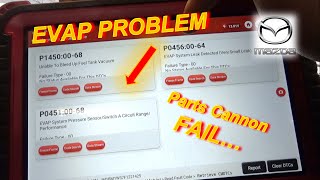
- Replacing the gas cap. A faulty gas cap typically causes a large leak code (like P0455), not a code for excessive vacuum. 🎬 See why replacing random parts won't fix these EVAP codes. P1450 indicates the system is sealed too well and cannot vent, which is the opposite problem of a leak.
Most Likely Causes
- Faulty Vapor Canister Purge Solenoid Valve 🔴 High Probability → Shop Vapor Canister This is a common failure item across many Mazda models from this era that share the same part design, as evidenced by a TSB for the Mazda 6. The valve gets stuck internally, allowing un-commanded engine vacuum to constantly pull on the fuel tank.
How to confirm: With the engine idling, locate the purge valve in the engine bay. Disconnect its electrical connector and the hose coming from the charcoal canister. Place your finger over the port on the valve itself. If you feel any suction, the valve is stuck open and has failed. This test is definitive and should be the first step.
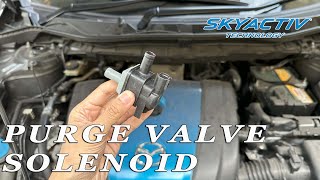
Typical fix: Replace the vapor canister purge solenoid valve. It is a 10-15 minute job with basic tools. 🎬 Watch this quick step-by-step purge valve replacement walkthrough.
Est. part cost: $60-$110 - Blocked EVAP Canister Vent Hose or Solenoid 🟡 Medium Probability → Shop Vapor Canister The vent hose outlet is located under the vehicle near the charcoal canister and can become clogged with dirt, debris, or even ice in cold climates. Spiders building nests in the vent hose opening is a surprisingly common cause of this blockage. A TSB for a related code (P0451) on other Mazda models notes that water can accumulate and freeze in the vent hose, causing a blockage.
How to confirm: Visually inspect the vent solenoid and its hose near the charcoal canister at the rear of the vehicle. Check for any obvious blockages or kinks. A smoke test can be used to verify that the vent path is clear when the vent solenoid is commanded open.
Typical fix: Clean the blockage from the vent hose or replace the canister vent solenoid if it is stuck closed.
Est. part cost: $50-$100 - Kinked or Collapsed EVAP Hose ⚪ Low Probability
How to confirm: Visually inspect all accessible EVAP system hoses between the engine bay, fuel tank, and charcoal canister for any sharp bends, kinks, or signs of collapse.
Typical fix: Straighten the kinked hose or replace the damaged section of the hose.
Est. part cost: $10-$30
Rare But Worth Checking
- Faulty Fuel Tank Pressure (FTP) Sensor: → Shop Fuel Tank The sensor itself can fail and send incorrect vacuum readings to the PCM, causing the code to set even if the mechanical parts are working correctly.
- Saturated Charcoal Canister: → Shop Vapor Canister Repeatedly overfilling the fuel tank (topping off after the pump clicks) can force liquid fuel into the charcoal canister, saturating it and blocking airflow.
Diagnosis Steps
- Confirm that P1450 is the only code present, or note any other related codes, using an OBD-II scanner.
- After driving the vehicle, carefully open the gas cap and listen for a loud 'whoosh' of air. This confirms that excessive vacuum is being held in the tank.
- Locate the vapor canister purge solenoid valve in the engine bay, typically on or near the intake manifold.
- Start the engine and let it idle. Disconnect the electrical connector from the purge valve.
- Disconnect the EVAP hose that runs from the charcoal canister to the purge valve. Place your finger on the valve's inlet port. If you feel any suction, the valve is internally stuck open and must be replaced. This is the most common failure.
- If no suction is felt, the purge valve is likely good. The next step is to inspect the vent path.
- Raise the vehicle and locate the charcoal canister and vent solenoid at the rear. Visually inspect the vent hose for clogs from dirt, debris, or spider webs.
- If possible, use a scan tool to command the vent solenoid open and closed to verify its operation. If it doesn't click or open, it may be faulty.
- If the vent path seems clear, inspect all other EVAP hoses for kinks or damage.
Parts You'll Likely Need
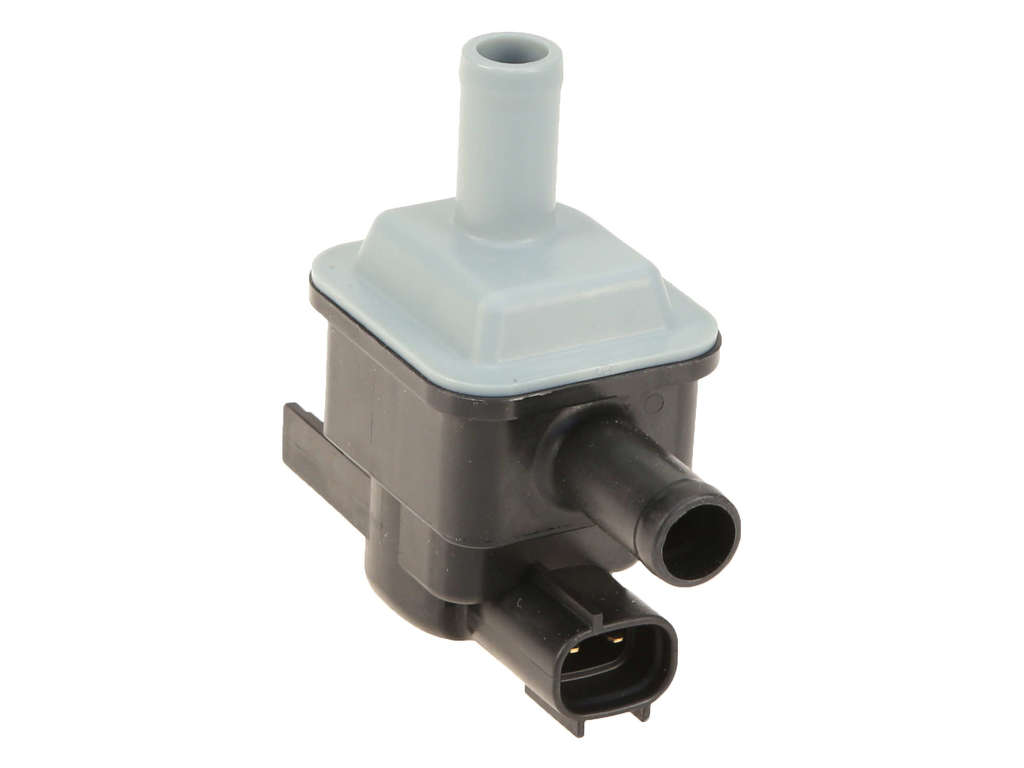
- Vapor Canister Purge Solenoid Valve
(OEM #PE01-18-751)— This is the most frequent failure point for code P1450 on this vehicle. It gets stuck open, causing a constant vacuum pull on the fuel tank. This part is also cross-referenced with Denso part number 136200-7230.
Trusted brands: Genuine Mazda, Standard Motor Products, Wells, Holstein
OEM price range: $105-$140
Aftermarket price range: $45-$75
Related Codes That Often Appear With This One
- P0496 — This code indicates 'Evaporative Emission System High Purge Flow', which is a direct result of the most common cause for P1450: a purge valve stuck open.
- P0451 — This code relates to a performance issue with the Fuel Tank Pressure (FTP) sensor. It can appear alongside P1450 if the sensor is faulty or if a blockage (like a frozen vent hose) causes an implausible pressure reading.
Technical Service Bulletins (TSBs) & Recalls
- 01-012/14: While officially for the 2009-2013 Mazda 6, this TSB addresses code P1450 caused by a faulty purge valve, indicating a known issue with this component in the Mazda family.
- Bulletin #01-012-14-2908A: This manufacturer bulletin notes that some vehicles may experience MIL illumination with DTC P1450:00 (Unable to bleed up fuel tank vacuum) stored in memory, a concern that may be caused by the purge valve which has since been modified.
Mechanic-Grade Diagnostic Values
- Vapor Canister Purge Solenoid Coil Resistance — expected: 22 - 26 Ω (ohms). Failure: A reading of infinite resistance (open circuit) or near-zero resistance (short circuit) indicates a failed solenoid.
- Fuel Tank Pressure (FTP) Sensor Voltage (Key On, Engine Off, Gas Cap Off) — expected: Approximately 2.5V - 2.6V. Failure: A voltage reading that is stuck high (near 5V), low (near 0V), or does not return to this baseline when the system is open to atmosphere indicates a faulty sensor or a blockage in its reference hose.
- Voltage at Purge Solenoid Connector (Power Pin to Ground) — expected: ~12V (Battery Voltage) with Key On. Failure: No voltage suggests a blown fuse or a break in the power supply wire.
Scan Tool Commands That Help
- Mazda M-MDS (or equivalent professional scanner): Simulation Function: [PRG_DUTY] — This bidirectional control allows a technician to manually command the purge solenoid valve to a specific duty cycle (e.g., 50% or 100%). While commanding the valve open, the technician should monitor the Short Term Fuel Trim PID ([SHRT_FUEL_TRIM11]). A corresponding change in fuel trim confirms the valve is opening and vapors are being introduced, helping to verify the valve's mechanical operation and flow.
- Mazda M-MDS (or equivalent professional scanner): EVAP Vent Valve Actuation Test — This command manually opens and closes the canister vent solenoid at the rear of the vehicle. When commanded open, any vacuum shown on the FTP sensor live data should bleed off to zero (atmospheric pressure). If the vacuum remains, it confirms a blockage in the vent path (hose, nipple, filter) rather than a faulty purge valve.
Wiring & Ground Locations
- Purge Solenoid Valve — On the right rear of the engine, typically mounted to a bracket near the intake manifold and firewall.. This is the physical location of the most common failure part. Access is required for the primary diagnostic test (feeling for suction) and for replacement.
- G07 — An engine ground point located on the left rear of the engine for the 2.0L Skyactiv engine.. A poor engine ground can cause erratic behavior in various electronic components, including solenoids controlled by the PCM. While not a primary cause, verifying major engine grounds are clean and tight is a good practice if electrical issues are suspected.
- Purge Solenoid Connector — The 2-pin electrical connector on the purge solenoid valve itself.. This is the main test point for electrical diagnosis. One pin should have battery voltage with the key on. The other is the control wire that the PCM pulses to ground to activate the valve. Testing here isolates the problem to the valve vs. the wiring or PCM.
Real Owner Repair Stories
- Pine Hollow Auto Diagnostics (YouTube) (2015 Mazda 3 (shares EVAP components and design with CX-5)) — Persistent P1450 and P0451 codes, needed to pass emissions inspection.
❌ Tried (didn't work) Replaced canister purge valve (OEM), Replaced charcoal canister (OEM), Replaced gas cap (OEM)
✅ What actually fixed it The canister vent hose nipple, where it vents into the vehicle's frame rail, was completely clogged with dirt and dust. Cleaning out this blockage allowed the system to vent properly and resolved the codes. The key diagnostic clue was the FTP sensor reading a slight vacuum at rest (2.2V) instead of atmospheric pressure (~2.6V). - Mazdas247 Forum User 'Droth' (2015 Mazda CX-9 (shares EVAP components)) — P1450 code present for almost a year.
❌ Tried (didn't work) Replaced gas cap, Replaced vapor canister purge valve (in engine bay)
✅ What actually fixed it The user did not post a final resolution, but after the common parts failed to fix the issue, other forum members advised them that the problem was likely a plugged line or a faulty vent solenoid in the charcoal canister area at the rear of the vehicle. This advice directly aligns with other confirmed, less common fixes for this code.
"I Checked Everything" — The Actual Cause
- In a documented case on a similar Mazda platform, the owner had replaced the purge valve, canister, and gas cap for a P1450 code without success. The root cause was not a leak that a smoke test would typically find, but a complete blockage. The small nipple on the end of the canister vent hose, which is designed to vent into a cavity in the vehicle's frame, was packed solid with dirt. This prevented the EVAP system from drawing in fresh air to release vacuum, triggering the 'Unable to Bleed' code. The fix was to simply clear the debris from the nipple.
Diagnostic Flowchart
Other Known Issues on This Vehicle
Issues unrelated to this code that are worth knowing about as an owner of this generation:
- Leaking Serpentine Belt Tensioner 🟠 Medium — A very common failure. The tensioner leaks hydraulic fluid, causing belt squeal and potential slippage. Often occurs between 60,000 and 100,000 miles. (Ref: TSB 01-019/19.)
- Failing LED Daytime Running Lights (DRL) 🟡 Low — Specific to 2016 models, the DRLs can flicker or fail completely. The entire headlight assembly often needs replacement. (Ref: Recall 4320A.)
- Intake Valve Carbon Buildup 🟠 Medium — As a direct-injection (GDI) engine, the Skyactiv platform is susceptible to carbon buildup on intake valves over time, as fuel does not wash over them. This can cause performance loss after 100,000+ miles.
- Failing Rear Hatch Liftgate Struts 🟡 Low — Struts can corrode and fail, causing the liftgate to drop unexpectedly. Particularly an issue in regions where road salt is used. (Ref: Recall 9916H.)
- Cracked Windshields 🟡 Low — Numerous owner reports suggest the original windshields are prone to cracking easily from small impacts or even temperature changes.
- Shifter Park Switch Failure 🟡 Low — A faulty switch in the shifter assembly can prevent the vehicle from fully turning off, leaving it in accessory mode and draining the battery.
Used vs. New Parts: Buying Guide for This Vehicle
When a used part is the smart pick: For the primary failure part, the vapor canister purge solenoid valve (PE01-18-751), a used OEM part from a reputable auto recycler can be a smart choice. It is often more reliable than a cheap, no-name aftermarket part. Since this is an electronic solenoid and not a high-wear mechanical item, its function is often binary (it works or it doesn't).
Donor-vehicle mileage cap: roughly under 80000 miles for the part to have meaningful remaining life.
What to inspect on the donor part:
- Source from a vehicle with verifiable low-to-moderate mileage.
- Ensure the part is a genuine OEM part (look for Mazda or Denso markings), not a previously installed aftermarket part.
- Inspect the plastic housing for cracks and the electrical connector pins for corrosion.
Aftermarket brands forum-validated for this vehicle:
- Standard Motor Products (SMP)
- Denso (often the original OEM manufacturer)
- Wells
- Holstein
Brands owners have reported issues with on this vehicle:
- Unbranded, 'white-box' parts from online marketplaces have been reported by some owners to fail quickly or not perform to OEM specification, sometimes causing new codes to appear.
Real Owner Stories
Aggregated from forums and TSBs cited above. Mileages and costs reflect what owners reported in those sources.
2016 Mazda CX-9
Symptoms: The owner dealt with a Check Engine Light P1450 for almost a year. They attempted to replace the purge valve and gas cap without success.
What fixed it: The owner was advised to check the charcoal canister and vent solenoid area for blockages.
Source hint: Mazdas247 - 'Been dealing with this Check Engine P1450 for almost a year'
2015 Mazda CX-5
Symptoms: The owner described a classic hard-start symptom specifically after filling the gas tank with fuel.
What fixed it: The issue was identified as a stuck-open EVAP purge valve flooding the engine with vapors.
Source hint: Mazda Forum - 'Problem Starting After Re-fueling'
2014 Mazda CX-5 — ~100000 miles
Symptoms: Performance loss and carbon buildup issues on the intake valves of the Skyactiv GDI engine.
What fixed it: Cleaning of the intake valves to remove carbon deposits that accumulate because fuel does not wash over them in direct-injection engines.
Source hint: Known issues section citing intake valve carbon buildup
Related OBD-II Codes
Frequently Asked Questions
Does TSB 01-012/14 apply to my 2013-2016 Mazda CX-5?
Why does my CX-5 struggle to start only after I fill up the gas tank?
Is there a specific part number I should look for when replacing the purge valve?
Why does the gas pump nozzle keep clicking off when I try to refuel my CX-5?
Can cold weather cause the P1450 code on my Mazda?
How can I quickly test if the purge solenoid is the problem?
Helpful Videos
We Have This Part in Stock


The information in this article is provided for general reference and educational purposes only. Vehicle specifications, procedures, and part compatibility can vary by production date, trim level, and region. Always consult your vehicle's factory service manual and verify part numbers before purchasing or performing repairs. Safety-critical components such as airbags, seat belts, and braking systems should be installed by a qualified professional.
- Mazda CX-5:
- 🧭 Diagnostic Flowchart
- 🎬 Helpful Videos
- 🛍️ Shop This Part
- What's Unique About the 2013-2016 Mazda CX-5
- Symptoms You May Notice
- Most Likely Causes
- Rare But Worth Checking
- Diagnosis Steps
- Parts You'll Likely Need
- Related Codes That Often Appear With This One
- Technical Service Bulletins (TSBs) & Recalls
- Mechanic-Grade Diagnostic Values
- Scan Tool Commands That Help
- Wiring & Ground Locations
- Real Owner Repair Stories
- "I Checked Everything" — The Actual Cause
- Other Known Issues on This Vehicle
- Used vs. New Parts: Buying Guide for This Vehicle
- Real Owner Stories
- 2016 Mazda CX-9
- 2015 Mazda CX-5
- 2014 Mazda CX-5 — ~100000 miles
- Related OBD-II Codes
- Frequently Asked Questions
- 🎟️ Get 5% Off