

P1450 on 2016-2024 Mazda MX-5 Miata: Causes for Unable to Bleed Fuel Tank Vacuum
On a 2016-2024 MX-5 Miata, code P1450 almost always means the canister purge solenoid valve is stuck open. This is a common issue on Mazda's Skyactiv engines. A loud 'whoosh' when opening the gas cap is a key symptom. Replacing the purge valve is a DIY-friendly fix, with the part costing approximately $50-$120.
- P1450 means your fuel tank has too much vacuum, not a leak. Do not replace the gas cap.
- The most likely cause is a faulty canister purge solenoid valve located on the engine.
- A key symptom is a loud 'whoosh' of air when you open the gas cap.
- You can test the purge valve yourself in about 15 minutes to confirm if it's bad before buying a new one.
- The repair is DIY-friendly and typically inexpensive.
What's Unique About the 2016-2024 Mazda MX-5 Miata
While there are very few documented cases of P1450 specifically for the ND generation (2016-2024) MX-5 Miata, the code is extremely common across other Mazda vehicles that share the Skyactiv engine technology, such as the Mazda3, Mazda6, and CX-5. On those models, the cause is overwhelmingly a faulty canister purge solenoid valve. A Technical Service Bulletin (TSB 01-012/14) was issued for 2014-2015 Mazda6 models for this exact issue, stating, "This concern may be caused by the purge valve, which has been modified to eliminate this concern." This confirms a known weakness in the original purge valve design, making it highly probable that the MX-5 Miata follows the same failure pattern. Manufacturer TSB Bulletin #01-012-14-2908A further clarifies that the code P1450:00 specifically indicates the system is "unable to bleed up fuel tank vacuum."
Symptoms You May Notice
- Check Engine Light is on.
- A loud 'whoosh' or suction sound when opening the gas cap after driving.
- Difficulty starting the engine immediately after refueling.
- Rough or erratic idle, sometimes hunting for idle.
- Difficulty refueling (gas pump nozzle clicks off repeatedly).
- Replacing the gas cap. This code is for an inability to vent vacuum, meaning the system is sealed too well. A faulty, leaking gas cap would typically cause a different code for a large EVAP leak (like P0455).
Most Likely Causes
- Canister Purge Solenoid Valve Stuck Open 🔴 High Probability → Shop Vapor Canister This is a well-documented, common failure item across the entire Mazda lineup using Skyactiv engines. Mazda issued TSB 01-012/14 for other models, acknowledging the fault and releasing a modified part.
How to confirm: With the engine idling, disconnect the electrical connector from the purge valve. Then, disconnect the hose running from the valve to the intake manifold. If you can feel suction from the valve's port with your finger, it is stuck open and faulty. The valve should be closed with no vacuum passing through it at idle with the connector unplugged. Alternatively, remove the valve and try to blow through it; if air passes, it is stuck open.
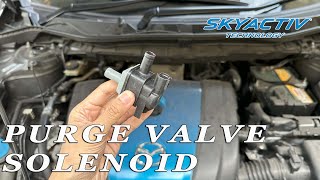
Typical fix: Replace the canister purge solenoid valve. It is typically located on the engine's intake manifold and is accessible for DIY replacement. 🎬 Watch: Step-by-step Mazda purge valve replacement guide
Est. part cost: $50-$120 - Blocked EVAP Canister Vent Solenoid or Hose 🟡 Medium Probability → Shop Vapor Canister The vent path, which allows fresh air in to relieve vacuum, can become blocked by debris, dirt, or spider webs, a known issue on some Mazda vehicles. A TSB for a different EVAP code on the Mazda3 even suggests cutting the vent hose at an angle to prevent water accumulation.
How to confirm: Locate the EVAP canister and vent solenoid at the rear of the vehicle. Inspect the vent hose outlet for any visible blockages. A professional may use a smoke machine to force smoke through the system and see if it exits the vent properly.
Typical fix: Clean the blockage from the vent hose or replace the canister vent solenoid if it is stuck closed.
Est. part cost: $40-$100 - Kinked or Collapsed EVAP Hose ⚪ Low Probability
How to confirm: Visually inspect all accessible EVAP hoses between the engine bay, the fuel tank, and the charcoal canister for any kinks, sharp bends, or signs of collapse.
Typical fix: Straighten the kinked hose or replace the damaged section of the hose.
Est. part cost: $10-$30
Rare But Worth Checking
- Faulty Fuel Tank Pressure (FTP) Sensor: → Shop Fuel Tank While less common, the sensor that reports the vacuum level to the PCM can fail and give false readings, causing the code to be set even if the mechanical parts are working correctly.
- Saturated Charcoal Canister: → Shop Vapor Canister Consistently overfilling the fuel tank (topping off after the pump clicks) can force liquid fuel into the charcoal canister, saturating it and blocking airflow. This is an expensive part to replace, so other causes should be ruled out first.
- Clogged Fuel Tank Pressure (FTP) Sensor Vent Hole: → Shop Fuel Tank On some vehicles, the FTP sensor has a small reference port open to the atmosphere. If this port becomes clogged, often by oily undercoating spray attracting dirt, it can cause incorrect pressure readings and trigger a P1450 code. This has been noted on other makes but is a plausible, though rare, cause.
Diagnosis Steps
- Confirm the code P1450 is present using an OBD-II scanner.
- After driving, listen for a 'whoosh' sound when opening the gas cap. A loud suction noise strongly suggests this vacuum issue.
- Locate the canister purge solenoid valve on the engine's intake manifold.
- With the engine running at idle, disconnect the electrical plug from the purge valve.
- Carefully detach the vacuum hose from the purge valve's outlet port (the side going to the intake).
- Place your finger over the port on the valve. If you feel any vacuum suction, the valve is stuck open and must be replaced. It should be closed by default.
- If the purge valve is not stuck, the next step is to inspect the EVAP system at the rear of the car.
- Visually inspect the vent hose from the charcoal canister for any obvious blockages, nests, or kinks.
- If the path seems clear, the canister vent solenoid may be stuck closed. This can be tested by applying 12V power to it (with a Power Probe or jumper wires) and listening for a click or by using a scan tool to command it open.
- If all components test good, consider a professional diagnosis with a smoke machine to find a hidden restriction in a line or the canister itself.
Parts You'll Likely Need
- Canister Purge Solenoid Valve
(OEM #PE01-18-751)— This is the most common failure point for code P1450 across the Mazda lineup, as it gets stuck open and constantly pulls vacuum on the fuel tank. A TSB confirms a modified part was released for this issue.
Trusted brands: Mazda (OEM), Bosch, Dorman, Standard Motor Products (CP737)
OEM price range: $80-$140
Aftermarket price range: $45-$90
Technical Service Bulletins (TSBs) & Recalls
- TSB 01-012/14: While this TSB is for the 2014-2015 Mazda6, it is highly relevant. It addresses DTC P1450 and states, "This concern may be caused by the purge valve, which has been modified to eliminate this concern." This is official acknowledgment from Mazda of a design flaw in the original part that causes this exact code.
- TSB Bulletin #01-012-14-2908A: This manufacturer bulletin notes that some vehicles may experience MIL illumination with DTC P1450:00 stored in memory, which is defined as being "unable to bleed up fuel tank vacuum." It confirms the purge valve has been modified to address this specific concern.
Mechanic-Grade Diagnostic Values
- Fuel Tank Pressure (FTP) Sensor Voltage — expected: Approximately 2.6 V with the key on, engine off, and the fuel cap removed (at atmospheric pressure).. Failure: Voltage is stuck high (near 5V), low (near 0V), or does not decrease from ~2.6V towards 1.5V when a light vacuum is applied to the system.
- Canister Purge Solenoid Valve Function Test — expected: When removed from the vehicle and de-energized, no air should pass through the valve when you blow into it. When 12V is applied to its two terminals, the valve should click open and allow air to pass through.. Failure: If air can be blown through the valve when it is de-energized, it is stuck open and faulty. If it does not open when 12V is applied, it has failed electrically. 🎬 Watch: How to clean and test a purge solenoid
Scan Tool Commands That Help
- Mazda IDS / FORScan: EVAP System Test — This function forces the onboard EVAP monitor to run on demand. It allows a technician to test the system's ability to generate and release vacuum without having to perform a specific drive cycle, speeding up diagnosis.
- Mazda IDS / FORScan: Purge Solenoid Valve (Purge V) Duty Cycle Command — This bidirectional control allows you to command the purge valve to 0% (fully closed). While monitoring live FTP sensor data, if vacuum still builds in the tank with the valve commanded closed, it definitively proves the valve is mechanically stuck open and needs replacement.
Wiring & Ground Locations
- Canister Purge Solenoid Valve Connector — On the purge valve itself, which is located on the engine's intake manifold. It is a 2-pin rectangular female connector.. This is the connector to disconnect for the primary diagnostic test (checking for vacuum at idle) and where voltage would be applied to test the solenoid's function off the vehicle.
- EVAP System Ground Points — Specific ground point locations for the ND Miata's chassis and engine bay can be found in the factory service manual's wiring diagrams.. A poor ground for the Fuel Tank Pressure sensor or vent/purge solenoids could cause erratic operation or incorrect readings, potentially leading to a P1450 code.
Real Owner Repair Stories
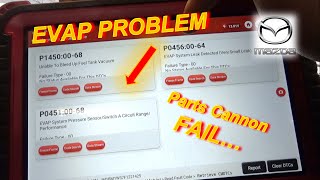
- Pine Hollow Auto Diagnostics (YouTube) (2015 Mazda 3 (Skyactiv Engine)) — Persistent P1450 and P0451 codes, needed to pass state emissions inspection.
❌ Tried (didn't work) Replaced Canister Purge Valve with OEM part, Replaced EVAP Canister with OEM part, Replaced Gas Cap with OEM part
✅ What actually fixed it The technician diagnosed the issue by analyzing live data from the FTP sensor, which was not reading 0 at atmospheric pressure. Referencing a TSB for the P0451 code, he identified the likely cause as water accumulating in the canister vent hose, which can freeze in cold weather and cause a blockage. The recommended fix was to inspect and clear this hose. - Ford Edge Forum user (2017 Ford Edge 2.0L EcoBoost (shares P1450 definition)) — P1450 code at 75,000 miles.
❌ Tried (didn't work) Replacing the purge valve initially cleared the code.
✅ What actually fixed it The same P1450 code returned one month after replacing the purge valve. The owner was advised that a second, brand-new purge valve failing is unlikely, and the next step is to investigate a blockage in the vent solenoid or associated lines. The final resolution was not posted, but it serves as a key example that the purge valve is not always the final fix.
"I Checked Everything" — The Actual Cause
- In a documented case on a Mazda 3, a shop performed a smoke test which revealed no leaks, but the P1450 code persisted. The actual cause was found to be a physically kinked EVAP hose that was restricting flow but not leaking, which was only found upon detailed visual inspection.
- A professional technician diagnosing a Mazda 3 with P1450 and P0451, after the owner had already replaced all common parts, suspected the issue was not a leak but a blockage. He referenced a TSB about water accumulating and potentially freezing in the canister vent hose, which would not show up on a smoke test as a leak but would prevent the system from bleeding vacuum.
When the Usual Fixes Don't Work
- While the canister purge solenoid valve is the cause in over 90% of cases, there are documented instances where replacing it does not solve the problem or only solves it temporarily. In one case involving a similar platform, the P1450 code returned a month after a purge valve replacement, pointing towards a more obscure underlying issue like a partially blocked vent line or a faulty vent solenoid. In another professional diagnosis, a vehicle had already had its purge valve, canister, and gas cap replaced with OEM parts without fixing the code; the root cause was suspected to be water trapped in a vent hose, a condition that requires a more advanced diagnostic approach beyond simple parts replacement.
Model Year Variations Within This Range
- 2019-2024 (ND2/ND3): For the 2019 model year, the MX-5 (ND2) received a significant engine update, increasing horsepower from 155 to 181. While this involved substantial internal engine changes, the primary EVAP system components, including the canister purge solenoid valve (PE01-18-751), appear to have remained the same across the entire 2016-2024 range.
Diagnostic Flowchart
Other Known Issues on This Vehicle
Issues unrelated to this code that are worth knowing about as an owner of this generation:
- Manual Transmission Grinding (ND1) 🔴 High — Common on 2016-2017 models, particularly during hard 2-3 shifts. Less common on later models. (Ref: TSB 05-001-17-3309c addressed this by reconfiguring second and third gears.)
- Thin Paint / Chipping 🟡 Low — A very common complaint across all years of the ND generation. The paint, especially Soul Red Crystal, is noted for being thin and susceptible to rock chips.
- Interior Trim and Soft Top Wear 🟡 Low — Owners report premature wear on touchpoints like the shifter and steering wheel. Plastic trim pieces can degrade or deform, and soft tops can develop wear spots.
- Rear Suspension Clunk (Early ND1) 🟠 Medium — Some early 2016 models produced a clunking noise from the rear suspension over bumps. Mazda later added rubber insulators to the coil springs to fix this. (Ref: Internal fix, not a formal TSB for customers.)
- Excessive Oil Consumption (2.5T Skyactiv Engines) 🔴 High — While the Miata uses a 2.0L, a major issue on 2021 2.5L Turbo Skyactiv engines involved faulty valve stem seals causing high oil consumption. This is a notable issue for the Skyactiv engine family during this era. (Ref: TSB 01-012/21)
Used vs. New Parts: Buying Guide for This Vehicle
When a used part is the smart pick: For this specific code, using a used part is generally not recommended for the primary suspect, the purge valve. However, for structural components like EVAP hoses or brackets, a used part from a reputable salvage yard is a perfectly acceptable and cost-effective choice.
Donor-vehicle mileage cap: roughly under 50000 miles for the part to have meaningful remaining life.
What to inspect on the donor part:
- For hoses, ensure they are pliable, not brittle or cracked.
- For any electrical component, check that the connectors are free of corrosion or damage.
- If sourcing a charcoal canister, ensure there are no signs of physical damage or cracks, and that it doesn't feel heavy or sound like it's full of liquid fuel when shaken.
OEM-only on this vehicle (don't cheap out):
- Canister Purge Solenoid Valve: Strongly recommended to buy new (OEM or reputable aftermarket). Mazda issued a TSB and a modified part due to a known flaw in the original design. A used part is highly likely to be the failure-prone original version.
Aftermarket brands forum-validated for this vehicle:
- Bosch
- Dorman
- Standard Motor Products (SMP)
Brands owners have reported issues with on this vehicle:
- No-name, unbranded parts from online marketplaces should be avoided, as their internal valve quality and durability can be highly inconsistent.
Real Owner Stories
Aggregated from forums and TSBs cited above. Mileages and costs reflect what owners reported in those sources.
2012 Mazda5
Symptoms: Stubborn P1450 code that persisted even after replacing multiple parts; the owner noted it was a blockage issue rather than a leak.
What fixed it: Identifying and clearing a blockage in the EVAP system.
Source hint: Mazdas247 Forum - 'Stubborn P1450 code...Any ideas? 2012 Mazda5'
Mazda3 Skyactiv
Symptoms: The owner experienced a 'Parts Cannon' failure where multiple EVAP parts were replaced without success; the vehicle had codes P1450 and P0451.
What fixed it: Professional diagnostic checking for vent line blockages and analyzing sensor data.
Source hint: YouTube - Pine Hollow Auto Diagnostics - 'Mazda EVAP Parts Cannon FAIL (P1450/P0451)'
Mazda CX-5 Skyactiv-G
Symptoms: High or erratic idle and a P1450 code.
What fixed it: Replacement of the canister purge solenoid valve (PE01-18-751).
Source hint: Platform mates section referencing CX-5 failure patterns
Related OBD-II Codes
Frequently Asked Questions
Does TSB 01-012/14 apply to my 2016-2024 Mazda MX-5 Miata?
I'm hearing a loud 'whoosh' when I open my gas cap; is this normal for the Skyactiv-G 2.0L?
Why does my Miata have trouble starting only after I fill up at the gas station?
Is the purge valve on the MX-5 Miata the same one used in the Mazda3 and CX-5?
Can a blocked vent hose cause the gas pump nozzle to click off repeatedly while I'm fueling?
Where is the purge valve located on my engine for a DIY replacement?
Helpful Videos

Used OEM Parts in Stock
New Aftermarket Parts Available


The information in this article is provided for general reference and educational purposes only. Vehicle specifications, procedures, and part compatibility can vary by production date, trim level, and region. Always consult your vehicle's factory service manual and verify part numbers before purchasing or performing repairs. Safety-critical components such as airbags, seat belts, and braking systems should be installed by a qualified professional.
- Mazda MX-5 Miata:
- 🧭 Diagnostic Flowchart
- 🎬 Helpful Videos
- 🛍️ Shop This Part
- What's Unique About the 2016-2024 Mazda MX-5 Miata
- Symptoms You May Notice
- Most Likely Causes
- Rare But Worth Checking
- Diagnosis Steps
- Parts You'll Likely Need
- Technical Service Bulletins (TSBs) & Recalls
- Mechanic-Grade Diagnostic Values
- Scan Tool Commands That Help
- Wiring & Ground Locations
- Real Owner Repair Stories
- "I Checked Everything" — The Actual Cause
- When the Usual Fixes Don't Work
- Model Year Variations Within This Range
- Other Known Issues on This Vehicle
- Used vs. New Parts: Buying Guide for This Vehicle
- Real Owner Stories
- 2012 Mazda5
- Mazda3 Skyactiv
- Mazda CX-5 Skyactiv-G
- Related OBD-II Codes
- Frequently Asked Questions
- 🎟️ Get 5% Off