

P1507 on 2004-2009 Toyota Prius: PTC Heater Circuit Fault Causes and Fixes
On a 2004-2009 Prius, P1507 means there's a communication error with the electric cabin heater, not an engine idle problem. This often results in no heat when the gas engine is off. The cause is usually a wiring fault in the permission signal line (DCIM), but can point to a failing Hybrid ECU or Inverter. Professional diagnosis is strongly recommended due to high-voltage risks.
- P1507 on a 2004-2009 Prius is NOT an idle control problem; it is a fault related to the electric cabin heater.
- The most common symptom is a lack of heat when the gas engine is off.
- Diagnosis and repair are NOT DIY-friendly due to the extreme danger of the high-voltage hybrid components. Always seek professional service.
- The most likely cause is a wiring issue, but it can also indicate a more expensive failure of the hybrid inverter or control ECU.
What's Unique About the 2004-2009 Toyota Prius
This code is a classic example of why manufacturer-specific definitions are critical. On many other vehicles, including non-hybrid Toyotas, P1507 indicates a problem with the Idle Air Control (IAC) valve. The Prius hybrid does not have a traditional IAC valve; its idle is managed by the electronic throttle and the hybrid computer. The P1507 code for the Prius is completely unrelated to engine idle and points specifically to a fault within the hybrid-specific electric heating system.
Symptoms You May Notice
- Check Hybrid System warning light is on
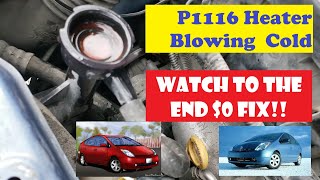
- No heat or poor heat from the vents, especially when the gasoline engine is not running 🎬 See how to fix a Prius heater blowing cold air
- Air conditioning system may behave erratically
- Replacing the PTC heater elements, relays, or fuses. While these are part of the heating circuit, code P1507 specifically points to a fault in the control/permission signal line, not the high-amperage power side of the circuit.
- Attempting to clean an Idle Air Control (IAC) valve. The Prius does not have one, and this diagnosis is based on what P1507 means for other, non-hybrid vehicles.
Most Likely Causes
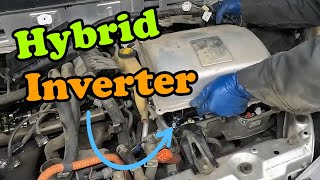
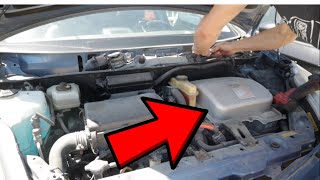
- Open or Short in PTC Heater Permission (DCIM) Signal Wire 🔴 High Probability Wiring can become damaged or corroded over time, or connectors can become loose, leading to communication faults between modules. The DCIM wire runs between the Hybrid Vehicle Control ECU and the Inverter with Converter Assembly. 🎬 Watch: Step-by-step guide to replacing the inverter
How to confirm: A technician will follow the service manual procedure to test the DCIM wire for continuity (less than 1 Ω) and for a short to ground (10 kΩ or higher) between the Hybrid Vehicle Control ECU and the Inverter connectors.
Typical fix: Repairing the damaged section of the wire harness or cleaning/re-seating the connectors.
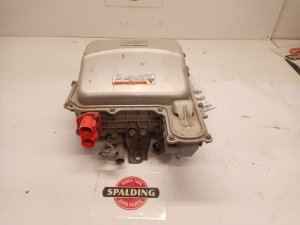
Est. part cost: $5-$50 - Faulty Inverter with Converter Assembly 🟡 Medium Probability The inverter/converter is a complex, high-power electronic component that can fail internally. It is responsible for managing power for the entire hybrid system, including sending status signals that allow other modules to operate.
How to confirm: If the wiring and connectors for the DCIM signal line test good, the service manual points to either the converter or the ECU as the likely source of the fault. Diagnosis requires a specialized scan tool to monitor hybrid system data.
Typical fix: Replacement of the Inverter with Converter Assembly. This is a complex job requiring high-voltage safety protocols.
Est. part cost: $500-$1500 (used/rebuilt), $2000+ (new) - Faulty Hybrid Vehicle Control ECU ⚪ Low Probability While ECUs are generally reliable, they can fail internally, causing them to send improper signals or no signal at all.
How to confirm: This is typically diagnosed by exclusion. If all wiring and the Inverter with Converter Assembly are confirmed to be good, the Hybrid Vehicle Control ECU is the remaining possibility.
Typical fix: Replacement and reprogramming of the Hybrid Vehicle Control ECU.
Est. part cost: $200-$800
Diagnosis Steps
- SAFETY FIRST: This diagnosis involves the high-voltage system. Professional service is required. The following is an overview of the professional procedure.
- Connect a Toyota-compatible scan tool (like Techstream) to the DLC3 port and check for P1507-207 and any other DTCs.
- Follow all safety precautions for disabling the high-voltage system, including wearing insulated gloves, removing the service plug, and waiting at least 10 minutes for the capacitors to discharge before proceeding.
- Inspect the physical condition and connection security of the connectors at the Hybrid Vehicle Control ECU and the Inverter with Converter Assembly.
- Following the service manual, disconnect the appropriate connectors and use a multimeter to test the DCIM signal wire. Check for continuity between the ECU and Inverter pins (should be under 1 Ω).
- Test the DCIM signal wire for a short to ground by measuring resistance between the wire and the chassis ground (should be 10 kΩ or higher).
- If the wiring tests good, the fault lies within either the Hybrid Vehicle Control ECU or the Inverter with Converter Assembly. Further diagnostics with advanced tools are needed to isolate the faulty component.
- Once the repair is complete, clear the DTCs and test the PTC heater function by setting the climate control to MAX HOT with the fan on and the vehicle in 'Ready' mode to confirm the fix.
Parts You'll Likely Need
- Inverter with Converter Assembly
(OEM #G9200-47121 (supersedes G9200-47120, G9200-47100))— If wiring is confirmed to be intact, the service manual points to the inverter/converter assembly as a primary suspect for the internal fault causing the communication error.
Trusted brands: Toyota (OEM)
OEM price range: $2000+
Aftermarket price range: $500-$1500 (remanufactured/used) - Hybrid Vehicle Control ECU
(OEM #89981-47211, 89981-47210 (Varies by year/options, VIN match is critical))— This is the computer that generates the signal. If it fails internally, it can set this code. It is considered a lower probability failure than wiring or the inverter.
Trusted brands: Toyota (OEM)
OEM price range: $500+
Aftermarket price range: $200-$400 (used)
Mechanic-Grade Diagnostic Values
- DCIM Wire Continuity (Open Circuit Check) — expected: Below 1 Ω. Failure: A reading of infinity or significantly above 1 Ω indicates an open circuit in the wire.
- DCIM Wire Short to Ground Check — expected: 10 kΩ or higher. Failure: A low resistance reading (especially below 10 kΩ) indicates the wire is shorted to chassis ground.
Hidden / Shadow Codes Worth Checking
- P1507-207: The '207' is a manufacturer-specific Information Code (INF code) that specifies the fault type. For P1507, it means 'Open or short to GND in the PTC heater permission signal line (DCIM)'. (see via This detail code is visible using Toyota's Techstream software or a compatible professional scan tool when reading codes from the Hybrid Control module.)
Scan Tool Commands That Help
- Toyota Techstream: Active Test: Quick Heater Level — Use this to verify if the A/C amplifier is commanding the PTC heater on. Navigate to 'Body Electrical / Air Conditioner / Active Test' to manually change the 'Quick heater active level'. If the level changes on the scan tool but the heater doesn't work (and P1507 is present), it further isolates the fault to the permission signal circuit or related components. Note that having the car in 'ECO mode' can inhibit PTC heater operation.
Wiring & Ground Locations
- Hybrid Vehicle Control ECU — Located in the instrument panel, behind the combination meter.. This ECU is the source of the DCIM permission signal for the PTC heater.
- A/C Amplifier — Located in the instrument panel as part of the A/C Control Assembly.. This module receives the DCIM signal and controls the PTC heater relays. Its backup power is grounded at point 'IJ'.
- DCIM Signal Wire Connectors — The wire runs from the Hybrid ECU (Connector A76, Pin 8) through an intermediate connector (nS1, Pin 15) to the Inverter's low voltage connector (z82, Pin 12).. These are the exact pins a technician must probe to test the signal wire for continuity and shorts.
- Ground Point IJ — Located in the instrument panel area.. This is a ground point for the A/C amplifier, which is related to the PTC heater control system. While not the direct cause of P1507, a poor ground here could cause other A/C system issues.
OEM Part Supersession History
G9200-47100, G9200-47120→G9200-47121— Standard part revision and improvement by the manufacturer.
Heads up: There was an inverter hardware update starting in May/July of 2007. An inverter from a 2008-2009 model (or one built after 05/2007) may not be compatible with a 2004-early 2007 model. It is critical to match the part to the vehicle's manufacturing date.
Model Year Variations Within This Range
- 2007: Toyota updated the Inverter with Converter assembly starting with vehicles manufactured in May/July 2007. This creates a compatibility issue when sourcing used parts; an inverter from a later Gen 2 may not work in an earlier one.
Diagnostic Flowchart
Other Known Issues on This Vehicle
Issues unrelated to this code that are worth knowing about as an owner of this generation:
- Combination Meter Failure 🟠 Medium — Very common, especially on higher mileage vehicles. The dashboard (speedometer, fuel gauge) goes blank intermittently or permanently. Can also cause issues with the power button and backup camera. (Ref: No recall, but a widely known issue. The cause is a single failed capacitor on the circuit board that can be replaced as a DIY repair.)
- Brake Actuator / Booster Pump Failure 🔴 High — Common failure item, typically occurring over 100,000 miles. Symptoms include a buzzing noise, a soft brake pedal, and multiple warning lights (ABS, Brake, VSC). (Ref: Toyota issued a Warranty Enhancement Program (not a full recall) for some model years, but many owners experience failure outside the extended coverage period.)
- Excessive Oil Consumption 🟠 Medium — Tends to begin after 100,000 miles and can worsen over time. Caused by carbon buildup on low-tension piston rings. (Ref: No recall. Toyota considers consumption up to 1.1 quarts per 600 miles to be within specification, which owners find excessive.)
- Inverter Coolant Pump Failure 🔴 High — A common failure point that can cause the inverter to overheat, triggering a 'Check Hybrid System' light and potentially shutting the car down. (Ref: Yes, Toyota issued a recall for this component. However, even replaced pumps can fail again due to age.)
- HV (High-Voltage) Battery Degradation 🔴 High — Inevitable with age and mileage. Lifespan is typically 100,000-150,000 miles or 8-10 years, after which capacity diminishes, reducing fuel economy and performance. (Ref: No recall, as it's a wear item. The battery is covered by a factory warranty (typically 8yr/100k or 10yr/150k miles in CARB states).)
Used vs. New Parts: Buying Guide for This Vehicle
When a used part is the smart pick: For this repair, sourcing a used Inverter with Converter or a used Hybrid Vehicle Control ECU from a reputable salvage yard is a very common and cost-effective strategy. The cost of new OEM parts can be prohibitive on an older vehicle.
Donor-vehicle mileage cap: roughly under 150000 miles for the part to have meaningful remaining life.
What to inspect on the donor part:
- Prioritize parts from vehicles with a known history, ideally from a running and driving car that was in a collision.
- Visually inspect the part for any signs of physical damage, corrosion, or coolant leaks (especially on the inverter).
- Check the donor vehicle's VIN on Toyota's recall website to see if any relevant recalls (like the inverter coolant pump) were performed.
- Obtain a warranty from the seller if possible; even a 30-day warranty provides significant protection.
- For the inverter, confirm the manufacturing date of the donor vehicle to ensure compatibility, due to the mid-2007 part change.
OEM-only on this vehicle (don't cheap out):
- Inverter with Converter Assembly
- Hybrid Vehicle Control ECU
Brands owners have reported issues with on this vehicle:
- No-name or unbranded electronic modules from online marketplaces without a warranty or return policy.
Real Owner Stories
Aggregated from forums and TSBs cited above. Mileages and costs reflect what owners reported in those sources.
2004-2009 Toyota Prius 1.5L
Symptoms: The owner performed detailed tests with a current meter to determine exactly when the PTC heaters activate and how much power they draw to understand the system's function.
What fixed it: Used real-world data monitoring to verify PTC heater power draw and activation timing.
Source hint: PriusChat: 'The ptc heater' (Jan 2, 2010)
2004-2009 Toyota Prius 1.5L
Symptoms: Owner was investigating methods for testing PTC heater functionality and noted that the heaters provide a relatively small contribution to overall cabin heat.
What fixed it: Testing and managing expectations regarding the limited heat output of the PTC system compared to the engine coolant heater.
Source hint: PriusChat: 'PTC checking?' (Jan 14, 2021)
Related OBD-II Codes
Frequently Asked Questions
Is there a recall for the inverter on my 2004-2009 Prius that might cause P1507?
Can I use a used Inverter with Converter Assembly to fix this code on my 2005 Prius?
Why does my heater stop working when the engine shuts off, even though I have no P1507 code yet?
Is the P1507 code related to the common dashboard 'blank out' issue on the Gen 2 Prius?
How can I confirm if the DCIM signal wire is the problem before replacing the expensive inverter?
Does the 2012 Prius c have this same issue?
Helpful Videos
We Have This Part in Stock

The information in this article is provided for general reference and educational purposes only. Vehicle specifications, procedures, and part compatibility can vary by production date, trim level, and region. Always consult your vehicle's factory service manual and verify part numbers before purchasing or performing repairs. Safety-critical components such as airbags, seat belts, and braking systems should be installed by a qualified professional.
- Toyota Prius:
- 🧭 Diagnostic Flowchart
- 🎬 Helpful Videos
- 🛍️ Shop This Part
- What's Unique About the 2004-2009 Toyota Prius
- Symptoms You May Notice
- Most Likely Causes
- Diagnosis Steps
- Parts You'll Likely Need
- Mechanic-Grade Diagnostic Values
- Hidden / Shadow Codes Worth Checking
- Scan Tool Commands That Help
- Wiring & Ground Locations
- OEM Part Supersession History
- Model Year Variations Within This Range
- Other Known Issues on This Vehicle
- Used vs. New Parts: Buying Guide for This Vehicle
- Real Owner Stories
- 2004-2009 Toyota Prius 1.5L
- 2004-2009 Toyota Prius 1.5L
- Related OBD-II Codes
- Frequently Asked Questions
- 🎟️ Get 5% Off