

P1523 on 2004-2008 Ford F-150 5.4L: VCT Solenoid Circuit Malfunction Guide
This code almost always points to a faulty Variable Camshaft Timing (VCT) solenoid. Replacing both VCT solenoids with updated Motorcraft parts is the most common fix. Expect to pay $100-$150 for OEM parts and consider it a 2/5 difficulty DIY job if your valve covers provide access.
- P1523 on your 5.4L F-150 means there's a problem with the Variable Camshaft Timing (VCT) solenoid circuit.
- The most probable cause is a faulty or clogged VCT solenoid, a very common failure point on this engine.
- Before any major repairs, check your oil. Ensure it's full, clean, and the correct 5W-20 viscosity.
- Replacing both VCT solenoids with updated Motorcraft parts is a highly effective and relatively inexpensive first repair step.
- Always use high-quality Motorcraft solenoids; aftermarket parts have a reputation for premature failure in this application.
What's Unique About the 2004-2008 Ford F-150
The 5.4L 3V Triton engine is well-known for VCT system issues, which are often triggered by oil pressure or oil quality problems. Unlike many other vehicles where this code might point to a variety of issues, on the F-150 with this engine, P1523 is almost exclusively linked to the VCT solenoids themselves getting clogged with oil sludge or failing electrically. Ford later released a revised VCT solenoid design (Part No. 8L3Z-6M280-B) to help combat these frequent failures. The updated part features smaller oil passages, which is thought to increase oil pressure directed to the phasers.
Symptoms You May Notice
- Rough, unstable idle
- Engine sounds like a diesel, especially at idle when warm (often called 'phaser rattle' or 'phaser knock')
- Engine stumbling or hesitating on acceleration, particularly on light tip-in between 800-1200 RPM.
- Stalling when coming to a stop or at idle.
- Noticeable loss of engine power
- Check Engine Light is on
- Replacing cam phasers when only the VCT solenoids are bad.
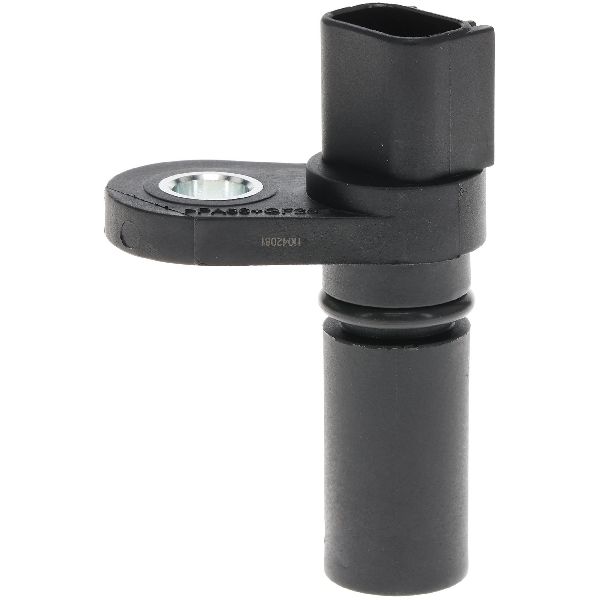
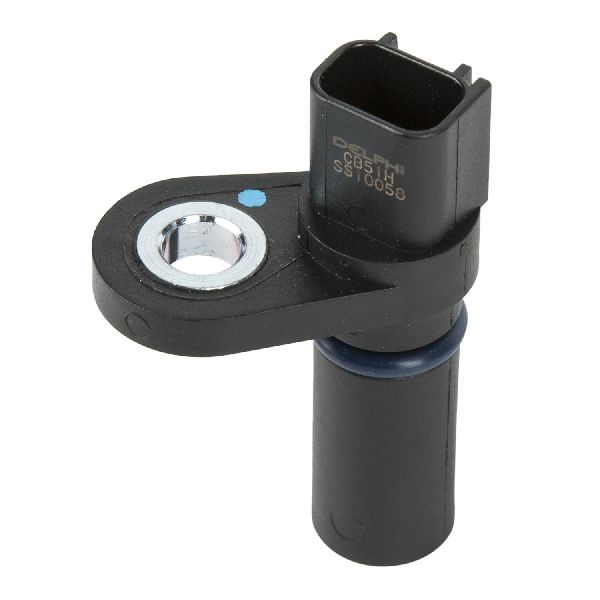
- Replacing camshaft position sensors, which rarely fail for this code and typically set different codes like P0340/P0341.
- Assuming a full timing job is needed immediately without first trying the simple and inexpensive VCT solenoid replacement and an oil change.
Most Likely Causes
- Faulty VCT Solenoid(s) 🔴 High Probability The original solenoid design was susceptible to clogging from engine oil deposits and varnish. The internal screens can break down or the solenoid's mechanical action can stick, a common failure mode.
How to confirm: Unplug the electrical connector for the suspect solenoid while the engine is idling and running rough. If the rough idle immediately smooths out, the solenoid is faulty. You can also remove the solenoid and inspect its screens for debris, varnish, or damage. A failed screen is a definitive sign of failure. A resistance check across the two pins should yield a reading between 5 and 15 Ohms.
Typical fix: Replace both VCT solenoids with the updated Motorcraft parts (8L3Z-6M280-B). It is highly recommended to replace them in pairs along with new seals (3L3Z-6C535-AA).
Est. part cost: $100-$150 for a pair of OEM solenoids and seals. - Low, Dirty, or Incorrect Viscosity Engine Oil 🟡 Medium Probability The VCT system is entirely dependent on oil pressure to function. The 5.4L 3V is sensitive to oil condition, and sludge from infrequent oil changes can clog the tiny passages in the VCT solenoids and cam phasers. Using a filter without the correct anti-drainback valve, like the specified Motorcraft FL-820S, can also contribute to timing issues.
How to confirm: Check the oil level on the dipstick. Note the oil's color and consistency. If it is dark, thick, or below the 'add' line, this is a likely contributor. Check maintenance records for the last oil change interval and oil viscosity used. A mechanical gauge should show a minimum of 15 PSI at hot idle.
Typical fix: Perform an engine oil and filter change using the manufacturer-specified 5W-20 oil and a high-quality filter like the Motorcraft FL-820S.
Est. part cost: $40-$70 - Damaged VCT Solenoid Wiring or Connector ⚪ Low Probability The connectors sit on top of the engine and are exposed to extreme heat and vibration, which can make them brittle over time. Oil leaks from the valve cover gaskets or VCT seals can also saturate the wiring, degrading the insulation.
How to confirm: Visually inspect the wiring and connector for each VCT solenoid. Look for broken plastic tabs, corroded pins, or oil contamination. Use a multimeter to check for 12V power on the power supply wire and ground at the connector with the key on.
Typical fix: Repair the damaged section of wiring or replace the pigtail connector. The Motorcraft pigtail is part number WPT1251.
Est. part cost: $15-$30 for a new pigtail.
Rare But Worth Checking
- Failing Cam Phasers: While P1523 points to the solenoid circuit, a mechanically failing cam phaser can cause erratic VCT operation and may be the underlying problem. This is usually accompanied by other codes like P0012 or P0022 🎬 See how to verify if your noise is a phaser. and a loud knocking noise from the valve cover area at hot idle. This is a much more intensive and expensive repair.
- Low Engine Oil Pressure: Beyond just low oil level, this could be caused by worn engine components, failed timing chain tensioner seals, or a clogged oil pump pickup tube in the oil pan, starving the entire VCT system of necessary pressure.
- Failing Powertrain Control Module (PCM): It is extremely rare, but the driver circuit within the PCM that controls the solenoid could fail. This should only be considered after all other possibilities have been exhausted and verified with an oscilloscope. Symptoms of a failing PCM can include multiple unrelated error codes appearing simultaneously.
Diagnosis Steps
- Verify the Check Engine Light is on and scan for all codes. Note any codes that appear alongside P1523, especially P0012 or P0022.
- Check engine oil level and condition. If low, dirty, or the wrong viscosity, perform an oil and filter change with 5W-20 oil and a Motorcraft FL-820S filter. Clear codes and re-test.
- If the problem persists, locate the VCT solenoids on top of each valve cover.
- With the engine idling and running rough, unplug the electrical connector on one solenoid. If the idle quality does not change, plug it back in. Unplug the other solenoid. If the engine idle suddenly smooths out, the solenoid you just unplugged is the faulty one.
- Inspect the wiring and connectors for both solenoids for any signs of damage, corrosion, or oil saturation. Check for 12V power at the connector with the key on.
- If a solenoid is confirmed bad, replace both VCT solenoids and their seals using updated Motorcraft parts.
- Clear the codes and perform a test drive, paying attention to idle quality and low-RPM acceleration to confirm the fix.
Parts You'll Likely Need
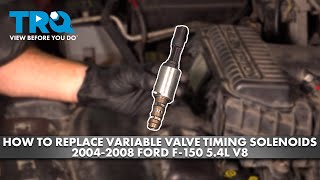
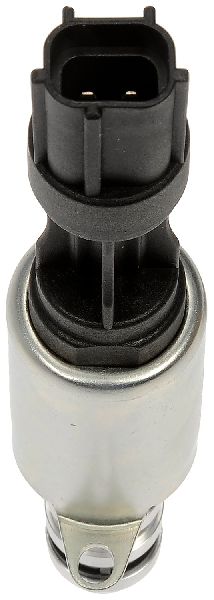
- VCT Solenoid / Camshaft Position Actuator
(OEM #8L3Z-6M280-B)— This is the component that fails most frequently, either by getting clogged with oil sludge or failing electrically, directly causing the P1523 code. This is the updated part number from Ford that supersedes older versions like 3L3Z-6M280-EA and 8L3Z-6M280-A.
Trusted brands: Motorcraft
OEM price range: $50-$75 each
Aftermarket price range: $30-$60 each - VCT Solenoid Seal
(OEM #3L3Z-6C535-AA)— This seal prevents oil from leaking out of the valve cover around the solenoid. It must be replaced anytime the solenoid is removed and often gets destroyed during removal.
Trusted brands: Motorcraft, Fel-Pro
OEM price range: $10-$20 each
Aftermarket price range: $5-$10 each
Related Codes That Often Appear With This One
- P0012 — 'A' Camshaft Position Timing - Over-Retarded (Bank 1). This code often appears with P1523, indicating a mechanical timing issue on the passenger side, often caused by a stuck VCT solenoid.
- P0022 — 'A' Camshaft Position Timing - Over-Retarded (Bank 2). This code points to the same issue as P0012 but on the driver's side (Bank 2).
- P0300-P0308 — Random or specific cylinder misfire codes. Improper valve timing caused by the VCT fault leads to incomplete combustion, resulting in misfires.
Technical Service Bulletins (TSBs) & Recalls
- TSB 06-19-8: Describes diagnosing ticking/knocking noises from the VCT system at hot idle, which is directly related to the function of the VCT solenoids and phasers.
- TSB 21574: Notes that a light tick/rattle noise on light acceleration between 800-1200 RPM can be a normal characteristic and advises not to attempt repairs for this specific noise if it's the only symptom.
- TSB 08-7-6: While not directly for P1523, this TSB details the complex procedure for removing the two-piece spark plugs used in these engines, a critical related maintenance item. It superseded earlier TSBs like 06-15-2.
Platform-Specific Known Issues
- On 2004-2007 and some early 2008 models, the valve cover design allows for VCT solenoid replacement without removing the valve cover, making the job much easier. On models with a build date after 10/09/07 (late 2008 and newer), the redesigned valve covers require removal to access the solenoid's retaining bolt, significantly increasing the labor time and complexity.
Mechanic-Grade Diagnostic Values
- VCT Solenoid Internal Resistance — expected: 5.0 to 15.0 Ohms. A more precise specification is 6.9 - 7.9 Ohms at 68°F (20°C).. Failure: A reading of 0 Ohms (short circuit), OL/infinity (open circuit), or a value significantly outside the expected range indicates a failed solenoid coil.
- VCT Solenoid Connector Voltage (Key On, Engine Off) — expected: Approximately 12V (battery voltage) on the power supply pin.. Failure: Low or no voltage points to a problem in the power supply circuit, such as a blown fuse (Fuse F16 in the battery junction box), a bad PCM power relay, or a wiring fault, rather than a bad solenoid.
- Engine Oil Pressure (at hot idle) — expected: A minimum of 15 PSI is required for the VCT system to function; ideally, pressure should be above 25 PSI.. Failure: Pressure below 15 PSI at a normal operating temperature indicates a significant internal engine issue (e.g., worn tensioner seals, bad oil pump) that is starving the VCT system of oil.
- FORScan PID: VCT_ERR (VCT Advance Error) — expected: Should hover close to 0 degrees at a stable idle. A variance of +/- 5 degrees is acceptable for short periods.. Failure: A large, persistent error value (e.g., >5-10 degrees) while the PCM is commanding changes indicates the phaser is stuck or not responding correctly to the solenoid.
Hidden / Shadow Codes Worth Checking
- Mode 6, Test ID $A2-$A9: In generic OBD-II Mode 6, Ford engines use specific Test IDs (TIDs) and Component IDs (CIDs) to track misfire counts per cylinder, even if they aren't severe enough to set a P030x code. For an 8-cylinder, these are typically TIDs $A2 through $A9, corresponding to cylinders 1 through 8. This data can reveal if a timing issue from a VCT fault is causing intermittent misfires on one or more cylinders. (see via A capable scan tool like FORScan or some higher-end generic scanners can access Mode 6 data.)
Scan Tool Commands That Help
- FORScan / Ford IDS: VCT Solenoid On/Off Command (Output State Control) — This bidirectional command allows you to manually activate and deactivate each VCT solenoid while the engine is idling. A functional solenoid will produce an audible click and cause a distinct change in idle quality or even stall the engine. If commanding the solenoid 'on' produces no change, it confirms a fault in the solenoid itself or its circuit.
- FORScan / Ford IDS: Live Data PID Monitoring (VCT_ADV, VCT_DC, VCT_ERR) — Monitoring the desired camshaft angle (VCT_ADV), the PCM's commanded duty cycle to the solenoid (VCT_DC), and the resulting error (VCT_ERR) in real-time is crucial. If the PCM commands a change and the solenoid duty cycle responds, but the actual angle and error do not, it points to a mechanical issue (stuck solenoid, bad phaser, low oil pressure) rather than an electrical one.
Wiring & Ground Locations
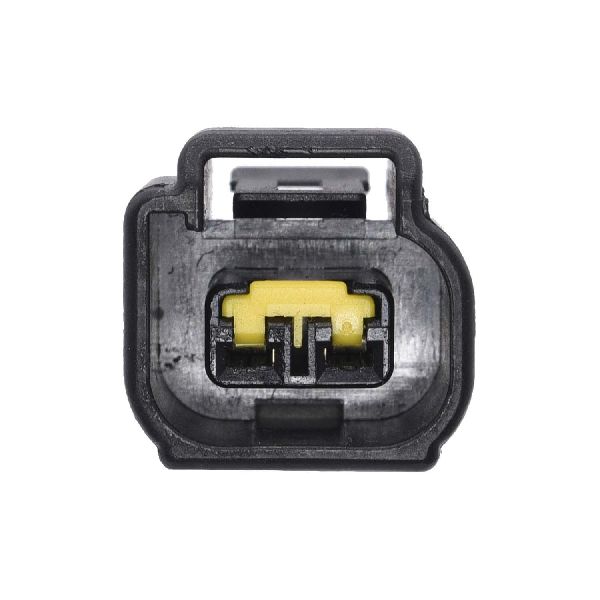
- VCT Solenoid Connector — On top of each valve cover, near the front of the engine. One for Bank 1 (passenger side) and one for Bank 2 (driver side).. This 2-pin connector is the direct interface for the solenoid. Pin 1 is the 12V power supply from the PCM power relay/fuse, and Pin 2 is the ground-side control wire from the PCM. Corrosion or damage here is a direct cause of a circuit malfunction code.
- Fuse F16 (15A) — Located in the Battery Junction Box (under the hood).. This fuse provides power to the VCT solenoids. If it's blown, neither solenoid will have power. However, this fuse often powers other critical components like fuel injectors, so a blown fuse would likely cause a no-start condition and other codes, not just P1523.
Real Owner Repair Stories
- F150online Forums user (2004 F-150 5.4L 3V with 131,000 miles) — Ticking noise from engine.
❌ Tried (didn't work) Initially replaced VCT solenoids with Dorman brand parts, which fixed the issue temporarily but the noise returned.
✅ What actually fixed it Replacing the Dorman solenoids with the updated Motorcraft (OEM) parts made the truck quiet and restored power. The user noted the revised Motorcraft part had a much smaller oil passage. - Go-Parts.com repair story (2008 Ford F-150 5.4L 3V at 116,000 miles) — Rough idle, especially in reverse, and a diesel-like rattling noise.
❌ Tried (didn't work) An engine flush and oil change slightly improved the noise but did not fix the rough idle.
✅ What actually fixed it The driver's side solenoid was found to have a failed mesh screen and was sticky with varnish. Replacing both VCT solenoids with the updated OEM part (8L3Z-6M280-B) completely resolved all symptoms. - Ford Truck Enthusiasts Forums user (2006 F-150 5.4L 3V) — Rough idle problem.
❌ Tried (didn't work) The truck had a Dorman VCT solenoid on the driver's side and an original Ford solenoid on the passenger side, which caused a rough idle.
✅ What actually fixed it Replacing both solenoids with a matching pair of new Motorcraft VCTs resolved the rough idle completely, highlighting an issue with mixing brands or using non-OEM parts.
OEM Part Supersession History
3L3Z-6M280-EA→8L3Z-6M280-A, then 8L3Z-6M280-B— The original design was prone to clogging and failure from oil sludge and debris. The final revision, 8L3Z-6M280-B, features redesigned internal components and smaller oil screen holes to improve durability and potentially increase oil pressure to the phasers.
Model Year Variations Within This Range
- Late 2007-2008: Ford changed the valve cover design around October 2007. Earlier models (2004-early 2007) have a large VCT solenoid seal that can be pried out, allowing the solenoid to be replaced without removing the valve cover. Later models have a smaller hole, making it physically impossible to remove the solenoid without first removing the entire valve cover, which significantly increases labor, especially on the passenger side.
Diagnostic Flowchart
Other Known Issues on This Vehicle
Issues unrelated to this code that are worth knowing about as an owner of this generation:
- Two-Piece Spark Plug Breakage 🔴 High — Very common on engines built before 10/9/07. Occurs during removal after 60k+ miles due to carbon buildup on the plug's ground shield. (Ref: TSB 08-7-6)
- Cam Phaser Failure 🔴 High — Extremely common, often presenting as a loud diesel-like knocking or rattling sound at hot idle. Can occur as early as 70,000-80,000 miles. (Ref: TSB 06-19-8)
- Fuel Pump Driver Module (FPDM) Corrosion 🟠 Medium — Common failure, especially in rust-belt regions. The module is mounted to the steel frame above the spare tire, causing galvanic corrosion of its aluminum housing, leading to water intrusion and failure.
- Timing Chain Tensioner & Guide Failure 🔴 High — Common at higher mileage (100k+ miles). The plastic timing chain guides break, and the tensioner seals can blow out, causing low oil pressure to the top end and catastrophic failure.
- Cracked Exhaust Manifolds 🟡 Low — Fairly common, resulting in an exhaust leak ticking noise that is loudest on a cold start and may quiet down as the engine warms up.
Used vs. New Parts: Buying Guide for This Vehicle
When a used part is the smart pick: For this specific repair, buying a used VCT solenoid is never a smart choice. The part has a high failure rate and was updated for a reason. A used part is likely to be the failure-prone original design or have significant internal wear and clogging. A used valve cover could be a sensible choice if one was damaged during repair, as they are not a wear item.
Donor-vehicle mileage cap: roughly under 150000 miles for the part to have meaningful remaining life.
What to inspect on the donor part:
- For a used valve cover: inspect thoroughly for cracks, especially around bolt holes.
- For a used valve cover: ensure all baffle plates on the underside are intact and not full of heavy sludge.
OEM-only on this vehicle (don't cheap out):
- VCT Solenoids: Due to the sensitivity of the VCT system and documented issues with aftermarket parts causing rough idle or premature failure, using only genuine Motorcraft (Part No. 8L3Z-6M280-B) solenoids is strongly recommended by forum veterans and mechanics.
Brands owners have reported issues with on this vehicle:
- Dorman: Multiple owner accounts report that Dorman VCT solenoids either failed shortly after installation or caused persistent rough idle issues that were only resolved by switching to OEM Motorcraft parts.
Real Owner Stories
Aggregated from forums and TSBs cited above. Mileages and costs reflect what owners reported in those sources.
2004-2008 Ford F-150 5.4L 3V
Symptoms: Severe engine noises that sounded like a diesel at idle.
What fixed it: Replacement of the VCT solenoids, which fixed the issue described in the TSB. Note that the owner had to evacuate the A/C system to complete the job on their specific model.
Source hint: F150Forum.com - 'VCT Solenoid Replacement Success'
2008 Ford F-150 5.4L 3V
Symptoms: Owner inquiring about VCT solenoid replacement on a later 2008 model.
What fixed it: Confirmed that for models built after 10/09/07, the valve covers must be removed to replace the solenoids.
Source hint: F150Forum.com - '2008 5.4 Variable Timing Solenoids'
2004-2008 Ford F-150 5.4L 3V
Symptoms: Cam phaser knock at hot idle.
What fixed it: While dealers often suggest replacing the phasers, owners found that the issue is frequently just the VCT solenoids, which is a common misdiagnosis.
Source hint: Ford-Trucks.com - '5.4 cam phasers...fix or not?'
2004-2008 Ford F-150 5.4L 3V
Symptoms: Rough idle and rattle.
What fixed it: Diagnosed by unplugging the VCT solenoids while the engine was running to see if the noise stopped, confirming the solenoids were the cause.
Source hint: BobIsTheOilGuy.com - '5.4 3V question'
Related OBD-II Codes
Frequently Asked Questions
Do I need to remove the valve covers to replace the VCT solenoids on my 2005 F-150 5.4L?
My 2008 F-150 was built in late 2007; does the solenoid replacement procedure change?
What specific oil filter should I use to prevent VCT and timing issues on the 5.4L 3V?
Is there a TSB for the diesel-like knocking sound my truck makes at hot idle?
What are the updated Ford part numbers for the VCT solenoids and seals?
I have a light rattle between 800-1200 RPM; should I replace the solenoids for this?
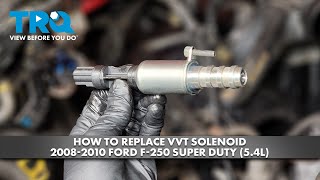
Helpful Videos
We Have This Part in Stock

The information in this article is provided for general reference and educational purposes only. Vehicle specifications, procedures, and part compatibility can vary by production date, trim level, and region. Always consult your vehicle's factory service manual and verify part numbers before purchasing or performing repairs. Safety-critical components such as airbags, seat belts, and braking systems should be installed by a qualified professional.
- Ford F-150:
- 🧭 Diagnostic Flowchart
- 🎬 Helpful Videos
- 🛍️ Shop This Part
- What's Unique About the 2004-2008 Ford F-150
- Symptoms You May Notice
- Most Likely Causes
- Rare But Worth Checking
- Diagnosis Steps
- Parts You'll Likely Need
- Related Codes That Often Appear With This One
- Technical Service Bulletins (TSBs) & Recalls
- Platform-Specific Known Issues
- Mechanic-Grade Diagnostic Values
- Hidden / Shadow Codes Worth Checking
- Scan Tool Commands That Help
- Wiring & Ground Locations
- Real Owner Repair Stories
- OEM Part Supersession History
- Model Year Variations Within This Range
- Other Known Issues on This Vehicle
- Used vs. New Parts: Buying Guide for This Vehicle
- Real Owner Stories
- 2004-2008 Ford F-150 5.4L 3V
- 2008 Ford F-150 5.4L 3V
- 2004-2008 Ford F-150 5.4L 3V
- 2004-2008 Ford F-150 5.4L 3V
- Related OBD-II Codes
- Frequently Asked Questions
- 🎟️ Get 5% Off