

P1523 on 2007-2016 Hyundai Elantra: Throttle Valve Stuck Causes and Fixes
On a 2007-2016 Hyundai Elantra, code P1523 almost always indicates the throttle plate is sticking due to carbon buildup. The most common fix is a thorough cleaning of the throttle body and a simple relearn procedure, which costs less than $20 for a can of cleaner and is a DIY-friendly job (2/5 difficulty). Ignoring this can lead to stalling and the vehicle entering a reduced-power 'limp mode'.
- P1523 on an Elantra means the throttle is sticking, not a liftgate problem like on other Hyundais.
- The most likely fix is cleaning the throttle body, a simple DIY task that costs under $20.
- After cleaning or replacing the throttle body, you must perform a simple reset procedure (Ignition ON for 15s, OFF for 10s) for the car to idle correctly.
- If cleaning doesn't work, the entire throttle body assembly needs to be replaced; the sensors are not available separately.
- Do not drive the vehicle extensively with this code, as it can stall unexpectedly, creating a safety hazard.
What's Unique About the 2007-2016 Hyundai Elantra
The definition for P1523 is highly inconsistent across the Hyundai lineup, which is the main source of confusion. A technician might see this code and think of a power liftgate on a Tucson or Santa Fe, but that is irrelevant for the Elantra. For the Elantra and its platform mates like the Kia Forte, this code is almost exclusively tied to the electronic throttle body becoming dirty over time. This is a common maintenance issue for which Hyundai has issued service bulletins (like TSB 13-FL-002) advising a specific cleaning procedure before considering replacement.
Generation note: This guide covers the fourth generation (HD, 2007-2010) and fifth generation (MD/UD, 2011-2016) Hyundai Elantra. The cause, symptoms, and repair process for this code are virtually identical for both generations as they both use an electronic throttle body prone to carbon buildup. The primary difference is the specific throttle body part number for each generation.
Symptoms You May Notice
- Rough or unstable idle, sometimes fluctuating
- Engine stalling, especially when coming to a stop or at low RPM
- Reduced engine power or 'limp mode'
- Poor or delayed throttle response
- Check Engine Light is on
- Hesitation during acceleration
- Replacing the Accelerator Pedal Position Sensor (APPS). This sensor reads the driver's foot input, but P1523 specifically relates to the throttle body at the engine not returning to its position correctly.
- Performing an incomplete cleaning. Simply spraying cleaner into the air intake without removing the throttle body and scrubbing the carbon buildup is often not effective enough to solve the sticking issue.
Most Likely Causes
- Dirty Throttle Body 🔴 High Probability → Shop Fuel Injection Throttle Body Over time, oil vapor from the PCV system and other contaminants build up as a sticky, black carbon layer inside the throttle body bore and on the throttle plate. This physically restricts the plate from closing smoothly, causing it to stick.
How to confirm: Remove the air intake duct from the throttle body and visually inspect for a black, gummy residue around the throttle plate and bore. The plate may feel sticky when moved by hand (with the ignition off). A Reddit user with a 2022 Santa Fe noted significant gunk after only 25k miles, which caused a rough idle.
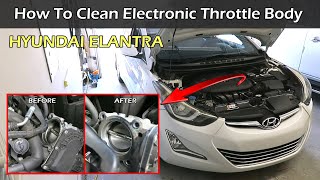
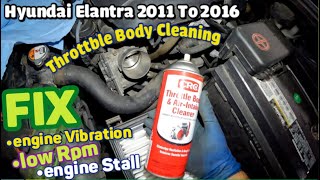
Typical fix: Remove the throttle body and clean it thoroughly with a dedicated throttle body cleaner and a soft cloth or brush. 🎬 Watch: A professional guide to cleaning your Hyundai's electronic throttle body. Pay special attention to the edges of the throttle plate and where it seats in the bore. A throttle position relearn must be performed after cleaning.
Est. part cost: $10-$20 - Failed Throttle Body Assembly ⚪ Low Probability → Shop Fuel Injection Throttle Body If cleaning does not resolve the issue, the internal components of the throttle body, such as the actuator motor or the non-serviceable Throttle Position Sensor (TPS), have likely failed due to wear or an internal electronic fault.
How to confirm: If the code returns immediately after a thorough cleaning and relearn procedure, and the wiring is confirmed to be good, the throttle body assembly is faulty.
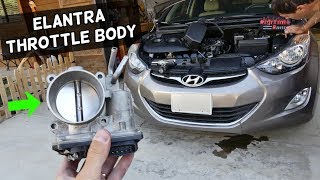
Typical fix: Replace the entire throttle body assembly. 🎬 See this walkthrough on how to remove and replace the assembly. The internal sensors and motor are not sold separately for this platform.
Est. part cost: $150-$450 - Damaged Wiring or Connector ⚪ Low Probability Vibrations and heat can cause wires to fray or the connector pins to lose contact over time, though this is far less common than a dirty throttle body.
How to confirm: Visually inspect the wiring harness leading to the throttle body for any signs of damage, chafing, or corrosion. Unplug the connector and check for bent or corroded pins.
Typical fix: Repair the damaged section of the wiring harness or clean/replace the connector.
Est. part cost: $5-$50
Rare But Worth Checking
- Failing Powertrain Control Module (PCM): This is extremely rare. Before condemning the PCM, all other possibilities, including cleaning/replacing the throttle body and checking all wiring, must be exhausted.
Diagnosis Steps
- Read the DTC with an OBD-II scanner to confirm P1523 is present.
- Turn the ignition off and disconnect the negative battery terminal for safety.
- Remove the engine cover and the air intake duct connected to the throttle body.
- Visually inspect the throttle body connector and wiring for any obvious damage.
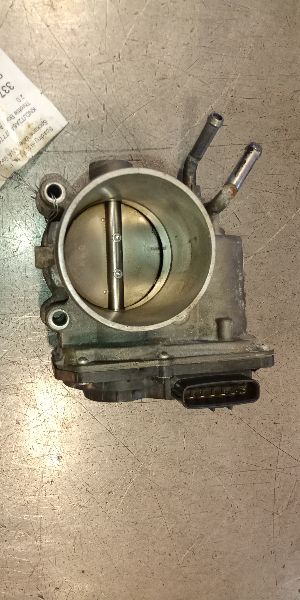
- Inspect the inside of the throttle body for heavy, black carbon buildup.
- If dirty, remove the four 10mm mounting bolts and the electrical connector. Pro-tip: It is not necessary to disconnect the two coolant lines. The throttle body can be carefully rotated out of the way to allow for cleaning.
- Spray a dedicated throttle body cleaner (do not use brake or carb cleaner) onto a rag and thoroughly wipe the inside of the bore and both sides of the throttle plate. A soft brush can be used for heavy deposits. Manually push the plate open to clean the edges where it seats.
- Reinstall the throttle body and torque the bolts to specification. Reconnect the air duct and electrical connector.
- Reconnect the negative battery terminal.
- Perform the throttle relearn procedure: Turn the ignition to the 'ON' position (engine off) for at least 10 seconds. Turn the ignition 'OFF' for at least 10 seconds. Repeat this cycle once more.
- Start the engine. The idle may be high initially but should settle down to normal (below 1,000 RPM) as the engine warms up and the PCM adapts.
- Clear the DTC with the scanner and test drive the vehicle. If the code returns, the throttle body assembly likely needs to be replaced.
Parts You'll Likely Need
- Throttle Body Cleaner — This is required for the most common fix, which is cleaning the carbon buildup from the throttle body.
Trusted brands: CRC, Gumout, WD-40 Specialist
Aftermarket price range: $10-$20 - Throttle Body Assembly
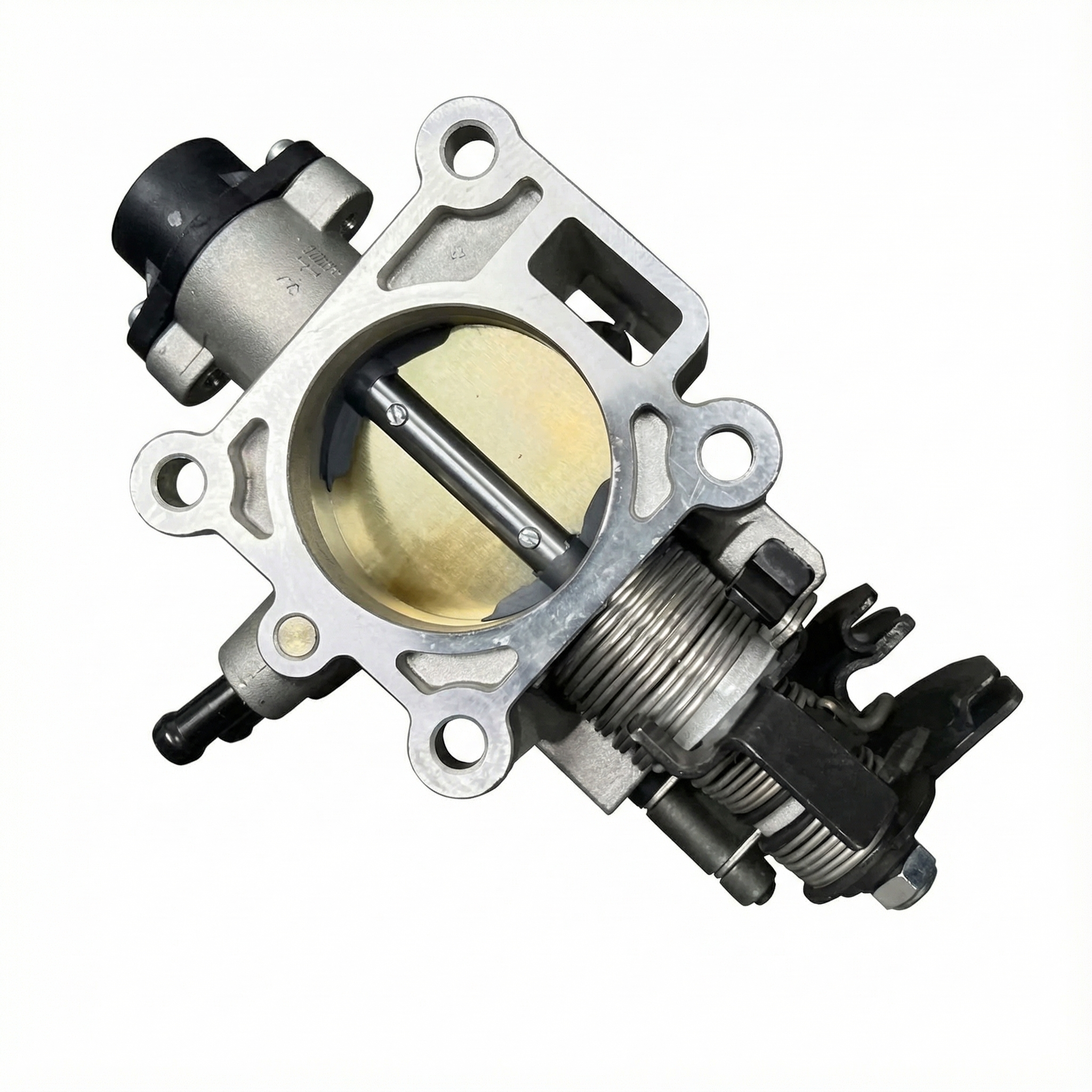
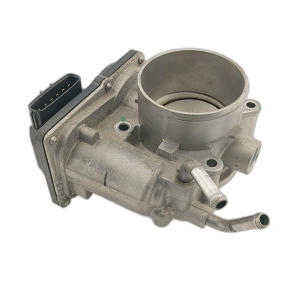
(OEM #35100-2E000)— If cleaning fails, the entire assembly must be replaced. 35100-2E000 fits the 2011-2016 (MD/UD) Elantra with the 1.8L/2.0L Nu engine. For 2007-2010 (HD) models with the 2.0L Beta II engine, use 35100-23950. Always verify with VIN before purchasing.
Trusted brands: Hyundai (OEM), Hitachi, Spectra Premium (TB1165), Standard Motor Products
OEM price range: $350-$450
Aftermarket price range: $150-$250 - Throttle Body Gasket
(OEM #35101-23700)— While the original gasket is often a reusable rubber O-ring style, it is best practice to replace it when removing the throttle body to prevent vacuum leaks. Some aftermarket throttle bodies may not include a new gasket.
Trusted brands: Hyundai (OEM), Fel-Pro
OEM price range: $5-$15
Aftermarket price range: $3-$10
Related Codes That Often Appear With This One
- P2111 — This code means 'Throttle Actuator Control System - Stuck Open'. It's a direct companion to P1523, as both are caused by a throttle plate that isn't moving as commanded due to carbon buildup or mechanical failure.
- P0121 — This code indicates a 'Throttle/Pedal Position Sensor 'A' Circuit Range/Performance' problem. A sticking throttle plate can cause the sensor's reported position to be out of sync with what the PCM expects, triggering this code alongside P1523.
- P2118 / P2119 — These codes relate to the throttle actuator control motor current performance. A sticking throttle plate can cause the motor to draw excessive current, triggering these codes along with P1523. TSB 13-FL-002 explicitly mentions these codes as being related to a dirty throttle body.
Technical Service Bulletins (TSBs) & Recalls
- TSB 13-FL-002: Supersedes the older TSB 10-FL-009. It provides the official procedure for cleaning the ETC throttle body and explicitly states not to replace the assembly before performing this cleaning. It applies to the Elantra (2011~) and many other Hyundai models.
- TSB 10-FL-009: An earlier version of the bulletin providing the procedure to clean the ETC throttle body on Theta engines, which established the precedent for this repair method.
Platform-Specific Known Issues
- Hyundai has released Technical Service Bulletins (e.g., TSB 10-FL-009, superseded by TSB 13-FL-002) that specifically instruct technicians to clean the throttle body to resolve issues like rough idle or stalling, confirming this is a well-documented maintenance issue on these platforms.
- Real-world owner story: A user on the Hyundai Forums reported that their dealership performed a throttle body cleaning at 49,337 miles per TSB 13-FL-002. By 82,000 miles, they were experiencing a rough start again, indicating that this is a recurring maintenance item every 30,000-40,000 miles.
Mechanic-Grade Diagnostic Values
- Throttle Position Sensor (TPS) Output Voltage at Closed Throttle (C.T) — expected: 0.25V - 0.9V. Failure: Voltage outside this range indicates a sensor or wiring fault.
- Throttle Position Sensor (TPS) Output Voltage at Wide Open Throttle (W.O.T) — expected: Minimum 4.0V. Failure: Voltage significantly below 4.0V at W.O.T. suggests a faulty sensor.
- TPS Sensor 'A' (TPS1) Live Data Voltage vs. Throttle Angle — expected: Increases from ~0.5V (closed) to ~4.5V (open). Failure: Voltage is erratic, does not change, or is stuck low/high.
- TPS Sensor 'B' (TPS2) Live Data Voltage vs. Throttle Angle — expected: Decreases from ~4.5V (closed) to ~0.5V (open). Failure: Voltage does not change inversely to TPS1, or is stuck.
- Sensor Reference Voltage at Throttle Body Connector — expected: ~5.0V. Failure: Voltage is significantly lower or missing, indicating a PCM or wiring issue.
Scan Tool Commands That Help
- Hyundai GDS (Global Diagnostic System): Actuation Test — To command the throttle body motor to open and close while observing its physical movement and live data. This helps determine if a failure to move is due to a bad motor, a wiring issue, or a physical obstruction.
- Hyundai GDS (Global Diagnostic System): DTC Analysis — To read manufacturer-specific fault codes and their detailed descriptions, which may provide more context than a generic OBD-II scanner.
- Hyundai GDS (Global Diagnostic System): Data Analysis (Live Data) — To monitor real-time data streams for TPS1 and TPS2 voltages simultaneously, which is crucial for diagnosing sensor correlation faults.
- Hyundai GDS (Global Diagnostic System): Flight Record — For intermittent issues, this function allows the technician to record sensor data during a test drive to capture the fault when it occurs. The trigger module can mark the event.
Wiring & Ground Locations
- Throttle Body Connector (2011-2016 MD/UD) — Directly on the Electronic Throttle Body assembly.. This 6-pin connector provides power, ground, and signal lines for the throttle motor and the two internal TPS sensors. A poor connection here is a primary point of failure. Pin details from a 2012 diagram are: Pin 2 (Red) is TPS2 Signal, Pin 3 (Orange) is ETC Motor (+), Pin 4 (Yellow) is TPS1 Signal, Pin 6 (Brown) is ETC Motor (-).
- Grounding Point GC501 (2012-2015) — The specific physical location is not detailed in the diagrams, but it serves as a ground point for the Engine Control Unit (E1).. A wiring diagram for the 2012-2015 Elantra shows the ECU (E1) relies on this ground point. A faulty ground here could cause erratic behavior in multiple systems controlled by the ECU, including the electronic throttle.
- Engine Ground Strap (HD & MD/UD) — Connects the engine block to the chassis. For the 2011-2015 Elantra, one key ground wire is part number 91861-A5040. For the 2007-2012 Elantra, a relevant part is 91860-2H220.. A corroded or loose main engine ground strap can cause a wide range of electrical issues, including incorrect sensor readings and module communication errors that could potentially mimic throttle body problems. Ensuring this connection is clean and tight is a fundamental diagnostic step.
Real Owner Repair Stories
- Hyundai Forums user (2013 Hyundai Elantra) — Car would not accelerate, Check Engine Light on, ESC light on.
❌ Tried (didn't work) Thoroughly cleaning the throttle body.
✅ What actually fixed it The user cleaned the throttle body, but the problem persisted. The code returned immediately. The final fix was replacing the entire throttle body assembly with a new unit. After replacement and a relearn procedure, the issue was resolved.
Model Year Variations Within This Range
- 2007-2010 (HD Generation): These models with the 2.0L Beta II engine use throttle body part number 35100-23950.
- 2011-2016 (MD/UD Generation): These models with the 1.8L and 2.0L Nu engines use throttle body part number 35100-2E000.
Diagnostic Flowchart
Other Known Issues on This Vehicle
Issues unrelated to this code that are worth knowing about as an owner of this generation:
- Engine Ticking / Piston Slap (1.8L Nu Engine) 🔴 High — Very common on 2011-2016 models, often noticeable on cold starts and can lead to oil consumption or eventual engine failure. A class-action lawsuit was filed regarding this issue. (Ref: TSB 14-20-002 (Canada) acknowledged the issue.)
- Steering Coupler Failure 🟠 Medium — Extremely common across both HD and MD/UD generations. The rubber coupler disintegrates over time, causing a distinct clicking or clunking noise in the steering wheel when turning. It is not a safety issue affecting control. (Ref: Hyundai extended the warranty for this part to 10 years/100,000 miles under campaign TXX7 (TSB 17-ST-002).)
- Transmission Slipping / Harsh Shifting (HD Generation) 🟠 Medium — Particularly noted on the 2010 model year, owners reported transmission jerking and slipping at low speeds, sometimes leading to transmission failure.
- Suspension Problems (HD Generation) 🟡 Low — Some owners of the 2009 model reported premature failure of front suspension components.
- Crankshaft Position Sensor Failure 🟠 Medium — A known cause for intermittent stalling or no-start conditions across various model years.
Used vs. New Parts: Buying Guide for This Vehicle
When a used part is the smart pick: A used OEM throttle body from a low-mileage donor vehicle can be a cost-effective and reliable option, often providing better quality than a cheap, no-name aftermarket part. Given that the primary failure mode is electronic and not just carbon buildup, a used part is a reasonable gamble if the price is significantly lower than a new OEM or premium aftermarket unit.
Donor-vehicle mileage cap: roughly under 75000 miles for the part to have meaningful remaining life.
What to inspect on the donor part:
- Verify the part number on the donor part matches your original exactly (e.g., 35100-2E000 or 35100-23950).
- Inspect the connector pins for any signs of corrosion, bending, or damage.
- Look at the throttle plate and bore; while it can be cleaned, excessive, heavy buildup might indicate a hard life.
- Ask the seller for the donor vehicle's mileage and if it comes with any warranty (many recyclers offer 30-90 day warranties).
Aftermarket brands forum-validated for this vehicle:
- Hitachi: Often an OEM supplier, Hitachi parts are generally considered high quality and reliable.
- Dorman OE FIX: Dorman offers an 'OE FIX' version that claims to have an upgraded shaft seal to prevent future failures, which could be a worthwhile improvement.
- Spectra Premium: A well-known aftermarket brand that is a common alternative.
Brands owners have reported issues with on this vehicle:
- Unbranded, generic parts from online marketplaces without a warranty or clear return policy can be risky. While some may work, quality control is inconsistent, and they may fail prematurely.
Real Owner Stories
Aggregated from forums and TSBs cited above. Mileages and costs reflect what owners reported in those sources.
2013 Hyundai Elantra — 49337 miles
Symptoms: Rough idle and stalling issues that led to a dealership visit.
What fixed it: The dealership performed a throttle body cleaning per TSB 13-FL-002.
Source hint: vehicle_specific_issues - Hyundai Forums report regarding TSB 13-FL-002
2015 Hyundai Elantra — 82000 miles
Symptoms: Experiencing a rough start again after a previous cleaning at lower mileage.
What fixed it: Throttle body cleaning (indicated as a recurring maintenance item).
Source hint: vehicle_specific_issues - Hyundai Forums report
Related OBD-II Codes
Frequently Asked Questions
Does TSB 13-FL-002 apply to my 2011-2016 Hyundai Elantra?
Can I just replace the throttle position sensor on my Elantra if it fails?
Is there a specific cleaner I should use for the Elantra throttle body?
How often should I expect to clean the throttle body on this vehicle?
Do I need to disconnect the coolant lines to clean the throttle body?
What is the 'relearn' procedure I need to do after cleaning?
Helpful Videos
We Have This Part in Stock

The information in this article is provided for general reference and educational purposes only. Vehicle specifications, procedures, and part compatibility can vary by production date, trim level, and region. Always consult your vehicle's factory service manual and verify part numbers before purchasing or performing repairs. Safety-critical components such as airbags, seat belts, and braking systems should be installed by a qualified professional.
- Hyundai Elantra:
- 🧭 Diagnostic Flowchart
- 🎬 Helpful Videos
- 🛍️ Shop This Part
- What's Unique About the 2007-2016 Hyundai Elantra
- Symptoms You May Notice
- Most Likely Causes
- Rare But Worth Checking
- Diagnosis Steps
- Parts You'll Likely Need
- Related Codes That Often Appear With This One
- Technical Service Bulletins (TSBs) & Recalls
- Platform-Specific Known Issues
- Mechanic-Grade Diagnostic Values
- Scan Tool Commands That Help
- Wiring & Ground Locations
- Real Owner Repair Stories
- Model Year Variations Within This Range
- Other Known Issues on This Vehicle
- Used vs. New Parts: Buying Guide for This Vehicle
- Real Owner Stories
- 2013 Hyundai Elantra — 49337 miles
- 2015 Hyundai Elantra — 82000 miles
- Related OBD-II Codes
- Frequently Asked Questions
- 🎟️ Get 5% Off