

P1524 on 2017-2024 Chrysler Pacifica 3.6L: Oil Pressure Out of Range Causes and Fixes
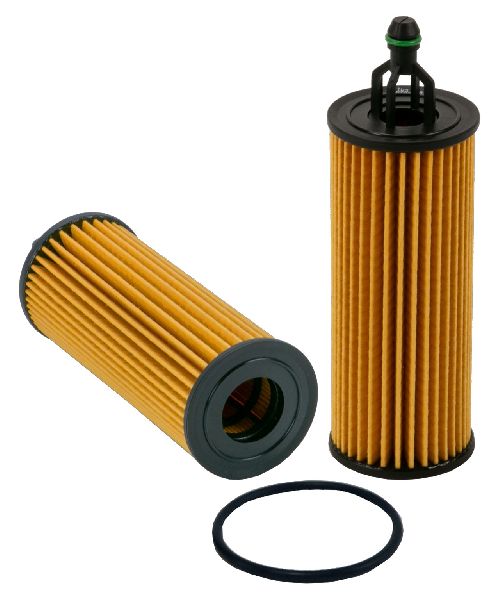
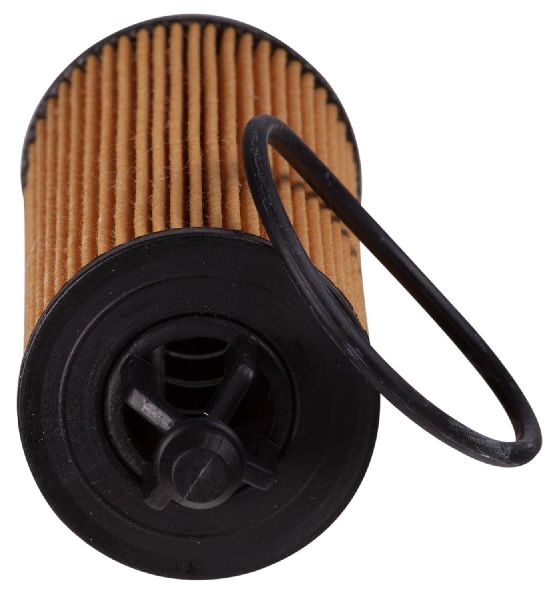
On a 3.6L Pacifica, code P1524 is almost always caused by a non-OEM oil filter or a cracked oil filter housing. The first and cheapest fix is to perform an oil change using a genuine Mopar oil filter (part #68191349AB). If that doesn't work, the oil filter housing assembly, a known failure point, is likely cracked and leaking.
- Do not drive your Pacifica with code P1524, as it indicates a potentially severe low oil pressure condition that can destroy the engine.
- The first, cheapest, and most likely fix is to change the engine oil and filter, using ONLY a genuine Mopar OEM filter (Part #68191349AB).
- If the code persists after an oil/filter change, inspect the engine valley for oil leaks. A leak here means the oil filter housing assembly needs to be replaced.
- Due to the high labor cost of accessing the area, if you are replacing either the oil pressure sensor or the oil filter housing, it is highly recommended to replace both parts at the same time.
What's Unique About the 2017-2024 Chrysler Pacifica
The 3.6L Pentastar V6 engine is notoriously sensitive to oil filter quality and suffers from a common design flaw. Many P1524 codes are triggered immediately after an oil change that used a non-OEM filter with incorrect flow characteristics, an issue documented in TSB S2109000001. 🎬 Watch: How a cheap oil filter triggers code P1524 Furthermore, the original plastic oil filter and cooler housing assembly, located in the 'V' of the engine, is prone to cracking from heat cycles or from over-tightening the filter cap, causing oil leaks that lead to low oil levels and trigger this code. These two issues account for the vast majority of P1524 cases on this platform.
Symptoms You May Notice
- Check Engine Light is on
- Remote start may be disabled
- Reduced engine power or sluggish acceleration
- Engine may run rough or stall in severe cases
- Burning oil smell if the oil filter housing is leaking onto hot engine parts
- Visible oil leak in the engine valley (between the cylinder heads)
- Engine may exhibit a ticking or knocking noise if oil starvation is severe.
- Replacing only the oil pressure sensor when the oil filter housing is the source of a leak. The labor is nearly identical, and failing to replace the leaking housing means the problem will soon return.
- Replacing the oil pump before verifying the oil filter is OEM and checking for leaks from the filter housing.
Most Likely Causes
- Incorrect or Low-Quality Oil Filter 🔴 High Probability → Shop Engine Oil Filter Adapter The 3.6L Pentastar's VVT system is highly sensitive to oil pressure and flow. Many aftermarket filters do not meet the specific bypass and flow specifications of the OEM Mopar filter, causing a pressure drop sufficient to trigger the code. This often happens immediately after an oil change at a non-dealership facility.
How to confirm: Check service records or inspect the oil filter to see if it is a genuine Mopar part (M0-349 or 68191349AB). If the code appeared right after an oil change, this is the most likely cause.
Typical fix: Perform an oil change using the correct grade of oil (typically 5W-20) and a new, genuine Mopar OEM oil filter. Ensure the filter cap is torqued to the correct specification of 18 ft-lbs (25 N·m).
Est. part cost: $10-$20 - Cracked or Leaking Oil Filter Housing Assembly 🔴 High Probability → Shop Engine Oil Filter Adapter The factory-installed plastic housing is a well-documented failure point on all 3.6L Pentastar engines. It warps and cracks from constant heat cycles or from over-tightening the filter cap, causing oil to leak into the engine valley.
How to confirm: Use a flashlight to inspect the area in the 'V' of the engine, directly under the intake manifold. Any pooling of fresh or old oil in this valley is a definitive sign of a failed housing.
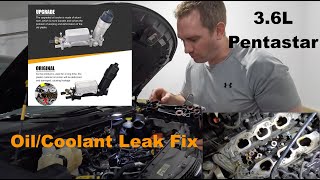
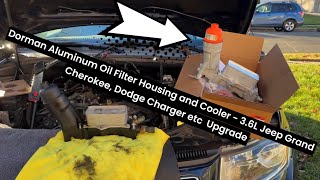
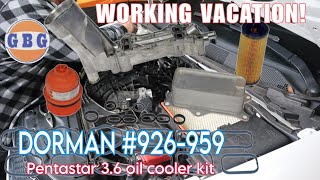
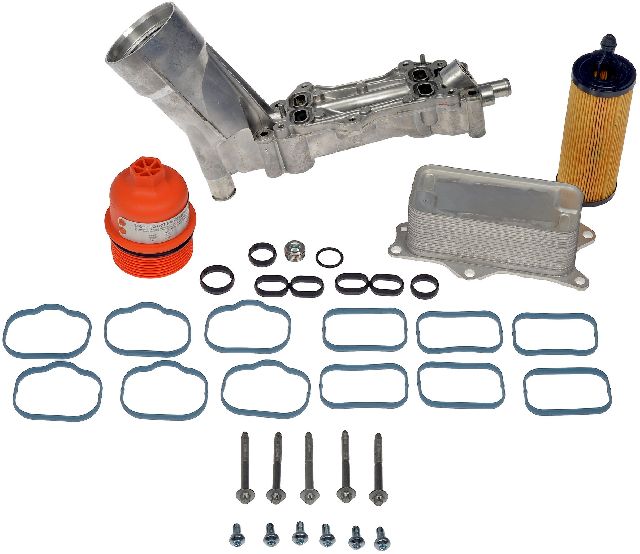
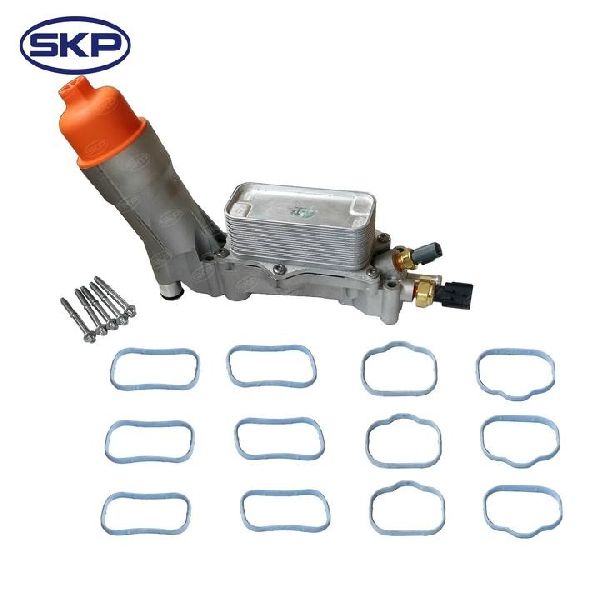
Typical fix: Replace the entire oil filter housing and cooler assembly. This is a labor-intensive job as the upper and lower intake manifolds must be removed. Many owners choose an upgraded aluminum replacement (e.g., Dorman 926-959) over the OEM plastic part to prevent future failures.
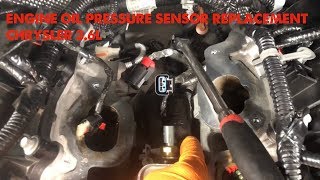
Est. part cost: $150-$350 - Faulty Engine Oil Pressure Sensor 🟡 Medium Probability The sensor is located in the hot engine valley, directly on the oil filter housing. This exposure to extreme heat cycles leads to a high failure rate. It can send false low-pressure readings to the PCM.
How to confirm: If an OEM filter is installed and there are no visible leaks, the sensor is the next likely culprit. A scan tool can monitor live oil pressure data; erratic or consistently low readings (despite a healthy engine sound) point to a bad sensor. Often seen with code P0520.
Typical fix: Replace the oil pressure sensor (OEM P/N 68334877AA). Since the labor to access it is identical to replacing the housing, it is strongly recommended to replace the entire oil filter housing assembly at the same time, even if it's not leaking yet.
Est. part cost: $40-$70 - Low Engine Oil Level 🟡 Medium Probability This is typically a symptom of a leaking oil filter housing, not a standalone cause. The gradual leak goes unnoticed until the oil level is low enough to cause the oil pump to suck in air, leading to a pressure drop.
How to confirm: Check the engine oil dipstick. If the level is below the minimum mark, this is a contributing factor.
Typical fix: Top off the oil to the correct level and find and fix the source of the leak, which is most often the oil filter housing.
Est. part cost: $15-$25
Rare But Worth Checking
- Failing Oil Pump: → Shop Engine Oil Pump While rare, if all other causes have been ruled out (correct filter, no leaks, new sensor) and oil pressure is mechanically verified to be low, the oil pump itself may be failing. This is often accompanied by code P06DD, which indicates the pump is stuck in its low-pressure mode.
- Damaged Wiring to Oil Pressure Sensor: The sensor connector or wiring can become brittle and break due to heat exposure in the engine valley, causing an intermittent or lost signal. Inspect the connector and wiring harness during sensor or housing replacement.
Diagnosis Steps
- Check Engine Oil Level and Condition: Pull the dipstick. If the oil is low, top it off and check for obvious leaks. If the oil is very old or dirty, it can contribute to the problem.
- Verify Oil Filter Type: This is the most critical first step. Remove the oil filter cap (torque spec is 18 ft-lbs or 25 N·m) and inspect the filter. If it is not a genuine Mopar filter, replace it with one (Part #68191349AB) and perform an oil change. Clear the code and see if it returns.
- Inspect for Leaks: Using a bright flashlight, carefully inspect the engine valley, which is the area between the two cylinder heads under the black plastic intake manifold. Look for any signs of pooled oil, which indicates a cracked oil filter housing.
- Scan for Other Codes: Use an OBD-II scanner to check for related codes like P0520 or P06DD, which can help pinpoint the issue to the sensor or pump circuit.
- Test the Sensor (Advanced): If no leaks are present and the filter is correct, the sensor is the next suspect. This involves removing the intake manifolds to access the sensor for electrical testing or replacement.
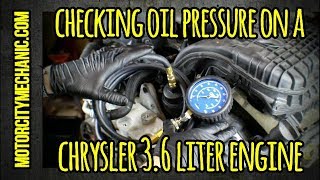
- Mechanical Pressure Test (Professional): If a new sensor does not resolve the issue, a mechanic can perform a mechanical oil pressure test to determine if the oil pump or internal engine components are at fault.
Parts You'll Likely Need
- Engine Oil Filter
(OEM #68191349AB)— The 3.6L Pentastar is extremely sensitive to filter specifications. Using a non-OEM filter is the most common cause of P1524. Always start with this part.
Trusted brands: Mopar
OEM price range: $10-$20
Aftermarket price range: $5-$15 - Engine Oil Filter Housing and Cooler Assembly
(OEM #68596317AB (latest revision))— The original plastic housing is a notorious failure point, frequently cracking and causing oil leaks that trigger this code. It's the second most common fix. The part has been superseded many times (previous numbers include 68105583AF, 68310865AF, etc.).
Trusted brands: Mopar (OEM), Dorman (OE FIX aluminum version 926-959)
OEM price range: $190-$280
Aftermarket price range: $150-$250 - Engine Oil Pressure Sensor
(OEM #68334877AA)— This sensor fails frequently due to heat exposure in the engine valley. It is almost always replaced during an oil filter housing job due to the shared labor.
Trusted brands: Mopar
OEM price range: $40-$70
Aftermarket price range: $20-$50 - Upper and Lower Intake Manifold Gaskets
(OEM #5281823AA (Upper x6), 5281824AA (Lower x6))— These gaskets must be replaced when removing the intake manifolds to access the oil filter housing and pressure sensor. They are not reusable.
Trusted brands: Mopar, Fel-Pro
OEM price range: $50-$80 (for the set)
Aftermarket price range: $30-$60 (for the set)
Related Codes That Often Appear With This One
- P0520 — This code indicates a fault specifically with the 'Engine Oil Pressure Sensor/Switch Circuit'. Its presence strongly suggests the sensor itself or its wiring is the root cause of the pressure reading that triggered P1524.
- P06DD — This code means the dual-stage oil pump is 'stuck off' (in low-pressure mode). It can appear with P1524 because the resulting low pressure is what causes the VVT system to be disabled.
Technical Service Bulletins (TSBs) & Recalls
- TSB S2109000001: Although written for Jeep, this TSB is highly relevant as it directly addresses code P1524 being caused by restrictive aftermarket oil filters (specifically calling out brands like Amsoil) on Pentastar engines. It instructs technicians to verify the oil filter is an OEM Mopar part as a primary diagnostic step.
Platform-Specific Known Issues
- The plastic oil filter/cooler housing assembly is a known weak point that frequently cracks, leading to significant oil leaks into the engine valley. This is the most common root cause of oil loss that triggers P1524 on the Pacifica and other vehicles with the 3.6L Pentastar engine.
Mechanic-Grade Diagnostic Values
- VVT System Enablement Pressure — expected: Must reach ~42 PSI. Failure: If pressure fails to reach this threshold, VVT will not activate and P1524 may be set.
- VVT System Disablement Pressure — expected: Must remain above ~31 PSI. Failure: If pressure drops below this threshold during operation, the PCM will disable VVT and set P1524.
- Engine Oil Pressure (Warm, at Idle) — expected: ~26-31 PSI. Failure: Pressure significantly below this range at idle suggests a mechanical issue or severe leak.
- Engine Oil Pressure (Warm, at 3,000 RPM) — expected: 25-110 PSI (typically 45-75 PSI). Failure: Pressure stuck in the 30-35 PSI range regardless of RPM strongly indicates a clogged filter or an oil pump stuck in low-pressure mode.
- Oil Pressure Sensor Circuit Voltage Check — expected: Less than 0.1 volts. Failure: If voltage does not drop to near zero when jumping the signal and ground circuits, a wiring issue exists between the sensor and PCM.
Scan Tool Commands That Help
- wiTECH (or equivalent professional scanner): VVT System Test — After verifying oil level and filter are correct, this bidirectional test commands the VVT solenoids to actuate. It helps determine if the fault is electrical (solenoid doesn't 'click') or mechanical/hydraulic (solenoid clicks but there's no change in engine sound or data), isolating the solenoid from a phaser or oil flow problem.
Wiring & Ground Locations
- Engine Oil Pressure Sensor Connector — On the oil filter/cooler housing assembly, located in the 'V' of the engine between the cylinder heads, underneath the upper and lower intake manifolds.. This connector and its wiring are exposed to extreme heat, making them prone to becoming brittle and failing. It contains the (G6) Engine Oil Pressure Signal circuit and the (K900) Sensor Ground circuit, which can be tested for continuity and shorts.
Real Owner Repair Stories
- Reddit user Original-Shock-3349 (Ram 1500 5.7L (similar VVT sensitivity)) — Check Engine Light for P1524, oil pressure stuck at 35 PSI regardless of RPM.
✅ What actually fixed it Replacing a cheap 'Carguard' brand oil filter installed by Carmax with a Mopar OEM filter and fresh oil. Oil pressure immediately returned to the normal 55-60 PSI range while driving. - AR15.com owner story cited by Go-Parts (Jeep Wrangler 3.6L) — P1524 and P06DD codes present.
✅ What actually fixed it The root cause was found to be an oil change shop installing the wrong size oil filter, which was crushed upon installation, severely restricting oil flow. Replacing it with the correct OEM filter resolved both codes. - YouTube user @bigboytruckandjeepstatus791 (2009 Ram) — P1524 code appeared.
✅ What actually fixed it The owner had used an 'engine restore' additive which allegedly clogged the brand new oil filter media with fine particles. Cutting the filter open revealed it was completely plugged. Replacing the clogged filter fixed the code.
When the Usual Fixes Don't Work
- While the vast majority of P1524 codes are fixed by a new OEM filter, sensor, or housing, there are rare cases where the issue is deeper. One owner on a forum reported that after replacing the filter housing, oil pressure sensor, and the entire dual-stage oil pump, the low oil pressure light and codes persisted. A mechanical gauge confirmed the issue was real: when the engine was warm, the oil pressure would intermittently drop to nearly zero when the pump's solenoid commanded a change in pressure stages. This indicates a rare internal engine problem, such as a faulty pressure relief valve or a blockage in an oil galley, that the common parts replacements will not fix.
OEM Part Supersession History
68105583AA (and revisions through AF)→68596317AB (latest known Mopar P/N)— Multiple revisions were made to the plastic oil filter/cooler housing to improve durability and resistance to cracking from heat cycles.
Heads up: All revisions are physically compatible, but installing the latest available part number is strongly recommended to get the most durable design.
Model Year Variations Within This Range
- 2017-2024: While the Pacifica uses the later-style oil filter (68191349AB), it's important to note that some aftermarket replacement housings, like the Dorman 926-959, are designed to update even earlier Pentastar applications to this later, more reliable filter design.
Diagnostic Flowchart
Other Known Issues on This Vehicle
Issues unrelated to this code that are worth knowing about as an owner of this generation:
- Engine Start-Stop (ESS) System Failure 🟠 Medium — Very common. Often occurs after 40,000 miles. The issue is typically a weak or failing auxiliary battery (AUX14 AGM) that supports the system.
- Rocker Arm / Lifter Failure ('Pentastar Tick') 🔴 High — A well-known design flaw affecting a significant number of 3.6L Pentastar engines, typically appearing after 60,000 miles. Failed rocker arm bearings cause a distinct ticking noise. If not addressed, it can lead to camshaft damage. (Ref: A class-action lawsuit has been filed regarding this issue.)
- Transmission Shudder and Rough Shifting (9-Speed Auto) 🟠 Medium — Commonly reported on 2017-2018 models. Owners experience jerking, hesitation, or rough shifts. Some cases require software updates, while others have led to transmission replacement. (Ref: Multiple software updates have been released. A small recall (18V492) was issued for a weld problem on only 5 vehicles.)
- Premature Paint Bubbling/Peeling 🟡 Low — Primarily reported on 2017 models, especially around the aluminum hood. Paint can bubble and peel prematurely, sometimes starting around 34,000 miles.
- Hybrid Propulsion System Shutdown (Hybrid Models Only) 🔴 High — Affects 2017-2023 Pacifica Hybrids. An internal transmission wiring connector can short, causing unexpected engine shutdown. (Ref: Recall 23V-010 (Chrysler 03A) was issued to update software to warn the driver before shutdown. Warranty extension D-23-07 covers the repair.)
Used vs. New Parts: Buying Guide for This Vehicle
When a used part is the smart pick: For the primary parts related to code P1524, using used parts is strongly discouraged. The oil filter housing and oil pressure sensor are both high-failure parts due to heat and material degradation. A used part from a salvage yard is likely near the end of its service life and carries the same risk of failure as the part being replaced.
What to inspect on the donor part:
- Not applicable, as used parts are not recommended for this repair.
OEM-only on this vehicle (don't cheap out):
- Engine Oil Filter: This is the most critical component. Using a genuine Mopar filter (68191349AB) is the safest and most reliable way to rule out filter-related issues, which are the number one cause of P1524.
Aftermarket brands forum-validated for this vehicle:
- Dorman OE FIX (926-959): This all-aluminum oil filter housing is a widely-used and recommended UPGRADE over the failure-prone OEM plastic housing.
- Mishimoto: Mentioned in forums as a potentially higher-quality aluminum housing alternative to Dorman.
- Wix XP: Some owners report success using Wix XP series filters as an alternative to Mopar, though OEM is still the safest first choice.
Brands owners have reported issues with on this vehicle:
- Generic/Store Brands: Filters from brands like 'Carguard' and other inexpensive, unverified aftermarket filters are frequently reported as the direct cause of P1524.
- Dorman Gaskets (Potentially): Some technicians and owners recommend using Mopar or Fel-Pro gaskets with the Dorman aluminum housing, reporting that the gaskets included with the Dorman kit can sometimes fail prematurely.
Real Owner Stories
Aggregated from forums and TSBs cited above. Mileages and costs reflect what owners reported in those sources.
2017-2024 Chrysler Pacifica 3.6L Pentastar V6
Symptoms: The owner received a P1524 code immediately after having an oil change performed at a quick lube shop.
What fixed it: Replacing the aftermarket oil filter with a genuine Mopar filter.
Source hint: pacificaforums.com thread titled 'P1524 code' by user 'JCsPacifica'
2011 Jeep Wrangler 3.6L Pentastar V6
Symptoms: The vehicle exhibited codes P1524 and P06DD after an oil change.
What fixed it: The shop had installed the wrong size filter and crushed it; replacing it with the correct Mopar filter fixed the issue.
Source hint: AR15.com forum thread '2011 Wrangler Issues P1524 and P06DD'
Related OBD-II Codes
Frequently Asked Questions
I just had my oil changed at a quick lube shop and now I have a P1524 code. What is the most likely cause?
Is there a specific torque specification for the oil filter cap on my Pacifica to prevent P1524?
I see oil pooling in the 'V' of my engine under the intake manifold. Is this related to P1524?
Should I replace the oil pressure sensor while fixing a housing leak?
Can I upgrade the plastic oil filter housing to prevent this code from returning?
Why is my remote start disabled when the P1524 code is present?
Helpful Videos
![2017 Chrysler Pacifica Oil Cooler Replacement. [3.6L]](https://img.youtube.com/vi/z1rrYCyqCN0/mqdefault.jpg)
We Have This Part in Stock


The information in this article is provided for general reference and educational purposes only. Vehicle specifications, procedures, and part compatibility can vary by production date, trim level, and region. Always consult your vehicle's factory service manual and verify part numbers before purchasing or performing repairs. Safety-critical components such as airbags, seat belts, and braking systems should be installed by a qualified professional.
- Chrysler Pacifica:
- 🧭 Diagnostic Flowchart
- 🎬 Helpful Videos
- 🛍️ Shop This Part
- What's Unique About the 2017-2024 Chrysler Pacifica
- Symptoms You May Notice
- Most Likely Causes
- Rare But Worth Checking
- Diagnosis Steps
- Parts You'll Likely Need
- Related Codes That Often Appear With This One
- Technical Service Bulletins (TSBs) & Recalls
- Platform-Specific Known Issues
- Mechanic-Grade Diagnostic Values
- Scan Tool Commands That Help
- Wiring & Ground Locations
- Real Owner Repair Stories
- When the Usual Fixes Don't Work
- OEM Part Supersession History
- Model Year Variations Within This Range
- Other Known Issues on This Vehicle
- Used vs. New Parts: Buying Guide for This Vehicle
- Real Owner Stories
- 2017-2024 Chrysler Pacifica 3.6L Pentastar V6
- 2011 Jeep Wrangler 3.6L Pentastar V6
- Related OBD-II Codes
- Frequently Asked Questions
- 🎟️ Get 5% Off