

P1524 on 2016-2017 Fiat 500X: Oil Pressure and Camshaft System Faults Explained
This code means the oil pressure is out of range, disabling the MultiAir variable valve timing system. The most common cause is low, old, or incorrect engine oil. Always check the oil level and type first; using the wrong oil (e.g., not full synthetic 5W-40 for the 1.4L or 0W-20 for the 2.4L) can cause this fault. A proper oil change with the correct filter is often the only fix needed.
- P1524 means your engine's advanced valve timing (MultiAir) has been shut down due to an oil pressure problem.
- Before any expensive repairs, your first and most important step is to check the engine oil level and verify that the correct type of full synthetic oil is being used.
- This code is serious. Do not ignore it, as continued driving could lead to major engine damage if the oil pressure is truly low.
- The problem is often seen with codes P1523 (VVA Low Oil Pressure) and P1D7F (ETC Self-Learning Failure), as confirmed by Fiat TSBs.
- If a proper oil change doesn't solve the issue, the next most likely causes are a bad oil pressure sensor or a clogged secondary MultiAir filter.
What's Unique About the 2016-2017 Fiat 500X
The Fiat 500X, with its MultiAir engines (both the 1.4L and 2.4L), uses engine oil as a hydraulic fluid to actuate the intake valves. This technology is extremely sensitive to oil level, quality, and viscosity. Unlike conventional engines, using the wrong type of oil or running even slightly low can directly trigger this fault. The 2.4L Tigershark engine, in particular, is known for oil consumption issues, making frequent oil level checks critical to prevent this code. If the system loses oil prime after sitting, it can lead to a 'crank, no-start' condition as the intake valves will not open.
🎬 Watch: How to fix a crank-no-start caused by lost oil prime.Diagnostic Flowchart
Tap your situation to follow the diagnostic path that matches what you're seeing on this vehicle.
Symptoms You May Notice
- Check Engine Light (MIL) is on
- Engine running rough or has an unstable idle
- Reduced engine power and poor acceleration
- Engine may stall, especially at idle
- Engine cranks but fails to start, sometimes cranking faster than usual as if there is no compression.
- Ticking noise from the top of the engine.
- Replacing spark plugs or ignition coils. While misfires can be a symptom, P1524 points directly to an oil pressure/hydraulic issue, not an ignition problem.
- Replacing camshaft or crankshaft position sensors. These sensors are generally not the cause for this specific oil pressure-related fault code.
Most Likely Causes
- Low or Incorrect Engine Oil 🔴 High Probability The MultiAir system is highly sensitive to oil volume and viscosity to function as a hydraulic control system for the valves. The manufacturer specifies very particular oil types (e.g., SAE 5W-40 full synthetic for the 1.4L, meeting FIAT 9.55535-S2 spec; SAE 0W-20 full synthetic for the 2.4L). The 2.4L engine is also known for oil consumption, which can cause the level to drop and trigger the code, especially during turns or on inclines.
How to confirm: Physically check the oil level on the dipstick after the vehicle has been off for at least 5 minutes on level ground. Review service records to confirm the correct type, viscosity, and a quality oil filter were used. Smell the oil on the dipstick for a gasoline scent, which could indicate fuel dilution thinning the oil.
Typical fix: Perform an oil and filter change using the exact manufacturer-specified oil. Reset the oil change reminder and clear the codes.
Est. part cost: $50-$100 - Faulty Oil Pressure Sensor 🟡 Medium Probability The sensor provides the critical pressure reading to the PCM. An inaccurate sensor can falsely trigger the code. Its location on the back of the engine block makes its wiring susceptible to damage.
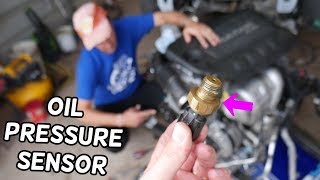
How to confirm: Compare the sensor's reading on a scan tool with a measurement from a mechanical oil pressure gauge. If the mechanical gauge shows proper pressure but the scan tool shows a reading out of range, the sensor is faulty. Visually inspect the sensor and its connector for damage or corrosion. On the 2.4L engine, it is located on the back of the engine, under the water pump.
Typical fix: Replace the oil pressure sensor. On the 2.4L engine, a 1 and 1/16 inch deep socket is often used for removal.
Est. part cost: $25-$75 - Clogged MultiAir Oil Filter/Passages 🟡 Medium Probability → Shop Engine Oil Filter Adapter In addition to the main oil filter, MultiAir engines have a small, secondary filter screen for the actuator assembly. This can become clogged with sludge, especially if oil changes are neglected or incorrect oil is used, starving the MultiAir 'brick' of oil.
How to confirm: This is an involved check performed after verifying oil level and pressure. The small filter is located under the timing cover and must be inspected for blockage. There is no official service interval, but replacement every 40,000-60,000 miles is recommended as preventative maintenance.
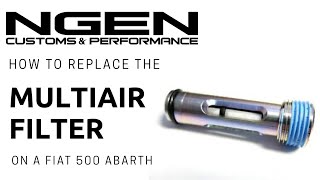
Typical fix: Replace the small MultiAir actuator filter. The Mopar part number is often cited as 68189847AA. This requires supporting the engine, removing an engine mount, and removing the timing cover for access.
Est. part cost: $15-$30 - Failing MultiAir Actuator ('Brick') ⚪ Low Probability The actuator is a complex electro-hydraulic unit that can fail internally. This is a known, though expensive, failure point on these engines, often occurring between 60,000-100,000 miles. It can also lose its oil prime after sitting for an extended period (30+ days), causing a no-start condition.
How to confirm: This is typically a diagnosis of exclusion. If oil level, quality, pressure, and all filters are confirmed good, the actuator itself is the likely culprit. A Fiat-specific scan tool can run tests on the actuator's solenoids. A user on a Fiat forum reported a replacement cost of ~€1500 for a 2016 500X with only 48,000km.
Typical fix: Replacement of the entire MultiAir actuator assembly. This is an expensive part and a labor-intensive job. For the 1.4L engine, a common part number is 68463929AA.
Est. part cost: $800-$1500
Rare But Worth Checking
- Failing Oil Pump: → Shop Engine Oil Pump If a mechanical gauge confirms low oil pressure throughout the engine's operating range and the oil level is correct, the oil pump may be worn or failing. This can also be caused by a clogged oil pump pickup screen in the oil pan, especially if engine sludge is present.
- Outdated PCM Software: As documented in TSBs for other codes like P0141, Fiat has issued software updates to change the sensitivity of fault monitoring. TSB 18-087-17 specifically lists P1524 as a code that may be addressed by a PCM software update. A dealer should check for the latest available software.
Diagnosis Steps
- Verify the code with an OBD-II scanner. Check for any other stored codes, paying close attention to P1523 and P1D7F.
- CRITICAL: Check the engine oil level and condition. Ensure it is full and clean. Smell for fuel contamination.
- Verify the correct engine oil is being used. For the 1.4L Turbo, this is a full synthetic 5W-40 oil meeting Fiat 9.55535-S2 specifications. For the 2.4L, use a full synthetic 0W-20 oil.
- If the oil level is low or the type is incorrect, perform a full oil and filter change with the correct products. An engine flush may be beneficial if sludge is suspected. Clear the codes and test drive.
- If the code returns, test the actual engine oil pressure using a mechanical gauge to rule out a faulty oil pressure sensor.
- If pressure is good but the code persists, inspect the wiring and connector for the oil pressure sensor, located under the water pump on the back of the 2.4L engine.
- If the vehicle sat for an extended period (30+ days), the MultiAir system may have lost its prime. Attempt the 'Extended Park Starting' procedure from the owner's manual, which involves repeated cranking cycles to rebuild oil pressure.
- If all the above check out, the next steps involve inspecting the secondary MultiAir filter (P/N 68189847AA) for clogs and, finally, diagnosing the MultiAir actuator ('brick') itself, which may require a specialized scan tool.
Parts You'll Likely Need
- Engine Oil and Filter — The most common cause is low, old, or incorrect oil. Using the manufacturer-specified oil is the first and most important step.
Trusted brands: Selenia, Pennzoil, Valvoline, Motul, Bardahl
OEM price range: $70-$120
Aftermarket price range: $50-$90 - Oil Pressure Sensor
(OEM #5047867AB)— This sensor can fail and send incorrect readings to the PCM, falsely triggering the code.
Trusted brands: Mopar, Bosch, Standard Motor Products
OEM price range: $40-$80
Aftermarket price range: $25-$50 - MultiAir Actuator Assembly ('Brick')
(OEM #68463929AA (for 1.4L))— If all other causes are ruled out, the complex actuator itself may have failed internally.
Trusted brands: Mopar
OEM price range: $1400-$2300
Related Codes That Often Appear With This One
- P1523 — P1523 is 'VVA Low Oil Pressure'. This code is very similar and often appears with P1524 as both relate to oil pressure problems in the MultiAir (VVA) system. When the PCM detects low pressure (P1523), it often disables the system and sets P1524 as a result. (TSB #1804221, #1808917)
- P1D7F — P1D7F is 'ETC Self-Learning Failure'. Manufacturer TSBs link this code directly with P1524, suggesting the oil pressure issue causes the engine to run poorly, which in turn can disrupt the electronic throttle control's ability to calibrate. (TSB #18-087-17, #1804221)
- P0141 — P0141 is 'O2 Sensor 1/2 Heater Performance'. This code is listed alongside P1524 in multiple TSBs. The connection isn't direct, but an underlying electrical or software issue could potentially trigger both. (TSB #1804221, #1808917)
Technical Service Bulletins (TSBs) & Recalls
- 18-087-17
- 1804221 (likely a typo for a different number, but cited in pass 1)
- 1808917 (likely a typo for a different number, but cited in pass 1)
- 18-089-23 (mentions P1524 for other vehicles, indicating PCM sensitivity)
- 18-084-17 (mentions P1524 for Fiat 500L)
Platform-Specific Known Issues
- The MultiAir system can lose its oil prime if the vehicle sits unused for an extended period (e.g., 30 days), leading to a no-start condition and potentially this code. The official owner's manual contains an 'Extended Park Starting' procedure to re-prime the system.
- Manufacturer Technical Service Bulletins (TSBs) #18-087-17, #1804221, and #1808917 all acknowledge this code as part of a pattern of known issues on these vehicles, often appearing with codes P1523 and P1D7F.
- The 2.4L Tigershark engine is known for higher-than-average oil consumption, which can lead to low oil levels and trigger P1524 if not checked frequently.
Mechanic-Grade Diagnostic Values
- Engine oil delivery pressure (1.4L Turbo MultiAir) at idle — expected: > 0.7 bar (> 10.1 PSI). Failure: Pressure below this threshold indicates a potential issue with the oil pump, pickup tube, or a major internal leak.
- Engine oil delivery pressure (1.4L Turbo MultiAir) at 4000 RPM — expected: > 4.0 bar (> 58 PSI). Failure: Failure to reach this pressure under load points to a weak oil pump or a significant flow restriction.
- MultiAir (VVA) Solenoid Resistance — expected: 0.5 - 1.0 Ohms. Failure: A reading outside this range, especially an open circuit (infinite resistance) or a short (very low resistance), indicates a failed solenoid within the actuator.
- Oil Pressure Sensor Signal Voltage (Key On, Engine Off) — expected: Approximately 0.5V. Failure: A significantly different voltage may indicate a faulty sensor or wiring issue.
Hidden / Shadow Codes Worth Checking
- P1524-79: Spark Plug anti-fouling diagnosis - mechanical linkage failure. While documented on a Fiat 500 with a TwinAir engine, the '-79' suffix indicates a manufacturer-specific sub-code providing more detail than the base P-code. This confirms Fiat's use of sub-codes, which may only be visible on dealer-level scanners. (see via A Fiat-specific diagnostic tool like Witech or a high-end aftermarket scanner is likely required to view these sub-codes.)
Scan Tool Commands That Help
- Witech or equivalent high-end scanner: MultiAir Solenoid Active Test — After confirming oil pressure is good, this bidirectional test is used to individually command each solenoid on the MultiAir actuator. The technician can listen for an audible click from each solenoid, confirming the electrical circuit and the solenoid's mechanical function are intact. This helps isolate a single failed solenoid within the expensive 'brick' assembly.
- N/A - Manual Procedure: Extended Park Starting / MultiAir Priming Procedure — This is the first step for a crank-no-start condition, especially if the vehicle has been sitting for 30+ days. It is used to purge air and re-prime the MultiAir actuator with oil. The procedure involves repeated 10-15 second cranking cycles with pauses in between. A mechanic-grade tip is to pull the fuel pump fuse or hold the accelerator to the floor during cranking to prevent flooding the engine.
Wiring & Ground Locations
- Oil Pressure Sensor (2.4L Engine) — On the backside of the engine block, located directly under the water pump.. This is the direct source of the pressure reading for the PCM. Its location makes it susceptible to oil leaks from above or physical damage during other repairs (like a water pump replacement), and its connector should be inspected for integrity.
- Oil Pressure Sensor (1.4L Engine) — On the oil filter housing assembly, typically accessed from underneath the vehicle.. Provides the oil pressure signal to the PCM. The wiring harness in this lower location can be exposed to road debris and corrosion.
- Main Chassis Ground — The thick black cable from the battery's negative terminal bolted to the vehicle's frame/body.. While not specific to P1524, many unexplained Fiat electrical faults can be traced to a poor main ground connection due to looseness or corrosion. It should be checked as a preliminary step in any complex electrical diagnosis.
- Oil Pressure Sensor Connector — Connects to the oil pressure sensor.. It is a 3-terminal weatherproof connector. Diagnostic procedures may involve jumping the sensor ground circuit (K900) and the signal circuit (G6) to test the wiring harness integrity back to the PCM.
Real Owner Repair Stories
- Reddit user on r/ram_trucks (Ram 1500 (uses similar oil pressure logic)) — Check engine light with code P1524, oil pressure stuck at a constant 35 PSI regardless of RPM.
❌ Tried (didn't work) Initially considered taking it to a dealer, suspecting a major issue.
✅ What actually fixed it The owner performed an oil change, replacing a low-quality 'Carguard' aftermarket oil filter with an OEM Mopar filter and the correct Pennzoil Ultra Platinum oil. After the change, oil pressure immediately returned to a normal, variable 55-60 PSI while driving, and the code was resolved.
"I Checked Everything" — The Actual Cause
- In the context of P1524, the equivalent scenario is 'oil pressure tests good with a mechanical gauge, but the code persists.' In this case, the root cause is not a mechanical oil pressure problem. The issue likely lies with the electrical side of the circuit or the PCM's software. Per TSB #18-087-17, the first step should be to check with a dealer for any available PCM software updates, as outdated software can have incorrect sensitivity for setting this fault. If software is up to date, the next step is to diagnose the oil pressure sensor's wiring harness for intermittent shorts or opens before condemning the PCM itself.
OEM Part Supersession History
04892697AA, 4892697AB, 4892697AC, 4892697AD, 4892697AE, 4892697AF, 4892697AG, 4893099AA, 4893099AB, 4893099AC, 4893099AD→68463929AA— This is the part history for the 1.4L MultiAir Actuator ('Brick'). The numerous supersessions indicate multiple revisions and improvements have been made to the part over its lifespan to improve reliability.
Model Year Variations Within This Range
- 2016-2017: No significant mechanical or electrical differences have been identified between the 2016 and 2017 model years for the Fiat 500X that would alter the diagnosis or common causes for code P1524. Both years utilize the same 1.4L and 2.4L MultiAir engines and are covered under the same Technical Service Bulletins for related issues.
Helpful Videos

We Have This Part in Stock



The information in this article is provided for general reference and educational purposes only. Vehicle specifications, procedures, and part compatibility can vary by production date, trim level, and region. Always consult your vehicle's factory service manual and verify part numbers before purchasing or performing repairs. Safety-critical components such as airbags, seat belts, and braking systems should be installed by a qualified professional.
- Fiat 500X:
- 🧭 Diagnostic Flowchart
- 🎬 Helpful Videos
- 🛍️ Shop This Part
- What's Unique About the 2016-2017 Fiat 500X
- Symptoms You May Notice
- Most Likely Causes
- Rare But Worth Checking
- Diagnosis Steps
- Parts You'll Likely Need
- Related Codes That Often Appear With This One
- Technical Service Bulletins (TSBs) & Recalls
- Platform-Specific Known Issues
- Mechanic-Grade Diagnostic Values
- Hidden / Shadow Codes Worth Checking
- Scan Tool Commands That Help
- Wiring & Ground Locations
- Real Owner Repair Stories
- "I Checked Everything" — The Actual Cause
- OEM Part Supersession History
- Model Year Variations Within This Range
- 🎟️ Get 5% Off