

OBD-II Code P1547: Ultimate Diagnostic & Repair Guide
What P1547 Means for VW, Audi, GM, BMW & More — And How to Fix It Right
- Code P1547 requires manufacturer-specific diagnosis: it means an N75 turbo valve short on VW/Audi, low A/C refrigerant on GM, and a CAN bus network failure on BMW.
- For VW and Audi models, test the N75 boost control valve resistance first; a healthy valve reads exactly 25-35 Ohms.
- On GM vehicles, do not replace the A/C compressor immediately; most P1547 codes stem from a simple refrigerant leak requiring a $200-$350 professional evacuate and recharge service.
- Never ignore a BMW P1547 CAN bus fault, as water damage from clogged sunroof drains corrodes footwell modules and causes a $2,000+ no-start condition within months.
What Does P1547 Mean?
P1547 is a manufacturer-specific diagnostic trouble code (DTC). For Volkswagen, Audi, and Volvo, it indicates a 'Short to Ground' in the N75 turbo wastegate bypass regulator valve circuit. For General Motors, it signals degraded A/C system performance, usually due to low refrigerant. For BMW, it points to a 'CAN bus signal not received in time' error, indicating a communication network failure. For Subaru, the closely related P1507 code traces to a faulty neutral safety switch causing idle issues.
Technical definition: The official SAE/OBD-II definition varies by manufacturer. For Volkswagen/Audi/Volvo: 'Boost Pressure Contr. Valve Short to Ground'. For General Motors: 'A/C System Performance Degraded'. For BMW: 'Engine Control Module (ECU) CAN bus signal not received in time'.
Can I Drive With P1547?
Yes, But With Caution. Driving is possible but strongly discouraged. On VW/Audi/Volvo models, ignoring the code causes chronic underboost (P0299), putting severe strain on the turbocharger and leading to a $1,500-$3,000 premature failure. On GM vehicles, the ECU disables the A/C compressor; if the root cause is a failing clutch, it eventually seizes, shredding the serpentine belt and causing an immediate breakdown. Diagnose and repair the issue within 100 miles.
Common Causes
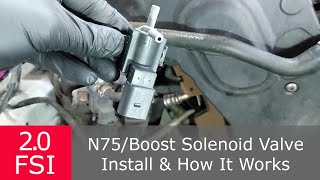
- Faulty Boost Pressure Control Valve (N75 Solenoid) (VW/Audi) (Very Common) — The N75 valve regulates the turbo's wastegate and frequently develops an internal short circuit. 🎬 Watch: How to test and install the N75 valve Its resistance changes when hot, causing intermittent issues not present during a cold test.
- Low Refrigerant Level (GM) (Very Common) — If the A/C system has a leak, refrigerant drops. The A/C pressure sensor detects this low pressure, and the ECU logs P1547 and disables the compressor to prevent it from running dry.
- Damaged or Shorted N75 Wiring (VW/Audi) (Common) — The wiring harness to the N75 valve sits in a high-heat area. Wires melt against the engine or turbo, become brittle, and chafe through, causing a direct short to a ground source.
- Faulty A/C Refrigerant Pressure Sensor (GM) (Common) — This sensor reports A/C line pressure to the ECU. It fails by sending an incorrect signal, causing the computer to log P1547 even if refrigerant levels are correct.
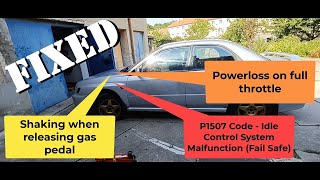
- Faulty Neutral Safety Switch (Subaru P1507) (Common) — On manual Subarus, a faulty neutral safety switch confuses the ECU into thinking the car is in neutral when in gear, commanding the wrong idle speed 🎬 Watch: Troubleshooting the mysterious Subaru P1507 idle code and triggering idle malfunction codes.
- Faulty A/C Compressor or Clutch (GM) (Less Common) — The magnetic clutch on the compressor fails to engage, or the compressor fails internally. This prevents refrigerant circulation, leading to no cooling and triggering the performance code.
- CAN Bus Communication Failure (BMW) (Uncommon) — The main engine computer (DME) is not receiving expected signals from other network modules. This is caused by water-damaged CAN bus wiring, a failing terminating resistor, or a faulty control module.
- Faulty Engine Control Module (ECM/ECU) (Rare) — The internal driver circuit in the ECM that controls the N75 valve (VW/Audi) or interprets A/C sensor data (GM) fails. Consider this only after definitively ruling out all wiring and component faults.
Symptoms
- Check Engine Light is On — The universal symptom for all vehicle makes when a P1547 fault is stored in the ECU.
- Loss of Engine Power / Limp Mode (VW/Audi) — A shorted N75 circuit prevents proper turbo boost regulation, causing sluggish acceleration and forcing the ECU into a protective 'limp mode' with drastically reduced power.
- A/C Blows Warm or Hot Air (GM) — The A/C system stops cooling because the ECU detects a performance issue and disables the A/C compressor clutch to prevent mechanical damage.
- Surging or Inconsistent Acceleration (VW/Audi) — An intermittently failing N75 valve or wiring causes the turbo to engage and disengage unpredictably, resulting in a surging feeling during acceleration.
- Multiple Warning Lights and Erratic Electronics (BMW) — A CAN bus fault causes a cascade of errors. ABS, DSC, and transmission warnings appear simultaneously, and instrument cluster displays behave erratically.
- Engine Stalling or Rough Idle (Subaru) — A bad neutral safety switch causes the engine to stall when coming to a stop or exhibit a rough, unstable idle as the ECU struggles to determine correct engine speed.
Diagnostic Flowchart
Tap your situation to follow the diagnostic path that matches what you're seeing on this code.
Common Fixes & Costs
- Replace Boost Pressure Control Valve (N75) — Parts: $40-$100, Labor: $60-$120, ~0.6 hr book time (DIY)
- A/C System Evacuate and Recharge — Parts: $50-$100, Labor: $150-$250, ~1.2 hr book time (Professional)
- Repair Wiring Harness — Parts: $10-$30, Labor: $150-$300, ~2 hr book time (Intermediate)
- Replace A/C Refrigerant Pressure Sensor — Parts: $40-$100, Labor: $70-$120, ~0.7 hr book time (DIY)
- Replace A/C Compressor — Parts: $300-$800, Labor: $500-$900, ~2.5 hr book time (Professional)
- Replace Neutral Safety Switch (Subaru) — Parts: $30-$70, Labor: $100-$180, ~1.3 hr book time (Intermediate)
Used vs. New Parts: Buying Guide
When a used part is worth it: For mechanical parts like an A/C compressor on a high-mileage GM vehicle, a used unit from a reputable salvage yard is a budget-friendly option. For electronic parts like the N75 valve, buying used is not recommended.
Donor-vehicle mileage cap: roughly under 70000 miles for the part to have meaningful remaining life.
Donor quality checklist:
- Verify the part number matches exactly.
- For A/C compressors, ensure the donor vehicle was not scrapped due to engine failure, which contaminates the A/C system.
- Ask for a short-term functional warranty (30-90 days).
Decision logic:
- If The part is electronic (N75 valve, pressure sensor) → Buy new from an OEM supplier. Cost savings do not justify the risk of failure.
- If The part is a GM A/C compressor and the vehicle has over 150,000 miles → A used or remanufactured compressor is a reasonable choice to save money.
- If The part is a GM A/C compressor and the vehicle has under 100,000 miles → Invest in a new or quality remanufactured compressor with a long warranty.
Warranty tradeoff: Used parts offer a 30-90 day warranty. New aftermarket parts come with a 1-year to limited lifetime warranty. A new OEM part provides the best guarantee of quality.
Worst-case if a used part fails: $600-$1200 if a used A/C compressor fails shortly after installation, requiring another system evacuation and recharge.
What Happens If You Wait — Timeline
- Immediate: VW/Audi: Check Engine Light on, car enters limp mode with severe power loss. GM: A/C blows warm air. BMW: Multiple warning lights (ABS, DSC, Brake) appear. (MPG impact: 10-20% (VW/Audi), 0% (GM/BMW)% · Added cost: $0)
- 1-3 Months: VW/Audi: Continued driving strains the turbo from improper boost regulation. GM: A failing compressor clutch starts making intermittent grinding noises. BMW: Electronic glitches become frequent; car fails to start intermittently. (MPG impact: 10-20% (VW/Audi), 0% (GM/BMW)% · Added cost: $50 in wasted fuel (VW/Audi). For BMW, diagnostic costs increase by $200-$400 as the issue becomes harder to trace.)
- 3-6 Months: VW/Audi: Poor performance masks other engine problems. GM: A failing compressor clutch is at high risk of seizing completely. BMW: Water damage worsens, spreading corrosion to control modules like the Junction Box Fuse Panel (JBE). (MPG impact: 10-20% (VW/Audi), 0% (GM/BMW)% · Added cost: GM: $800-$1500 if the compressor seizes and shreds the belt. BMW: $500-$1000 for corroded module replacement.)
- 6+ Months: VW/Audi: Operating outside design parameters accelerates general engine wear. GM: Driving after a belt shreds causes engine overheating or loss of power steering. BMW: Widespread corrosion damages multiple modules, leading to a permanent no-start condition. (MPG impact: 10-20% (VW/Audi)% · Added cost: GM: $1500+ for total repair after a seized compressor. BMW: $2000-$3000+ for complex CAN bus diagnostics and multiple module replacements.)
Cost of Not Fixing It
- Immediate: VW/Audi: Significant loss of power ('limp mode') and a 10-20% drop in fuel economy. GM: Complete loss of air conditioning. (Added cost: Negligible, aside from increased fuel consumption.)
- 1-6 Months: GM: A failing A/C compressor clutch seizes, shredding the serpentine belt and causing an immediate loss of power steering and alternator function. (Added cost: $400-$800 to replace the seized compressor and serpentine belt on top of the original repair cost.)
- 6+ Months: VW/Audi: Chronically poor performance accelerates wear on other engine components. BMW: A CAN bus issue worsens, leading to severe electronic glitches and a no-start condition. (Added cost: $1500+ if a cascading failure occurs or a no-start condition requires extensive module replacement.)
Diagnosis Steps
- Identify Your Vehicle's Manufacturer
The diagnostic path for a Volkswagen turbo issue is completely different from a Chevrolet A/C problem. Confirm your vehicle's brand before proceeding.
Tools: Vehicle Owner's Manual (Beginner) - Visual Inspection (All Makes)
For VW/Audi, inspect the N75 valve wiring harness near the turbo for melting or chafing. For GM, inspect wiring to the A/C compressor and pressure sensors. For BMW, check for water ingress in the floor wells or trunk, paying attention to sunroof drain exit points.
Tools: Flashlight (Beginner) - Test N75 Valve Resistance (VW/Audi/Volvo)
Disconnect the N75 valve's electrical connector. Use a multimeter set to Ohms (Ω) to measure resistance between the two pins. A good valve reads 25-35 Ohms. A reading near zero indicates a short, confirming the P1547 fault.
Tools: Multimeter (Intermediate) - Check A/C Static & Dynamic Pressure (GM)
With the engine OFF, connect an A/C manifold gauge set. Static pressure on both sides should roughly equal ambient air temperature (e.g., ~78-85 PSI at 75°F). If pressure is < 20 PSI, there is a leak. With the engine running and A/C on MAX, the low side should be 35-45 PSI and the high side 150-170 PSI.
Tools: A/C Manifold Gauge Set, Ambient Thermometer (Advanced) - Check for Short to Ground at N75 Connector (VW/Audi/Volvo)
Disconnect the N75 harness connector. With the ignition OFF, use a multimeter to check for continuity between the ECU control wire pin and a solid chassis ground. Any reading other than open loop (OL) confirms the wiring harness is shorted to ground.
Tools: Multimeter, Wiring Diagram (Intermediate) - Check A/C Pressure Sensor Voltage (GM)
Back-probe the signal wire of the 3-wire A/C pressure sensor with a multimeter. Voltage should correspond to system pressure (~0.5V at low pressure, rising to ~4.5V at high pressure). If you see 0V or a constant 5V, the sensor or its wiring is faulty.
Tools: Multimeter, Back-probe kit, Wiring Diagram (Advanced) - PRO TIP: Test N75 Valve When Hot (VW/Audi/Volvo)
If cold resistance passes, remove the valve and heat it with a heat gun to approximately 180-200°F (82-93°C) and re-test resistance. A drop to near-zero Ohms indicates a heat-related internal failure.
Tools: Multimeter, Heat Gun or Hot Water, Infrared Thermometer (Advanced) - PRO TIP: Check N75 Duty Cycle with VCDS (VW/Audi/Volvo)
Using VCDS, monitor the N75 duty cycle in Measuring Blocks Group 011. At idle, it should be <10%. During a full-throttle run in 3rd gear, it should modulate between 70-95%. If stuck at 0% or 99.6%, the ECU is detecting a fault or unable to control the valve.
Tools: VCDS or equivalent advanced scan tool (Advanced) - PRO TIP: Analyze CAN Bus Waveform (BMW)
Use an oscilloscope to view the CAN bus. A healthy CAN bus shows two clean, square-wave signals switching between 2.5V and 3.5V (CAN High) and 2.5V and 1.5V (CAN Low). A corrupted signal pulled flat to ground confirms the network fault.
Tools: Oscilloscope, Wiring Diagram (Expert)
When This Code Triggers (Freeze-Frame Conditions)
- Engine Coolant Temp: 180-210°F (82-99°C) (The fault is detected once the engine is fully warmed up and enters closed-loop fuel control.)
- Engine RPM: 1800-3000 RPM (VW/Audi) or 800-1500 RPM (GM) (For VW/Audi, it sets during steady-state cruising or light acceleration when boost is requested. For GM, it sets at idle or low RPMs shortly after the A/C is turned on.)
- Engine Load: 25-50% (On VW/Audi, the code triggers under partial load when the ECU actively modulates the N75 valve to control boost pressure.)
- A/C Command Status (GM): On (For GM vehicles, the driver has requested air conditioning, and the ECU has commanded the compressor to engage.)
Related Codes
- P0299 — On VW/Audi/Volvo, this 'Turbo Underboost' code is a direct consequence of P1547. The electrical fault prevents the N75 valve from controlling the wastegate. Always fix the P1547 electrical short first.
- P1548 / P1549 — Sister codes to P1547 on VW/Audi. P1548 indicates an 'Open Circuit' in the N75 valve circuit. A multimeter resistance test differentiates them: near-zero ohms for P1547, infinite ohms for P1548.
- P0532 / P0533 — On GM vehicles, these codes for 'A/C Refrigerant Pressure Sensor Circuit Low/High' are specific. If present with P1547, the pressure sensor or its circuit is the direct cause.
- U-codes (e.g., U0100, U0140) — On BMWs with a P1547 CAN fault, U-prefix codes indicate 'Lost Communication' with control units, confirming a network-wide communication problem rather than a single component failure.
Climate & Environmental Factors
- High Engine Bay Heat (VW/Audi/Volvo): Prolonged exposure to high heat from the turbocharger makes the N75 valve's plastic housing brittle and melts wiring insulation, leading to shorts against the engine block.
- High Ambient Temperature & Humidity (GM): High outside temperatures place maximum load on the A/C system. A marginally low system fails to cool on a 95°F day, causing pressure to drop below the minimum threshold and triggering P1547.
- Water Ingress from Clogged Drains (BMW): Clogged sunroof drains cause rainwater to overflow into the passenger footwell, soaking CAN bus wiring and junction boxes. This causes corrosion and shorts out the communication network.
How to Talk to a Mechanic About This Code
Say this: "I have a P1547 code. For my [VW/Audi], please test the N75 valve and its wiring for a short to ground. For my [GM vehicle], please perform a full A/C system diagnosis with pressure gauges and a leak test before quoting a compressor. For my [BMW], please inspect for water intrusion in the passenger footwell and check CAN bus resistance before replacing any modules."
This signals you've done research and directs the technician to the correct diagnostic path for your specific vehicle, preventing unnecessary part replacements.
Avoid saying:
- 'My check engine light is on, can you just fix it?'
- 'I think it's the turbo/compressor, can you replace it?'
- 'Just do whatever you think is best.'
Questions to ask before authorizing the repair:
- For VW/Audi: Did you test the N75 valve's resistance when cold and hot? Did you find a direct short to ground in the wiring harness?
- For GM: What were the static and dynamic A/C pressures? Did you locate a leak with UV dye, and if so, where?
- For BMW: Did you find evidence of water damage or corrosion on any connectors? What was the Ohm reading on the CAN bus?
Where to Take It: Dealer vs Independent vs Chain
- Dealer:
Best for: Vehicles under warranty or with a relevant recall/service campaign (e.g., GM A/C condenser issues)., Complex BMW CAN bus faults where multiple modules need programming.
Downsides: Highest labor rates and parts costs., Defaults to replacing larger, more expensive assemblies instead of performing detailed wiring repairs. (Typical cost: +50% vs. baseline) - Independent Shop:
Best overall choice. A specialist independent shop offers the best balance of expertise and value. For VW/Audi/BMW, find a German car expert. For GM, find a shop with a strong reputation for A/C diagnostics.
Best for: Out-of-warranty VW/Audi N75 valve and wiring diagnosis., GM A/C system diagnostics and repair at a fair price., BMW CAN bus issues, provided the shop specializes in German vehicles.
Downsides: Quality and expertise vary greatly; a German car specialist is crucial for VW/Audi/BMW. (Typical cost: +0% vs. baseline) - Chain Shop:
AVOID. The diagnostic complexity of P1547 across all manufacturers is beyond the scope of most chain shops. The risk of misdiagnosis is very high.
Best for: Not recommended for this code.
Downsides: Technicians lack specialized knowledge for VW turbo or BMW CAN bus diagnostics., For GM A/C, they perform low-quality 'recharges' without diagnosing the root-cause leak. (Typical cost: -10% vs. baseline)
When to Walk Away From the Repair
If the estimated repair cost exceeds 40-50% of the car's private-party value, pause and consider your options.
- Car worth $3000, fix is $1800: Walk away. A $1,800 repair for a seized A/C compressor and belt on an old GM vehicle is not a sound investment.
- Car worth $15000, fix is $800: Fix it. An $800 repair for a new A/C condenser on a newer GM truck is well below the threshold and restores a key feature.
- Car worth $4000, fix is $500: Fix it. A $500 repair for a wiring short on a VW/Audi is a reasonable cost to restore full engine power and drivability.
What Scan Tool You Need for This Code
Minimum: A tool that reads manufacturer-specific codes and live data. A basic code reader is insufficient as it won't differentiate the cause for VW, GM, or BMW.
A $20 reader only shows 'P1547'. It cannot show the N75 duty cycle on a VW, A/C pressure sensor voltage on a GM, or the list of failing modules on a BMW's CAN bus.
Budget: BlueDriver Pro (~$100) — Reads manufacturer-specific fault codes and displays live data for some systems, helping confirm the symptom (e.g., no A/C pressure on GM).
Mid-range: Foxwell NT510 Elite (with specific manufacturer software) (~$180) — Provides OE-level diagnostics for a specific brand. Reads codes from all modules, views live data PIDs (like N75 duty cycle), and performs bidirectional tests.
Professional: Autel MaxiCOM MK808 / MK808BT (~$450-600) — Offers comprehensive all-system diagnostics. Performs bidirectional active tests (e.g., command the GM A/C clutch on/off) and helps diagnose complex communication issues on BMWs.
Rent vs buy: For a one-time fix, a free rental from an auto parts store is not sufficient for this code's complexity. Buying a mid-range, brand-specific scanner is a high-value investment.
How to Clear the Code After You Fix It
- Perform the physical repair (e.g., replace N75 valve, fix wiring short, recharge A/C).
- Reconnect the battery if it was disconnected.
- Use an OBD-II scan tool to select the 'Clear/Erase Codes' function.
- Perform a complete drive cycle to allow readiness monitors to run.
Drive cycle (~30 minutes): Start with a cold soak (vehicle off for 8+ hours). Start the engine and idle for 2-3 minutes. Drive for 15-20 minutes with a mix of stop-and-go city conditions and steady highway cruising (55 mph for 5-10 minutes). Allow the vehicle to cool down.
Readiness monitors affected: Comprehensive Component Monitor, Catalyst (CAT) Monitor, Evaporative (EVAP) System Monitor
Before emissions retest: drive at least 100 miles to fully set monitors.
Watch out for:
- Disconnecting the battery clears the Check Engine Light but resets all readiness monitors to 'Not Ready', causing an immediate emissions test failure.
- The code returns immediately if the underlying electrical short (VW/Audi) or performance issue (GM) was not correctly repaired.
Will This Fail Emissions / State Inspection?
Yes — this code typically fails an OBD-II emissions inspection.
- California: An illuminated Check Engine Light is an automatic failure. For model years 2001 and newer, only one readiness monitor is permitted to be 'Not Ready' to pass.
- New York: A vehicle fails the OBD-II inspection if the Check Engine Light is on. For 2001 and newer vehicles, only one monitor can be 'Not Ready'.
- Texas: An active Check Engine Light results in an automatic failure. Texas allows one 'Not Ready' monitor for 2001+ vehicles to pass the inspection.
Most Commonly Affected Vehicles
- Volkswagen Jetta / Golf (1999-2006) — Extremely common on the 1.8T and 1.9L TDI engines. The N75 valve is a frequent failure point.
- Audi A4 / TT (1997-2006) — The 1.8T engine is highly susceptible to P1547 from a failed N75 valve or brittle wiring harness.
- Chevrolet Silverado / GMC Sierra (2014-2019) — These trucks are known for A/C condenser leaks (Special Coverage #17336) and faulty pressure sensors triggering this generic A/C performance code.
- Cadillac CTS / ATS (2010-2019) — Sets P1547 when A/C performance degrades, commonly linked to failing A/C pressure transducers or low refrigerant levels.
- Volvo S60 / V70 / XC70 (2001-2009) — Models with 2.4T and 2.5T 5-cylinder turbo engines use a similar boost control solenoid to VW/Audi and trigger P1547 for the same electrical fault.
- BMW 3-Series (E90) / 5-Series (E60) (2005-2013) — P1547 points to a CAN bus communication timeout, often caused by water ingress in the passenger footwell from clogged sunroof drains.
- Subaru Impreza / Legacy / Forester (Manual) (1999-2007) — Uses the similar P1507 code, frequently traced to a faulty Neutral Safety Switch causing stalling and rough idle.
- Volkswagen Passat (1998-2005) — Shares the same N75 valve and wiring vulnerabilities as the Jetta and Golf of the same era.
Manufacturer-Specific Notes
- Volkswagen/Audi: The N75 valve is a common maintenance item on 1.8T and TDI engines. Due to its high failure rate, technicians often replace it as a primary diagnostic step after a quick visual check of the wiring.
- General Motors: P1547 is a 'catch-all' code for A/C underperformance. GM has issued multiple service bulletins for A/C leaks on 2014+ trucks/SUVs, including Special Coverage #17336 for condenser leaks.
- BMW: A P1547 CAN fault is rarely the ECU itself. The root cause is almost always physical: water damage from clogged sunroof drains corroding a splice point, or a single faulty module shorting the network.
- Subaru: The P1507 code causes mechanics to unnecessarily replace expensive Idle Air Control (IAC) valves. The inexpensive Neutral Safety Switch is a far more common culprit on manual transmission models.
Real Owner Stories
2004 Audi A4 1.8T Quattro at 135K miles
Check engine light came on with codes P1547 (N75 short to ground) and P0299 (underboost). Car felt very sluggish, like it had no turbo.
What they tried:
- Cleared codes, but they returned immediately.
- Replaced the N75 valve (Part #06A906283E). The code P1547 remained.
- Inspected the wiring harness to the N75 valve and found wires melted together, shorting on the engine block.
Outcome: Repaired the melted section of the wiring harness using butt connectors and heat-resistant tape. Both P1547 and P0299 resolved, and full power was restored.
Lesson: P1547 is an electrical code. If replacing the N75 valve doesn't fix it, the problem is in the wiring harness. Inspect the harness thoroughly for heat damage before assuming the ECU is bad.
2015 GMC Sierra 1500 at 70K miles
A/C started blowing warm air, and the check engine light came on for P1547 (A/C Performance Degraded). No other symptoms.
What they tried:
- Used a DIY A/C recharge can, which did not solve the problem.
- Took it to a shop, which diagnosed a very low refrigerant level.
- The shop performed a leak test with UV dye and found a leaking A/C condenser.
Outcome: The shop replaced the A/C condenser, evacuated the system, and recharged it. Total cost was $800. The P1547 code cleared, and the A/C worked correctly.
Lesson: On modern GM trucks, P1547 is usually caused by a leak, not a bad compressor. Condenser leaks are extremely common. Avoid DIY recharge cans, as they cannot diagnose the root cause.
2008 BMW 328i (E90) at 110K miles
Car suddenly displayed ABS, DSC, Brake, and transmission faults. Scanned and found P1547 (CAN timeout) and multiple U-codes for lost communication.
What they tried:
- Checked the battery and alternator, which tested good.
- Inspected fuses in the glove box; none were blown.
- Checked the passenger footwell and found the carpet soaked with water.
Outcome: Removed the passenger seat to find a main CAN bus junction box corroded from water damage. Cleaned the clogged front sunroof drain, dried the interior, and repaired the damaged wires. All communication codes cleared.
Lesson: On BMWs, a cascade of seemingly unrelated electronic faults (P1547, U-codes) is almost always a physical network problem caused by water ingress from clogged sunroof drains flooding footwell modules.
How to Prevent This Code From Triggering
- Clean BMW Sunroof Drains Annually (Once per year, especially before rainy seasons) — Prevents water from overflowing into the cabin and soaking CAN bus wiring and modules located in the footwells, the primary cause of P1547 network faults on BMWs.
- Protect VW/Audi N75 Wiring with Heat-Resistant Loom (During any service near the turbo) — Wrapping the N75 wires in high-temperature cloth tape or a heat-shield sleeve prevents the insulation from cracking and shorting to ground, directly preventing P1547.
- Perform a Professional A/C Service on GM Vehicles (Every 3-4 years) — A professional service recovers old refrigerant, pulls a deep vacuum to remove moisture, and recharges with the precise weight. This prevents the low-refrigerant condition that triggers P1547.
- Replace VW/Audi N75 Valve as a Maintenance Item (Every 60,000-80,000 miles) — The N75 valve is a known high-failure item due to heat. Proactively replacing this inexpensive part prevents sudden limp mode and the P1547 code.
Key Takeaways
- Code P1547 requires manufacturer-specific diagnosis: it means an N75 turbo valve short on VW/Audi, low A/C refrigerant on GM, and a CAN bus network failure on BMW.
- For VW and Audi models, test the N75 boost control valve resistance first; a healthy valve reads exactly 25-35 Ohms.
- On GM vehicles, do not replace the A/C compressor immediately; most P1547 codes stem from a simple refrigerant leak requiring a $200-$350 professional evacuate and recharge service.
- Never ignore a BMW P1547 CAN bus fault, as water damage from clogged sunroof drains corrodes footwell modules and causes a $2,000+ no-start condition within months.
Helpful Videos
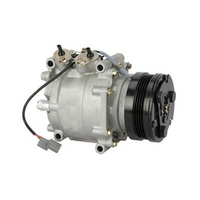
Shop the Parts Behind P1547
Below are the parts most often responsible for code P1547, ranked by how frequently each one is the actual culprit (per the diagnosis above). Tap any to see what we have for your vehicle.




The information in this article is provided for general reference and educational purposes only. Vehicle specifications, procedures, and part compatibility can vary by production date, trim level, and region. Always consult your vehicle's factory service manual and verify part numbers before purchasing or performing repairs. Safety-critical components such as airbags, seat belts, and braking systems should be installed by a qualified professional.
- 🧭 Diagnostic Flowchart
- 🎬 Helpful Videos
- 🛍️ Shop This Part
- What Does P1547 Mean?
- Can I Drive With P1547?
- Common Causes
- Symptoms
- Common Fixes & Costs
- Used vs. New Parts: Buying Guide
- What Happens If You Wait — Timeline
- Cost of Not Fixing It
- Diagnosis Steps
- When This Code Triggers (Freeze-Frame Conditions)
- Related Codes
- Climate & Environmental Factors
- How to Talk to a Mechanic About This Code
- Where to Take It: Dealer vs Independent vs Chain
- When to Walk Away From the Repair
- What Scan Tool You Need for This Code
- How to Clear the Code After You Fix It
- Will This Fail Emissions / State Inspection?
- Most Commonly Affected Vehicles
- Manufacturer-Specific Notes
- Real Owner Stories
- 2004 Audi A4 1.8T Quattro at 135K miles
- 2015 GMC Sierra 1500 at 70K miles
- 2008 BMW 328i (E90) at 110K miles
- How to Prevent This Code From Triggering
- Key Takeaways
- 🎟️ Get 5% Off