

P1571 on 2000-2006 Chevrolet Tahoe: Traction Control Torque Request Fixes
On a 2000-2006 Tahoe, P1571 almost always points to a communication failure between the ABS module (EBCM) and the engine computer (PCM). The most common cause is a failed EBCM, often due to cracked internal solder joints from vibration. The module is located on the driver's side frame rail. A DIY-friendly fix is to send the module to a rebuild service for around $150 or buy a remanufactured unit for $150-$400.
- P1571 on your Tahoe means the traction control system is disabled due to a communication error.
- The most likely cause is a failed Electronic Brake Control Module (EBCM/ABS Module), a very common issue on these trucks due to cracked internal solder joints.
- Check for other codes in the ABS system (C-codes) with a capable scanner to confirm the diagnosis.
- Replacing the EBCM is a manageable DIY job that usually doesn't require bleeding the brakes. Sending the original module for a rebuild is often the most cost-effective solution.
- Before buying parts, always check the EBCM wiring connector and the main frame ground under the driver's door for corrosion or damage.
What's Unique About the 2000-2006 Chevrolet Tahoe
On the GMT800 platform, which includes the 2000-2006 Tahoe, the EBCM is mounted on the frame rail underneath the driver's side of the vehicle. This location exposes it to significant vibration, moisture, and road grime. Over time, this leads to a very common failure where the solder joints inside the EBCM crack, causing intermittent or total loss of communication and triggering the P1571 code. This is a well-documented weak point on these trucks.
Symptoms You May Notice
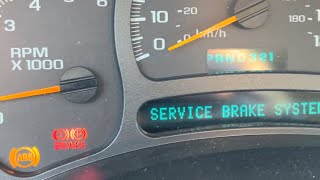
- Traction Control (TCS) or 'TRAC OFF' light is illuminated on the dashboard.
- ABS warning light may also be on.
- Brake warning light may be on.
- Traction control system is inoperative.
- The Check Engine Light (MIL) will NOT be illuminated for this specific code.
- Replacing the PCM before thoroughly testing the EBCM and wiring.
- Replacing wheel speed sensors, as they typically set their own specific codes (C0xxx) and are not the root cause of a P1571 communication fault.
- Replacing the EBCM with an incorrect part number. Some salvage yard replacements may be from vehicles without traction control (non-JL4 option), which will physically connect but lack the necessary internal circuitry, causing this code to appear.
Most Likely Causes
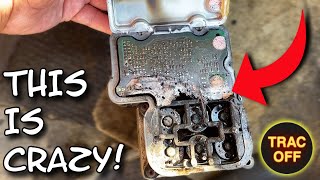
- Failed Electronic Brake Control Module (EBCM) 🔴 High Probability The module is mounted to the vehicle's frame, where years of vibration and exposure to the elements cause internal solder joints to crack and fail. This is the most common cause by a wide margin.
How to confirm: Check for ABS/TCS-related codes (C-codes) using a scan tool capable of reading the ABS module. If the scan tool cannot communicate with the EBCM at all, it strongly points to a failed module or a power/ground issue. Inspect the EBCM connector for corrosion or backed-out pins.
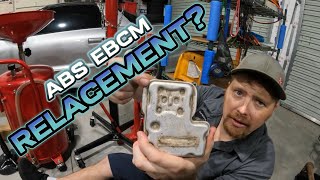
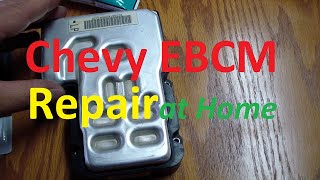
Typical fix: Remove the electronic portion of the EBCM and send it to a specialized rebuild service (e.g., ModuleMaster, ABS Repair) for repair of the internal solder joints. 🎬 Watch: How to repair your EBCM at home Alternatively, replace the EBCM with a new or remanufactured unit. The electronic module can often be unbolted from the main hydraulic block, which avoids the need for bleeding the brakes. 🎬 See this step-by-step EBCM replacement walkthrough
Est. part cost: $150 for a rebuild service, $150-$400 for a remanufactured module. - Damaged Wiring or Poor Connection 🟡 Medium Probability The wiring harness to the EBCM is routed under the vehicle and can be damaged by road debris, corrosion, or improper servicing. The main connector is particularly vulnerable to moisture and corrosion.
How to confirm: Visually inspect the wiring harness leading to the EBCM for any signs of chafing, breaks, or corrosion. Unplug the main connector and inspect for green crust (corrosion) or bent/pushed-out pins. Test for continuity on the 'Torque Request' signal wire (typically a Dark Green wire) between the EBCM and PCM connectors.
Typical fix: Repair the damaged section of wiring or clean/replace the affected connector. Dielectric grease should be used on reassembly to prevent future moisture intrusion.
Est. part cost: $10-$50 for wiring repair supplies - Poor Ground Connection ⚪ Low Probability The main EBCM ground is on the vehicle frame and is susceptible to rust and corrosion over time, leading to high resistance and communication issues.
How to confirm: Locate the EBCM ground point on the frame, typically a heavy 12-gauge wire bolted directly to the frame rail beneath the driver's side door. It is often designated as G103 or G104. Remove the bolt, and clean the terminal, frame surface, and bolt head to bare metal. Re-secure tightly.
Typical fix: Clean and secure the ground connection. Some owners add a star washer to ensure a better bite into the metal.
Est. part cost: $0-$5
Rare But Worth Checking
- Failed Powertrain Control Module (PCM): While possible, the PCM is much less likely to fail than the EBCM. This should only be considered after all other possibilities, including the EBCM and wiring, have been definitively ruled out.
Diagnosis Steps
- Connect a scan tool capable of reading codes from the PCM and the EBCM (ABS module). A GM Tech 2 or equivalent is recommended to read manufacturer-specific 'C' codes.
- Check for P1571 in the PCM and any C-codes (e.g., C1277, C0267) or U-codes in the EBCM and other modules.
- Attempt to communicate directly with the EBCM. If you cannot communicate at all, this strongly suggests a failed module or a power/ground issue to the module.
- Inspect the EBCM connector and wiring harness for any visible damage, corrosion, or loose connections. Pay close attention to the large connector on the module itself.
- Locate and inspect the main ground wire for the EBCM on the frame rail under the driver's door (often G103 or G104). Disassemble, clean to bare metal, and re-secure.
- If wiring and grounds are good, the most likely culprit is the EBCM itself. The signal wire (typically a dark green wire on these models) can be tested for the PWM signal with an oscilloscope if available, but this is an advanced step.
- Given the high failure rate, if codes are present and wiring appears intact, sending the EBCM for rebuild or replacing it is the most common and effective repair.
Parts You'll Likely Need
- Electronic Brake Control Module (EBCM)
(OEM #19302069 (ACDelco Remanufactured - verify specific application))— This is the most common failure point for this code on this platform due to cracked internal solder joints from vibration and heat cycling.
Trusted brands: ACDelco (Remanufactured), Dorman, Cardone, ModuleMaster (Rebuild Service), ABS-Fixer (Rebuild Service), Circuit Board Medics (Rebuild Service)
OEM price range: $300-$500 (Reman)
Aftermarket price range: $150-$400
Related Codes That Often Appear With This One
- P1689 — P1689 is for the 'Delivered Torque Output Circuit', which is the companion communication signal from the PCM back to the EBCM. A fault that disrupts one signal (P1571) often disrupts the other.
- C1277 — This is a common companion code set in the EBCM itself, indicating a fault with the requested torque signal circuit. Its presence helps confirm the issue is not a 'phantom' code.
- C0267 — This code indicates a problem with the ABS pump motor circuit, which is internal to the EBCM/ABS unit. It often appears when the EBCM is failing due to internal solder joint issues or a failed internal relay.
- U0121 — A more generic 'Lost Communication With Anti-Lock Brake System (ABS) Control Module' code that may be set in other modules (like the TCM or BCM) when the EBCM goes offline.
Platform-Specific Known Issues
- A user on TahoeYukonForum.com with a 2002 Tahoe experienced P1571 and P1689 together, a common pairing indicating the two-way communication failure between the PCM and EBCM. 🎬 Watch: Step-by-step diagnosis of P1571 and P1689 codes
- A detailed YouTube video by 'Advanced Level Automotive' documents a case on a 2002 Tahoe where a faulty replacement EBCM (from a vehicle without traction control) was installed, causing P1571 because the necessary communication pins were physically missing from the module's connector.
Mechanic-Grade Diagnostic Values
- Requested Torque Signal Circuit Voltage — expected: 5.0 V. Failure: 0 volts or significantly less than 5.0 V indicates an open/short in the wiring or a faulty PCM. This test is performed at the EBCM connector with it unplugged, and the ignition ON.
- EBCM Ground Circuit Resistance — expected: Less than 1.0 Ω (ideally near 0 Ω). Failure: Higher resistance indicates a corroded or loose ground connection at the frame rail (G103/G104).
- Requested Torque PWM Signal (Oscilloscope) — expected: A square wave with a duty cycle between 10% and 90%. At rest (no traction event), the signal should be at ~90% duty cycle.. Failure: A flat line at 0V or 5V, or a signal outside the 10-90% range, indicates a communication failure.
Hidden / Shadow Codes Worth Checking
- C-prefix codes (e.g., C1277, C0267): These are chassis codes stored in the EBCM, not the PCM. P1571 is often a secondary code triggered by a primary fault in the EBCM. Reading these codes is essential for diagnosis. (see via A standard OBD-II scanner cannot read them. A more advanced scan tool with ABS/chassis capability, like a GM Tech 2 or LAUNCH X431, is required.)
Scan Tool Commands That Help
- GM Tech 2 / equivalent: Read All Module DTCs — This is the first step to see if the P1571 in the PCM is accompanied by more specific codes (like C1277 or C0267) in the EBCM, which will pinpoint the fault.
- GM Tech 2 / equivalent: Active Tests / Special Functions — Allows the technician to command the ABS pump motor and solenoids directly. This can confirm if the EBCM is responsive or if the pump motor itself has failed, which often accompanies a C0267 code.
- GM Tech 2 / equivalent: Automated Bleed — This is required *after* replacing the entire ABS hydraulic unit (BPMV), not just the electronic module. It purges air from the internal passages of the ABS block.
Wiring & Ground Locations
- G103 / G104 — Bolted to the vehicle frame directly underneath the driver's side door.. This is the primary ground for the EBCM. Corrosion or looseness at this point creates high resistance, causing communication failures and phantom codes like P1571. It is a heavy 12-gauge wire.
- EBCM Main Connector — The large multi-pin connector that plugs into the EBCM on the frame rail.. This connector contains the power, ground, and the critical 'Requested Torque' signal wire. It is exposed to road spray and grime, making it a common point for corrosion and pin-fitment issues.
- Requested Torque Signal Wire — Runs between a pin on the PCM connector and a pin on the EBCM connector. It is often a Dark Green or Orange/Black wire on GM platforms of this era.. This specific wire carries the PWM signal that P1571 is based on. A short or open in this single wire will set the code even if both modules are perfectly fine.
Real Owner Repair Stories
- YouTube video from 'Advanced Level Automotive' (2002 Chevrolet Tahoe 5.3L V8) — TRAC OFF light was on, could not be turned off. P1571 and P1689 codes stored in the PCM. No codes in the ABS module.
❌ Tried (didn't work) The owner first attempted to repair the original EBCM by re-soldering the board, but it failed and burned out., The owner then installed a used EBCM from a salvage yard.
✅ What actually fixed it The technician diagnosed that the salvage yard EBCM was from a vehicle WITHOUT traction control. It physically fit, but the connector was missing the specific pins for the torque request communication circuits. Replacing the incorrect salvage unit with a proper, rebuilt EBCM for a vehicle with traction control resolved the issue. - GM Forum user 'Hawkmn' (2000 Pontiac Bonneville SLE (shares similar GM electronics)) — P1571 and P1602 codes would set when putting the car into gear.
❌ Tried (didn't work) Initial wire checks.
✅ What actually fixed it The user replaced the rubber weather-pack seals in the EBCM electrical connectors and also resealed the air box where the connectors sit. This suggests the root cause was moisture intrusion into the EBCM connector causing a poor connection, which was resolved by replacing the seals.
OEM Part Supersession History
Varies (e.g., 13354718)→Varies (e.g., 13354746, 88982287)— Standard part revisions and updates by GM/ACDelco.
Heads up: Crucially, there are two distinct types of Kelsey-Hayes 325 EBCMs for this platform: one for vehicles WITH traction control (RPO code JL4) and one for vehicles WITHOUT. They are not interchangeable. The non-TCS module lacks the circuitry and connector pins for the torque request signal and will cause P1571 if installed on a TCS-equipped truck. Always match the part number AND the vehicle's options.
Model Year Variations Within This Range
- 2000-2006: The primary variation is not year-based but option-based. Tahoes were available with or without 'Active Brake Control' (RPO code JL4), which is GM's term for the stability/traction control system. This option dictates which EBCM is required. A vehicle with the JL4 option needs the traction-control-capable EBCM, which has more connector pins than the base model's EBCM.
Diagnostic Flowchart
Other Known Issues on This Vehicle
Issues unrelated to this code that are worth knowing about as an owner of this generation:
- Instrument Cluster Stepper Motor Failure 🟠 Medium — Extremely common. Gauges (speedometer, tachometer, etc.) will stick, read incorrectly, or stop working entirely. Typically occurs after 50,000 miles. (Ref: GM offered a special coverage adjustment, but it has long since expired. Not a formal recall.)
- Intermediate Steering Shaft Clunk 🟡 Low — Very common. A clunking or popping noise is felt in the steering wheel, especially at low speeds over bumps. Caused by a lack of lubrication in the collapsible shaft. (Ref: GM TSB #00-02-35-003L describes a procedure to exercise the shaft to redistribute grease.)
- Cracked Cylinder Heads (Castech) 🔴 High — Affects engines with 'Castech' branded 706 casting number heads. A manufacturing defect can cause a crack, leading to a slow, often difficult-to-diagnose coolant loss into the crankcase. Failure can occur anywhere from 80k-150k miles. (Ref: GM TSB #06-06-01-019B addresses this issue.)
- Fuel Pump Failure 🟠 Medium — Common, especially on higher mileage vehicles. Symptoms include long crank times, hesitation under load, whining from the tank, or a no-start condition.
- Intake Manifold Gasket Leaks 🟡 Low — The original plastic/rubber gaskets can become brittle, causing vacuum leaks that lead to a rough idle and lean codes (P0171, P0174).
- Broken Exhaust Manifold Bolts 🟡 Low — The bolts holding the exhaust manifold to the cylinder head are prone to breaking, causing an exhaust leak with a characteristic 'ticking' noise, especially when the engine is cold.
Used vs. New Parts: Buying Guide for This Vehicle
When a used part is the smart pick: A used EBCM from a salvage yard can be a viable, low-cost option, but only if you can verify the donor vehicle's options. It is absolutely critical to get a module from a truck that also had traction control (RPO code JL4).
Donor-vehicle mileage cap: roughly under 150000 miles for the part to have meaningful remaining life.
What to inspect on the donor part:
- Verify the part number matches your original module exactly.
- Confirm the donor vehicle had a traction control button on the dash.
- Inspect the electrical connector sockets on the used module for any signs of corrosion (green crust) or bent pins.
- Avoid modules from vehicles with obvious signs of flood damage or severe undercarriage impact.
Aftermarket brands forum-validated for this vehicle:
- ModuleMaster
- ABS-Fixer
- Circuit Board Medics
- MyAirbags.com
Brands owners have reported issues with on this vehicle:
- No-name, unbranded modules from online marketplaces without a clear warranty or core return policy should be treated with caution.
Real Owner Stories
Aggregated from forums and TSBs cited above. Mileages and costs reflect what owners reported in those sources.
2002 Chevrolet Tahoe 5.3L V8
Symptoms: The owner experienced P1571 and P1689 codes appearing together, indicating a two-way communication failure between the PCM and EBCM.
What fixed it: Identified as a communication failure between the PCM and EBCM, typically requiring EBCM repair or replacement.
Source hint: TahoeYukonForum.com
2002 Chevrolet Tahoe 5.3L V8
Symptoms: P1571 code triggered after a replacement EBCM was installed.
What fixed it: The technician discovered the replacement EBCM was from a vehicle without traction control; the module was physically missing the necessary communication pins in the connector.
Source hint: YouTube video by 'Advanced Level Automotive'
2000-2006 Chevrolet Tahoe 5.3L V8
Symptoms: Communication issues and ABS/TCS related codes.
What fixed it: Located the EBCM ground on the frame rail beneath the driver's side door, removed the bolt, cleaned the terminal and frame surface to bare metal, and re-secured it.
Source hint: GMT800 - The '99 - '06 GM Truck Forum
Related OBD-II Codes
Frequently Asked Questions
Will the Check Engine Light (MIL) come on for code P1571 on my 2000-2006 Tahoe?
Where is the EBCM ground located on the GMT800 Tahoe frame?
Can I fix the P1571 code without replacing the entire ABS hydraulic block?
Is there a TSB for the clunking I feel in my steering wheel along with these lights?
Why does the EBCM fail so frequently on the 2000-2006 Chevrolet Tahoe?
What should I look for when inspecting the EBCM wiring for P1571?
Helpful Videos
Used OEM Parts in Stock
New Aftermarket Parts Available


The information in this article is provided for general reference and educational purposes only. Vehicle specifications, procedures, and part compatibility can vary by production date, trim level, and region. Always consult your vehicle's factory service manual and verify part numbers before purchasing or performing repairs. Safety-critical components such as airbags, seat belts, and braking systems should be installed by a qualified professional.
- Chevrolet Tahoe:
- 🧭 Diagnostic Flowchart
- 🎬 Helpful Videos
- 🛍️ Shop This Part
- What's Unique About the 2000-2006 Chevrolet Tahoe
- Symptoms You May Notice
- Most Likely Causes
- Rare But Worth Checking
- Diagnosis Steps
- Parts You'll Likely Need
- Related Codes That Often Appear With This One
- Platform-Specific Known Issues
- Mechanic-Grade Diagnostic Values
- Hidden / Shadow Codes Worth Checking
- Scan Tool Commands That Help
- Wiring & Ground Locations
- Real Owner Repair Stories
- OEM Part Supersession History
- Model Year Variations Within This Range
- Other Known Issues on This Vehicle
- Used vs. New Parts: Buying Guide for This Vehicle
- Real Owner Stories
- 2002 Chevrolet Tahoe 5.3L V8
- 2002 Chevrolet Tahoe 5.3L V8
- 2000-2006 Chevrolet Tahoe 5.3L V8
- Related OBD-II Codes
- Frequently Asked Questions
- 🎟️ Get 5% Off