

P1571 on 2006-2012 Toyota RAV4: Lost Steering Angle Sensor Communication Causes and Fixes
On a 2006-2012 RAV4, P1571 means the control modules have lost communication with the steering angle sensor. This is most often caused by a failed sensor (part of the clock spring assembly) or the need for a 'Zero Point Calibration' after an alignment or battery change. Expect to see VSC, ABS, and Brake lights on the dash.
- P1571 on a 2006-2012 RAV4 means the steering angle sensor has stopped communicating, disabling the VSC, ABS, and TRAC systems.
- The most likely cause is a failed sensor, which is part of the clock spring assembly in the steering column.
- Before replacing parts, check if a 'Zero Point Calibration' is needed, especially if the code appeared after a wheel alignment or battery disconnect.
- Diagnosis requires a scan tool that can read Toyota-specific live data to see if the sensor's readings are frozen.
- Replacement of the sensor is a complex job involving airbag removal and requires a Zero Point Calibration afterward, making it a job best left to professionals or experienced DIYers.
What's Unique About the 2006-2012 Toyota RAV4
The third-generation RAV4 (2006-2012) integrates the steering angle sensor's data deeply into its VSC and electric power steering systems. A communication loss isn't just a minor glitch; it disables key safety features. Notably, Toyota issued a recall (NHTSA #13V383000) for the spiral cable assembly on 2006-2008 models, which houses the steering angle sensor. The recall addressed a design issue where the internal flexible flat cable could become damaged from turning the steering wheel, leading to connection loss and failures like P1571.
Symptoms You May Notice
- ABS, VSC, and Brake warning lights illuminated on the dashboard.
- Traction Control (TRAC) light on
- Steering feels heavy, inconsistent, or requires more effort.
- Cruise control is disabled
- Power Steering System (PSS) warning light may be on
- AWD warning light may be on (if equipped)
- Replacing the ABS module when only a Zero Point Calibration is needed.
- Replacing wheel speed sensors, as they can also cause VSC/ABS lights but typically set different codes.
- Assuming a new clock spring is good. Some owners report receiving defective aftermarket parts that cause the same codes to persist.
Most Likely Causes
- Faulty Steering Angle Sensor / Clock Spring Assembly 🔴 High Probability → Shop Air Bag Clockspring The spiral cable assembly that houses the sensor was subject to a recall on 2006-2008 models for premature failure due to wear from steering wheel rotation. The internal flexible cable fractures, breaking the electrical connection.
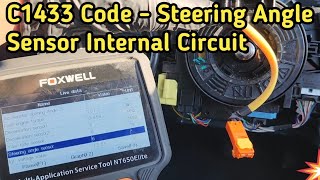
How to confirm: Use a scan tool to monitor live data for the 'Steering Angle'. If the value is frozen (e.g., stuck at -864, 1044, or -1440 degrees), erratic, or doesn't change smoothly as you turn the wheel, the sensor has failed. Code C1433 ('Steering Angle Sensor Internal Circuit') often appears alongside P1571, definitively pointing to an internal sensor failure. 🎬 See this guide on diagnosing the C1433 code
Typical fix: Replace the steering angle sensor, which is sold as part of the clock spring/spiral cable assembly. A 'Zero Point Calibration' is required after replacement. This is the most common successful repair reported by owners.
Est. part cost: $150-$450 - Zero Point Calibration Required 🟡 Medium Probability The system is sensitive and requires recalibration after common service procedures like wheel alignments, battery replacement, or replacement of steering/suspension components. An alignment that leaves the steering wheel off-center can also trigger this code.
How to confirm: If the code appeared immediately after a wheel alignment, battery disconnect, or suspension work, this is the most likely cause. The only way to confirm is to attempt the calibration procedure. If calibration succeeds and the code clears, the problem is solved.
Typical fix: Perform a 'Zero Point Calibration' using a compatible bidirectional scan tool (like Toyota Techstream) or the manual 'paper clip' method. The manual method involves jumping specific terminals (Ts and CG) in the OBD-II port in a specific sequence to reset and relearn the sensor's zero position.
Est. part cost: $0 - Damaged Wiring or Connectors ⚪ Low Probability
How to confirm: Visually inspect the wiring harness and connectors going to the steering column clock spring assembly and the ABS/VSC control module for any signs of damage, corrosion, or loose pins. Check for continuity with a multimeter, paying close attention to the connector at the base of the steering column.
Typical fix: Repair the damaged section of the harness or clean/replace the faulty connector.
Est. part cost: $10-$100
Rare But Worth Checking
- Faulty ABS/VSC Control Module: While rare, the module that interprets the sensor's signal can fail. This is usually diagnosed by ruling out all other possibilities and checking for specific module-related fault codes.
- Low or Unstable Battery Voltage: Weak batteries or failing alternators can cause a wide range of communication errors across the vehicle's network. Always check battery health and charging system output as a preliminary step.
Diagnosis Steps
- Connect a bidirectional scan tool capable of reading Toyota-specific codes and live data (e.g., Toyota Techstream).
- Scan all modules for any stored trouble codes. Note any codes accompanying P1571, especially C1433 or C1290.
- Navigate to the ABS/VSC module's live data stream.
- Observe the 'Steering Angle' parameter while turning the steering wheel lock-to-lock. The value should change smoothly and read near 0° when the wheels are straight.
- If the value is stuck (e.g., at -1440 or 1044), erratic, or does not change, the sensor/clock spring assembly is almost certainly bad. Proceed to inspect wiring as a final check.
- If the value changes smoothly but the code persists, a Zero Point Calibration is the next logical step.
- Inspect the wiring and connector at the base of the steering column for the clock spring assembly. Check for any damage or loose connections.
- If a recent alignment was performed, or if the sensor and wiring are good, perform the 'Zero Point Calibration' procedure. This can be done with a scan tool or manually by jumping the Ts and CG terminals of the DLC3 port. 🎬 Watch: How to perform a Zero Point Calibration
- If calibration fails or the code returns immediately, replace the steering angle sensor/clock spring assembly.
- After replacement, a successful Zero Point Calibration is mandatory for the system to function.
Parts You'll Likely Need
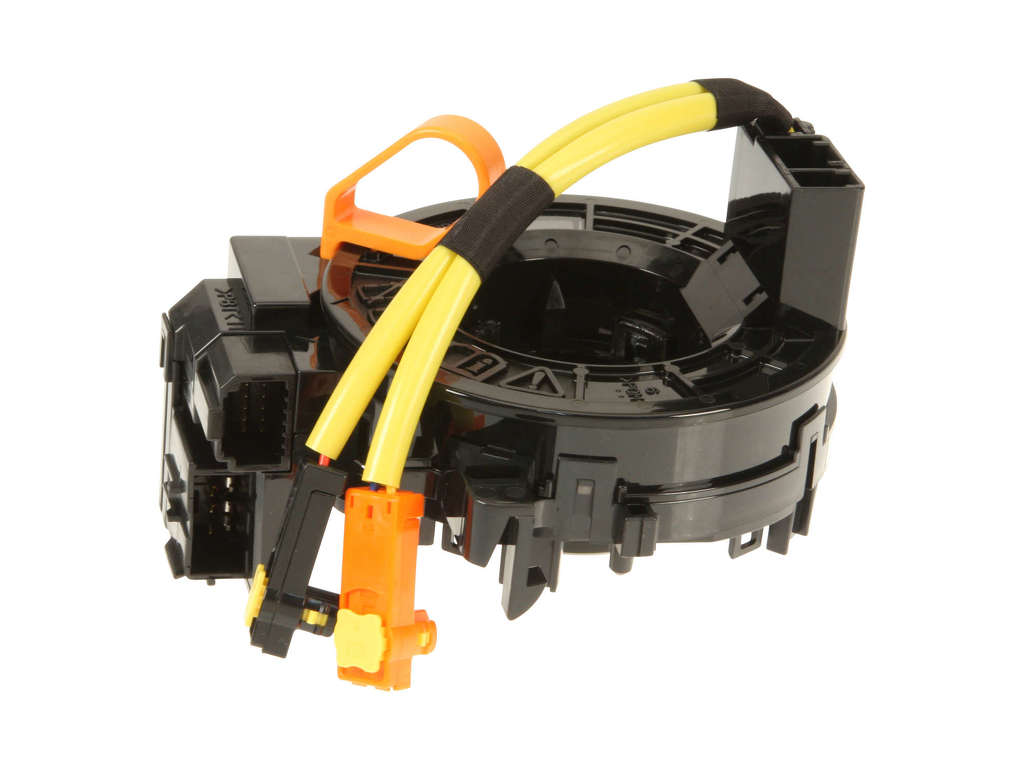
- Steering Angle Sensor / Clock Spring Assembly
(OEM #84306-42030 (Verify with VIN, may be superseded by 84306-0E010 or other numbers))— This is the most common failure point for this code. The sensor is integrated into the clock spring and fails from wear or internal circuit faults. The recall on early models highlights its propensity to fail.
Trusted brands: Toyota (OEM), Denso (OEM supplier), Duralast, ACDelco
OEM price range: $250-$530
Aftermarket price range: $80-$250
Related Codes That Often Appear With This One
- C1433 — This code specifically means 'Steering Angle Sensor Internal Circuit', directly pointing to a failed sensor as the root cause 🎬 Watch: Troubleshooting the steering angle sensor circuit of the P1571 communication loss.
- U0126 — This is a generic SAE code for 'Lost Communication With Steering Angle Sensor Module'. P1571 is Toyota's manufacturer-specific equivalent, and they often appear together.
- C1290 — This code indicates 'Steering Angle Sensor Zero Point Malfunction' and often appears when a calibration is needed or has failed.
Technical Service Bulletins (TSBs) & Recalls
- T-SB-0318-08: Details the repair for a clunking noise from the steering intermediate shaft on 2006-2008 models.
- T-TT-0255-13: A tech tip that supplements T-SB-0318-08, helping technicians order the correct parts for the steering shaft repair.
- BR001-04: A bulletin detailing the Zero Point Calibration procedure for various Toyota models, including the RAV4, both with and without a diagnostic tester.
Platform-Specific Known Issues
- NHTSA Recall 13V383000 / Toyota Safety Recall D0H: Affects 2006-2008 RAV4s. The spiral cable assembly, which includes the steering angle sensor, could be damaged through normal steering wheel use, leading to a loss of connection.
- Warranty Enhancement Program ZE7: Addressed excessive oil consumption on 2006-2008 models with the 2.4L 2AZ-FE engine by replacing piston assemblies. This program is now expired.
- TSB T-SB-0318-08: Addresses a clunking noise from the steering column by replacing the intermediate steering shaft with an updated part. While not directly causing P1571, it involves work in the same area of the vehicle.
Mechanic-Grade Diagnostic Values
- Voltage at Steering Angle Sensor Connector Pin 3 (BAT) — expected: 10 to 14 V. Failure: Voltage below 10V or absent indicates a power supply issue to the sensor.
- Voltage at Steering Angle Sensor Connector Pin 1 (IG) — expected: 10 to 14 V (with ignition ON). Failure: Voltage below 10V or absent with the key on points to an ignition circuit problem.
- Resistance at Steering Angle Sensor Connector Pin 2 (ESS) to Body Ground — expected: Below 1 Ω. Failure: Resistance higher than 1 Ω indicates a poor ground connection for the sensor.
- Resistance between CAN H and CAN L pins at sensor connector (E11-10 and E11-9) — expected: 54 to 69 Ω. Failure: Resistance outside this range indicates a problem on the CAN bus communication lines.
Scan Tool Commands That Help
- Toyota Techstream: Zero Point Calibration — This function, found under the ABS/VSC ECU menu, is mandatory after replacing the steering angle sensor, clock spring, or any steering/suspension components. It is also used to resolve code C1290 or P1571 when they appear after an alignment or battery disconnect.
- Toyota Techstream: Test Mode (VSC Check) — This utility mode allows a technician to check signals from various VSC sensors, including the steering angle sensor. It can be used to confirm if the sensor is sending data before attempting a full calibration. Note that failing to complete the test mode procedure correctly can sometimes set other codes like C1571.
Wiring & Ground Locations
- E11 — The main electrical connector for the steering angle sensor, located at the base of the spiral cable/clock spring assembly on the steering column.. This is the primary point for testing power, ground, and CAN bus signals directly at the sensor to determine if the fault is with the sensor itself or the vehicle's wiring.
- Ground Point 'IC' — Located on the instrument panel reinforcement bar, typically behind the center of the dashboard.. This is a common ground point for multiple ECUs in the dashboard area. A loose or corroded connection here can cause a variety of intermittent communication faults, including P1571.
- Ground Point 'IB' — Located behind the driver's side kick panel, near the base of the A-pillar.. This ground point serves the main body ECU and other nearby components. A fault here can lead to unpredictable electrical issues and communication codes.
- DLC3 Terminals Ts & CG — Pins in the OBD-II port under the driver's side dash. CG is pin 4 (Chassis Ground), and Ts is pin 12 (Test Sense).. These specific pins are jumped with a wire or paperclip in a specific sequence to perform the manual, non-scan tool Zero Point Calibration procedure.
Real Owner Repair Stories
- Reddit user in r/MechanicAdvice (2006 Toyota RAV4) — Cruise control inoperative, airbag light was previously on.
❌ Tried (didn't work) Dealer diagnosis suggested replacing the clock spring for $500 with no guarantee of a fix, potentially followed by replacing the ECM.
✅ What actually fixed it The owner found a bent pin on the connector of the aftermarket clock spring they had installed. The pin was not making proper contact inside the wiring harness connector. Bending the pin back into position restored function and fixed the issue, saving hundreds of dollars. - YouTube user Mr Fix It (2009 Toyota RAV4) — VSC and traction control lights on, car would brake on its own when driving straight after an intermediate steering shaft replacement.
❌ Tried (didn't work) Initial driving after the repair.
✅ What actually fixed it The steering angle sensor's zero point was incorrect after the steering shaft work. Performing a manual Zero Point Calibration using the 'paper clip' method (jumping pins in the OBD-II port) successfully recalibrated the sensor and resolved all symptoms.
OEM Part Supersession History
84306-42030→84306-0E010, 84306-48030— Part consolidation and potential minor revisions.
Heads up: While many part numbers are listed as compatible, it is critical to verify fitment with the vehicle's VIN. Some aftermarket listings group multiple OEM numbers together (e.g., 84306-48030, 84306-0E010, 84306-06140) that may have subtle differences. Always match the old part number if possible.
Model Year Variations Within This Range
- 2006-2008: These model years were subject to NHTSA recall 13V383000 for the spiral cable assembly (which houses the steering angle sensor). The original design was more prone to internal cable fracture from normal use, making a failed sensor a higher probability on these earlier models compared to the 2009-2012 models which had a revised part from the factory.
- 2006-2012: The steering angle sensor itself is a physically separate component that can be unclipped from the main spiral cable (clock spring) assembly. However, it is almost exclusively sold as a complete unit with the clock spring. This is important because if a known-good sensor is available, it can be swapped onto a new clock spring if an aftermarket unit is suspected of having a faulty sensor.
Diagnostic Flowchart
Other Known Issues on This Vehicle
Issues unrelated to this code that are worth knowing about as an owner of this generation:
- Excessive Oil Consumption (2.4L 2AZ-FE Engine) 🔴 High — Very common in 2006-2008 models, typically starting after 60,000 miles. Caused by defective piston ring design. (Ref: Toyota issued Warranty Enhancement Program ZE7 to address this, but it has since expired.)
- Steering Intermediate Shaft Clunk 🟠 Medium — Common on 2006-2008 models, causing a clunk or pop noise when turning the wheel at low speeds or when stationary. (Ref: T-SB-0318-08 and T-TT-0255-13 were issued, providing a procedure to replace the shaft with an improved part.)
- Water Pump Failure 🟠 Medium — Reports of premature failure, particularly on early models of this generation, can lead to coolant leaks and overheating.
- Stripped Head Bolt Threads (2.4L 2AZ-FE Engine) 🔴 High — A less common but catastrophic issue where the threads for the cylinder head bolts strip out of the engine block, causing head gasket failure.
Used vs. New Parts: Buying Guide for This Vehicle
When a used part is the smart pick: A used OEM clock spring assembly from a low-mileage, accident-free donor vehicle can be a viable budget option, especially if the new OEM part is prohibitively expensive. However, given that this is a known wear item and was subject to a recall, it carries significant risk.
Donor-vehicle mileage cap: roughly under 75000 miles for the part to have meaningful remaining life.
What to inspect on the donor part:
- Verify the donor vehicle was not in a front-end collision (airbag deployment can damage the clock spring).
- Ensure the part comes with a short warranty or return period from the dismantler.
- Visually inspect the connectors for any bent pins or corrosion.
- Confirm the part number on the used unit matches your original part number exactly.
OEM-only on this vehicle (don't cheap out):
- While not strictly 'OEM-only', the clock spring/steering angle sensor assembly is a part where OEM or a high-quality OEM supplier (like Denso) is strongly recommended. The high rate of issues reported with cheap aftermarket units failing out of the box or having bent pins makes them a risky choice.
Aftermarket brands forum-validated for this vehicle:
- Denso (often the original equipment manufacturer for Toyota)
Brands owners have reported issues with on this vehicle:
- Unbranded, low-cost units from online marketplaces are frequently cited in forums as being defective on arrival or failing shortly after installation.
Real Owner Stories
Aggregated from forums and TSBs cited above. Mileages and costs reflect what owners reported in those sources.
2006-2008 Toyota RAV4 2.4L — ~60000 miles
Symptoms: ABS, VSC, and Brake warning lights illuminated; Traction Control (TRAC) light on; Cruise control disabled.
What fixed it: Replacement of the steering angle sensor/spiral cable assembly followed by a mandatory Zero Point Calibration.
Cost: $150-$450
Source hint: common_causes - Faulty Steering Angle Sensor / Clock Spring Assembly
Toyota Corolla (Platform Mate)
Symptoms: C1433 code persisted after replacing the clock spring; steering angle reading remained frozen at -1440.
What fixed it: Replacing the faulty component with a non-OEM steering angle sensor.
Source hint: Reddit r/Toyota - 'C1433 code after replacing clock spring'
2014 Toyota RAV4
Symptoms: C1433 error code with a frozen steering angle reading of 1044 degrees after steering rack or steering wheel work.
What fixed it: Technicians discussed the issue as an internal circuit failure often requiring sensor replacement or calibration.
Source hint: Auto-bk.ru Forum - 'Toyota Rav-4 2014 Ошибка C1433...'
Related OBD-II Codes
Frequently Asked Questions
Is there a recall for the steering issues on my 2006-2008 Toyota RAV4?
My 2007 RAV4 has a clunking noise when I turn the wheel; is this related to P1571?
Can I fix the P1571 code on my RAV4 without a professional scan tool?
Why did the VSC and ABS lights come on after my RAV4 had a wheel alignment?
Does the Warranty Enhancement Program ZE7 cover my 2008 RAV4's steering sensor?
What should I check if my steering angle reading is frozen at -1440 or 1044 degrees?
Helpful Videos

We Have This Part in Stock


The information in this article is provided for general reference and educational purposes only. Vehicle specifications, procedures, and part compatibility can vary by production date, trim level, and region. Always consult your vehicle's factory service manual and verify part numbers before purchasing or performing repairs. Safety-critical components such as airbags, seat belts, and braking systems should be installed by a qualified professional.
- Toyota RAV4:
- 🧭 Diagnostic Flowchart
- 🎬 Helpful Videos
- 🛍️ Shop This Part
- What's Unique About the 2006-2012 Toyota RAV4
- Symptoms You May Notice
- Most Likely Causes
- Rare But Worth Checking
- Diagnosis Steps
- Parts You'll Likely Need
- Related Codes That Often Appear With This One
- Technical Service Bulletins (TSBs) & Recalls
- Platform-Specific Known Issues
- Mechanic-Grade Diagnostic Values
- Scan Tool Commands That Help
- Wiring & Ground Locations
- Real Owner Repair Stories
- OEM Part Supersession History
- Model Year Variations Within This Range
- Other Known Issues on This Vehicle
- Used vs. New Parts: Buying Guide for This Vehicle
- Real Owner Stories
- 2006-2008 Toyota RAV4 2.4L — ~60000 miles
- Toyota Corolla (Platform Mate)
- 2014 Toyota RAV4
- Related OBD-II Codes
- Frequently Asked Questions
- 🎟️ Get 5% Off