

P1604 on 2016-2018 Toyota RAV4 Hybrid: Startability Malfunction Causes and Fixes
On a 2016-2018 RAV4 Hybrid, code P1604 indicates the engine failed to start correctly. This is most often caused by a weak 12V auxiliary battery, not the main hybrid battery. Before suspecting major components, fully test and charge or replace the 12V battery located in the trunk. A failing battery can trigger this code even before you notice significant starting issues.
- P1604 means 'Startability Malfunction' and indicates your RAV4 Hybrid failed to start properly.
- The most likely cause is a weak or failing 12V auxiliary battery, not the main hybrid battery.
- Always check for other diagnostic codes, as P1604 is usually a symptom of another problem.
- Start your diagnosis with the simplest things: test the 12V battery and check the relevant fuses.
- Do not drive the vehicle if this code is active, as you risk being stranded.
What's Unique About the 2016-2018 Toyota RAV4 Hybrid
On the RAV4 Hybrid, the starting process is different from a conventional car. There is no traditional starter motor. Instead, the high-voltage hybrid battery powers a motor-generator (MG1) to spin the gasoline engine. However, the entire vehicle's electronic system, including the computers and relays needed to initiate the start sequence, relies on a conventional 12V auxiliary battery. A weak or failing 12V battery is a very common cause for starting-related codes like P1604 on modern hybrids, as it can't properly power up the network of computers required to get the car to the 'Ready' state.
Symptoms You May Notice
- Vehicle does not enter 'Ready' mode
- Engine cranks for an extended period but does not start
- Engine starts and then immediately stalls
- Check Engine light is illuminated (though sometimes it may not be)
- Hybrid system warning messages on the dashboard
- A faint smell of fuel may be present after failed starting attempts
- Replacing the main high-voltage hybrid battery. The HV battery is rarely the cause of a no-start condition that logs a P1604; issues usually begin with the 12V system.
- Replacing the starter motor. The RAV4 Hybrid does not have a conventional starter motor.
Most Likely Causes
- Weak or Failing 12V Auxiliary Battery 🔴 High Probability → Shop Vehicle Battery The 12V battery powers all the vehicle's computers (ECUs) during startup. If the voltage is low (even slightly), the complex handshake between the hybrid ECU, engine ECU, and other modules can fail, preventing the high-voltage system from engaging to start the engine. This is the most common cause.
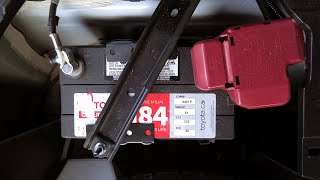
How to confirm: The 12V battery is in the trunk under the cargo floor. 🎬 Watch: How to find and access the 12V battery location. Use a multimeter to test its voltage with the car off. A healthy battery should read 12.4V-12.6V or higher. Anything below 12.0V indicates a discharged or failing battery. Many auto parts stores can perform a load test for free, which is a more definitive test of battery health.
Typical fix: Recharge or replace the 12V auxiliary battery. This is a DIY-friendly job.
Est. part cost: $200-$350 - Fuel Delivery Issue 🟡 Medium Probability Like any gasoline engine, the 2AR-FXE needs adequate fuel pressure to start. A failing fuel pump, clogged filter, or faulty relay can prevent the engine from getting the fuel it needs. Poor quality or contaminated fuel is also a known trigger. A manufacturer service bulletin for related Toyota engines, TSB Bulletin #T-SB-0166-19_Rev, notes that P1604 can be accompanied by negative fuel trims and elevated alcohol density estimates.
How to confirm: Listen for a faint hum from the rear of the vehicle when it's first powered on; this is the fuel pump priming. A more definitive test involves checking the fuel pressure with a gauge connected to the fuel rail to ensure it meets specification. Also, check the EFI and fuel pump related fuses and relays.
Typical fix: Replace the failing fuel pump, relay, or filter. The fuel pump is an assembly inside the fuel tank.
Est. part cost: $20-$400 - Dirty or Failed Mass Airflow (MAF) Sensor ⚪ Low Probability The MAF sensor measures the amount of air entering the engine. If it's dirty or faulty, it can send incorrect data to the ECM, leading to an improper air-fuel mixture that prevents starting.
How to confirm: Unplug the MAF sensor and attempt to start the vehicle. If it starts and runs (though poorly), the MAF sensor is likely the issue. A diagnostic scan tool can also read the airflow data to see if it's within the expected range. A visual inspection may reveal dirt or debris on the sensor wires.
Typical fix: Clean the MAF sensor with dedicated MAF sensor cleaner 🎬 Watch: Step-by-step guide to cleaning your RAV4 MAF sensor. or replace the unit if cleaning doesn't work.
Est. part cost: $15-$150 - Faulty Crankshaft or Camshaft Position Sensor ⚪ Low Probability → Shop Engine Crankshaft These sensors tell the ECM the position and speed of the engine's rotating parts, which is critical for spark and fuel timing. A failed sensor can prevent the ECM from initiating spark or fuel injection, leading to a no-start condition.
How to confirm: These failures typically set their own specific codes (e.g., P0335 for crankshaft sensor). Diagnosis involves checking the sensor's signal with an oscilloscope or swapping with a known good part.
Typical fix: Replace the failed sensor.
Est. part cost: $50-$200
Rare But Worth Checking
- Loose or Corroded Ground Wire: A poor ground connection for the engine controls can cause a variety of unpredictable electrical issues, including a no-start. One technician found a crank-no-start issue on a RAV4 was caused by a bad ground for the ignition coils and injectors.
- Ran Out of Fuel: If the vehicle was recently run completely out of gas, the fuel system may have air in it, and the P1604 code can be stored from the failed start attempts.
- ECM Software Glitch: Toyota issued TSB T-SB-0094-12 for some models, indicating that a brief interruption during the start sequence could incorrectly log a P1604. The fix is an ECM software update. Check with a dealer to see if your vehicle's VIN is affected.
Diagnosis Steps
- Scan for all stored trouble codes. P1604 is often secondary, so look for other codes that point to a specific system (fuel, spark, sensor, etc.). NHTSA ODI #11534554 describes a case where P1604 appeared alongside misfire codes P0300-P0306 and stalling code P1603, eventually traced to a damaged spark plug and piston.
- Thoroughly test the 12V auxiliary battery. Check its static voltage (should be >12.4V) and perform a load test. This is the most common culprit and should always be the first step.
- Check all fuses related to the EFI (Electronic Fuel Injection) and ignition systems in both the under-hood and interior fuse panels.
- Verify fuel delivery. Listen for the fuel pump priming when the car is powered on. If possible, perform a fuel pressure test.
- Inspect the air intake system, including the air filter and the MAF sensor. Ensure the sensor is clean and the wiring is secure.
- If other codes are present (e.g., P0335, P0171), follow the diagnostic tree for those codes first as they indicate the root cause. NHTSA ODI #11723306 notes that P1604 can sometimes appear with transmission-related codes like P0741 and P2757.
- Inspect major engine ground connections for tightness and corrosion, particularly the grounds for the engine control system.
- Check with a Toyota dealer for any open recalls or applicable TSBs, such as an ECM software update (T-SB-0094-12).
Parts You'll Likely Need
- 12V Auxiliary Battery
(OEM #28800-37092 (Vendor #S46B24R))— This is the most frequent cause of starting-related electrical issues on modern hybrids, as it powers the ECUs needed to initiate the start sequence.
Trusted brands: Toyota TrueStart, East Penn (Deka), Clarios (DieHard, Optima)
OEM price range: $250-$350
Aftermarket price range: $200-$280 - Fuel Pump Assembly
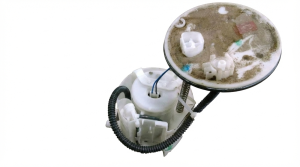
(OEM #23220-36011 (AWD) or 23220-0P101 (FWD))— A failed fuel pump is a common cause for a crank-no-start condition on many vehicles, which will log a P1604.
Trusted brands: Denso, Aisin, Delphi
OEM price range: $310-$510
Aftermarket price range: $100-$250
Related Codes That Often Appear With This One
- P1603 — P1603 indicates an 'Engine Stall History.' These two codes often appear together, logging that the engine has had trouble starting (P1604) and has also stalled.
- P0A0F — This code means 'Engine Failed to Start.' It is a more specific hybrid-system code that often accompanies the more generic P1604.
- P0300-P0304 — Cylinder misfire codes. If the starting issue is due to a lack of spark or fuel in one or more cylinders, these codes may be present.
- P0171 — 'System Too Lean.' This can indicate a fuel delivery problem (like a weak fuel pump) that is severe enough to prevent the engine from starting.
- P0562 — 'System Voltage Low.' This code directly points to a weak battery, which is a primary cause of P1604.
- P2610 — 'ECM/PCM Internal Engine Off Timer Performance.' NHTSA ODI #11023574 reports this code appearing intermittently alongside P1604.
Technical Service Bulletins (TSBs) & Recalls
- T-SB-0094-12: Some Toyota vehicles may exhibit a P1604 due to a brief interruption during engine start. An ECM software update is available to correct this logic.
- T-SB-0166-19_Rev: This bulletin notes that P1604 (Startability Malfunction) may be present along with fuel system codes P0171 or P0174, often requiring analysis of fuel trims and alcohol density estimates.
Platform-Specific Known Issues
- The 12V battery is located in the right rear of the trunk area, under the floor cover, not in the engine bay.
- A recall was issued for 2013-2018 RAV4s concerning improperly sized replacement 12V batteries that could short circuit against the hold-down bracket, potentially causing a fire. Ensure any replacement battery is the correct size and properly secured.
Mechanic-Grade Diagnostic Values
- 12V Auxiliary Battery Static Voltage — expected: 12.4V - 12.7V (car off). Failure: Below 12.4V indicates a discharged state; below 12.0V suggests a failing battery.
- Charging System Voltage — expected: 13.7V - 14.7V (engine running). Failure: Voltage outside this range points to a problem with the DC-DC converter (hybrid equivalent of an alternator).
- Fuel Pressure (Low-Pressure Side) — expected: Approximately 45-55 PSI during cranking/idle.. Failure: Significantly low or zero pressure indicates a failing fuel pump, clogged filter, or relay issue.
- ECM Power Supply (BATT terminal to Ground) — expected: 9V to 14V at all times.. Failure: No voltage indicates a blown fuse or wiring issue between the battery and ECM.
- ECM Switched Power (IGSW terminal to Ground) — expected: 9V to 14V with ignition ON.. Failure: No voltage indicates a problem with the ignition switch circuit or related fuses.
Hidden / Shadow Codes Worth Checking
- Freeze Frame Data: P1604 is an informational code, so the Freeze Frame Data is critical. It captures a snapshot of all sensor values (engine speed, coolant temp, fuel trim, etc.) at the exact moment the starting fault occurred. Analyzing this data with a tool like Techstream is the primary way to find the root cause. For example, low 'Engine Speed' during cranking could point to a weak battery, while abnormal 'Fuel Temp' could indicate frozen fuel. (see via Toyota Techstream or other advanced OBD-II scanner with freeze frame data capability.)
Scan Tool Commands That Help
- Toyota Techstream: Data List > Primary / Starter Signal — To verify if the ECM is receiving the 'start' signal from the ignition switch and park/neutral position switch. The display should show 'ON' when the start button is pressed.
- Toyota Techstream: Active Test > Control the Fuel Pump / Speed — To manually command the fuel pump to turn on without starting the car. This allows a technician to confirm the pump motor works and to check fuel pressure, isolating it from relay or wiring issues.
- Toyota Techstream: Read Freeze Frame Data — This is the most important function for P1604. It allows a technician to see the exact conditions (engine speed, battery voltage, temperatures) when the no-start event was logged, pointing them toward the failing system.
Wiring & Ground Locations
- ECM Ground (E1) — The main ECM grounds are typically located on the engine block or cylinder head, secured by bolts. Specific diagrams for the 2016-2018 RAV4 show multiple ground points on the chassis and engine.. A poor ECM ground can cause a wide range of issues, including the inability to properly sequence the starting procedure, leading to a P1604.
- EFI MAIN Relay — Located in the under-hood fuse and relay box (Engine Room Relay Block).. This relay provides the main power to the Engine Control Module (ECM). If it fails or has a poor connection, the ECM will not power up correctly, preventing a start.
- ECM Connector A9, B30 — These are two of the main multi-pin connectors on the Engine Control Module itself.. Technicians need to access specific pins on these connectors to test for power, ground, and sensor signals (like the starter signal) when diagnosing a no-start condition. For example, pin A9-20 (BATT) is the constant power supply.
Real Owner Repair Stories
- Reddit user u/deleted in r/rav4club (Gen 4 Toyota RAV4 (consistent with 2016-2018 model years)) — P1604 code appeared on a scan, but the vehicle had no noticeable starting problems at the time.
❌ Tried (didn't work) Clearing the code (it came right back).
✅ What actually fixed it The 12V auxiliary battery died about a month after the code first appeared. Replacing the battery resolved the code. A friend with the same model year had the exact same sequence of events, suggesting the P1604 code can act as an early warning for a failing 12V battery before other symptoms are obvious. - NHTSA ODI #11592352 — An owner reported that their vehicle stalled while in a drive-thru. A mechanic retrieved code P1604 but noted the code was too generic to pinpoint the exact problem immediately.
OEM Part Supersession History
28800-YZZPD→28800-AZC34— Part number update/revision for the S46B24R 12V auxiliary battery.
Heads up: Both part numbers refer to the correct Group Size S46B24R AGM battery required for the vehicle. Ensure any replacement is this specific group size to avoid fitment and safety issues mentioned in the recall.
Model Year Variations Within This Range
- 2017-2018: For 2017, Toyota made the 'Toyota Safety Sense' package standard on all RAV4 Hybrid trims. An SE trim was also added. For 2018, the vehicle was largely a carryover with no significant mechanical changes affecting a P1604 diagnosis.
- 2016: The base trim was the XLE, and the 'Toyota Safety Sense' package was optional on the highest Limited trim only.
Diagnostic Flowchart
Other Known Issues on This Vehicle
Issues unrelated to this code that are worth knowing about as an owner of this generation:
- High-Voltage Cable Corrosion ('Cablegate') 🔴 High — Common in regions with road salt ('Salt Belt'). Affects the high-voltage cable connecting to the rear electric motor, causing hybrid system failure. Repair costs can be $5,000+. (Ref: Toyota issued Customer Support Programs (e.g., ZLA, ZKK, 22TE09) extending the warranty on this part for affected models, typically to 8 years/100,000 miles or 10 years/160,000 km.)
- Brake Booster / Actuator Failure 🔴 High — Less common, but can occur. Leads to a loss of braking assist and multiple warning lights. (Ref: Toyota has issued warranty extensions/Customer Support Programs (e.g., ZKK) for this issue on other hybrid models like the Camry and Avalon Hybrid from a similar era.)
- Peeling White Paint (Blizzard Pearl & Super White) 🟡 Low — A known issue on many Toyota models from this period with paint codes 070 and 040. Large flakes of paint peel off. (Ref: Toyota initiated Customer Support Program ZKG to cover repainting of affected panels for an extended period.)
- 12V Battery Hold-Down Short Circuit Risk 🔴 High → Shop Vehicle Battery — A recall was issued for 2013-2018 RAV4s because certain smaller, third-party replacement 12V batteries could shift and contact the metal hold-down bracket, causing a short circuit and fire risk. (Ref: NHTSA Recall 23V-723.)
Used vs. New Parts: Buying Guide for This Vehicle
When a used part is the smart pick: For this repair, used parts are generally not recommended for the most common failure items. However, simple, non-wear components like relays (e.g., EFI relay) or fuse box assemblies from a low-mileage donor vehicle can be a cost-effective and reliable choice.
Donor-vehicle mileage cap: roughly under 60000 miles for the part to have meaningful remaining life.
What to inspect on the donor part:
- For relays, check for any signs of corrosion or heat damage on the terminals.
- Ensure the donor vehicle is from a similar climate (avoid parts from rust-belt regions if possible).
- Verify the part number on the used component matches the original exactly.
OEM-only on this vehicle (don't cheap out):
- 12V Auxiliary Battery: Due to the specific AGM S46B24R group size and the vehicle's sensitivity to voltage, an OEM or exact-match high-quality aftermarket battery is critical. Never install a used battery.
- Engine Control Module (ECM): A used ECM will require reprogramming by a dealer or specialist to match the vehicle's immobilizer system, often making a new part a simpler, albeit more expensive, solution.
Aftermarket brands forum-validated for this vehicle:
- Fuel Pumps: Denso, Aisin (Denso and Aisin are often the original OEM suppliers for Toyota).
- 12V Battery: Interstate (MTX-S46B24R), Deka, Optima (YellowTop S46B24R).
Brands owners have reported issues with on this vehicle:
- Avoid generic, unbranded 'white box' fuel pumps and electronic sensors from online marketplaces, as their quality and longevity are often poor and can cause repeat failures.
Real Owner Stories
Aggregated from forums and TSBs cited above. Mileages and costs reflect what owners reported in those sources.
2016-2018 Toyota RAV4 Hybrid 2.5L
Symptoms: The user reported a persistent P1604 code without any noticeable starting problems at first.
What fixed it: The 12V auxiliary battery failed shortly after the code appeared; replacing the battery resolved the issue.
Source hint: Reddit r/rav4club (u/deleted)
2016-2018 Toyota RAV4 Hybrid 2.5L
Symptoms: The owner experienced a P1604 code with no other accompanying symptoms.
What fixed it: The community advised performing a load test on the 12V battery to confirm health, as it is the primary culprit for this code.
Source hint: ClubLexus Forum
Related OBD-II Codes
Frequently Asked Questions
Is there a software update for the P1604 code on my 2016-2018 RAV4 Hybrid?
Where is the 12V auxiliary battery located in my RAV4 Hybrid?
I heard there was a fire risk related to the battery in this model. Should I be concerned?
My RAV4 Hybrid won't enter 'Ready' mode and shows P1604. What is the most likely cause?
Can a dirty sensor cause the P1604 startability code?
Is the high-voltage cable issue related to P1604?
Helpful Videos
Used OEM Parts in Stock
New Aftermarket Parts Available



The information in this article is provided for general reference and educational purposes only. Vehicle specifications, procedures, and part compatibility can vary by production date, trim level, and region. Always consult your vehicle's factory service manual and verify part numbers before purchasing or performing repairs. Safety-critical components such as airbags, seat belts, and braking systems should be installed by a qualified professional.
- Toyota RAV4 Hybrid:
- 🧭 Diagnostic Flowchart
- 🎬 Helpful Videos
- 🛍️ Shop This Part
- What's Unique About the 2016-2018 Toyota RAV4 Hybrid
- Symptoms You May Notice
- Most Likely Causes
- Rare But Worth Checking
- Diagnosis Steps
- Parts You'll Likely Need
- Related Codes That Often Appear With This One
- Technical Service Bulletins (TSBs) & Recalls
- Platform-Specific Known Issues
- Mechanic-Grade Diagnostic Values
- Hidden / Shadow Codes Worth Checking
- Scan Tool Commands That Help
- Wiring & Ground Locations
- Real Owner Repair Stories
- OEM Part Supersession History
- Model Year Variations Within This Range
- Other Known Issues on This Vehicle
- Used vs. New Parts: Buying Guide for This Vehicle
- Real Owner Stories
- 2016-2018 Toyota RAV4 Hybrid 2.5L
- 2016-2018 Toyota RAV4 Hybrid 2.5L
- Related OBD-II Codes
- Frequently Asked Questions
- 🎟️ Get 5% Off