

P1613 on 2015 Dodge Challenger: Boost/MAF Sensor Correlation Causes and Fixes
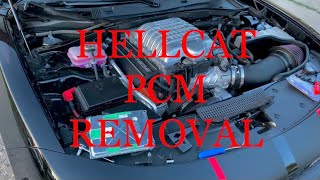
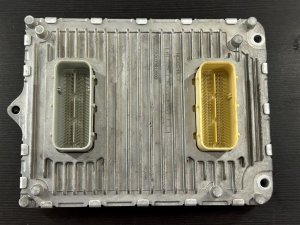
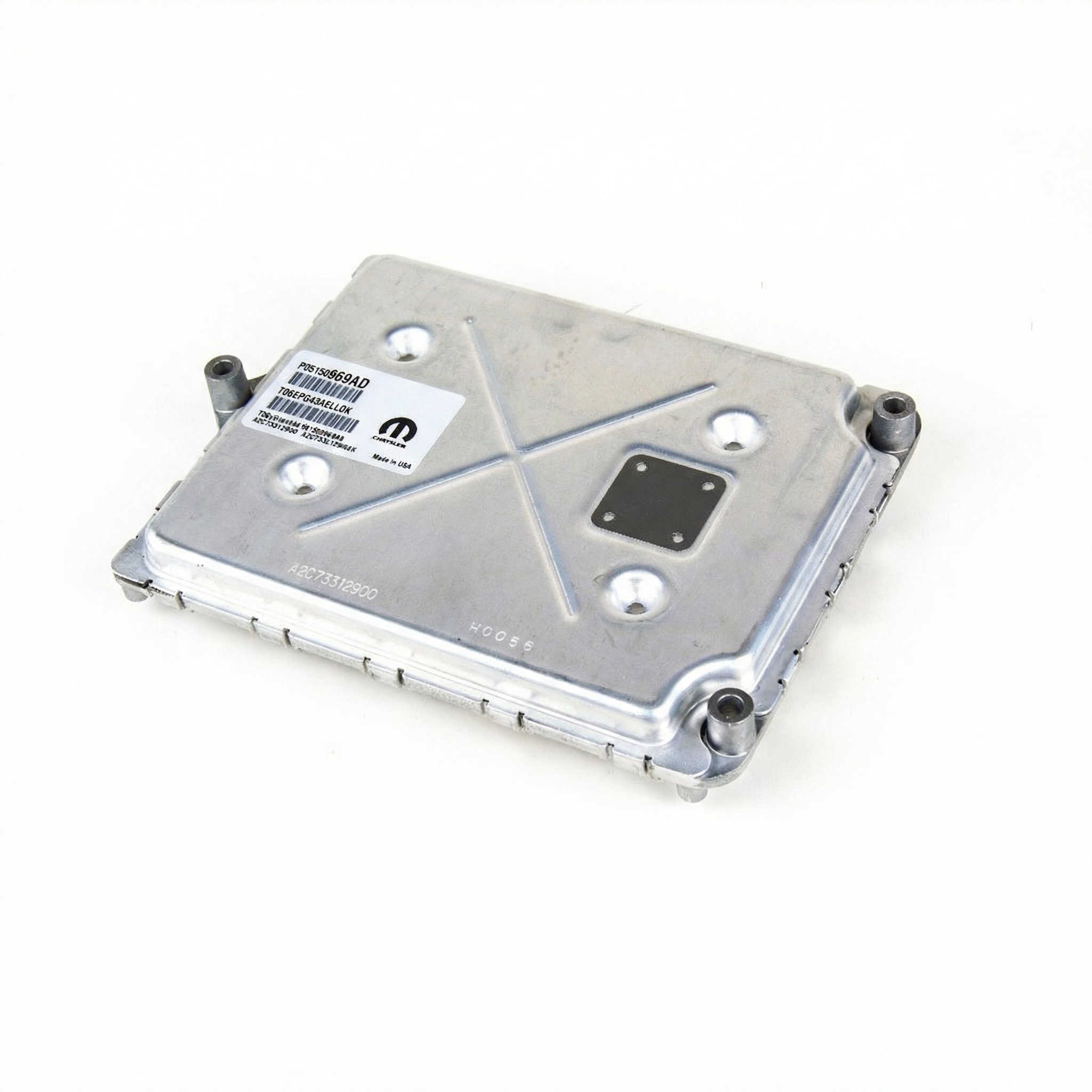
On a 2015 Dodge Challenger, especially the 6.2L Hellcat, P1613 is most often caused by outdated Powertrain Control Module (PCM) software. The primary fix is a software update performed by a Dodge dealer, as outlined in multiple Technical Service Bulletins. Before replacing any hardware, ensure the vehicle's PCM software is current.
- For a 2015 Dodge Challenger (6.2L), P1613 almost always points to a needed PCM software update.
- Before replacing any parts, have a dealer check if TSBs #18-061-17 or #18-047-16 have been performed.
- If the software is current, the next steps are to check for intake air leaks (boost leaks) and then test the MAP sensor.
- This code is often accompanied by other codes like P0300 or P2227, which are also resolved by the same software flash.
What's Unique About the 2015-2015 Dodge CHALLENGER
For the 2015 Dodge Challenger equipped with the 6.2L Supercharged engine, this code is exceptionally well-documented by the manufacturer. Dodge/FCA released several Technical Service Bulletins (TSBs) to address this specific code, indicating the original PCM software was overly sensitive or had flawed logic for monitoring these sensors. Unlike many other vehicles where this type of correlation code points directly to a hardware failure like a sensor or a vacuum leak, on this specific platform, the most common cause is the software itself. The TSBs explicitly list P1613 as a fault that is resolved by the PCM reflash.
Diagnostic Flowchart
Tap your situation to follow the diagnostic path that matches what you're seeing on this vehicle.
Symptoms You May Notice
- Check Engine Light (Malfunction Indicator Lamp, MIL) is on
- Reduced engine performance or power, sometimes described as 'no boost'
- Slight spark knock during aggressive driving
- Hesitation or stuttering during acceleration
- Replacing the MAP or MAF sensor without first checking if the PCM software update TSBs have been performed. On this vehicle, the software is the most likely culprit and should always be the first check.
- Replacing the wrong MAP sensor. The Hellcat engine has multiple MAP sensors, and proper diagnosis is required to identify the specific one that is faulty.
Most Likely Causes
- Outdated Powertrain Control Module (PCM) Software 🔴 High Probability → Shop Engine Control Module (ECM) The factory software calibration was prone to setting this code, which prompted Dodge to issue multiple TSBs (18-061-17, 18-047-16, 18-016-15 REVA) to resolve the issue. These bulletins were created specifically because the original logic was too sensitive.
How to confirm: A Dodge dealership or a properly equipped independent shop can check the vehicle's current software calibration number against the latest version specified in the TSBs using the VIN.
Typical fix: Reprogramming the PCM with the latest available software. Per the TSBs, the Transmission Control Module (TCM) is often updated at the same time; the flash files may be combined into a single procedure.
Est. part cost: $0 - Faulty Manifold Absolute Pressure (MAP) / Boost Sensor 🟡 Medium Probability → Shop Manifold Absolute Pressure Sensor The Hellcat engine utilizes four MAP sensors which operate in a high-heat, high-pressure environment and can fail over time, sending incorrect data to the PCM. If the PCM software is confirmed to be up-to-date, a sensor failure is the next logical suspect.
How to confirm: Use a scan tool to monitor the live data from all MAP sensors at idle and under load. The readings should change smoothly and logically with throttle input. Compare the readings to each other at ignition-on, engine-off to check for rationality.
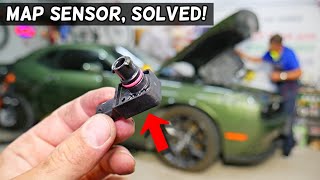
Typical fix: Replace the faulty MAP sensor. The most common OEM part number for the 2015-2017 Hellcat is Mopar 68207074AB, which supersedes 68207074AA. 🎬 Watch: How to locate and replace the MAP sensor
Est. part cost: $40-$90 - Vacuum or Boost Leak 🟡 Medium Probability The complex intake plumbing on a supercharged engine has many connection points where a leak can develop, allowing unmetered air to enter the system and disrupt the sensor correlation. Gaskets and hoses can degrade over time.
How to confirm: Perform a visual inspection of all intake hoses and vacuum lines. A smoke test is the most effective method to pinpoint the location 🎬 See this guide on performing a boost leak test of a hard-to-find leak.
Typical fix: Repair the leak by replacing the cracked hose, faulty gasket, or loose clamp.
Est. part cost: $10-$150 - Faulty Mass Air Flow (MAF) Sensor ⚪ Low Probability
How to confirm: Monitor live data with a scan tool to see if the MAF sensor readings are erratic or illogical. The sensor can also be cleaned with a dedicated MAF sensor cleaner as a first step. 🎬 Watch: Tutorial on cleaning your MAF sensor and throttle body
Typical fix: Clean or replace the MAF sensor.
Est. part cost: $70-$150
Rare But Worth Checking
- Wiring Harness Issue: A damaged wire or poor connection to either the MAP or MAF sensor can cause intermittent or incorrect signals, leading to this code. Check for chafing, corrosion, or loose pins at the sensor connectors and along the harness, especially near the throttle body where wires can be stressed.
- Clogged Air Filter: A severely restricted air filter can limit the amount of air entering the engine, potentially causing a discrepancy between what the MAF sensor reads and what the MAP sensor expects.
- Faulty Supercharger Bypass Valve: The TSBs that address P1613 also list codes related to the Supercharger Bypass Valve (e.g., P1611). A malfunctioning valve could potentially create boost readings that the PCM deems uncorrelated with airflow, contributing to a P1613 code.
Diagnosis Steps
- Check for TSBs: The first and most important step is to determine if TSBs #18-061-17, #18-047-16, or #18-016-15 REVA have been performed on the vehicle. A dealer can verify this with the VIN. If not, this is the most likely solution and should be done before any parts are replaced.
- Analyze Live Sensor Data: Use an OBD-II scanner to view live data from the MAF and all MAP sensors. At ignition-on with the engine off, the MAP sensors and the BARO sensor should read very close to each other. Observe their readings at idle, during steady RPMs, and while snapping the throttle. Look for any values that are stuck, slow to respond, or don't make sense relative to each other.
- Inspect for Air Leaks: If the software is up to date, thoroughly inspect the entire intake system for cracks, loose connections, or damaged gaskets. Pay close attention to the path between the MAF sensor and the supercharger, and between the supercharger and the intake manifold.
- Perform a Smoke Test: To definitively find hard-to-see air leaks, introduce smoke into the intake system (with the engine off) and look for any that escapes. This is the most reliable way to rule out a vacuum or boost leak.
- Test Sensor Wiring: If a sensor provides an illogical reading, check for proper voltage (typically 5V reference), ground, and signal at its connector using a multimeter to rule out a wiring problem.
- Test the Sensors: If wiring is good and no leaks are present, the sensor itself is suspect. Test the sensor according to the manufacturer's procedure or by substitution with a known-good part, such as Mopar 68207074AB.
Parts You'll Likely Need
- Powertrain Control Module (PCM) Reflash — This is a service, not a physical part. It is the most common fix documented by Dodge to correct the logic that triggers code P1613.
Trusted brands: Mopar (Dealer Service)
OEM price range: $150-$250 - Manifold Absolute Pressure (MAP) Sensor
(OEM #68207074AB)— If the software is up-to-date and an air leak is not present, a failing MAP sensor is the next most likely hardware cause. This part number fits 2015-2017 Hellcat models.
Trusted brands: Mopar
OEM price range: $70-$110
Aftermarket price range: $40-$90
Related Codes That Often Appear With This One
- P0300 — Multiple Cylinder Misfire. This code is listed alongside P1613 in the TSBs, indicating the faulty software logic could also contribute to misfire detection.
- P2227 — Barometric Pressure Circuit Performance. Also listed in the same TSBs, suggesting it's part of the same software-related group of potential codes.
- P0513 — Invalid Skim Key. This code is also mentioned in the TSBs as being resolved by the same PCM flash.
- P1217 — Active Exhaust Valve 1 Performance. Another code addressed by the PCM software update specified in the TSBs.
Technical Service Bulletins (TSBs) & Recalls
- 18-061-17: 'Flash: Powertrain Diagnostic and System Enhancements' - Supersedes 18-047-16
- 18-047-16: 'Flash: Powertrain Diagnostic and System Enhancements' - Supersedes 18-016-15 REV. A
- 18-016-15 REV. A: 'Flash: Powertrain Diagnostic and System Enhancements'
Platform-Specific Known Issues
- The primary vehicle-specific issue is the factory PCM software calibration on 2015 6.2L models, which was prone to incorrectly flagging a correlation error between the boost and MAF sensors. This was significant enough for Dodge to release multiple software updates to fix it.
- Real Owner Experience: Multiple owners on forums like Hellcat.org have reported getting the P1613 code, sometimes accompanied by a loss of power. In many documented cases, a trip to the dealership for the TSB-specified PCM flash resolved the issue completely. However, in instances where the code returned after the flash, the next successful repair was often the replacement of one of the MAP sensors.
Mechanic-Grade Diagnostic Values
- MAP Sensor 5V Reference Voltage — expected: ~5.0 Volts. Failure: Voltage significantly lower than 5.0V indicates a wiring issue or a problem with the PCM's 5V reference circuit.
- MAP Sensor Ground Circuit — expected: Less than 100 millivolts (0.1V). Failure: A reading higher than 0.1V indicates a poor ground connection, which can cause incorrect sensor readings.
- MAP Sensor Signal Voltage (Key On, Engine Off) — expected: ~4.5 Volts (at sea level). Failure: A significantly lower voltage suggests the sensor is not reading atmospheric pressure correctly.
- MAP Sensor Signal Voltage (Engine Idling) — expected: ~1.0 - 2.0 Volts. Failure: Voltage that remains high (near 4.5V) or does not drop indicates the sensor is not responding to engine vacuum.
Wiring & Ground Locations
- MAP Sensor Connector — There are four MAP sensors on the Hellcat engine. They are located on the intake manifold system. A service manual or wiring diagram is needed to identify the specific sensor and its wiring.. A poor connection, corrosion, or damaged pin at any of the MAP sensor connectors can cause erratic readings and trigger a P1613. A wiring diagram is essential for testing the correct pins for 5V reference, ground, and signal.
- Engine Ground Straps — Key ground straps are located between the engine block and the vehicle's chassis/frame. One common location is from the engine mount to the frame.. A corroded, loose, or broken engine ground strap can cause a variety of phantom electrical issues, including incorrect sensor readings. The PCM and its sensors rely on a stable ground reference. If the engine block's ground potential fluctuates, sensor readings can become unreliable, potentially leading to correlation codes like P1613.
OEM Part Supersession History
68207074AA→68207074AB— The reason for the supersession is not officially stated, but it is common for manufacturers to update parts to improve reliability, durability, or manufacturing efficiency.
Heads up: No known incompatibilities. 68207074AB is the correct direct replacement for 68207074AA on 2015-2017 Hellcat models.
Helpful Videos
We Have This Part in Stock

The information in this article is provided for general reference and educational purposes only. Vehicle specifications, procedures, and part compatibility can vary by production date, trim level, and region. Always consult your vehicle's factory service manual and verify part numbers before purchasing or performing repairs. Safety-critical components such as airbags, seat belts, and braking systems should be installed by a qualified professional.
- Dodge CHALLENGER:
- 🧭 Diagnostic Flowchart
- 🎬 Helpful Videos
- 🛍️ Shop This Part
- What's Unique About the 2015-2015 Dodge CHALLENGER
- Symptoms You May Notice
- Most Likely Causes
- Rare But Worth Checking
- Diagnosis Steps
- Parts You'll Likely Need
- Related Codes That Often Appear With This One
- Technical Service Bulletins (TSBs) & Recalls
- Platform-Specific Known Issues
- Mechanic-Grade Diagnostic Values
- Wiring & Ground Locations
- OEM Part Supersession History
- 🎟️ Get 5% Off