

P1614 on 2008-2019 Mazda 3: Immobilizer Failure Causes and Fixes
P1614 on a Mazda 3 means the car's anti-theft system can't recognize your key, preventing the engine from starting. The most common fix is trying your spare key or replacing a dead battery in the key fob. If that fails, you may need a new key programmed or a new immobilizer antenna, which often requires a trip to a dealer or automotive locksmith.
- P1614 means your Mazda 3's anti-theft system has been activated and is preventing the engine from starting.
- Always try your spare key first; it's the simplest way to diagnose a bad key.
- Replacing a dead battery in the key fob is a cheap and easy potential fix. Don't trust that a 'new' battery is good; try a second one if needed.
- Due to the need for key programming, a final repair often requires a visit to a Mazda dealer or a certified automotive locksmith.
- Do not replace parts like the starter or fuel pump for this code; the issue is with key recognition.
What's Unique About the 2008-2019 Mazda 3
The immobilizer system on the Mazda 3, like many Ford/Mazda vehicles of this era, is generally reliable but sensitive to key and battery issues. Unlike some manufacturers where this code could point to various unrelated electrical faults, on the 2008-2019 Mazda 3, P1614 is almost exclusively tied to the anti-theft communication chain: the key, the antenna ring around the ignition, and the associated wiring. The problem is consistent across both the second (2008-2013) and third (2014-2018) generations. A unique point of failure, particularly on platform-mate Ford Focus models, can be the instrument cluster itself, where failed solder joints can disrupt PATS communication. While less common on the Mazda 3, it's a known possibility within the shared platform architecture.
Generation note: This guide covers the second generation (BL, 2008-2013) and third generation (BM/BN, 2014-2018) of the Mazda 3. The meaning of code P1614 and its common causes are consistent across these generations as they use a similar immobilizer system architecture based on the Ford C1 platform.
Symptoms You May Notice
- Engine will not start (no-start condition).
- Engine cranks but does not fire up.
- Engine starts and then immediately stalls.
- Flashing red security indicator light on the dashboard (often shaped like a car with a key inside).
- Starter Motor: A faulty starter often produces a single click sound, but a P1614 code with a flashing security light specifically points to the anti-theft system, not the starter itself.
- Fuel Pump: While the immobilizer does disable the fuel system, replacing the fuel pump without addressing the P1614 code will not solve the problem.
Most Likely Causes
- Defective or Unprogrammed Ignition Key 🔴 High Probability → Shop Ignition Switch The transponder chip in the key can be damaged from being dropped or getting wet. Aftermarket keys may also have quality issues or may not have been programmed correctly. This is the most common cause for P1614.
How to confirm: The easiest way to confirm is to try starting the car with a spare key. If the spare key works, the original key is the problem.
Typical fix: Replace and reprogram the faulty key. This must be done by a dealer or a qualified automotive locksmith.
Est. part cost: $150-$400 - Faulty Immobilizer Antenna Ring 🟡 Medium Probability → Shop Antenna The antenna is a coil of wire around the ignition cylinder that reads the key chip. Over time, its internal wiring can break or develop a poor connection, preventing it from reading the key. Corrosion on the antenna ring is also a common culprit on older vehicles.
How to confirm: A professional scan tool can monitor the data from the immobilizer system to see if the antenna is sending a signal. A visual inspection of the wiring and connector at the ignition switch can also reveal damage. On some forums, owners report success after simply cleaning the antenna contacts.
Typical fix: Replace the immobilizer antenna ring (also called a coil antenna).
Est. part cost: $50-$120 - Dead or Weak Key Fob Battery 🟡 Medium Probability → Shop Vehicle Battery
How to confirm: If your key has a remote, a weak battery can sometimes interfere with the transponder signal. Replace the battery in the key fob as a simple, low-cost first step. Some owners on BobIsTheOilGuy forums noted that even a supposedly 'new' battery can be faulty, so trying a second new battery is worthwhile.
Typical fix: Replace the coin battery (typically a CR2025) inside the key fob.
Est. part cost: $5-$15 - Wiring or Connector Issue ⚪ Low Probability
How to confirm: Visually inspect the wiring harness and connectors between the immobilizer antenna, the immobilizer module (if separate), and the ECM for any signs of damage, corrosion, or loose pins.
Typical fix: Repair the damaged section of wiring or clean/replace the faulty connector.
Est. part cost: $10-$50 - Low Vehicle Battery Voltage ⚪ Low Probability → Shop Vehicle Battery
How to confirm: Check the main vehicle battery with a multimeter; it should be above 12.4 volts. A weak battery can cause unpredictable communication errors across various electronic modules, mimicking an immobilizer fault.
Typical fix: Recharge or replace the vehicle's 12V battery.
Est. part cost: $150-$250 - Aftermarket Remote Starter Interference ⚪ Low Probability → Shop Starter Motor Improperly installed aftermarket remote start systems often use a bypass module with a coil wrapped around the ignition cylinder to 'trick' the immobilizer. This coil can create magnetic interference, preventing the factory antenna from reading the key correctly.
How to confirm: Check for any non-factory wiring or modules around the ignition switch and steering column.
Typical fix: A Reddit user with a 2013 Mazda 3 reported their P1614 issue was resolved when the dealer simply moved the interfering coil from the aftermarket remote starter away from the ignition cylinder. In other cases, the module may need to be removed.
Est. part cost: $0-$150
Rare But Worth Checking
- Faulty Immobilizer Control Module or PCM: → Shop Anti-Theft Control Module While rare, the module that controls the anti-theft system or the main Powertrain Control Module (PCM) can fail internally. This is typically the last item to suspect after all other possibilities have been exhausted. The immobilizer logic is often integrated into the PCM or Body Control Module (BCM).
- Faulty Instrument Cluster: → Shop Instrument Cluster On the shared Ford C1 platform, particularly the Ford Focus, a known failure point is the instrument cluster's circuit board, where cracked solder joints can interrupt communication with the immobilizer system. While less frequently reported for the Mazda 3, it remains a possibility due to the shared architecture. 🎬 Watch: How to fix instrument cluster solder joints
Diagnosis Steps
- Try a Spare Key: This is the quickest and easiest test. If another key works, the first key is faulty.
- Check the Key Fob Battery: → Shop Vehicle Battery If applicable, replace the battery in your key fob. Try a second new battery if the first one doesn't work to rule out a faulty new battery.
- Check the Vehicle Battery: → Shop Vehicle Battery Use a multimeter to ensure the main car battery has adequate voltage (12.4V+). Charge or replace if necessary.
- Inspect Fuses: Check the vehicle's fuse boxes for any fuses related to the anti-theft system, ignition, or instrument cluster.
- Observe the Security Light: Turn the key to the 'ON' position. Note the behavior of the security light. A rapidly flashing light typically confirms the immobilizer is active and not recognizing the key. 🎬 Watch: How to reset the Mazda anti-theft system Some forum users note you can count the flashes to get a more specific diagnostic code.
- Inspect for Aftermarket Devices: Look for signs of an aftermarket remote starter or alarm system near the ignition cylinder. An interfering antenna coil is a known cause of this issue.
- Inspect Immobilizer Antenna: → Shop Antenna Visually inspect the wiring and connector going to the antenna ring around the ignition cylinder for any obvious damage.
- Professional Scan: If the above steps don't resolve the issue, the vehicle needs to be scanned with a high-end tool that can communicate with the immobilizer/PATS module to read live data and pinpoint the fault between the antenna, module, or key programming.
Parts You'll Likely Need
- Transponder Key — The transponder chip in the key is the most common point of failure, either through damage or loss of programming.
Trusted brands: Mazda (OEM)
OEM price range: $150-$400 (including programming)
Aftermarket price range: $75-$200 (including programming) - Immobilizer Antenna Ring
(OEM #C236-66-938B)— This component reads the key chip and can fail, causing a communication breakdown. Also referred to as 'COIL, ANTENNA-IMMOBILIZER'.
Trusted brands: Mazda (OEM)
OEM price range: $50-$120
Aftermarket price range: $30-$80 - Keyless Entry Antenna
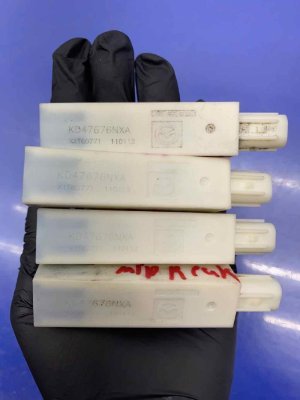
(OEM #KD47-67-6NXA)— For models with keyless start, there are multiple antennas in the vehicle. While less common to fail than the ignition ring, a fault in one of these can also cause communication issues.
Trusted brands: Mazda (OEM)
OEM price range: $60-$100
Related Codes That Often Appear With This One
- P1610: On some related vehicles (like Nissan/Infiniti), multiple failed start attempts with an unrecognized key can trigger a P1610 'Lock Mode' in addition to P1614, requiring a professional reset.
Hidden / Shadow Codes Worth Checking
- P1610: Indicates 'Lock Mode' on similar immobilizer systems (like Nissan/Infiniti), triggered after multiple failed start attempts with an unrecognized key. The vehicle will not start until this code is cleared with a capable scan tool. (see via Professional scan tool that can communicate with the immobilizer/BCM.)
Scan Tool Commands That Help
- Mazda M-MDS (Mazda Modular Diagnostic System): Parameter Reset — Used after replacing an immobilizer module or PCM to initialize the system. Requires at least two keys to be programmed for the vehicle to start.
- Mazda M-MDS: Ignition Key Code Erase and Program — Used to erase all previously stored key codes and program new/existing keys. This is required when a key is lost or a new PCM is installed.
- Mazda M-MDS: Programmable Module Installation (PMI) — When replacing a PCM, this function transfers vehicle-specific data (including immobilizer info) from the old module to the new one.
Wiring & Ground Locations
- Body Control Module (BCM) — On 2014-2018 models, the main BCM is located in the driver's side footwell, attached to the interior fuse panel behind the lower dash trim.. The BCM integrates the immobilizer logic. A poor connection or fault in this module can cause a P1614 code.
- Front Body Control Module (F-BCM) — On 2014-2018 models, this secondary module is physically part of the fuse and relay box in the engine compartment.. The F-BCM is part of the vehicle's data network and a communication failure here can potentially impact the immobilizer system.
- Keyless Entry Antennas (3rd Gen) — On 2014-2018 models with advanced keyless entry, multiple antennas are used: one in the rear bumper area, one under the rear seat, and one in the center console area.. These antennas detect the smart key's presence. A failure or disconnection of any single antenna can cause the entire system to fail and prevent the car from starting.
- G06 Ground — On some 2nd generation (2012 model year) vehicles, a key ground point is located at the left rear of the engine.. A poor ground connection at this point can cause various electrical issues, potentially affecting the PCM and immobilizer communication.
OEM Part Supersession History
C236-66-938→C236-66-938B— Standard part revision by the manufacturer.
Heads up: The new part number is a direct replacement for the old one for applicable models (primarily 2008-2013).kd45676nx, kd45676nxa, kd47676nx→KD47-67-6NXA— Part consolidation and revision for the keyless entry antennas.
Heads up: Applies to 3rd generation (2014-2018) models with advanced keyless entry. Ensure the correct antenna is ordered for the specific location (e.g., rear bumper vs. center console).
Model Year Variations Within This Range
- 2014-2019 (Third Generation): Vehicles with advanced keyless entry (push-button start) use a more complex system with multiple low-frequency antennas located throughout the car (rear bumper, center console, under seat) to detect the key fob's location. This differs from the 2nd generation's single antenna coil around the ignition cylinder. A failure of any one of these antennas can trigger a no-start condition. Additionally, the Body Control Module is split into a main BCM and a Front BCM (F-BCM).
- 2008-2013 (Second Generation): These models typically use a single immobilizer antenna ring (transceiver coil) located around the keyed ignition cylinder. The system is simpler, with fewer potential points of failure compared to the later multi-antenna keyless systems.
Diagnostic Flowchart
Other Known Issues on This Vehicle
Issues unrelated to this code that are worth knowing about as an owner of this generation:
- Defective Passenger Motor Mount 🟠 Medium — Very common on second-generation (2010-2013) models. The hydraulic mount fails, causing excessive engine vibration and noise, particularly at idle and upon acceleration.
- Premature Clutch Failure 🔴 High — Reported frequently on 2010-2012 models with manual transmissions, sometimes failing well under 100,000 km.
- Infotainment System Glitches ('Ghost Touch') 🟠 Medium — Common on third-generation models (2014-2016). The touchscreen may delaminate or register false touches, causing erratic behavior. Mazda issued a service program for this. (Ref: SSP 99)
- Rattling Rear Suspension / Faulty Stabilizer Bar Links 🟡 Low — Common across multiple model years (2004-2015). Worn or loose rear stabilizer bar links cause clunking or rattling noises from the rear of the vehicle over bumps.
- Transmission Control Module (TCM) Failure 🔴 High — Affects a number of second-generation models with automatic transmissions, causing the 'AT' light to illuminate and harsh or erratic shifting. (Ref: There is a warranty extension for this issue on some model years.)
- Premature Brake Wear 🟠 Medium — A common complaint on 2014 models, where rear brakes in particular were reported to wear out quickly.
Used vs. New Parts: Buying Guide for This Vehicle
When a used part is the smart pick: A used immobilizer antenna ring (the coil around the ignition) is generally a safe bet, as it's a simple, non-programmed component. Other simple electrical connectors or wiring pigtails from a junkyard are also acceptable.
Donor-vehicle mileage cap: roughly under 150000 miles for the part to have meaningful remaining life.
What to inspect on the donor part:
- For an antenna ring, ensure the plastic housing is not cracked or broken.
- Check that the electrical connector pins are clean, straight, and free of corrosion.
- Verify the part number on the used component matches the original exactly.
OEM-only on this vehicle (don't cheap out):
- Powertrain Control Module (PCM) / Engine Control Module (ECM)
- Body Control Module (BCM)
- Transponder Keys
Brands owners have reported issues with on this vehicle:
- Generic/unbranded transponder keys and key fobs from online marketplaces. Forum users and dealership technicians report a high failure rate during programming for these knock-off parts.
Real Owner Stories
Aggregated from forums and TSBs cited above. Mileages and costs reflect what owners reported in those sources.
2013 Mazda 3
Symptoms: No-start condition with a flashing anti-theft light on the dashboard.
What fixed it: The dealer moved the antenna coil of an aftermarket remote starter away from the ignition cylinder to stop magnetic interference.
Source hint: Reddit r/mazda3 thread titled 'mazda_3_2013_no_start_with_flashing_antitheft/'
Related OBD-II Codes
Frequently Asked Questions
My 2013 Mazda 3 won't start and the security light is flashing. Could an aftermarket remote starter be the cause?
Is there a specific part number for the immobilizer antenna ring if I need to replace it on my Mazda 3?
I have a third-generation (2014-2016) Mazda 3 with infotainment issues; is this related to my P1614 code?
Can a weak key fob battery really cause a P1614 no-start condition on this vehicle?
My Mazda 3 security light is flashing rapidly when I try to start it. What does this mean?
Does the Mazda 3 share this immobilizer issue with any other vehicles?
Helpful Videos

We Have This Part in Stock

The information in this article is provided for general reference and educational purposes only. Vehicle specifications, procedures, and part compatibility can vary by production date, trim level, and region. Always consult your vehicle's factory service manual and verify part numbers before purchasing or performing repairs. Safety-critical components such as airbags, seat belts, and braking systems should be installed by a qualified professional.
- Mazda 3:
- 🧭 Diagnostic Flowchart
- 🎬 Helpful Videos
- 🛍️ Shop This Part
- What's Unique About the 2008-2019 Mazda 3
- Symptoms You May Notice
- Most Likely Causes
- Rare But Worth Checking
- Diagnosis Steps
- Parts You'll Likely Need
- Related Codes That Often Appear With This One
- Hidden / Shadow Codes Worth Checking
- Scan Tool Commands That Help
- Wiring & Ground Locations
- OEM Part Supersession History
- Model Year Variations Within This Range
- Other Known Issues on This Vehicle
- Used vs. New Parts: Buying Guide for This Vehicle
- Real Owner Stories
- 2013 Mazda 3
- Related OBD-II Codes
- Frequently Asked Questions
- 🎟️ Get 5% Off