

P1621 on 2008-2016 Audi A4: Coolant Gauge Signal Failure Causes and Fixes
On a 2008-2016 Audi A4, code P1621 almost always means the Engine Coolant Temperature (ECT) sensor has failed or its wiring is damaged. This causes an incorrect reading on your dashboard's temperature gauge and may make the cooling fans run constantly. A new sensor is the most common fix.
- P1621 on your Audi A4 points directly to a problem with the temperature gauge signal, not an immobilizer or ECM memory issue.
- The most common symptoms are a dead or erratic temperature gauge and cooling fans that won't shut off.
- The fix is almost always a new Engine Coolant Temperature (ECT) sensor, which is an inexpensive part.
- Before buying parts, check the sensor's connector and wiring for obvious damage, as this can also cause the code.
- You can likely still drive the car, but you lose the ability to monitor engine temperature, so the repair should not be delayed.
What's Unique About the 2008-2016 Audi A4
The Audi A4 of this era (B8 generation) uses a dual-purpose Engine Coolant Temperature sensor, often referred to as the G62 sensor. It has four pins: two send a temperature reading to the Engine Control Module (ECM) for managing engine performance, and the other two send a separate reading to the instrument cluster for the driver's gauge. This architecture is why you can have a situation where the car's computer knows the correct engine temperature (and the car runs normally), but the gauge on your dash is dead or erratic, which specifically triggers the P1621 code in the instrument cluster module.
Generation note: The 2008-2016 model years cover the entire B8 and B8.5 generation of the Audi A4. The causes and repair procedures for code P1621 are consistent across this generation for models equipped with the dual-output G62 sensor.
Symptoms You May Notice
- Temperature gauge on the instrument cluster reads incorrectly (e.g., stays at the lowest setting, jumps to maximum, or fluctuates wildly).
- Check Engine Light is illuminated.
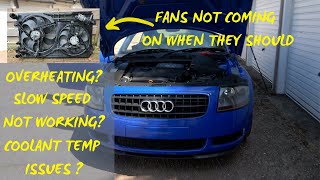
- Radiator cooling fans run continuously at high speed, even when the engine is cold 🎬 See how to diagnose radiator fan issues (fail-safe mode).
- In some cases, a coolant level warning light may also appear intermittently.
- With a VCDS or similar advanced scan tool, the instrument cluster may report a temperature of -40°C or a similar impossibly low value.
- Replacing the thermostat. While a faulty thermostat can cause heating issues, it will not cause a 'short to ground' code or make the gauge read an impossible value like -40°F, which is what the cluster often interprets from a shorted signal.
Most Likely Causes
- Faulty Engine Coolant Temperature (ECT) Sensor 🔴 High Probability → Shop Engine Coolant Temperature Sensor The ECT sensor (often a G62 type) is a common failure item on many VW/Audi products due to age and repeated heat cycles. It can fail internally, causing a short on the circuit dedicated to the instrument cluster. These sensors are known to degrade over time.
How to confirm: Use a VCDS/VAG-COM or other advanced scan tool to compare the ECT reading in the ECM's data blocks (e.g., Engine Block 01) versus the reading in the Instrument Cluster block (Module 17). If the ECM shows a plausible temperature while the cluster shows an error or extreme value, the sensor is the primary suspect.
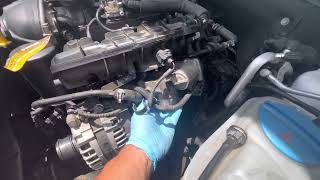
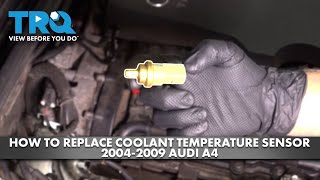
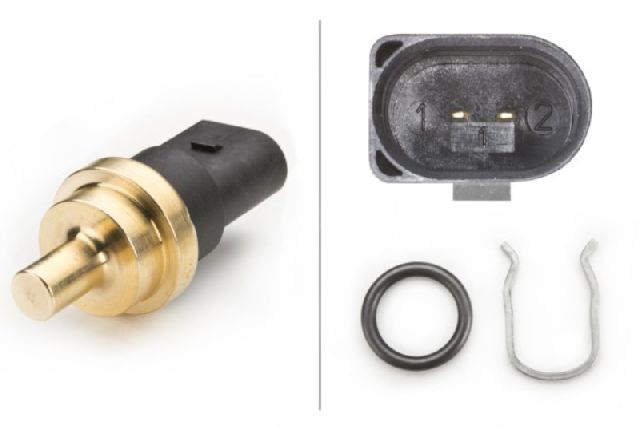
Typical fix: Replace the Engine Coolant Temperature sensor, its O-ring, and the retaining clip. The sensor is typically located on a coolant flange at the rear of the cylinder head on 2.0T engines. 🎬 Watch: 2.0T coolant temperature sensor replacement walkthrough
Est. part cost: $15-$50 - Damaged ECT Sensor Wiring or Connector 🟡 Medium Probability → Shop Engine Coolant Temperature Sensor The wiring harness is located in a hot, tight space at the back of the engine, making it susceptible to becoming brittle and cracked over time, which can lead to a short circuit. The plastic connector can also become brittle and fail to make a secure connection, or the terminals can corrode.
How to confirm: Visually inspect the entire length of the wiring harness from the ECT sensor as far as you can see. Check for cracked insulation, exposed wires, or corrosion inside the connector. Wiggle the connector with the engine running to see if it affects the gauge reading. A multimeter can be used to check for a short to ground on the signal wire to the instrument cluster.
Typical fix: Repair the damaged section of wire using a quality butt connector with heat shrink. If the connector itself is broken, it can be replaced with a pigtail repair kit (e.g., Dorman P/N 645-572 or equivalent).
Est. part cost: $10-$30
Rare But Worth Checking
- Faulty Instrument Cluster: → Shop Instrument Cluster This is very uncommon. Before condemning the expensive instrument cluster, all other possibilities (sensor, wiring) must be exhaustively ruled out. A cluster fault would typically require sending the unit to a specialist for repair and would likely present with other simultaneous gauge or display issues.
Diagnosis Steps
- Connect an OBD-II scanner (preferably VCDS/VAG-COM) and confirm P1621 is stored in the Instrument Cluster (Module 17).
- Access the live data stream. In the Engine module (01), monitor the Engine Coolant Temperature value. Note this temperature.
- Switch to the Instrument Cluster module (17) and view its coolant temperature reading. Compare the two values.
- If the Engine module shows a normal, rising temperature but the Instrument Cluster shows a fixed, extreme low value (like -40°C) or an error, the fault is isolated to the cluster's input circuit.
- Turn off the engine and allow it to cool completely. Locate the ECT sensor (G62), typically on a coolant flange on the back of the engine for the 2.0T.
- Disconnect and carefully inspect the sensor's electrical connector and nearby wiring for any signs of damage, corrosion, green crust, or loose pins.
- If the wiring appears intact, the most probable cause is the sensor itself. Replacing the sensor is the next logical step. It's an inexpensive part and a very common point of failure.
- If a new sensor does not resolve the issue, perform a continuity test on the signal wire between the sensor connector and the instrument cluster connector plug to check for a short to ground. This will require a wiring diagram for your specific vehicle.
- As a last resort, if both the sensor and wiring are confirmed to be good, the instrument cluster itself may be faulty, which is rare.
Parts You'll Likely Need
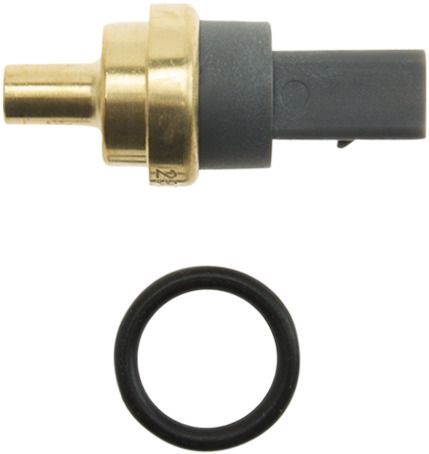
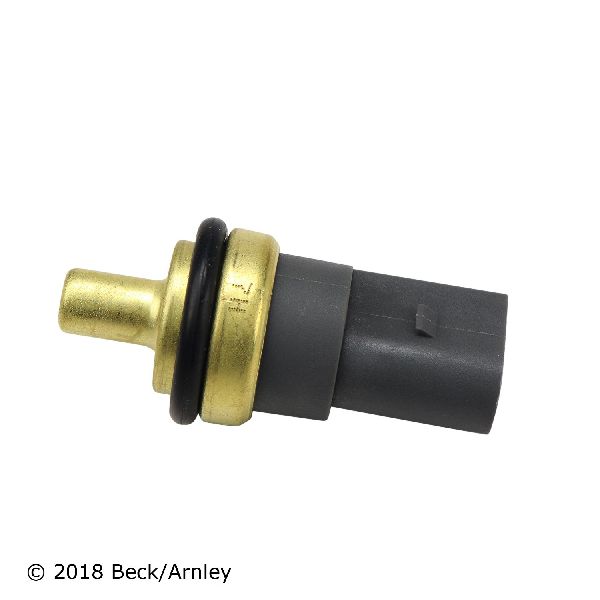
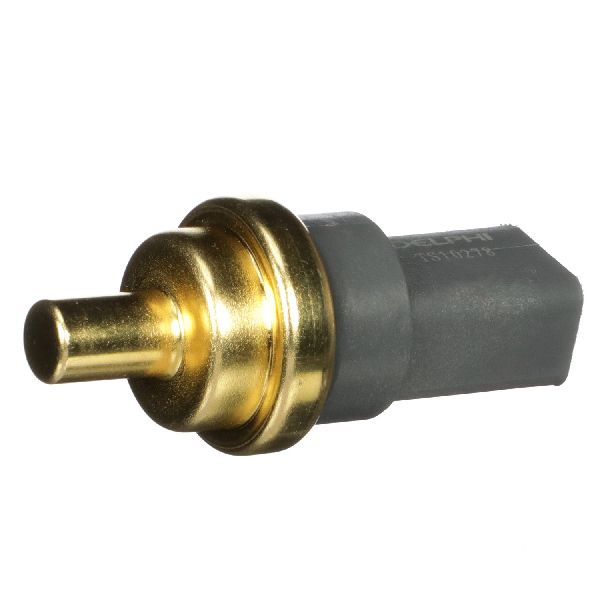
- Engine Coolant Temperature Sensor (G62)
(OEM #06A919501A)— This sensor is the most frequent cause of failure for code P1621, as it contains the circuit that sends the temperature reading to the instrument cluster. This part number is widely used across many VW and Audi vehicles.
Trusted brands: Bosch, Hella, Febi Bilstein, Genuine VW/Audi
OEM price range: $30-$50
Aftermarket price range: $15-$30 - ECT Sensor Connector Pigtail
(OEM #1J0973704)— Needed if the original plastic connector is cracked, broken, or has corroded terminals, preventing a secure connection to the new sensor. The locking tab is notoriously brittle.
Trusted brands: URO Parts, Dorman, Genuine VW/Audi
OEM price range: $20-$40
Aftermarket price range: $10-$20 - ECT Sensor Retaining Clip and O-Ring
(OEM #N90316802 (O-Ring), 032121142 (Clip))— The plastic retaining clip often breaks upon removal and the O-ring should always be replaced to prevent coolant leaks. They are often sold with the sensor but sometimes must be purchased separately.
Trusted brands: Genuine VW/Audi
OEM price range: $5-$10
Aftermarket price range: $2-$5
Platform-Specific Known Issues
- {'title': 'Real-world diagnostic on AudiWorld', 'description': 'A user on the AudiWorld forums with a 2013 A4 B8.5 experienced fans running constantly and the gauge stuck at 50°C after a radiator issue. After replacing the CTS with no change, an expert user advised that a scan tool is necessary to differentiate between the ECM temperature reading and the cluster reading, confirming the dual-signal nature of the system.'}
- {'title': 'Forum user confirms wiring failure', 'description': 'On Audizine, a thread titled \'P1621 and constant cooling fans on B8 A4\' described a user who replaced the sensor twice with no luck. The eventual fix was a damaged wire found behind the engine, near the firewall, which had rubbed through its insulation and was shorting to the chassis. The repair involved splicing a new section of wire.'}
Mechanic-Grade Diagnostic Values
- G62 Sensor Resistance (disconnected) — expected: At ~20°C (68°F): 2,200 - 3,000 Ω. At ~80°C (176°F): 250 - 375 Ω.. Failure: Readings are infinite (open circuit), near zero (short circuit), or significantly outside the expected range for a given temperature.
- G62 Sensor Signal Voltage (Key On, Engine Off) — expected: Approximately 4.8V - 5.2V on the signal wire pin with the sensor disconnected.. Failure: Voltage is 0V (short to ground) or significantly lower than 5V, indicating a wiring issue before the sensor.
Hidden / Shadow Codes Worth Checking
- P1621 with fault type '02 - Signal Shorted to Ground': This is not a hidden code, but the additional information provided by VCDS or a similar VW/Audi specific tool. It explicitly confirms the nature of the electrical fault, distinguishing it from an open circuit or implausible signal. (see via VCDS (VAG-COM) or ODIS (dealer tool) by scanning the Instrument Cluster (Module 17).)
Scan Tool Commands That Help
- VCDS (VAG-COM): Read Measuring Value Blocks in Module 01 (Engine) and Module 17 (Instruments) — This is the primary diagnostic step. It allows a direct comparison of the coolant temperature the ECM is seeing versus the temperature the Instrument Cluster is seeing. A large discrepancy (e.g., ECM sees 85°C, Cluster sees -40°C) confirms the fault lies in the cluster's signal path.
Wiring & Ground Locations
- G62 Sensor Connector (at sensor) — On a coolant flange, typically at the rear of the cylinder head on 2.0T engines.. This is the starting point of the circuit. The 4-pin connector contains two separate thermistors. One pair of pins signals the ECM for engine management, and the other pair signals the ECM for the instrument gauge reading. A failure in the gauge-side of the sensor or its wiring triggers P1621.
- G43 - Ground Connection — Located behind the passenger side kick panel.. This is a critical ground point that serves the instrument cluster, among other components. A corroded or loose G43 ground can cause a variety of instrument cluster issues, including erratic gauge readings. While less common than a sensor failure, it should be checked if sensor and wiring tests are inconclusive.
- J285 - Instrument Cluster Connector — At the rear of the instrument cluster, accessible after removing dashboard trim.. This is the termination point for the signal. On the B8 platform, the temperature reading arrives via the CAN bus network, not a dedicated analog wire. A fault here is unlikely unless the cluster itself has failed.
Real Owner Repair Stories
- YouTube user comment/video (2013 Audi A4 B8.5) — Cooling fans running continuously after starting the engine, RPMs limited to 4,000 (limp mode).
❌ Tried (didn't work) Replacing the coolant temperature sensor did not solve the issue.
✅ What actually fixed it The wires to the ambient air temperature sensor (located in the front bumper area) were cut. Repairing the wires solved both the fan issue and the limp mode. This is an important misdiagnosis pattern, as the fan fail-safe can be triggered by other sensor faults. - Audi-Sport.net forum user (2008 Audi A4 B8 2.0 TDI) — Code P2185 (Coolant Temp Sensor on Radiator Outlet), fans running full speed, poor fuel economy.
❌ Tried (didn't work) After replacing the faulty sensor, the car would only reach 90°C when stationary and the temperature would drop when driving.
✅ What actually fixed it The vehicle has a second thermostat that was stuck open, causing the engine to over-cool while driving. Replacing the second thermostat resolved the temperature regulation issue. This shows a potential secondary fault to look for if gauge issues persist after fixing the P1621 code. - AudiWorld forum user (2012 Audi A4 B8) — Radiator fans running at highest speed intermittently, even when car is off or just unlocked.
❌ Tried (didn't work) Initial scans showed a fan control module code.
✅ What actually fixed it The user discovered rubbed/damaged wiring in the main harness that runs under the air filter box, a result of a previous front-end accident. Soldering and repairing the damaged wires resolved the fan issue. This highlights the vulnerability of the wiring harness in the front of the engine bay.
OEM Part Supersession History
06A919501A→06A919501A (current)— This part number has remained stable for many years, though the manufacturer may have changed (e.g., from Bosch to Hella or other OEM suppliers). The color of the plastic sensor body (e.g., green, black, blue) often indicates a revision or manufacturer change, but the part number and function remain the same.
Model Year Variations Within This Range
- 2013-2016 (B8.5 Facelift): While the cause and fix for P1621 are the same, the B8.5 models feature electromagnetic power steering, an updated MMI system, and different front/rear bumper and light designs. These changes do not directly affect the G62 sensor circuit but are important to note for general vehicle identification and unrelated repairs.
Diagnostic Flowchart
Other Known Issues on This Vehicle
Issues unrelated to this code that are worth knowing about as an owner of this generation:
- 2.0T TFSI Excessive Oil Consumption 🔴 High — Very common on 2009-2012 models with CAEB engine code. Caused by faulty piston rings. Can begin as early as 30k miles and worsen over time. (Ref: TSB 2027731/5 addresses the issue, and a class-action lawsuit resulted in extended warranty coverage for many owners.)
- Timing Chain Tensioner Failure 🔴 High — Common on pre-2013 2.0T engines. The original tensioner design can fail without warning, often between 60k-100k miles, causing the chain to skip and leading to catastrophic engine damage (bent valves). (Ref: An updated tensioner part was released. No recall, but a class-action lawsuit extended some coverage.)
- Plastic Water Pump Failure 🟠 Medium — The OEM water pump has a plastic housing that can crack or leak, often around 60k-90k miles. Symptoms include coolant loss and overheating. (Ref: Several recalls were issued for related coolant pump issues, but not universally for this specific failure mode.)
- PCV Valve / Oil Separator Failure 🟠 Medium — The diaphragm in the PCV valve can tear, causing a large vacuum leak, high-pitched whistling noise, rough idle, and increased oil consumption. Common around 50k-80k miles. (Ref: An updated PCV valve was part of the oil consumption TSB.)
- Carbon Buildup on Intake Valves 🟠 Medium — As a direct-injection engine, fuel does not wash over the intake valves. This leads to significant carbon buildup over time (typically noticeable by 60k-100k miles), causing misfires, rough idle, and power loss.
Used vs. New Parts: Buying Guide for This Vehicle
When a used part is the smart pick: For this specific repair, buying a used part is only recommended for the **wiring connector pigtail** or a complete **engine wiring harness** if significant damage is found. A used **instrument cluster** is a viable but complex option if the original is confirmed faulty, but it will require specialized programming to adapt it to the vehicle's immobilizer and mileage.
Donor-vehicle mileage cap: roughly under 100000 miles for the part to have meaningful remaining life.
What to inspect on the donor part:
- For a wiring pigtail: Ensure the plastic is not brittle, the locking tab is intact, and there are at least 4-6 inches of clean, uncracked wire.
- For an instrument cluster: Check the plastic lens for deep scratches or fogging. Ask for a video showing the cluster powering on with all pixels and gauges functioning if possible.
- Avoid parts from vehicles with known flood or fire damage.
OEM-only on this vehicle (don't cheap out):
- While not strictly 'OEM-only', it is strongly advised to use a new, high-quality OEM or reputable OE-supplier sensor (Bosch, Hella, Febi) for the G62. The part is inexpensive and critical for engine management.
Aftermarket brands forum-validated for this vehicle:
- Bosch
- Hella
- Febi Bilstein
- Genuine VW/Audi
Brands owners have reported issues with on this vehicle:
- Unnamed, no-brand sensors from online marketplaces. Failure rates are high, and incorrect readings can cause performance issues even if they don't trigger a code immediately.
Real Owner Stories
Aggregated from forums and TSBs cited above. Mileages and costs reflect what owners reported in those sources.
2013 Audi A4 B8.5 2.0T
Symptoms: Radiator fans running constantly and the temperature gauge was stuck at 50°C after a radiator issue. Replacing the Coolant Temperature Sensor (CTS) did not fix the problem.
What fixed it: The owner was advised to use a scan tool to differentiate between the ECM temperature reading and the cluster reading to confirm the dual-signal failure.
Source hint: AudiWorld forums: 'Real-world diagnostic on AudiWorld'
Audi A4 (B8 platform) 2.0T
Symptoms: P1621 code and constant cooling fans. The owner replaced the sensor twice but the issue remained.
What fixed it: Found a damaged wire behind the engine near the firewall that had rubbed through its insulation and was shorting to the chassis. The fix involved splicing a new section of wire.
Source hint: Audizine: 'P1621 and constant cooling fans on B8 A4'
Audi A4 (B8 platform)
Symptoms: Erratic gauge behavior and P1621 code.
What fixed it: The sensor connector locking tab was found to be broken, leading to a poor connection. It was permanently fixed with a new pigtail connector.
Source hint: Audizine Forums: 'A common repair story involves finding the sensor connector locking tab broken'
Related OBD-II Codes
Frequently Asked Questions
Why are my radiator fans running at high speed even when my 2012 Audi A4 is cold?
I replaced the ECT sensor on my B8 A4 but the P1621 code and fan issue persist. What else should I check?
Where is the G62 Engine Coolant Temperature sensor located on the 2.0T engine?
Can I use a generic OBD-II scanner to diagnose P1621 on my Audi?
Is there a specific repair kit for a broken ECT connector on the A4?
Does the P1621 code affect the Audi A5 or Q5 as well?
Helpful Videos
We Have This Part in Stock


The information in this article is provided for general reference and educational purposes only. Vehicle specifications, procedures, and part compatibility can vary by production date, trim level, and region. Always consult your vehicle's factory service manual and verify part numbers before purchasing or performing repairs. Safety-critical components such as airbags, seat belts, and braking systems should be installed by a qualified professional.
- Audi A4:
- 🧭 Diagnostic Flowchart
- 🎬 Helpful Videos
- 🛍️ Shop This Part
- What's Unique About the 2008-2016 Audi A4
- Symptoms You May Notice
- Most Likely Causes
- Rare But Worth Checking
- Diagnosis Steps
- Parts You'll Likely Need
- Platform-Specific Known Issues
- Mechanic-Grade Diagnostic Values
- Hidden / Shadow Codes Worth Checking
- Scan Tool Commands That Help
- Wiring & Ground Locations
- Real Owner Repair Stories
- OEM Part Supersession History
- Model Year Variations Within This Range
- Other Known Issues on This Vehicle
- Used vs. New Parts: Buying Guide for This Vehicle
- Real Owner Stories
- 2013 Audi A4 B8.5 2.0T
- Audi A4 (B8 platform) 2.0T
- Audi A4 (B8 platform)
- Related OBD-II Codes
- Frequently Asked Questions
- 🎟️ Get 5% Off