

P1621 on 2013-2015 Buick Encore: Control Module Memory Failure Causes and Fixes
On a 2013-2015 Buick Encore, code P1621 almost always indicates an internal memory failure in the Transmission Control Module (TCM). The TCM is located inside the transmission housing, making replacement a labor-intensive job. This is a known issue confirmed by manufacturer TSBs. The only reliable fix is replacing the TCM, which requires professional programming and can cost between $700 and $1,500.
- P1621 on a 2013-2015 Encore almost certainly means the Transmission Control Module (TCM) has an internal memory fault.
- The TCM is located inside the transmission, making its replacement a labor-intensive job for a professional.
- Symptoms are primarily transmission-related, including harsh shifting, getting stuck in gear, and a blank gear indicator.
- This is not a DIY repair. The fix requires replacing the TCM and using specialized equipment to program the new part to your vehicle.
- Before replacing the expensive TCM, it is critical to have a professional verify the battery and charging system are healthy, as low voltage can sometimes trigger this code falsely.
What's Unique About the 2013-2015 Buick ENCORE
While P1621 can technically point to various modules on GM vehicles, its appearance on the Buick Encore and its platform mates (Chevy Cruze, Sonic, Trax, Verano) is overwhelmingly linked to the Transmission Control Module (TCM). The TCM is located inside the transmission, subjected to constant heat and vibration, which leads to a high failure rate of its internal electronics. Manufacturer TSBs specifically guide technicians to investigate the TCM when this code is present, indicating a known pattern of failure for this component.
Diagnostic Flowchart
Tap your situation to follow the diagnostic path that matches what you're seeing on this vehicle.
Symptoms You May Notice
- Check Engine Light (Malfunction Indicator Lamp) is on
- Erratic or harsh transmission shifting
- Vehicle gets stuck in a single gear (limp mode)
- Failure to shift or a complete loss of reverse
- Warning messages like 'Service Stabilitrak' may appear due to lost communication with the TCM
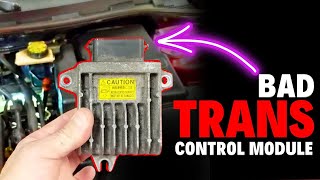
- PRNDL gear indicator on the dash may be blank or incorrect 🎬 Watch: 6 common symptoms of a failing transmission control module
- Delayed engagement when shifting from Park to Drive or Reverse
- Replacing the entire transmission when only the electronic TCM, which is located inside it, has failed.
- Replacing various engine or transmission sensors, as P1621 is an internal module fault, not a sensor input fault.
- Condemning the TCM before thoroughly testing the battery, charging system, and main ground connections.
Most Likely Causes
- Internal Failure of the Transmission Control Module (TCM/TEHCM) 🔴 High Probability → Shop Transmission Assembly The TCM on this platform is a TEHCM (Transmission Electro-Hydraulic Control Module) located inside the transmission pan, mounted to the valve body. This environment leads to failure from heat cycles and vibration, causing internal solder joints or electronic components to fail. TSB #PIP4653E directly links P1621 to this internal TCM fault.
How to confirm: After confirming stable 12V+ power and good grounds to the transmission and that software is up-to-date, the code returning points to internal failure. A professional scan tool may also show the module is unresponsive or fails to program.
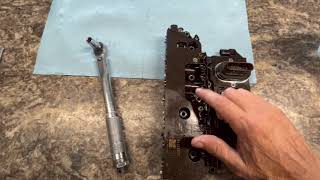
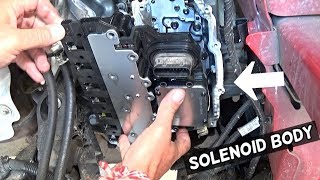
Typical fix: Replace the Transmission Control Module (TEHCM). 🎬 See this walkthrough for removing and replacing the 6T40 TCM The new module must be professionally programmed to the vehicle's VIN. This involves draining the transmission fluid and removing the side cover and valve body.
Est. part cost: $300-$750 - Corrupted TCM Software 🟡 Medium Probability Software glitches can cause memory checksum tests to fail. TSB #05-06-04-060A suggests that this code can be related to software across multiple modules. An incomplete previous flash can also cause this.
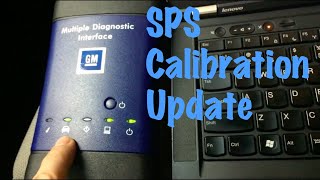
How to confirm: A dealership or qualified shop with a GM MDI or equivalent J2534 tool can check for and perform available software updates for the TCM. 🎬 Watch: How to perform a GM module calibration update
Typical fix: Reprogram (reflash) the TCM with the latest factory software. If the reflash fails or the code returns immediately, the module hardware has failed.
Est. part cost: $100 - $250 - Low or Unstable System Voltage ⚪ Low Probability All modern control modules are sensitive to voltage, and a weak battery, failing alternator, or poor ground connection can cause memory errors during startup, falsely triggering a P1621 code. Some Encore owners report issues with defective battery sensors causing voltage problems.
How to confirm: Test the battery voltage (should be 12.4V+ with engine off) and the charging system output (should be 13.7-14.7V with engine running). Perform a voltage drop test on the main battery and ground cables.
Typical fix: Recharge or replace the battery, replace the failing alternator, or clean/replace faulty ground straps.
Est. part cost: $150-$600
Rare But Worth Checking
- Aftermarket Programmer/Tuner:
Diagnosis Steps
- CRITICAL FIRST STEP: Verify battery health and charging system operation. Test the battery with a GR8 or equivalent load tester. Ensure voltage is stable and above 12.4V engine-off and 13.7-14.7V engine-on. A weak battery is a common cause of false module codes.
- Use a professional scan tool to confirm that P1621 is stored in the Transmission Control Module (TCM). Note any other codes, especially P0700 or U0101.
- Inspect all power and ground connections to the engine and transmission case. Clean and tighten any corroded or loose grounds.
- Check for available software updates for the TCM using a dealer-level tool. If an update is available, perform the reflash procedure.
- If the code returns after a reflash and all electrical connections are verified, the TCM is internally faulty and requires replacement.
- To replace, drain transmission fluid, remove the transmission side cover, and then remove the valve body to access the TCM/TEHCM.
- Install the new TCM and program it to the vehicle's VIN using a GM-specific programming tool (MDI/SPS).
Parts You'll Likely Need
- Transmission Control Module (TCM/TEHCM)
(OEM #24287422 (supercedes 24265789, 24287425, 24268164))— This is the component that fails internally, causing the P1621 code. It is a combined electronic module and solenoid body located inside the transmission.
Trusted brands: ACDelco (GM Genuine), Dorman (e.g., 609-050)
OEM price range: $500-$800
Aftermarket price range: $350-$550
Related Codes That Often Appear With This One
- P0700 — This is a generic 'Transmission Control System Malfunction' code. The TCM sends this request to the ECM to turn on the Check Engine Light when it has stored a fault like P1621.
- U0101 — This code for 'Lost Communication With TCM' often appears when the TCM's internal fault is severe enough to prevent it from communicating on the vehicle's data network.
- P0601 — This code means 'Internal Control Module Memory Check Sum Error' and is a very similar internal fault. The provided TSBs list it alongside P1621 as a related code.
- P0603 — This code for 'Internal Control Module Keep Alive Memory (KAM) Error' is another related internal memory fault mentioned in TSB #PIP4653E.
- P0604 — This code for 'Internal Control Module Random Access Memory (RAM) Error' is also listed in TSB #PIP4653E as a potential companion code indicating an internal module failure.
Technical Service Bulletins (TSBs) & Recalls
- PIP4653E: Advises technicians that DTC P1621 (and related codes) stored in the Transmission Control Module points to an internal fault requiring TCM replacement.
- 05-06-04-060A: Lists P1621 as one of several control module internal diagnostic codes and advises ruling out electrical system issues before module replacement.
Platform-Specific Known Issues
- TSB #PIP4653E specifically notes that on the 2013 Encore, DTCs P0601, P0603, P0604, P062F or P1621 may be found stored in the Transmission Control Module, strongly indicating an internal TCM issue that requires module replacement.
- TSB #05-06-04-060A provides broader context, communicating that P1621 is one of several control module diagnostic codes that can be set in multiple modules, often related to software or internal memory. It advises checking for voltage issues first.
- The TCM is physically located inside the 6T40/MH8 transmission, mounted to the valve body. This location subjects it to significant heat and vibration, which is the primary reason for its high failure rate.
Mechanic-Grade Diagnostic Values
- CAN Bus Network Resistance — expected: Approximately 60 Ω. Failure: A reading of 120 Ω indicates an open circuit in one of the two terminating resistors or the wiring. A reading near 0 Ω indicates a short between CAN High and CAN Low wires.
- TCM Ground Circuit Resistance — expected: < 5.0 Ω. Failure: Resistance higher than 5.0 Ω indicates a poor ground connection, which can cause intermittent module operation and false codes.
- Negative Battery Cable Voltage Drop — expected: < 200 mV. Failure: A voltage drop greater than 200 mV while the engine is cranking indicates high resistance in the main ground cable or its connections.
Scan Tool Commands That Help
- GM GDS2/SPS (Service Programming System): Replace and Reprogram ECU — This function within the SPS software is used to flash the vehicle's VIN and correct operating software onto a new, blank TCM/TEHCM.
- GM GDS2: Service Fast Learn Adapts / Transmission Adaptive Pressure Reset — This procedure must be performed after a new TCM is programmed. It allows the module to learn the hydraulic characteristics of the specific transmission for smooth shifting.
- GM GDS2: Clear All DTCs — After using SPS to program a new module, it's critical to use GDS2 to perform a vehicle-wide DTC clear. The SPS programming process itself does not clear pre-existing fault codes.
Wiring & Ground Locations
- Main Transmission Harness Connector (X1) — The large, 14-pin gray connector on the outside of the transmission case where the main vehicle harness connects to the internal transmission wiring.. This is the primary interface for all power, ground, and data communication to the TCM. Poor pin fit, corrosion, or damage here can cause loss of communication or power, mimicking an internal TCM failure. The service connector part number is GM 13503939.
- G106 / G107 — These are key ground points for the engine and transmission controls, typically located on the engine block or front frame cross rail.. A loose or corroded ground at these locations can cause unstable voltage to the TCM, leading to memory errors and the P1621 code. A voltage drop test on the ground circuit is essential before condemning the module.
Real Owner Repair Stories
- Chevrolet Forum user 'treetop' (2002 Chevy Silverado (different platform, but identical code definition and electrical principle)) — P1621 code, clock resets on startup, radio and seat memory lost.
❌ Tried (didn't work) A professional shop diagnosed it as a bad TCM and/or ECM, quoting a high replacement cost.
✅ What actually fixed it The owner found a lack of ground to the TCM and ECM. He ran a new ground wire from the negative battery terminal directly to the mounting bolts of both modules, which restored communication and fixed all issues. - BobIsTheOilGuy forum user (2011 GM LML w/ Allison 1000 (different transmission, but similar TEHCM design and failure mode)) — Vehicle went into limp mode, lost PRNDL gear indicator, multiple warning lights came on.
❌ Tried (didn't work) Resetting fault codes with a tuner and a Snap-On scanner provided only a temporary fix; faults returned within 5 minutes.
✅ What actually fixed it The TEHCM was replaced with an upgraded part number (19431596). The new module had to be programmed (flashed) at a GM dealership to match the vehicle's VIN, which resolved all issues.
When the Usual Fixes Don't Work
- While the vast majority of P1621 codes on this platform are caused by a failed TCM requiring replacement, there are documented cases where the root cause was electrical. In one instance, a vehicle with classic TCM failure symptoms was fully repaired by creating a new, redundant ground wire from the battery to the TCM/ECM mounting bolts after a shop had already condemned the modules. In another case, a failing fuel rail pressure sensor was found to be sending corrupting data, causing the P1621; replacing the sensor fixed the memory code. This underscores that before performing the expensive TCM replacement, verifying the integrity of all power, ground, and critical sensor inputs is essential.
OEM Part Supersession History
Gen 1 TEHCMs (e.g., for 2008-2011 models)→Gen 2 TEHCMs (e.g., 24264425, 24287422 for 2012+ models)— The design was changed around 2012. Gen 1 units used internal fluid pressure switches which were a common failure point. Gen 2 units eliminated these switches and use a software-based 'Clutch Pulse Learning' strategy instead.
Heads up: Gen 1 and Gen 2 TEHCMs are NOT interchangeable. The vehicle's core programming expects one type of hardware. Installing the wrong generation TEHCM will result in a no-communication or no-function state, even if it physically fits.
Model Year Variations Within This Range
- 2013-2015: The 2013-2015 Buick Encore uses the 'Gen 2' version of the 6T40 TEHCM. Unlike the earlier 'Gen 1' modules used in other GM vehicles prior to ~2012, this version does not contain internal fluid pressure switches. Instead, it uses a 'Clutch Pulse Learning' process to monitor clutch operation. This makes it fundamentally different from earlier versions and not interchangeable.
Helpful Videos
We Have This Part in Stock




The information in this article is provided for general reference and educational purposes only. Vehicle specifications, procedures, and part compatibility can vary by production date, trim level, and region. Always consult your vehicle's factory service manual and verify part numbers before purchasing or performing repairs. Safety-critical components such as airbags, seat belts, and braking systems should be installed by a qualified professional.
- Buick ENCORE:
- 🧭 Diagnostic Flowchart
- 🎬 Helpful Videos
- 🛍️ Shop This Part
- What's Unique About the 2013-2015 Buick ENCORE
- Symptoms You May Notice
- Most Likely Causes
- Rare But Worth Checking
- Diagnosis Steps
- Parts You'll Likely Need
- Related Codes That Often Appear With This One
- Technical Service Bulletins (TSBs) & Recalls
- Platform-Specific Known Issues
- Mechanic-Grade Diagnostic Values
- Scan Tool Commands That Help
- Wiring & Ground Locations
- Real Owner Repair Stories
- When the Usual Fixes Don't Work
- OEM Part Supersession History
- Model Year Variations Within This Range
- 🎟️ Get 5% Off